

Equipment & Specialty Supplies
Sushi Chef Uniforms, Counter Service & Restaurant Environment
A tied cotton coat, a samue with a detachable collar and a concealed-zipper service jacket make different demands on fit and laundering. An oshibori's textile, wrapper and prepared roll determine its tray and cabinet requirements. A noren's cloth, image process and suspension determine what can be ordered, installed and maintained. At a sushi counter, these details are visible at close range and encountered throughout service.

Equipment & Specialty Supplies
This reference covers the complete working outfit, oshibori provision, selected guest-service accessories and the room-level textiles and conditions around the counter. It explains actual Japanese and international commercial products, the construction behind their names, and the specifications that govern a correct purchase. Counter architecture and the complete workstation are treated separately in Sushi Bar Design, Counters & Chef Workstations.
Explore: Chef uniforms · Oshibori service · The guest's setting · Noren · Light and atmosphere
In this guide 9 sections
01 / Equipment & Specialty Supplies
01. Sushi chef coats: form, closure and movement
Commercial sushi uniforms include happi-style coats, samue-style workwear and tailored or zip-front service coats. These names identify useful families, but the fastening and pattern determine how the individual garment works. Current Japanese hospitality clothing readily combines familiar forms with synthetic blends, replaceable trim and contemporary closures.
Ties, buttons and concealed zippers
Seven's BC1303 is a substantial cotton-katsuragi coat with a broad overlapping front, inner and outer ties, an inside chest pocket and hem slits. The ties allow the front to be adjusted, while the shoulder, armhole and available overlap remain fixed by the pattern. The coat must remain adequately closed when the wearer reaches and bends; tightening the waist cannot correct an unsuitable shoulder or sleeve. Seven BC1303.
The BC1350 closes differently. It has visible front buttons and a separate snap securing the inner overlap. Seven specifically notes its reduced sizing tolerance compared with a tied coat. The fixed closing position gives a consistent front arrangement, but it makes the correct size and shape particularly important. Seven BC1350.
The EA3061 samue adds a different kind of flexibility. Alongside its internal/external ties, chest fastening, right waist pocket and side slits, it has attachment points for a separately purchased collar. The neckline is an assembly of coat and replaceable component. That affects the order and the laundry as directly as it affects appearance. Seven EA3061.
Servo's JT1258/JT1259 uses a concealed front zipper, three-quarter sleeves, a left chest pocket, side slits and a name loop. Its maker labels the 90% polyester / 10% cotton fabric kasuri. The catalog supplies that cloth description; it does not establish handweaving or a particular historic resist-dyeing process. Servo coat specifications, printed pages 044–045.
Choose the front that suits the desired fit, appearance and handling, then assess the complete pattern through the working movement.
Sleeves, hems and pockets belong in the fitting
A sleeve opening must stay clear of the task through the chef's working reach. A hem slit can accommodate movement, but the garment still needs sufficient coverage when the wearer bends or turns. Pocket position matters beneath an apron and when retrieving the objects the wearer actually carries. Those relationships are easily concealed by an attractive, arms-at-sides product photograph.
ERS's white cotton LL coat, BC1303-OLL, and white/navy L coat, BC1340-8L, provide two established commercial routes. The latter corresponds to Seven's tied 65/35 polyester/cotton broadcloth family with patterned collar trim. Confirm the supplied size and sewn care label when ordering. Seven BC1340-8.

Exact-product catalog views, shown separately; not to a common scale. Confirm the supplied item, size and care label.
Explore the ERS collection
Sushi Coats
Compare the assortment for this part of your service.
-
 Image unavailable
Sushi Chef Coat, Happy coat Wht/Navy Trim Poly Cotton -(M)
View details & options : Sushi Chef Coat, Happy coat Wht/Navy Trim Poly Cotton -(M)
Image unavailable
Sushi Chef Coat, Happy coat Wht/Navy Trim Poly Cotton -(M)
View details & options : Sushi Chef Coat, Happy coat Wht/Navy Trim Poly Cotton -(M)
-
 Image unavailable
Sushi Chef Coat, Happy coat White Cotton -(L)
View details & options : Sushi Chef Coat, Happy coat White Cotton -(L)
Image unavailable
Sushi Chef Coat, Happy coat White Cotton -(L)
View details & options : Sushi Chef Coat, Happy coat White Cotton -(L)
-
 Image unavailable
Sushi Chef Coat, Happy coat Navy/Pattern Trim Poly Cotton -(M)
View details & options : Sushi Chef Coat, Happy coat Navy/Pattern Trim Poly Cotton -(M)
Image unavailable
Sushi Chef Coat, Happy coat Navy/Pattern Trim Poly Cotton -(M)
View details & options : Sushi Chef Coat, Happy coat Navy/Pattern Trim Poly Cotton -(M)
-
 Image unavailable
Sushi Chef Coat, Happy coat White Cotton -(LL)
View details & options : Sushi Chef Coat, Happy coat White Cotton -(LL)
Image unavailable
Sushi Chef Coat, Happy coat White Cotton -(LL)
View details & options : Sushi Chef Coat, Happy coat White Cotton -(LL)
-
 Image unavailable
Sushi Chef Coat, Happy coat White Cotton -(M)
View details & options : Sushi Chef Coat, Happy coat White Cotton -(M)
Image unavailable
Sushi Chef Coat, Happy coat White Cotton -(M)
View details & options : Sushi Chef Coat, Happy coat White Cotton -(M)
-
 Image unavailable
Sushi Chef Coat, Happy coat Reddish Purple/ Navy Line Trim Cotton -(LL)
View details & options : Sushi Chef Coat, Happy coat Reddish Purple/ Navy Line Trim Cotton -(LL)
Image unavailable
Sushi Chef Coat, Happy coat Reddish Purple/ Navy Line Trim Cotton -(LL)
View details & options : Sushi Chef Coat, Happy coat Reddish Purple/ Navy Line Trim Cotton -(LL)
-
 Image unavailable
Sushi Coat, Bk Poly Cotton -(L)
View details & options : Sushi Coat, Bk Poly Cotton -(L)
Image unavailable
Sushi Coat, Bk Poly Cotton -(L)
View details & options : Sushi Coat, Bk Poly Cotton -(L)
-
 Image unavailable
Sushi Coat,Bk Poly Cotton -(M)
View details & options : Sushi Coat,Bk Poly Cotton -(M)
Image unavailable
Sushi Coat,Bk Poly Cotton -(M)
View details & options : Sushi Coat,Bk Poly Cotton -(M)


02 / Equipment & Specialty Supplies
02. Cloth, sizing and laundering
Read the cloth beyond the blend
Fiber composition is only one part of a uniform specification. Broadcloth provides a smooth plain-weave example; twill is distinguished by its diagonal interlacing pattern. Yarn, density, weight, finish and garment cut still govern the behavior of the finished article. A cotton percentage cannot supply all of that information. CottonWorks woven-fabric structures.
In the garments above, cotton katsuragi twill gives BC1303 its substantial cloth, while BC1340-8 uses blended broadcloth. EA3061 uses 50/50 polyester/cotton sudare: Seven describes thick yarns and a coarse weave resembling a woven blind. That visible structure is a different choice from smooth broadcloth. Handle and assess the actual samples. EA3061 fabric description.
Seven's EA3075 seersucker samue has a puckered surface and a published blend of 50% cotton, 30% polyester and 20% composite polyester fiber. The maker specifies light, low-temperature pressing, or leaving it unpressed, to preserve that surface. Its texture is part of the garment rather than a wrinkle to be aggressively pressed away. Seven EA3075.
Seersucker's comfort-related properties vary with its construction. Published textile research found effects from structural repeat and yarn selection in the cotton fabrics studied; those results cannot be assigned to every stretch seersucker or to the Seven garment. Evaluate the actual cloth in the intended work and laundering conditions rather than buying a universal promise of coolness. Matusiak, research on cotton seersucker fabrics.
Slub and craft-derived names need equal precision. Seven's EC3126 uses a 75% cotton / 25% polyester slub-tsumugi cloth whose maker expressly identifies machine weaving. Its thick/thin yarn character supplies texture without implying handwoven silk. Servo's kasuri-labeled blend is a separate product description. Cloth name, visual effect, manufacturing method and provenance should each be supported independently. Seven EC3126.
For treated fabrics, retain the exact model's claim and care directions. A soil-release or antibacterial designation does not supply a wash-life guarantee, prove removal of a restaurant's particular stains or replace clean working clothing.
The same letter size can describe very different garments
Seven distinguishes its body-size references from finished garment dimensions. Its male/unisex L body reference includes a 91–97 cm chest. The table below instead compares published finished garments, all labeled L. Values are centimeters. Seven body-size and measurement guide.
Scroll to read all columns
| Garment | Finished chest/bust | Length | Published sleeve measurement |
|---|---|---|---|
| BC1303 tied coat | 134 | 76 | Yuki 61 |
| BC1350 buttoned coat | 110 | 74 | Yuki 64 |
| EA3061 samue | 130 | 80 | Shoulder width 62; shoulder-based sleeve 31 |
| Servo JT1258/JT1259 | 111 | 74 | Shoulder width 47; shoulder-based sleeve 45 |
Sources: BC1303, BC1350, EA3061, Servo.
The two Seven coats differ by 24 cm in published finished chest dimension. That is not a 24 cm difference in the wearer's body chest, nor a measured difference in usable wearing ease. In an overlapping garment, the maker's measuring and closing convention matters. The letter L cannot resolve it.
24 cm difference between published finished garments. These are not wearer-body chest measurements or a measurement of usable ease. The maker’s closing and measurement convention still matters. Sources: Seven BC1303 and BC1350.
Sleeve figures also require their starting point. Yuki runs from the center-back neck through the shoulder and elbow toward the wrist; a shoulder-based sleeve measurement starts farther along that route. A dropped shoulder can produce a short sleeve number while moving the sleeve's starting point outward.
EA3075 illustrates the effect within one model: its SS shoulder width is 48 cm with a 32 cm sleeve; its 3L shoulder width is 73 cm with a 29.5 cm sleeve. The larger garment's smaller sleeve figure does not mean a shorter reach. EA3075 size table.
Different patterns deserve more than a blanket size-down instruction. Seven's BC1341 is a separately designated women's counterpart to BC1340-8, with its own dimensions and pocket placement. Fit the individual's chest, hip, shoulder, height and required coverage against the particular pattern. Seven BC1341.
Approve the complete outfit in motion: intended underlayer, all fastenings closed, working reach and bend, then apron added. Check the front overlap, sleeve opening, hem and pocket access again. Record the model with the approved size; “L” alone is an inadequate staff-order record.
A detachable collar can change the laundry arrangement
The EA3061 coat's optional collars do not share one material or cleaning instruction. EY3510 is 70% cotton / 30% polyester cloth. EY3514 is printed cotton, removed from the coat for very mild wet cleaning, with low-temperature ironing without steam. Both are separately sized: SS/S coats take an S collar, M/L coats take M, and LL/3L coats take L. An L coat therefore takes an M collar. EY3510, EY3514.
Here, wet cleaning means a professional water-based cleaning and finishing process using specialist techniques. It is not an instruction to select a household delicate cycle. That distinction can determine whether the printed collar belongs in the restaurant's uniform order at all. Japan Consumer Affairs Agency care-label guidance.
Other restrictions are equally concrete. BC1303's white cotton cloth carries a shrinkage warning and a direction to avoid tumble drying. BC1340-8's patterned-trim coat excludes tumble drying and bleach and limits ironing to 150°C. White appearance and commercial supply do not establish permission to put either into an unrestricted white-linen process. BC1303 care, BC1340-8 care.
Care labels describe treatment tolerances of the finished article, including sensitive components; they do not guarantee that any permitted process will remove every soil. If the available laundry cannot deliver the necessary clean condition within those tolerances, change the garment or arrange an appropriate process. Do not buy the appearance first and discover that conflict after embroidery. GINETEX care principles.
03 / Equipment & Specialty Supplies
03. Aprons, trousers and headwear
Apron coverage and attachment
Specify apron width, front length, tie or strap adjustment and pocket position together. The size letter alone may conceal which dimension changes.
Seven's cotton-katsuragi TT8700 has M and L versions that are both 60 cm wide. Their front-center lengths are 58 and 66 cm, with 250 cm waist ties. Moving from M to L adds length without adding width. The item also excludes tumble drying. Seven TT8700.
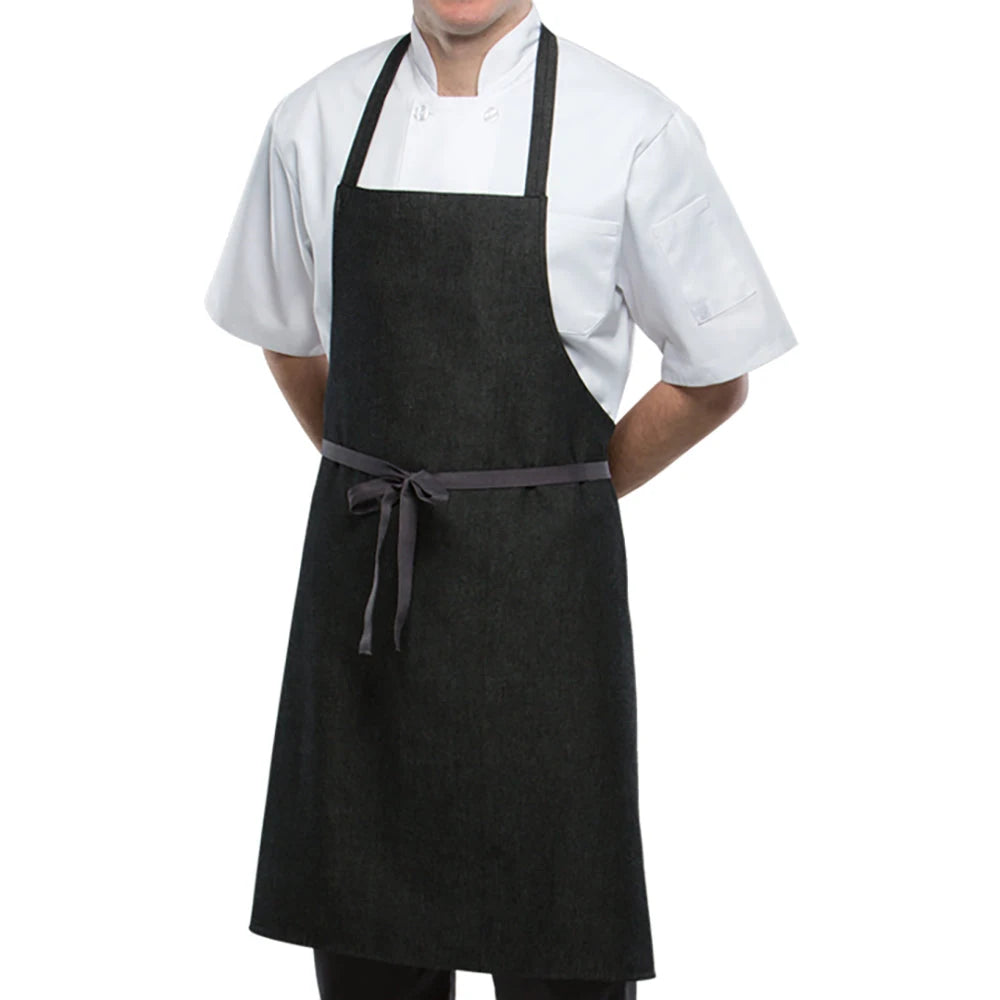
Chef Works' ABX01 is a 34 × 30 inch cross-back bib in 75/25 cotton/polyester textured denim. Adjustable ties and snap tabs, reinforced stress points, double-needle stitching and divided pockets are specified. Its care permits low tumble drying after cold washing at no more than 30°C, with non-chlorine bleach only as needed and no dry cleaning. The finish is intended to change with washing and wear. Chef Works ABX01.
Check how the cross-back straps sit over the coat, whether they distort the collar, whether the waist ties close comfortably and whether the pockets remain useful at the work. An intentionally evolving denim finish also requires a decision about mixing newly purchased and older aprons.
Maekake: the cloth and edges are the craft
Anything's Toyohashi-made maekake gives a precise alternative to a generic waist apron. The maker documents shuttle-loom production, thick yarn, flexible cloth, selvage edges and a fringed lower edge. Anything's material and making account.
One color-series model is 100% cotton, 67 × 47 cm including the fringe, with a 260 cm belt and stated suitability up to a 95 cm waist. Its care excludes warm-water washing, fabric softener, bleach and tumble drying, and warns of dye transfer and shrinkage. Anything maekake specification.
The fringe belongs in the overall-length assessment, the selvages in the edge construction and the belt in the fitting. Assess its coverage and tying arrangement over the actual working layers.
Separate trousers, separate fit
Seven's EL3378 coordinates with sudare samue clothing in a 50/50 polyester/cotton fabric. It has an elasticized waist with a drawstring, hem drawstrings, side-seam pockets and rear pockets. Its finished-size table lists L with a 78–84 cm waist and a 76 cm inseam. Seven EL3378.
A coat size does not determine trouser rise, hip clearance or leg length. Fit the trousers with the intended footwear and check the hem during movement. A drawstring does not excuse an unsuitable length. Where shortening is needed, resolve the hem construction and care process before alteration.
Headwear: circumference and restraint
Seven's cotton-katsuragi JW4620 waboshi is offered in head circumferences from 56 to 64 cm across S–3L. ERS's NO.20-LL white chef hat is separately described as 62 cm. Those are useful measurements; a size-small mesh listing supplies no equivalent circumference unless the seller states one. Do not infer a common maker or fit merely because two hats share a nominal size. Seven JW4620.
California's food code addresses clean outer clothing and effective hair restraint for the covered food and utensil handling activities. The hair-restraint rule has specified exceptions. It does not prescribe a white coat or make one hat style effective for every employee. Match circumference, adjustment and coverage to the wearer and work. California Retail Food Code, §§113969–113971.
ERS also offers a black-denim bib apron and mesh waboshi. Confirm their own dimensions and care rather than borrowing the specifications of the examples above.
Footwear and the standing surface need the same attention to the actual wet and cleaning conditions. Cushioning and slip resistance are different properties, and a curled mat edge creates a trip concern. Anti-fatigue mats belong within the whole standing-work arrangement, with suitable cleaning and condition checks. CCOHS mat guidance.
Explore the ERS collection
Aprons
Compare the assortment for this part of your service.
-
 Image unavailable
Apron Medium Length 3 Pocket, Black
View details & options : Apron Medium Length 3 Pocket, Black
Image unavailable
Apron Medium Length 3 Pocket, Black
View details & options : Apron Medium Length 3 Pocket, Black
-
 Image unavailable
Apron w/ 2 Pocket, Neck Strap 28"x30" Black
View details & options : Apron w/ 2 Pocket, Neck Strap 28"x30" Black
Image unavailable
Apron w/ 2 Pocket, Neck Strap 28"x30" Black
View details & options : Apron w/ 2 Pocket, Neck Strap 28"x30" Black
-
 Image unavailable
Adjustable Heavy Duty Vinyl Bib Apron, Waterproof, 26"x28"
Image unavailable
Adjustable Heavy Duty Vinyl Bib Apron, Waterproof, 26"x28"
Currently unavailable online
View details & options : Adjustable Heavy Duty Vinyl Bib Apron, Waterproof, 26"x28" -
 Image unavailable
Apron Full Length w 2 Pocket, 3 Colors (White/Black/Red)
View details & options : Apron Full Length w 2 Pocket, 3 Colors (White/Black/Red)
Image unavailable
Apron Full Length w 2 Pocket, 3 Colors (White/Black/Red)
View details & options : Apron Full Length w 2 Pocket, 3 Colors (White/Black/Red)
-
 Image unavailable
Waist Apron, Three Fold-Up Pockets 22"x12″, Black
View details & options : Waist Apron, Three Fold-Up Pockets 22"x12″, Black
Image unavailable
Waist Apron, Three Fold-Up Pockets 22"x12″, Black
View details & options : Waist Apron, Three Fold-Up Pockets 22"x12″, Black
-
 Image unavailable
Euro Lightweight Chef Coat Shirt M/L/XL - Burgundy/Black
View details & options : Euro Lightweight Chef Coat Shirt M/L/XL - Burgundy/Black
Image unavailable
Euro Lightweight Chef Coat Shirt M/L/XL - Burgundy/Black
View details & options : Euro Lightweight Chef Coat Shirt M/L/XL - Burgundy/Black
-
 Image unavailable
Apron Cotton Bib 35L x 30"W Blue Denim
View details & options : Apron Cotton Bib 35L x 30"W Blue Denim
Image unavailable
Apron Cotton Bib 35L x 30"W Blue Denim
View details & options : Apron Cotton Bib 35L x 30"W Blue Denim
-
 Image unavailable
Apron 1/2 Bistro 2 Center Pockets 28"x19", Black
View details & options : Apron 1/2 Bistro 2 Center Pockets 28"x19", Black
Image unavailable
Apron 1/2 Bistro 2 Center Pockets 28"x19", Black
View details & options : Apron 1/2 Bistro 2 Center Pockets 28"x19", Black


04 / Equipment & Specialty Supplies
04. Oshibori towels, trays and service
An oshibori is the prepared hand towel offered to the guest. Its supply form determines how much processing remains at the restaurant. Cotton fiber alone does not tell the buyer whether the supplied item is reusable.
Scroll to read all columns
| Supply arrangement | What arrives | Work that remains at the restaurant |
|---|---|---|
| Dry reusable stock | Clean or newly supplied cloth requiring the agreed preparation | Laundry provision, preparation where required, protected storage, service and used collection |
| Processed reusable rental supply | Towels prepared through a contracted service | Receiving, protected storage, conditioning where appropriate, service and segregated return |
| Individually wrapped single-use stock | Premoistened product in its supplied wrapper | Label-directed storage/conditioning, issue, collection and disposal |
Japan's rental-oshibori guidance addresses the chain from collection and processing to handling and inspection. For a U.S. rental arrangement, confirm the actual collection territory, processing responsibilities and return terms before selecting the service. Japanese rental-oshibori guidance.
Textile, edges and prepared size
The Oshibori Company's dry towels are 100% cotton, sewn on all four sides, in 10 × 10 and 12 × 12 inch formats. Four finished edges matter when a towel is repeatedly opened, folded, rolled and handled. The page does not publish a dry textile weight or complete commercial-laundry specification, so those remain part of selecting the stock. Dry cotton towels.
Yumekobo's so_100ot Senshu oshibori is a different shape: approximately 29 × 45 cm, 31 g and 100% cotton, with illustrated pile and hem details. The maker describes processing after weaving through scouring, bleaching, dyeing and repeated washing. Its care calls for ample wash water, separation where color or lint may transfer, avoiding softener initially and limiting tumble drying because of pile/lint effects. Its chlorine exception applies to specifically vat-dyed products; the selected listing does not establish that exception for its colors. Yumekobo Senshu towel.
That distinction can rule out a towel before its color is chosen. A cloth that conflicts with the restaurant's contracted wash chemistry or drying process is an unsuitable reusable purchase, however attractive its hand and appearance. Product-care guidance also should not be mistaken for a validated disinfection procedure.
Open dimensions are only the beginning. The prepared roll depends on the cloth's bulk, moisture and folding. Check its diameter, length, edge feel, lint and odor in the supplied or intended condition. A larger open square does not translate directly into a proportionately larger cabinet count.
Japanese towel weight descriptions require the correct denominator. Taiji expressly lists its 90-monme cotton towel at 338 g per dozen, approximately 28.2 g per towel, with 30 × 30 cm open dimensions. The trade weight is not 338 g for one hand towel. It also does not, by itself, rank softness or absorbency. Taiji towel specifications.
Wrapped cotton can be single-use
The Oshibori Company's wrapped cotton towels are premoistened, rolled and enclosed individually, and are sold for single use. FSX America's US COTTON is likewise an unscented disposable cotton product, 9 × 9 inches. Its published 34 g net weight is not identified as dry-textile mass, so it should not be used to calculate dry-fabric GSM. Wrapped cotton towels, FSX America.
Specify the actual substrate, fragrance selection, formulation information, wrapper and storage instructions. Cotton, rayon/pulp and composite wipes are different products even when sold under the same service name. The remaining life of sealed stock and the condition of a towel already held warm are separate questions. Do not turn an alcohol-free statement, proprietary treatment name or incomplete preservative description into a disinfectant claim.
For aroma-sensitive counter service, unscented stock is the straightforward starting point. If fragrance is part of the restaurant's intended service, assess it with the food and check the towel's compatibility with the selected cabinet. A towel seller's warming suggestion does not override the appliance instructions.
The tray is part of the towel specification
Scroll to read all columns
| Exact tray | Material and overall size | Care distinction |
|---|---|---|
| NR-102 | Bamboo, curved open weave; 7 × 3.25 × 1 inches | Seller-marked dishwasher-unsafe |
| NR-7B-001 | Plastic lacquer; 6.3 × 2.8 × 0.5 inches in the description | Seller-marked dishwasher-safe; commercial-cycle limits are not specified |
| ALART Circles | Aluminum; 15.4 × 8 × 0.4 cm | Seller specifies no dishwasher; avoid metal sponges and abrasive cleaners |
Sources: third-party retail product records for NR-102 bamboo, NR-7B-001 plastic lacquer and ALART Circles aluminum trays.
These are item-specific permissions. “Lacquer,” black color or metal construction does not establish a common washing method. Where a seller marks an item dishwasher-safe without defining temperature or chemistry, confirm compatibility with the restaurant's actual cycle.
An open weave allows moisture through to the surface below and introduces intersections to inspect during cleaning. A continuous base can retain moisture and must be emptied and dried. Fit the prepared towel to the usable tray: overhang, roll diameter, rim height and the guest's grip matter more than a name such as “standard oshibori tray.” Check the underside against the counter finish as well.
- 01Clean stock
- 02Prepared towel + wrapper
- 03Compatible cabinet + tray
- 04Guest service
- 05Used return and processing
The textile, wrapper, prepared size and cabinet instructions belong to the exact service assembly.
From clean stock to used return
Keep clean dry cloth, sealed ready-to-use stock and used returns distinct. For reusable towels prepared on site, laundering, wetting, rolling and wrapping need an agreed procedure and a clean preparation area. A preparation-counter wiping cloth should never drift into guest hand-towel stock.
Approve the wrapper with the cabinet. “Individually wrapped” does not identify the resin or heat resistance. Load the basket as instructed, allowing for the actual towel and upcoming issue period rather than compressing extra rolls against heated surfaces to reach a catalog count.
Before issue, check the towel itself. Cabinet settings are not skin-contact temperatures. Staff need an agreed response to a towel that is too hot, cold, dry or otherwise unsuitable; the equipment specification does not supply a universal guest-safe numerical target.
Decide whether the towel remains on its tray during the meal or is cleared after the opening service. In either case, it needs a reachable resting place and an unobstructed clearing route. Used reusable stock goes to its designated laundry return; single-use stock follows its disposal route. Neither returns to the clean cabinet for another guest. Reset the tray according to its own material and the establishment's approved cleaning procedure.
Clean-linen storage and separation from soiled returns are addressed in the FDA Food Code, which is a national model subject to local adoption and interpretation. An oshibori should not be assigned a napkin or counter-wiping-cloth procedure simply because all three are cloth. FDA Food Code and adoption context, 2026 model-code text.
The service ends with the cabinet's prescribed drainage, cleaning and drying, as well as the return of the textiles. The appliance is the next specification to resolve.
05 / Equipment & Specialty Supplies
05. Towel cabinets: capacity, temperature and installation
Capacity starts with the towel
The same cabinet can carry strikingly different towel-count estimates. For Taiji's HC-11UV Pro, The Oshibori Company estimates 90–100 of its 8-inch towels or 35–40 of its 12-inch towels. Taiji gives a guideline of 55 hand towels. These figures retain their respective towel assumptions; liters alone cannot reconcile them into one universal capacity. Seller's HC-11UV Pro listing, Taiji HC-11UV Pro.
Use the selected towel, wrapper and permitted basket arrangement to assess the service load. The relevant demand is the next issue period plus the replenishment pattern, not necessarily the entire day's covers. Door opening, starting towel condition and access to the next basket all matter. A published count is not a promised recovery time.
Scroll to read all columns
| Cabinet and documentation | External W × D × H | Capacity basis | Function and electrical distinction |
|---|---|---|---|
| Taiji HC-6, current international page | 300 × 307 × 230 mm | 6 L; 25–30 hand towels or about 10 face towels | Heating, 120 W. White version offered at 110–120 V; 220–240 V alternatives are separate. |
| Taiji HC-11UV Pro, current page and 120 V manual | 450 × 363 × 322 mm | 11 L; 55 hand towels or about 20 face towels | Heating with a 2 W UV lamp; 190 W. The 120 V manual specifies 50/60 Hz. |
Sources: HC-6, HC-11UV Pro, HC-11/21UV Pro 120 V manual.
An international page listing two voltage ranges is describing alternatives, not necessarily a universal-input appliance. Match the supplied nameplate, plug, manual and required electrical documentation. HC-6's black and stainless options are listed with its 220–240 V offering, so their appearance should not be used to specify an assumed 110–120 V version.
Taiji's HC-8 adds selectable low 60–70°C and high 70–80°C heating, but the currently documented version is 220–240 V. It is a useful functional comparison, not an established 120 V U.S. alternative. Taiji HC-8.
Loading, wrapper and heat belong together
The HC-6 manual specifies heat-resistant polyethylene wrappers rated for at least 120°C, use of the basket and separation from interior walls that can exceed 100°C. Its stated cabinet range is 70–80°C at 30°C ambient. Protective gloves are required when handling hot towels and baskets. These are appliance/loading instructions; none is a guest-contact temperature. HC-6 manual, revision 2101I.
The manual also requires a stable, ventilated indoor position away from water and at least 60 cm from heat sources. After use, switch off, unplug and cool the unit before removing contents, drying moisture and emptying the drain tray. Water jets, solvents and abrasives are excluded. “Waterless warmer” does not mean dry cloth becomes damp inside the cabinet or condensation management disappears.
Allow the installation space around the cabinet as well as its exterior rectangle: door movement, basket removal, ventilation and cleaning access. HC-6's current page gives 135 mm internal height while its older English manual gives 140 mm. The supplied unit's current drawing should control a clearance-sensitive order.
UV is an appliance feature with defined controls
Taiji's HC-11/21UV Pro 120 V manual provides heat-plus-UV, heat-only and UV-only modes. The UV lamp does not operate with the door open. It also specifies basket loading, suitable heat-resistant wrappers and separation from heated surfaces. Its placement instruction calls for at least 50 cm from heat sources, distinct from HC-6's 60 cm requirement. HC-11/21UV Pro manual.
A lamp specification does not establish sterilization of the actual rolled towel through its wrapper and full load. Do not substitute the UV feature for laundering, correct stock handling or the product's holding instructions. Condensate removal, cleaning and drying remain part of operating the UV-equipped cabinet. Lamp and electrical servicing belong with the appropriate service route, with the door safeguard intact.
REION: switchable heating and cooling, with a regional specification
REION combines Peltier-based cooling, a heater and circulating air, with a molded resin interior and a replaceable core described by the maker. REION technology.
Its upper and lower shelves cannot run hot and cold simultaneously. Mode-change time varies, and its FAQ calls for regular rear-filter cleaning. The three-year warranty stated there is expressly valid only in Japan. REION FAQ.
For a U.S. inquiry, FSX America currently offers REION S and L with an adaptor input of 100–240 V, 50/60 Hz. REION's English specification page, however, is dated June 1, 2017 and identifies Japan-suffix models with 100 V input and a stated 90–110 V range. The older model identities, temperature conditions and installation data must not be combined with the current U.S. adaptor declaration to create a specification that neither source publishes. FSX America, REION dated specifications.
Obtain the actual regional model, adaptor, installation manual, applicable electrical documentation and local warranty/repair terms before specifying the cabinet. Check replacement baskets, filters and lamps where relevant. Those details are part of the equipment order, not a problem to discover when an imported appliance needs service.
06 / Equipment & Specialty Supplies
06. The guest's place at the counter
An immediately handed-over temaki and a piece-by-piece tasting do not require identical counter assortments. Hello Nori describes hand rolls intended to be eaten as served; Sukiyabashi Jiro explains its already-seasoned sushi and corresponding handling. These are specific operating choices with physical consequences for the guest's setting. Hello Nori, Jiro's service guidance.
Set out the actual towel tray, drink, chopsticks, menu and any sauce vessel alongside the largest planned food presentation. Evaluate where the guest receives the food and where staff clear it. A familiar restaurant photograph is not a reason to add objects that this service does not need. The broader differences are developed in Omakase, Edomae & Chef's Counter Restaurants and Hand-Roll & Temaki Restaurants.
Chopstick sleeves and printed accessories
A sleeve is ordered around the actual chopstick as well as the artwork. Check insertion, coverage, opening, paper feel and the location of print on the supplied piece. A digital rendering cannot resolve those physical relationships.
ERS's custom chopstick-sleeve service offers paper sleeves, up to two printed colors, samples and a digital proof before manufacture. Its online dimensions identify front and back print surfaces; confirm the finished sleeve with the selected chopstick rather than treating those fields as a universal cut size. Retain the approved sample and proof for reorders.
A partial sleeve covers part of the chopstick; it does not create a sealed sterile package. Reusable chopsticks still require their own cleaning and protected storage, and a rest remains a separate service object. Keep the sleeve, chopstick and rest proportionate to the setting rather than selecting each in isolation.
A presenter has usable dimensions beneath its clip
The documented mini clipboard is 3.75 × 7.75 inches and 1/4 inch thick, with an antiqued brass clip and rivets. Its options include solid walnut or oak and birch plywood. The semigloss finish can be wiped clean, but the supplier excludes soaking and dishwashing. Third-party supplier mini clipboard specification.
Check the receipt or menu stack beneath the clip, not only against the outside rectangle. Include the pen and the pocket in which the presenter will be carried. Wood species, plywood construction, finish and hardware are separate selections, and a wipe-clean presenter belongs in a different cleaning routine from washable tableware.
Belongings storage occupies real space
Scroll to read all columns
| Saki model | W × H × D | Maker's load guide | Construction and maintenance consequence |
|---|---|---|---|
| R-331 mini side wagon, mesh S | 37 × 27 × 26 cm | About 3 kg | Nylon mesh with chrome-plated steel and low-foamed polyethylene; replacement mesh bags are listed. |
| R-326 side wagon, tarpaulin M | 43 × 38 × 25 cm | About 4 kg | PVC/polyester tarpaulin with polypropylene and acrylic-coated steel; wipeable hammock form with reinforced lower strapping. |
Sources: Saki R-331, R-326, replacement-bag lineup.
The mesh makes contents visible; the tarpaulin provides a different wiping surface. Establish cleaner compatibility for the actual textile. A replaceable bag is useful when the textile wears before the frame, provided the replacement is the correct component.
Evaluate the loaded holder with the chair and the guest's approach. Beneath a counter is not automatically surplus space. A suspended basket can consume knee or toe clearance, and a floor-standing unit can obstruct movement or cleaning. At accessible dining surfaces, the required forward approach and knee/toe space must remain available. ADA dining-surface provisions, Access Board clearance guidance.
Specialty serving vessels are treated in Traditional Sushi Servingware: Geta, Boats, Oke & Wooden Presentation. Leaves, miniature fences, garnish supports and food-level display pieces belong to Sushi Bar Presentation, Display Accessories & Decorations. Those objects serve the food presentation; the accessories here serve the guest's immediate place.
07 / Equipment & Specialty Supplies
07. Noren: fabric, dyeing and hanging
Begin with the complete textile
A noren order should identify the cloth, image method, width, drop, panels and suspension. Mizuno's commission for Furuki makes those fields tangible: cotton, one-color hikizome, 150 cm wide by 60 cm drop, four panels and separate hanging loops. Mizuno custom noren.
Four panels describe the division of that hanging. The drop, split position and installed support height determine what the textile conceals and how people pass it. A short upper curtain and a 150 cm hanging can share a motif while making entirely different demands on the opening.
Dye, print and woven texture
For its documented hikizome route, Mizuno prepares the design and colors, pipes glutinous-rice-based resist paste along the design in a process called tsutsu-oki, brushes on the dye, dries and fixes it, washes out paste and excess dye, then dries and sews the specified hanging construction. The resist controls the image boundary; dye application, fixing and washing precede the final textile assembly. Mizuno's production sequence.
Texture and image production are separate. Mizuno offers cotton katsuragi twill and slub cloth with irregular yarn thickness, alongside polyester options. Cosmos's catalog identifies cotton shantung with horizontal irregular texture and an asa-look slub used for its No. 96271 navy ensō design that is 100% polyester, 85 × 150 cm and made in Japan. An asa-like appearance does not establish flax, hemp or another natural fiber. Mizuno fabrics, Cosmos catalog, page 13.
An image can also imitate a process. Cosmos's rōketsu-fū blowfish description identifies a wax-resist-style appearance; it does not prove that wax resist was used. Specify the actual composition and production method rather than turning the visual vocabulary into a provenance claim.
View cloth samples in the intended light and from both sides. Opacity, yarn texture, image clarity across the splits and the way the cloth hangs all affect the result. Evaluate natural and synthetic options against those requirements and the planned care.
Match the textile to the rod and supports
Chichi are separate hanging loops; a fukuro or sleeve-like pocket carries the rod continuously. Mizuno's standard noren loops and pocket accommodate a rod around 35 mm in diameter. Its paired end loops allow a support hook to sit between them to restrain sideways movement. Mizuno construction FAQ.
The same maker's separately offered hook accepts a rod only up to 30 mm. A rod that fits the textile's nominal 35 mm allowance can therefore be too large for the selected hardware. Approve the cloth opening, rod and supports as one compatible assembly. The supplied screws do not establish suitability for every wall or frame. Mizuno rods and hooks.
Rod allowance for the maker’s standard noren loops or pocket.
Maximum rod diameter for the separately offered hook.
A rod that fits the textile may exceed the hook’s limit. These are maker-specific allowances; the supporting wall or frame and fixing still need their own resolution.
The drawing should show finished width, the datum for drop, whether hanging loops are included, panel widths, split height, suspension dimensions and support position. Resolve joins and artwork on that drawing. A rod pocket also needs enough access to slide the textile off for cleaning.
The reverse deserves its own proof. Mizuno describes strong color penetration through its cotton production, while its ordinary one-sided Tetron-twill route leaves the reverse largely white; a two-sided option is available. Color showing through still leaves lettering reversed when viewed from behind. If the design must read from both directions, specify that explicitly. Mizuno reverse-side explanation.
“Uncut” needs an actual construction instruction
Three conditions can look similar in a folded package. Mizuno may temporarily join finished splits with delivery threads, which are cut with scissors rather than torn. Some Cosmos products are supplied unslit with an engineered central cut line the maker says will not fray when cut. A product simply titled “uncut” establishes neither of those arrangements. Mizuno delivery-thread guidance, Cosmos cut-line example, page 5.
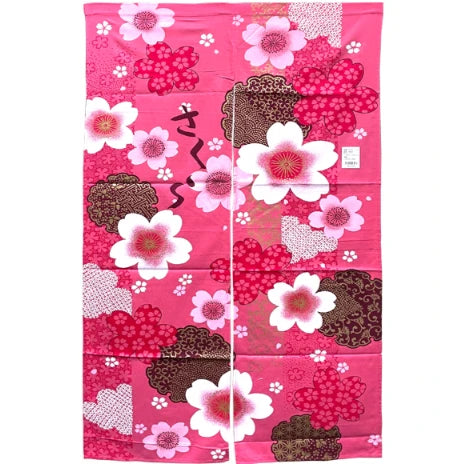
ERS's PCOS-202 moon-and-white-sakura noren is described as uncut cotton, 85 × 150 cm. Obtain the supplied cutting instruction before altering it. An uninterrupted panel may be selected for its image; a frequently used passage needs the intended division and finished edges. Do not transfer a non-fraying cut-line claim from another product.
Cleaning follows the image process and finish
Mizuno's hikizome/nassen noren guidance specifies separate washing around 20–40°C, excludes bleach/enzyme-containing detergents and warns that optical brighteners can affect dark colors. Its broader dyed-textile guidance also addresses wet color transfer and the shrinkage risk from prolonged high-temperature tumble drying. These directions belong to the specified dyed/printed route. Mizuno textile care.
An added logo can change the article. Mizuno's ready-made cotton slub range uses pigment printing for optional names or logos. Its flame-retardant, water-repellent and antibacterial options are mutually exclusive: the maker offers one, not all three together. Approve the completed cloth, image and finish before agreeing its care. Mizuno ready-made range.
Plan removal, cleaning and rehanging without improvised handling over active service. Replacement quantity follows cleaning and treatment turnaround, while the retained artwork and finished drawing preserve the original order.
Flame treatment and project documentation
Mizuno warns that its offered indoor flame-retardant treatment is lost after one washing. That limitation belongs to its applied treatment. Cosmos also sells a Japanese-labeled flame-retardant plain polyester range expressly described as washable. “Washable” still requires the actual care instructions and does not mean unlimited treatment endurance. Mizuno treatment note, Cosmos catalog, page 16.
California's Office of the State Fire Marshal describes registration of approved flame-retardant chemicals, applicators and fabrics and its authority over decorative fabrics in dining/drinking establishments. Obtain the documentation and any required tag or certificate for the actual finished item, cleaning and retreatment history, and intended location. A Japanese label alone does not establish local acceptance. Placement, exits and structural fixing remain project-specific matters for the responsible authority and design team. California OSFM decorative-fabric program.
ERS's current assortment includes the PCOS-44 blue blowfish cotton noren, 85 × 30 cm, and PCOS-108 sakura cotton noren, 85 × 150 cm, alongside the uncut piece above. Specify the current item description and dimensions, then confirm its care and required treatment documentation. A similar motif elsewhere does not establish the same maker or production method.

Exact-product catalog views, shown separately; not to a common scale. Confirm the supplied item, size and care label.
Explore the ERS collection
Noren & Furoshiki
Compare the assortment for this part of your service.
-
 Image unavailable
Noren 85 x 150cm
View details & options : Noren 85 x 150cm
Image unavailable
Noren 85 x 150cm
View details & options : Noren 85 x 150cm
-
 Image unavailable
Noren 85 x 150cm
View details & options : Noren 85 x 150cm
Image unavailable
Noren 85 x 150cm
View details & options : Noren 85 x 150cm
-
 Image unavailable
Noren 85 x 150cm (Sakura)
View details & options : Noren 85 x 150cm (Sakura)
Image unavailable
Noren 85 x 150cm (Sakura)
View details & options : Noren 85 x 150cm (Sakura)
-
 Image unavailable
Noren 85 x 150cm
View details & options : Noren 85 x 150cm
Image unavailable
Noren 85 x 150cm
View details & options : Noren 85 x 150cm
-
 Image unavailable
Noren 85 x 150cm 100% Poly Uncut
View details & options : Noren 85 x 150cm 100% Poly Uncut
Image unavailable
Noren 85 x 150cm 100% Poly Uncut
View details & options : Noren 85 x 150cm 100% Poly Uncut
-
 Image unavailable
Noren 85 x 150cm (Uncut)
View details & options : Noren 85 x 150cm (Uncut)
Image unavailable
Noren 85 x 150cm (Uncut)
View details & options : Noren 85 x 150cm (Uncut)
-
 Image unavailable
Noren 33-1/2" x 51"
View details & options : Noren 33-1/2" x 51"
Image unavailable
Noren 33-1/2" x 51"
View details & options : Noren 33-1/2" x 51"
-
 Image unavailable
85 x 150 Noren /Utagawa
View details & options : 85 x 150 Noren /Utagawa
Image unavailable
85 x 150 Noren /Utagawa
View details & options : 85 x 150 Noren /Utagawa


08 / Equipment & Specialty Supplies
08. Lighting, sound and restaurant atmosphere
Lighting and atmosphere are assessed with the counter occupied and the actual objects in place.
Light the work and assess the seated view
The chef's hands, the food presentation, the guest's face and the menu occupy different planes. A source comfortable to a standing observer can appear as a bright reflection in a glossy plate or counter from the guest's seat. The chef can also shade the work beneath an apparently well-lit empty counter. Assess aiming, height and surface finish from both positions.
California's §114252 requires at least 50 foot-candles at the specified food-work or safety-sensitive utensil/equipment surface, with a separate 20-foot-candle provision for food preparation in server stations. Cleaning requires 20 foot-candles throughout rooms. The actual activity determines the classification; a visible preparation counter is not automatically a server station. Section 114252.1 addresses bulb protection around exposed ready-to-eat food and specified clean items. California Retail Food Code.
Ambient dimming must preserve the applicable working conditions. Separate the controls where necessary rather than asking one decorative source to provide every task and cleaning scene.
Color temperature does not specify color rendition
Correlated color temperature describes the appearance of the white light. It does not fully describe how tuna, nori, rice, skin, wood or ceramic glazes will appear. Average fidelity and the direction of changes in particular hue regions supply different information. The DOE's current TM-30 account identifies ANSI/IES TM-30-24; Royer's 2022 tutorial explains the earlier framework and the underlying distinctions. DOE TM-30 guidance, Royer tutorial.
ERCO's Parscan New 120V for 2-circuit track makes the selections concrete. Its U.S. family offers different distributions, including a 15°–65° zoom option, separate glare-control accessories and different control arrangements. Even its 3000 K options include CRI 92 and 97 alternatives. Those are family choices, not features automatically supplied together in one article number. ERCO U.S. specification.
Select the exact optic, output, spectrum, control and compatible track. Evaluate actual food colors, servingware and counter finishes under the proposed task and ambient combination at the intended dim level. There is no universal sushi color temperature that removes this work, and attractive rendering is not a test of freshness.
A craft lamp is a material object
The Noguchi Museum's Akari 10A is a floor lamp made in Japan from washi, bamboo, basswood and steel. Close bamboo ribbing supports the paper shade; wooden collars and a basswood crossbar with cotton string connect it to a three-legged frame. Ozeki & Co. in Gifu has manufactured Akari since 1951. Noguchi Museum Akari 10A.
The 10A is 54 cm wide and 125.7 cm high, with a 49.5 cm-wide base. The bulb is separate; the model suggests an E26 LED up to 60 W incandescent-equivalent output.
Its paper, framework and footprint require deliberate placement, cord routing, stability, shade access and replacement planning. Specify the required electrical documentation and suitability for the actual restaurant location. The product's craft provenance does not establish a flame rating, wipeability or approval above exposed food. California's §114271 distinguishes dining-area wall/ceiling finishes from preparation areas and addresses cleanable attachments and acoustic-panel conditions. A dining-room photograph is not evidence for a preparation-counter installation. California Retail Food Code, §114271.
Conversation depends on the occupied room
Sound absorption within a room, isolation between spaces and quieter individual sources are different problems. A soft-looking textile supplies no tested acoustic result, and an absorption rating does not establish sound isolation. Listen to the occupied service: the chef–guest exchange, neighboring conversations, music and equipment all contribute.
A primary field study of 142 visitors in 12 Berlin restaurants examined sound level, reverberation and guest assessments. Occupied reverberation was calculated from unoccupied measurements and occupancy information. The authors reported relationships with perceived restaurant quality while identifying the study's observational and self-selection limits. It supports careful assessment of the actual room, not a universal sushi-counter noise target. Restaurant-acoustics field study.
Armstrong's FeltWorks data gives a useful assembly example: 1-inch PET felt panels with an NRC range of 0.75–0.90 depending on mounting, tested under ASTM C423 using ASTM E795 mounting. The installation belongs with the rating. NRC is not the percentage reduction in restaurant noise. FeltWorks technical data.
The maker's installation guidance also addresses dry-cloth/vacuum cleaning, a damp mild-detergent method where needed, moisture removal, dust accumulation near diffusers and coordination with sprinklers/plenums. Field painting the panels is excluded. Those details determine where the material can be maintained and how the assembly is specified; fiber content alone supplies no soaking or unrestricted-disinfectant permission. FeltWorks installation and maintenance.
Scent, drafts and seasonal objects
Sukiyabashi Jiro's request that guests avoid strong perfume illustrates one restaurant's priority for aroma. Apply the same deliberate judgment to scented towels, room diffusers and cleaning residues: decide whether that scent belongs beside the food. Cleaning products must still be used according to their own directions and material compatibility. Jiro's guest guidance.
A moving noren, paper lifted by a diffuser or decorative screening around a towel cabinet can create a specific service problem. Preserve the appliance's ventilation and access, and coordinate room textiles with actual air movement. Larger extraction and heat-management decisions belong with the workstation and hot-kitchen design.
Wall art and seasonal arrangements should have secure mounting, workable maintenance access and an appropriate relationship to the food/service area. The restaurant can choose an ensō or sakura motif without adopting an invented universal rule about its meaning or season. Immediate food-level decoration remains a separate presentation subject.
09 / Equipment & Specialty Supplies
09. Ordering and replacement
Preserve the specification that made the original choice work. A visually similar replacement can change the uniform's fit, a towel's cabinet load or a noren's care and mounting.
- Uniform: maker/model, color, finished size, separate collar or trousers, supplied care directions and approved decoration position.
- Oshibori: exact towel and intended reuse, wrapper and tray, regional cabinet version, correct manual and local service/parts route.
- Noren: finished drawing, cloth and image method, face/reverse, hanging components and the applicable care/treatment record.
Set quantities from actual staff changes, service demand, laundry or treatment turnaround, and reserves for damaged or missing components. Collars, aprons, trays and replacement bags need not follow the same replacement pattern as the larger item. Retain the physical sample or approved proof where it governs the reorder.
Resolve fit and care before customization. Seven, for example, distinguishes its embroidery approval process and excludes returns/exchanges on embroidered goods; its international-order terms are separately restrictive. Those are supplier-specific conditions, not ERS's return policy. Obtain the current terms from the actual seller before committing to a decorated or imported order. Seven embroidery, Seven ordering FAQ.
Browse ERS chef uniforms and apparel, develop custom chopstick sleeves, or contact ERS with the garment sizes, service requirements or noren opening and specification.
Related reading: Omakase, Edomae & Chef's Counter Restaurants · Hand-Roll & Temaki Restaurants · Sushi Equipment Maintenance, Cleaning & Replacement Parts · Sushi Bar Presentation, Display Accessories & Decorations.