

Flagship & Reference
Sushi Restaurant Equipment & Supplies: The Definitive Commercial Guide
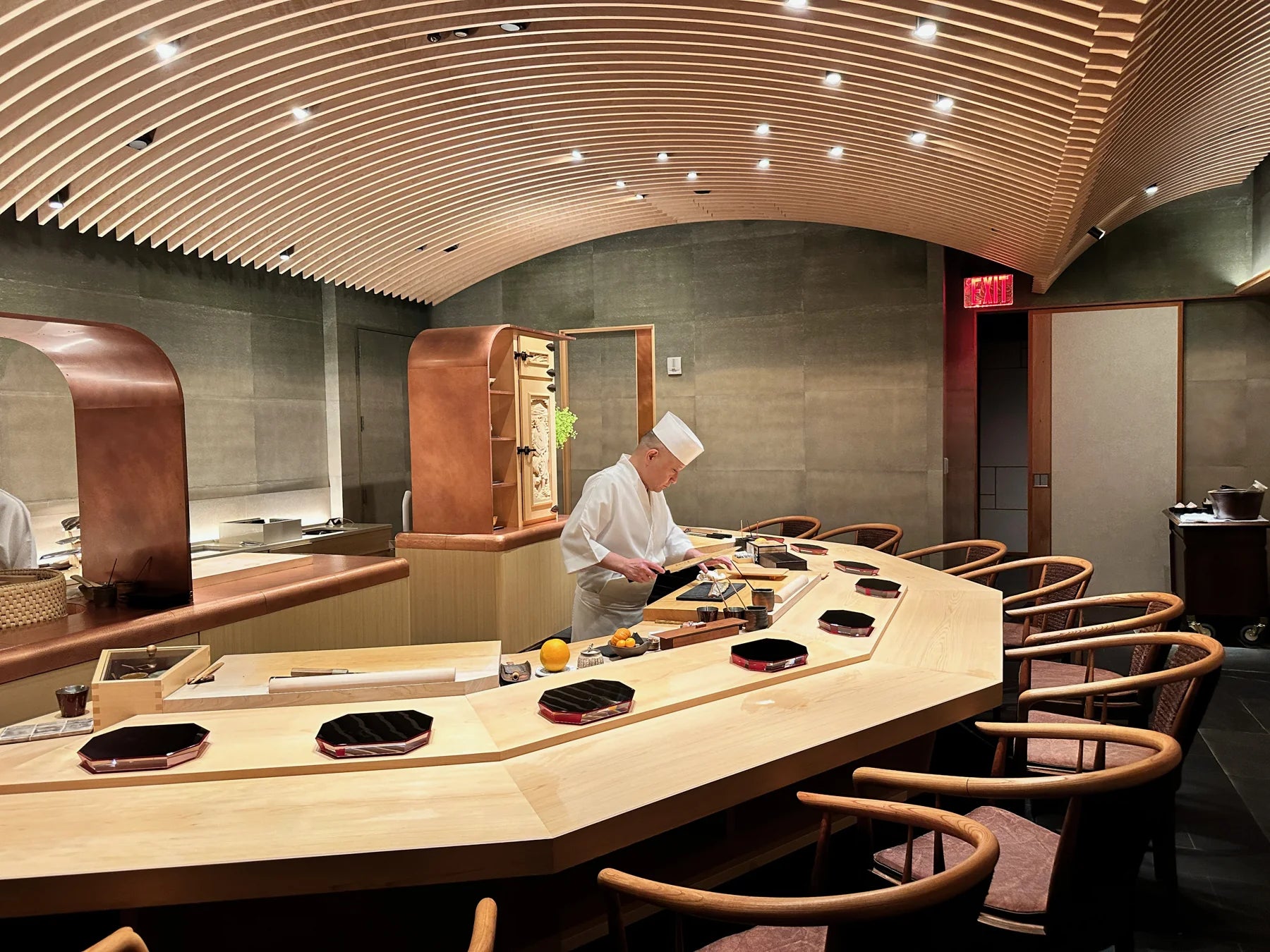
A sushi restaurant comes together at the point where prepared neta, working shari, a maintained cutting edge and the right receiving surface meet. Behind that moment are rice batches, covered reserves, cooked ingredients, clean vessels and people moving each into position. The equipment purchase has to support that whole restaurant, from the first delivery to the last washed cup.
The choices reach well beyond refrigeration and rice cookers. A hand-roll counter depends on the condition of its nori and the immediacy of its handoff. A restaurant serving composed platters needs a different assortment of vessels and a workable return through the dishroom. A retail operation must complete and identify a selling pack. A machine may change one precise action while leaving the food preparation, finishing and service around it intact.
ERS has supplied equipment and specialty tableware from its Japanese-restaurant roots in Los Angeles since 2002, growing alongside the Asian dining community. That perspective brings the large appliance and the small working object into the same conversation: their construction, useful capacity, fit, care and place in the meal. About ERS.
This guide follows those decisions through the restaurant, then into specification, cost, purchasing and continuing supply. For item identification, use the illustrated equipment and supplies encyclopedia. For a complete conditional order schedule, use the equipment and supplies checklist.
In this guide: Restaurant formats · Counter and kitchen · Rice and shari · Seafood and refrigeration · Knives and tools · Machines · Servingware · Hot food · Beverages · Packed sushi · Care · Specification · Cost and ordering · Full library
The complete specialist library
Choose the decision in front of you.
Open a subject to reach its detailed guides.
In this guide 19 sections
The complete commercial guide
Define the restaurant
The food, the service and the work retained on site.
01 / Flagship & Reference
Sushi restaurant formats and equipment requirements
Start with what the restaurant makes and how it serves it. Nigiri brings shaped rice and a prepared topping together. Maki introduces spreading, filling, closure and sectioning. A hand roll brings nori into its final contact with rice and fillings near the handoff. Pressed sushi needs a forming cavity, controlled release and portioning. Gunkan, inari and bowl presentations each place different demands on the hands, food supports and receiving vessels.
Then establish where those actions happen. The same menu item can be made entirely at the outlet, assembled from prepared components or received as a finished pack. That decision changes the fish-preparation space, rice equipment, cold reserve and washing the outlet must provide.
Dining language needs the same precision. Omakase describes the chef-led offer; Edomae refers to a culinary tradition; a chef's counter is a physical service arrangement. Together they can inform an operation, but none supplies a complete equipment schedule by itself. The retained preparation and the way each serving reaches the guest determine the purchase.
Scroll to read all columns
| Restaurant arrangement | The demand that changes the equipment and supplies |
|---|---|
| Traditional full-service sushi restaurant | Coordinate counter service, table orders, cooked food and beverages, with a usable server pickup and returned-ware route. |
| Omakase and chef's counter | Support deliberate course release, close guest contact and the less visible preparation and courseware behind it. |
| Hand-roll restaurant | Bring working nori, rice and fillings within the assembly motion; define whether the roll is eaten immediately or packed in a different form. |
| Conveyor and kaiten restaurant | Distinguish food circulating for selection from an identified order being delivered; provide compatible ware, loading and return. |
| AYCE and high-volume operation | Provide for concentrated rounds, repeated replenishment and clean receivers. The pricing format and the actual production volume remain separate questions. |
| Fast-casual and express sushi | Complete the selling unit, whether a roll, bowl, wrapped item or set, through finishing, packing and collection. |
| Takeout and delivery kitchen | Assemble and identify the whole order, including companion packages, suitable waiting positions and accurate release. |
| Grocery and grab-and-go program | Match local production or received supply to identified retail packs, customer-access display and replenishment. |
| Commissary and multi-location production | Specify the food state supplied to each outlet and the preparation, receiving and storage left there. |
| Hotel and shared hospitality program | Establish which host facilities are available, when they can be used and what the sushi outlet must retain locally. |
These arrangements often overlap. A full-service restaurant can use the same rice and fish preparation for dining and takeout, then provide a dedicated position for packing and gathering closed orders. That preserves shared production while keeping boxes, labels and waiting packages out of the chef's cutting area.
Central preparation can similarly remove some whole-fish work while leaving rice cooking and final assembly at each restaurant. An outlet receiving prepared blocks still needs suitable cutting, protected reserve and working neta access. Receiving finished retail packs shifts much more of the production elsewhere, while adding a clear obligation for acceptance, display and stock rotation.
At a hotel, shared stewarding can replace a separate local dishroom only when it can accept the selected ware and return it in time. A banquet taking the same bowls or cups out of circulation changes that arrangement. Build the purchase around the service actually available to this operation, including its competing demands.
The complete commercial guide
Build the working kitchen
Counter, rice, seafood, tools and mechanization.
02 / Flagship & Reference
The sushi counter and its supporting kitchen
The occupied working position
The chef's station should be drawn with the work in it. A long slicing knife needs its stroke clear of a rice vessel or case edge. The board needs stable support and usable room for the food being cut. Working shari needs a position from which the chef can remove it without turning each portion into a bulk-handling operation. Neta, nori, sauce and finishing tools need their own accessible positions.
The guest occupies the other side. A landing plate, soy dish, chopsticks, tea, water and towel can fill a surprisingly large part of a seemingly generous counter. The height of a case and the relationship between working and dining surfaces affect the view and the handoff. Examine that relationship with a guest seated and the chef working, rather than judging an empty elevation.
Linear, wrapped and island counters create different replenishment and staff routes. The useful plan is the one that accommodates the operation's actual movements: ingredients arriving, food leaving, vessels being exchanged and staff passing while another person is cutting or serving. A table-service restaurant also needs a clear receiving point for servers. A takeout component needs a packing destination that stays available during dining service.
The work behind the visible counter
Bulk seafood preparation, reserve refrigeration and frozen stock often belong away from the guest-facing station. Rice washing, cooking and mixing need their own handling room. Cooked components bring heat, receiving vessels and sometimes a separate cooling duty. Dry supplies, packaging cartons, cleaning materials and refuse all require appropriate storage and movement.
Handwashing and the treatment of food-contact tools are separate provisions. Neither should depend on a working area that becomes inaccessible when production is busiest. The washing arrangement must accommodate the largest selected articles, including a long board, broad hangiri, projecting boat or removed machine component. Their size may determine the practical support more than the plates that dominate the daily count.
Shared or remote preparation changes this plan but does not eliminate support. Prepared ingredients still arrive in containers, occupy reserve space and need to reach the working station. Soiled vessels and empty transport equipment have to leave it. These routes deserve space before the visible counter is finalized.
Fit the case with its air and access requirements
A refrigerated case occupies more than the outline of its cabinet. Hoshizaki's HNC SLH specification, for example, shows a rear condenser inlet and side outlet, with six inches of clearance at those openings. Its specified access and surrounding space belong to that series' fitted arrangement. They cannot be borrowed as universal dimensions for another case. HNC SLH specification.
This is a consequential fabrication detail. An enclosure can fit the case neatly while blocking the air route it needs. The selected left- or right-unit configuration, drainage, controls, service access and eventual removal should be resolved with the actual unit's documentation before the surrounding millwork closes those choices.
The same care applies to the supporting cabinet below. Doors and drawers move into occupied space; loaded pans must clear their openings; food-contact parts need a route out for treatment. The final counter should permit the equipment to be used and maintained as well as displayed.
The counter and workstation guide develops these relationships in depth. Use the neta-case guide for the working display and commercial requirements guide for the exact installation. Browse refrigerated sushi cases after establishing that fitted role.
03 / Flagship & Reference
Rice cooking, mixing and working shari
Rice equipment should follow the restaurant's shari: its preparation, seasoning, texture, working condition and replenishment. The purchase begins before the cooker and continues after the mixing vessel has been emptied.
Scroll to read all columns
| Work | Equipment and objects involved | Capacity basis to preserve |
|---|---|---|
| Measuring, washing and draining | Measure or scale, washing vessel or machine, draining provision | Raw rice and its preparation state |
| Cooking and completion | Selected cooker, pot and lid; appropriate heat and utilities | Raw input, usable batch range and completion of the prescribed cycle |
| Seasoning and mixing | Hangiri and paddle, or a configured mixer | Cooked input and the required finished shari |
| Transfer and replenishment | Receiving vessel, paddle, cover and handling support | Useful load and how much is moved at each transfer |
| Working supply | Suitable holder or vessel under the restaurant's established controls | Accessible shari at the required condition and time |
| Return for the next batch | Compatible washing, drying and protected storage | Complete clean vessels and components available to work again |
Cooking arrangements and batch flexibility
A simple commercial cooker-warmer can provide a straightforward batch arrangement. Zojirushi rates the NYC-36 for twenty approximately 180 mL cups of raw short-grain white rice, equivalent to 3.6 liters on that measure. That specification describes raw input. It should remain attached to its stated cup and food basis when comparing cookers or planning batches. Zojirushi NYC-36.
Gas batch cooking introduces a different heat source, vessel arrangement and installation. It also requires attention to the whole cooking sequence. The Rinnai RER-55AS manual separates the main burner's shutoff from the covered completion period that follows. A burner duration therefore cannot be used alone as the time from loading to rice ready for the next operation. Rinnai RER-55AS manual.
Induction heating changes how heat reaches the pot; selected machines also offer staged controls. Tiger's Japan-market JIN-A is an example of that architecture, with adjustable stages and menu settings. Its regional electrical specification belongs to that offering, so a U.S. project must identify the actual eligible unit and documents before installation. Tiger JIN-A.
The useful comparison includes the batch range, operator control, completion period, pot handling and time until the cooker can take the next load. Several smaller batches can provide flexibility around staggered service. A larger batch can suit a concentrated requirement. The choice depends on when usable rice must be available and what the staff and vessels are doing at the same time.
A cooker performing keep-warm duty may remain occupied when the next batch needs to begin. Separate holding can release it, provided the transfer and selected holding arrangement suit the food. That purchase consequence is easy to miss when comparing only the nominal cooker capacity.

Hangiri and manual mixing
The hangiri gives the operator a broad working field for seasoning and mixing. Its diameter matters, but so do the interior profile, working depth, paddle access and loaded handling. A large vessel that is awkward to lift, carry or wash can create a burden well beyond the mixing stage.
Wooden tubs are constructed objects. Shimizu's documented making process includes shaped side members, assembly, hoop fitting, insertion of the bottom and finishing. Those relationships explain why the condition of the complete vessel matters. They do not establish the species or maker of another tub with a similar appearance. Shimizu vessel-making.
The ERS I-654-60 wooden hangiri is one offered example of this working form. Select the actual vessel around the intended batch and confirm its fitted dimensions where they matter. The paddle should suit the mixing action and reach; the utensil used to retrieve shari repeatedly at the station may be a different shape and size.
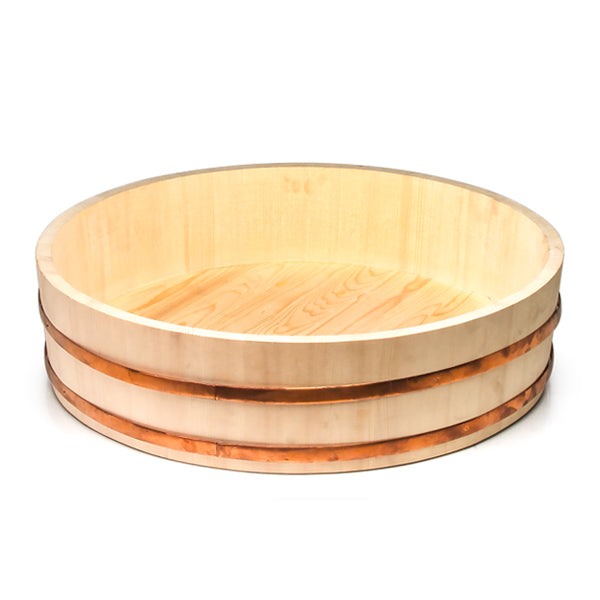
Provide somewhere to receive the mixed rice, a suitable cover and the means to handle the loaded vessel. The washing and drying route should support the actual wooden construction and its instructions. A mixing tub waiting to dry remains unavailable to the next batch even when the cooker is ready.
Mechanized mixing
A mixer mechanizes a defined stage. Suzumo's North American MCR-ASB-ET is specified for up to 13 kilograms of cooked rice. The operator adds rice and vinegar; the stated five-to-seven-minute stage covers automatic mixing and dispensing. Rice washing and cooking remain upstream, and the discharged shari still needs its receiving and working arrangement. MCR-ASB-ET.
Judge that arrangement with the restaurant's rice, seasoning and next operation. The useful result includes uniform incorporation, the intended texture, discharge and handling. The smallest workable batch can be as important as the maximum load when demand arrives in separated services or several product types.
Mechanized mixing can be appropriate for reasons beyond headline volume. It may take over a repeated physical task or support a specified result. Manual mixing may retain useful control and flexibility in another operation. Either needs a complete path into working supply, plus compatible care and clean receivers.
Working shari and holding
Plain cooked rice and seasoned shari can call for different vessels and controls. Confirm the actual appliance's suitability for the food, including acidic ingredients where relevant. A powered warmer's keep-warm function and a passive holder have different operating roles.
Zojirushi's RDS is a non-electric thermal holder described for use with acidic ingredients. It is an example of passive working provision: the vessel does not produce heat during service. Its instructions govern preparation and component care, while the restaurant's established food-control method governs the rice. Zojirushi RDS.
Keep that control decision explicit. Adding vinegar for flavor and using acidification as a preservation or food-safety control are different processes in the FDA model. The applicable local requirements and the operation's approved method determine the controls and records needed; a holder's construction or thermal test cannot settle them. FDA Food Code.
For the detailed production account, continue to rice equipment, hangiri and shari production and the established commercial rice-equipment research. Use capacity planning to relate batches to service, then compare the relevant rice cookers and warmers.
04 / Flagship & Reference
Seafood preparation, refrigeration and neta display
Start with the incoming food
Whole fish, trimmed blocks, prepared neta, cooked toppings and frozen portions occupy the restaurant differently. Whole-fish work needs handling and cutting provision for the fish and its by-products. Trimmed blocks retain the finishing cuts and portioning. Ready portions shift more work upstream but still need protected receiving, usable reserve and controlled replenishment.
Frozen inputs add package handling and a defined thawing arrangement. Cooked components can add active cooling before storage. A restaurant using ice-supported fish needs suitable support and drainage as well as a cold location. Delicate roe, liquid-packed ingredients and sliced fish may need different containers within the same operation.
Those food forms determine the occupied load. A long covered tray has to pass through the opening, rest on suitable supports and leave the required airflow. New deliveries, thawing lots and prepared replenishment may all be present while the current service is underway. Advertised cabinet volume alone cannot describe that requirement.
Scroll to read all columns
| Refrigeration duty | What the equipment must support |
|---|---|
| Chilled reserve | The actual covered stock, usable shelving or pans, access and replenishment |
| Working neta display | The intended working food, supports, retrieval and room conditions |
| Refrigerated preparation | Repeated ingredient access while preserving useful assembly space |
| Frozen reserve | The purchased or prepared stock and its required storage condition |
| Active cooling or freezing | Heat removal from a defined starting load through a specified process |
| Thawing | The selected product and package through its intended transition |
| Packed display or transport | The complete closed product through loading, access and receipt |
Working display and reserve
The case brings ingredients into view and within working reach. Its trays, supports, opening and usable food field deserve as much attention as its overall length. The chef needs to retrieve the intended portions without continuously disturbing the rest of the load.
Reserve storage supports that working stock and may carry the food outside service. Hoshizaki's HNC SLH specification expressly excludes overnight storage. For that series, an appropriate off-hours destination is therefore part of the restaurant's refrigeration provision. The specification's unloaded temperature condition should also remain distinct from the condition of food in a loaded working case. HNC SLH specification.
Undercounter drawers can place assigned pans directly within reach. Door cabinets may accommodate a changing mix of covered trays. A refrigerated preparation rail creates another access and replenishment pattern. Select the interior arrangement with the real containers, including covers and inserts, rather than assuming every cabinet of similar exterior size accepts the same load.
The display-case guide develops the working presentation. The broader seafood refrigeration and cold-chain guide covers the reserve, processing and transport duties around it.
Storage and treatment
A freezer used to store frozen ingredients and equipment used for a specified seafood treatment have different obligations. A treatment depends on the product, process and evidence that the required conditions were achieved, including the food's own freezing and holding history. A setpoint printed on a cabinet does not establish that history.
FDA's seafood guidance addresses those process dependencies. Its retail model also provides for applicable supplier freezing documentation and recognizes specific exceptions. The restaurant's seafood selection and accepted sourcing arrangement should therefore be settled before assigning an in-house treatment duty or purchasing equipment for it. FDA parasite guidance, FDA retail provisions.
Ultra-low tuna storage, controlled aging and live holding are specialized applications. Each requires a specification appropriate to the actual food and process. Their existence broadens the equipment field; it does not make an ordinary storage cabinet suitable for all of them. Active cooling similarly needs a defined load and completion requirement, including what happens to that load afterward.
Measurement and interruption
Cabinet air, a controller setting and product temperature answer different questions. Choose the instrument and record for the condition that must be established. Provide practical access for measurement and the action the team will take if equipment or power is interrupted.
An alarm can report a condition; the restaurant still needs the means to protect and assess the food and determine its disposition. Reserve capacity, service support and access to the affected load can all influence that response. The details belong in the operation's controls and the specification and commercial-requirements guide.
When browsing commercial refrigerators, keep the intended food, complete containers and required duty beside the model comparison. They determine the useful purchase more reliably than nominal volume or an isolated low-temperature claim.
05 / Flagship & Reference
Knives, cutting boards and sharpening
A useful knife assortment begins with the cuts retained on site. Breaking down fish, making long boneless presentation slices, preparing vegetables, trimming and sectioning a filled roll place different demands on the blade and board.
A yanagiba's long narrow form suits presentation slicing. Deba patterns address fish preparation. Usuba and nakiri can share a broad outline while using different edge constructions. Gyuto, sujihiki and petty patterns support wider preparation and trimming. Sectioning a completed roll or pressed block adds a composite product of rice, wrapper and filling to the selection.
Blade length has to work with the chef's hand, the food and the station. A long edge offers little advantage if the cutting stroke is obstructed or the board cannot support the piece. Establish the operator's handedness and intended technique before choosing a single-bevel article.
Read the complete construction
TOJIRO's F-910 is a 300 mm, right-hand single-bevel yanagi with a White-steel core and soft-iron outer material. That combination describes an actual knife construction, with its associated edge and care obligations. ERS lists the F-910. TOJIRO model specification.
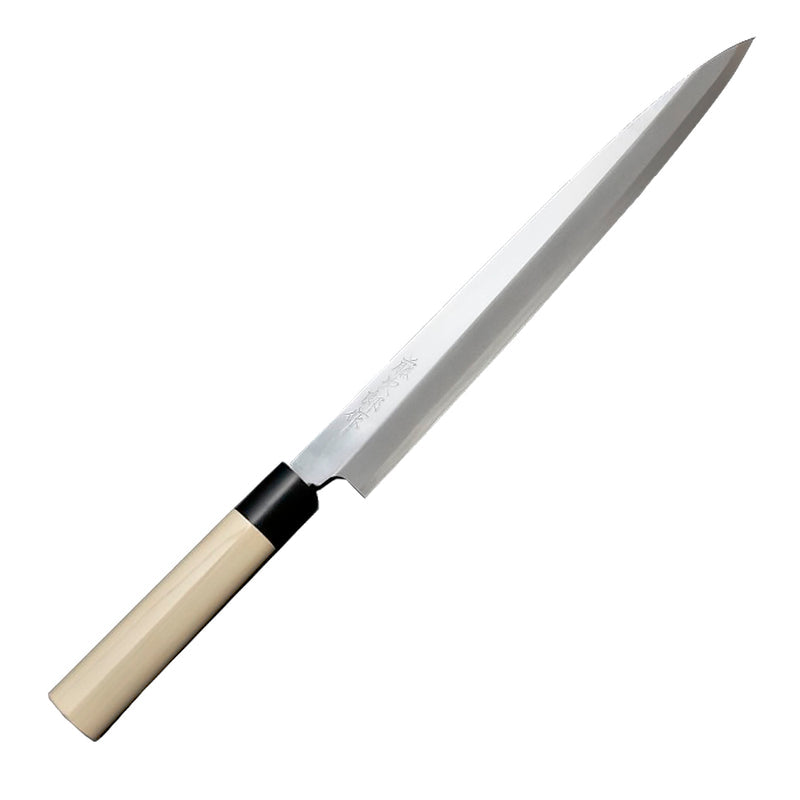
A comparison within a similar outline is instructive. TOJIRO's 165 mm F-918 usuba is right-hand single-bevel White steel with soft iron; the 165 mm FD-568 nakiri is double-bevel VG10 with stainless cladding. Nominal length and a rectangular profile leave important differences in the actual cutting edge and its maintenance. F-918, FD-568.
Steel, heat treatment, geometry, cladding and finish contribute to the complete tool. An alloy name, layer count or hardness figure is useful information within that construction; none alone ranks every knife for every cutting task.
The supporting board
The board has a contact face, a structure beneath it and a permitted care route. Solid plastic, rubber and enclosed-core constructions should be compared on those terms. Stable support at the workstation is a separate requirement from the material that meets the edge.
Hasegawa's Pro-Soft FSR encloses a wood core within its soft exterior. The knife contacts that exterior, so treating it as exposed wooden board stock would misdescribe the article. The maker's care restrictions, including limits on hot/oily contact and prolonged bleach soaking, belong to that construction. FSR construction, FSR care instructions.
The selected board must also be lifted, washed, dried and stored. Its full length and weight matter along that route. Renewal methods such as scraping, sanding or resizing should follow the actual construction and manufacturer's permission rather than a habit learned on a different board.
Maintaining the edge
Routine sharpening, restoration of geometry and repair of damage are different tasks. Provide appropriate stones or other qualified sharpening equipment, stable support, water and debris management, drying and protected storage. A restaurant also needs access to skilled work when the edge or blade requires more than its staff can reliably perform.
Single- and double-bevel knives require geometry-appropriate maintenance. The stone itself has its own preparation and care requirements, so a universal angle, soaking instruction or weekly schedule is a poor substitute for the selected equipment and actual condition. TOJIRO maintenance guidance.
The knife, board and sharpening guide develops these choices in detail. Compare cutlery as a working assortment, with the supporting board and maintained edge included.
06 / Flagship & Reference
Manual tools, nori and working mise en place
Small tools perform much of the work between the major appliances. Makisu and presses form food; scalers and bone tools follow the incoming fish; graters and slicers prepare distinct surfaces and cuts. Moribashi, tweezers, spoons, spatulas and brushes complete the arrangement. Their size and construction should follow the action rather than a generic sushi-tool set.
Forming and grating
A rolling mat is an assembly of members and binding. Bamboo with cotton binding and a monofilament-bound alternative can both be coherent choices, with different handling and care. Shindoh documents its bamboo/cotton construction; Hasegawa's FMK instructions identify the binding and precautions for that article. The complete tool, including its ends and flexing behavior, belongs in the evaluation. Shindoh mat, Hasegawa FMK instructions.
Choose the mat's working size and movement for the intended roll. A press needs the corresponding attention to cavity, release and sectioning. A successful outline is only one part of the result; food should leave the tool in the condition needed for the next action.
Graters make the distinction between overall size and working field especially clear. Kinjirushi's KS230P natural-skin grater measures 235 × 105 mm overall, with a 105 × 105 mm active area on wooden backing. Its KZ-170 stainless model measures 170 × 83 mm overall, with a 79 × 83 mm grating field. These are different surfaces and usable fields, not interchangeable rectangles. KS230P, KZ-170.
Paste recovery, transfer and application also need suitable contacts. A scraper that works on one surface can damage another. A fine grating field should be assessed with its recovery tool and actual care, rather than selected on a claim of sensory superiority alone.
Moribashi provide two independently controlled points; tweezers close paired tips. Useful reach, approach and release determine which works for a given placement. A brush applying sauce has a different assignment from one recovering paste or cleaning a tool. Keep those functions intelligible in both the assortment and the working layout.
Nori reserve and working access
Nori selection and handling should reflect the interval between assembly and eating. Maruyama's producer guidance distinguishes immediate hand-roll use from rolls eaten after standing, and addresses moisture protection and bringing closed cold-stored supply toward room temperature before opening. Apply that guidance to the selected product and supply conditions. Maruyama nori guidance.
The restaurant then needs containers that suit its working cut. Whole sheets, half sheets and narrow gunkan strips have different retrieval requirements. Check usable interior space and the opening through which the chef removes the nori. Exterior dimensions alone cannot establish that a sheet lies flat or comes out without awkward handling.
The ERS NC-1 hinged nori tin has a stainless-steel inner base and an outside size of 8½ × 5⅛ × 3¾ inches. Those facts describe a working article. A protected reserve container and a powered conditioning unit provide different functions; choose them according to the actual moisture protection and access required.
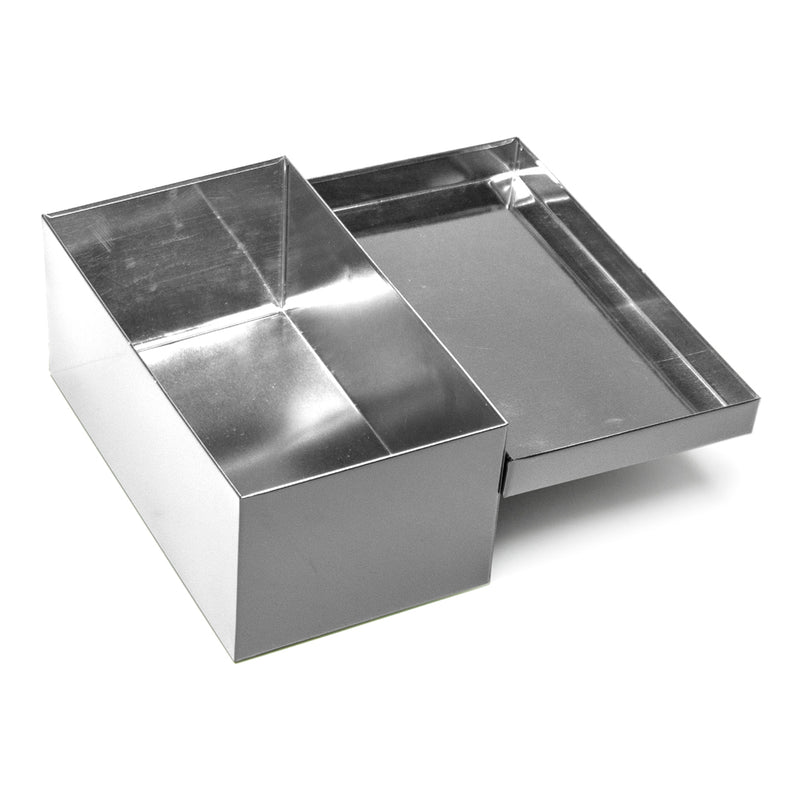
A manageable working quantity keeps frequent retrieval concentrated in a small supply while the reserve remains protected. At a hand-roll counter, that arrangement should align with where rice and fillings meet the sheet and where the roll is received.
Neta and finishing supplies
Trays, covers, draining inserts and small vessels should follow their ingredients. A delicate sliced topping, roe, liquid-packed item, drained vegetable and sauce need different support or access. Deliberate drainage, absorbency and dehydration serve different purposes and should be selected deliberately.
Complete tray, lid and insert assemblies must fit the actual case or preparation cabinet. Clean replacements need to be available in the same useful configuration. Brushes and paste utensils require suitable resting and treatment arrangements; dispensing bottles need both the intended flow and workable cleaning access.
The manual-tools guide develops the tool families, while nori, neta and mise en place develops the ingredient arrangements. Use the kitchen-supplies assortment to build those specific duties into the order.
07 / Flagship & Reference
Sushi machines and automated service
Production machinery and the food it delivers
Specify production machinery by the action it performs and the food state it supplies. That makes its value, configuration and supporting work clear before advertised speed enters the comparison.
Scroll to read all columns
| Machine function | Output to examine | Work that must remain in the restaurant plan |
|---|---|---|
| Rice sheeting | A rice mat of the intended dimensions and release | Prepared shari, ingredient placement, closure, cutting and presentation |
| Combined sheeting and roll forming | A formed roll in the selected configuration | Ingredients, setup, removal, sectioning and arrangement |
| Rice-base forming | Shaped portions | Collection, topping, finishing and receiving ware |
| Tray placement | Bases positioned on a supported tray or plate | Compatible clean receivers, replenishment, topping and removal |
| Roll cutting | Pieces in the required pattern | Completed rolls, registration, collection and final arrangement |
| Specialty forming or filling | The specified onigiri, musubi, gunkan or inari intermediate | The exact filling, wrapper or pouch work outside the supplied function |
AUTEC's ASM895A provides a useful sheeting example. Its feeding and cutting arrangement produces a rice mat; the cutter described in the manual separates that mat. The sheet then enters ingredient placement, rolling, sectioning and presentation. The manual's paired component arrangements also show that some geometry changes involve parts rather than a simple control adjustment. ASM895A manual.
That endpoint can be desirable. A sheeter can standardize one repeated action while leaving the chef flexibility in fillings and closure. A combined machine offers a different arrangement: AUTEC's ASM890 specifications tie roll sizes to particular wrapping units, sold separately. The proposed product range must therefore be matched to the supplied configuration. ASM890.
Continue the comparison through the actual receiver. Suzumo's North American SSN-KTA-AC with TRS-JLX-AC forms and transfers rice bases into trays; the manufacturer identifies the receiver arrangements, including an optional adapter for specified one-way containers. Placement changes the repeated collection work and makes tray supply and removal part of the machine's operation. Suzumo forming and transfer arrangement.
Specialty machines solve different material problems. Suzumo's FIS-SND uses air to help open a prepared tofu pouch before filling it with rice. Pouch behavior is part of the task being mechanized. A machine that forms a rice base, one that opens and fills a pouch and one that applies a wrapper should be evaluated against their own defined outputs. FIS-SND.
Loading, replenishment, changeover, collection and cleaning remain visible throughout the decision. Use the offered regional model and its applicable documents for dimensions, power and supplied parts; specifications from a global page and an older regional manual cannot be combined into a new composite model.
Moving food to the guest
Service automation begins with a completed load and a destination. Circulating prepared portions lets guests select from moving stock. An ordered-delivery lane carries an identified dish to a particular receiving point. A floor-running unit moves staff-loaded food or used ware along a route. Restaurants may combine these functions, but each creates different loading, retrieval and return work.
The transported load includes the vessel and its food. Dish dimensions, base geometry, stability and permitted load must suit the actual carrier or lane. The guest also needs to remove the serving comfortably. A shuttle may remain committed until retrieval and return are complete; a directly conveyed plate has another relationship to the mechanism and to dirty-ware collection.
Ishino's AW-100 AutoWaiter, for example, identifies table-number dispatch and a permitted transported range of 130–800 grams per dish in its Japanese-market specification. That example makes the lower load limit visible alongside the maximum. It is a requirement of that identified arrangement, not a universal specification for restaurant plates. Ishino AutoWaiter.
Dirty-ware handling, clean dish supply and the staff's remaining service duties must fit the same plan. Automating the outward movement does not by itself provide the plate's return to useful stock.
Evaluate the completed contribution
The meaningful demonstration follows the food into the next action. Examine the rice sheet after it is closed around the intended filling, the formed base after topping, the cut roll after arrangement and the delivered dish after guest retrieval. Where the promised benefit concerns completed meals, keep the remaining assembly and service visible.
Machinery can justify itself through a particular product geometry, consistency of a defined action, physical workload or useful capacity. The production-machine guide develops those choices; the automated-service guide develops food movement. For the full restaurant arrangement, use the kaiten concept guide. Browse sushi robots and machines against the specific function the operation needs.
The complete commercial guide
Complete the meal
Vessels, presentation, hot food, beverages and packed service.
08 / Flagship & Reference
Sushi servingware and the materials behind it
The serving object determines how the food is arranged, carried, seen and eaten. Its usable surface deserves the same precision as a machine's working envelope.
An individual piece placed directly by the chef needs an accessible landing surface. A complete order of nigiri and rolls needs room for the arrangement and its accompaniments. Sashimi may use depth, supports and a different relationship to garnish. A chirashi bowl should work for the guest's movement through the food. A shared platter introduces loaded carrying and access to pieces across the vessel.
Overall length and diameter tell only part of that story. A broad rim can occupy space that never holds food. Raised edges can frame the arrangement while restricting the approach of chopsticks. A high foot can lift the presentation into view and change both stability and stacking. Place the intended food on a sample, then handle and eat from it in the actual setting.
Forms and the meal they support
Scroll to read all columns
| Serving form | Useful qualities to examine |
|---|---|
| Flat plate or low board | Food field, edge treatment, grip and access to individual pieces |
| Footed geta | Raised presentation, foot stability, under-surface clearance and complete-assembly care |
| Sushi oke or broad serving bowl | Usable interior, access to inner pieces, loaded carrying and any separate lid |
| Boat or elongated platter | Working deck, projecting ends, table fit, support and storage position |
| Chirashi or donburi bowl | Interior profile, useful fill, utensil access, foot and intended temperature use |
| Small dish or sauce vessel | Dipping or pouring, refill, handling and its place beside the main presentation |
The same service may need several of these forms. A course plate can emphasize one piece; a bowl can contain a layered meal; a shared vessel can organize an assortment. Coherence comes from their proportions and use through the meal, including how they fit with cups, chopsticks and smaller dishes.
Wood and assembled vessels
Wood appears in flat boards, footed geta, coopered tubs and turned bowls, with different joints, finishes and food uses. A description that stops at “wooden” leaves those differences unresolved.
Shimizu's vessel-making account shows the preparation and shaping of side members, assembly, compression for hoop fitting, insertion of the bottom and final shaping. It gives concrete meaning to the construction of a coopered vessel. A serving board and a turned bowl are made differently, and a visually similar product from another source cannot inherit that maker's process or provenance. Shimizu making process.
For an offered restaurant object, the ERS 90024-C geta is listed at 9½ × 6 × 2¼ inches and requires handwashing and thorough drying. Its raised form and its return-to-use route are both part of the selection. The restaurant needs suitable handling and dry storage for the quantity it intends to keep in circulation.
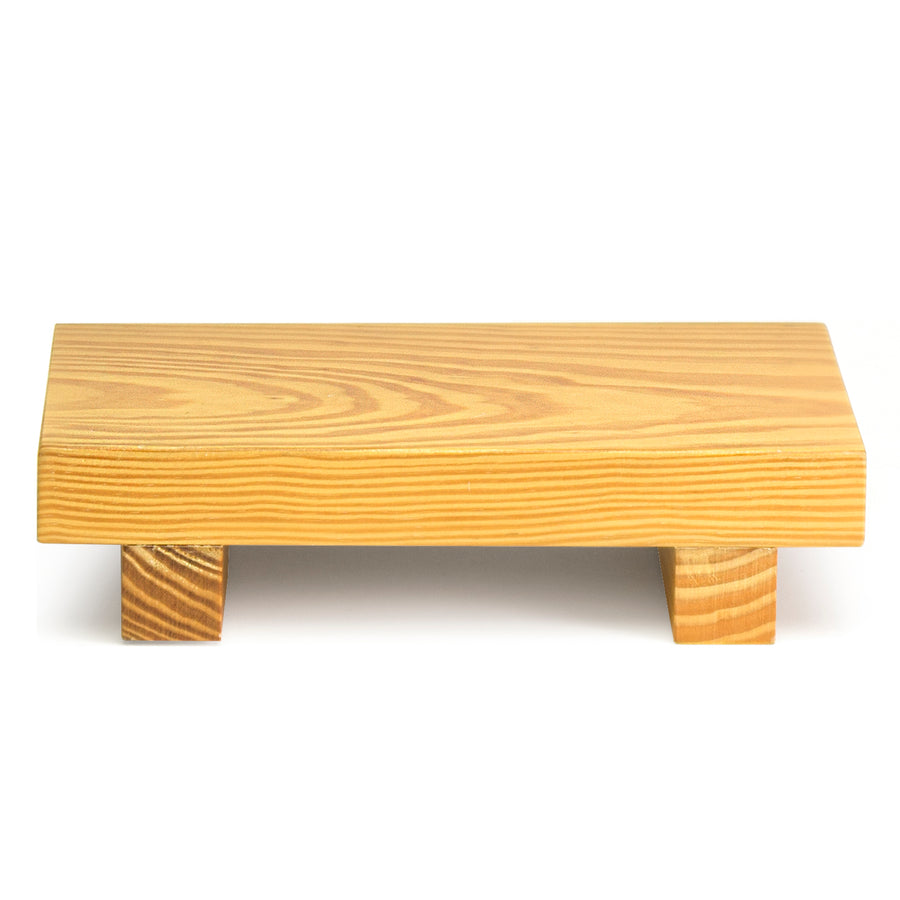
Wood's visual and tactile qualities can be a deliberate part of the meal. Select the particular article with its condition, construction and care understood. The working question is whether that object can deliver the intended presentation repeatedly within the restaurant's actual service and treatment arrangements.
Lacquered objects and their bodies
A lacquerware description should identify both the body and the finish. Yamanaka's craft association describes wooden production involving turned bodies, ground preparation, selected reinforcement, coating and finishing, as well as contemporary resin-bodied work. Its documented processes include different final surface treatments. Those distinctions explain far more than a black-and-red color description. Yamanaka production.
A resin body can intentionally preserve a familiar serving form. A wooden body can carry different coatings. Grain-like decoration does not identify the substrate, and a glossy surface does not establish the coating's chemistry or its permitted treatment.
Read the actual article's temperature, washing and handling instructions. The useful specification might combine a particular bowl profile, body material, coating, finish and intended use. Keeping those fields separate makes later replacement and substitution more reliable, especially where different generations of a familiar pattern coexist.
Ceramic body, glaze and form
Porcelain can be developed to look earthy, glass-like or lacquer-like. Kaneko Kohyo's Rinka account describes the development of textured form and edge treatment; its Giyaman series uses relief and glaze behavior to produce a different visual depth. These examples from the maker's own collections show how material and appearance can deliberately diverge. Rinka, Giyaman.
A molded ceramic form can embody substantial work on rim, foot, weight, texture and glaze. The mold describes part of the production method; it does not settle the finished object's character. Likewise, a rustic appearance does not establish an absorbent earthenware body.
For restaurant use, examine the complete vessel. The rim must work with the food and guest access. The foot affects the contact with the counter and the way plates stack. The loaded weight matters to service staff. Surface variation may be desirable within a course assortment but should be understood when replenishing a matching set.
Porcelain, other ceramic bodies and the various glaze treatments should be selected from the actual product's properties and instructions. A maker's stated care permission belongs to the identified article and conditions; it is not a guarantee about every commercial wash chemistry or handling practice.
Commercial alternatives and a continuing assortment
Synthetic materials can preserve a useful serving shape while changing weight, construction or care. The ERS 10-BR boat, for example, is identified as melamine, with an overall size of 10¼ × 4½ inches and stated dishwasher suitability. Its black-and-red presentation is a different material choice from the wooden geta.

A restaurant may combine a distinctive ceramic course plate, practical bowls, wooden presentation and separate sake vessels. That assortment should remain understandable through the meal and manageable in service. Trial the largest loaded pieces through carrying, table placement, collection and storage, as well as at the photographic plating position.
Replacement planning also belongs here. An unusual outline, seasonal selection or intentionally varied surface can enrich the service while requiring a more deliberate continuation strategy. Decide which attributes must match and where variation is part of the design. The receiving object should remain useful when the first opening order has been supplemented several times.
The traditional servingware guide develops geta, boats and oke; the craft guide develops their making. For assortment depth, use the established tableware report and sushi and omakase tableware guide. Browse sushi servingware and the wider tabletop assortment with the actual meal and return route in view.
09 / Flagship & Reference
Presentation, guest supplies and the counter environment
Presentation continues beyond the main vessel. Dividers, leaves, papers, picks and supports can organize the food or complete its visual arrangement. Their purpose and intended contact should remain clear.
An edible accompaniment, a manufactured food-contact divider and an ornamental prop are different articles even when their appearance is similar. Asahi Sogyo's Sanbon-sugi No. 1 baran, code 401, is identified as polyethylene. That is a manufactured divider with a decorative form; the material description does not turn it into an edible leaf or a food-safety control. Asahi Sogyo baran.
Choose these supplies for their actual contact, support and presentation. A liner beneath food needs the appropriate use specification; an object set behind the case has another role. Keep the guest able to recognize the edible components, and preserve the food's own temperature and handling controls independently of its decoration.
The complete place setting
A landing plate, soy dish, chopsticks and rest, tea cup, water glass and oshibori tray all occupy the guest's space. A counter receiving one piece at a time and a table receiving a complete assortment therefore need different layouts even when they share the same main vessel.
Follow how the objects arrive and leave. A restaurant may retain one landing surface, exchange plates between courses or bring a complete platter. Sauce can be applied by the chef, served individually or supplied in a shared vessel. Cups may be replenished in place or exchanged. These choices affect both the guest's use and the staff's clean-stock requirement.
Oshibori provision also has a full service route. Reusable cloth supplied clean, a laundry arrangement and a specified disposable towel create different supply and return obligations. Warming or cooling determines the presentation of the towel; cleaning and clean storage remain separate duties. The actual towel, fold, cabinet loading and retrieval should be matched to the chosen equipment.
Clothing, textiles and the occupied room
Chef clothing should work through reach, repeated movement and cleaning. Sleeve behavior, closures, pockets, garment size and laundering matter alongside appearance. Provide the actual size assortment and enough clean garments for the restaurant's service and laundry schedule.
Noren brings another working textile into the space. Its width, drop, split panels and mounting affect sightlines and passage. Consider the curtain with staff carrying a loaded tray and guests entering, as well as in the artwork proof. Mizuno's documented making process shows resist work, dye application, fixing, washing and alternative attachments as one specific craft route. The finished installation still requires the appropriate local material and fire-safety review. Mizuno noren-making.
Lighting should reveal the food and working surfaces without distracting reflections across the case. Heat and noise from appliances reach both the chef and the guest. Cleanable surroundings, stable objects and comfortable access belong to the same occupied restaurant; they should be considered together rather than added after the decorative scheme.
Use presentation and display accessories for the food's supporting objects and uniforms, counter service and environment for clothing, towels and textiles.
11 / Flagship & Reference
Sake, Japanese tea, water and ice service
Beverage equipment and vessels should express the restaurant's intended service. The source container, preparation method, dispensing arrangement and guest's cup can each require a separate decision.
Sake equipment and receiving vessels
Sake may be served chilled, at another selected drinking temperature or warmed according to the sake and the restaurant's intention. The equipment should support that choice without imposing a universal temperature hierarchy.
A tokkuri, katakuchi, ochoko, guinomi or masu names a serving form. Its material and instructions determine its actual thermal and care capabilities. A wooden masu receiving sake directly has a different contact duty from one supporting a glass. Both need a coherent place in pouring, presentation, collection and return.
A chirori warmed in an externally supplied hot-water bath illustrates one arrangement. Fukumitsuya shows such a vessel within a separate bath container; the source of heat and the sake-bearing object remain distinct. Fukumitsuya warming tools.
TAIJI's TSK-130B illustrates an appliance-based arrangement supplied by a 5–18-liter cubic sake container. It warms through a water bath and dispenses into a receiving bottle; the source container and serving bottle are excluded from the listed equipment. The source package size therefore does not describe a quantity of sake already at serving temperature. TAIJI TSK-130B.
Fit the whole service: source placement, heating or cooling, receiving bottle, outlet clearance, removal and care of the beverage path. Provide enough clean vessels for the actual pouring and guest use. The sake equipment and vessel guide develops the alternatives; the sake-ware assortment supplies the receiving objects.
Brewing and serving Japanese tea
A prepared house tea, an individual leaf infusion and a shared pot create different work. The hot-water appliance supplies one input. Leaf handling, infusion, straining, serving and the return of wet leaves and vessels still belong in the arrangement.
Hario's ChaCha Kyusu Maru combines a glass pot and lid with a removable stainless-steel basket, in practical capacities of 300, 450 and 700 mL. The basket becomes a separate component to empty, wash and keep with its pot. The vessel's heatproof construction is for the maker's stated uses; it is not a direct-flame or induction kettle. Hario ChaCha Kyusu Maru.
KINTO's LT 300 mL kyusu uses porcelain with fine straining holes and a hand-finished spout. Its construction creates a different leaf-removal and cleaning arrangement from a removable basket. KINTO LT kyusu.
Relate practical pot capacity to the actual cups and intended fills. A teapot can carry much of the service's visual character, but it also has a spout, grip, lid and care route that staff and guests use. Keep those qualities together when selecting the wider tabletop assortment.
Ready hot water and recovery
The first group of tea orders draws on water already ready. Continuing orders depend on restoration at the required condition. Those are separate capacities.
Marco's 2025 U.S. catalog makes the distinction tangible: the MIX UC3 configurations identified by order codes 1001880 and 1000880US both list 0.8 US gallon of immediate draw-off, while their rated hourly outputs are 3.6 and 7.3 gallons respectively, with different electrical specifications. Equal immediate reserve therefore leaves an important difference in continuing output and installation. Marco U.S. catalog.
The fitted purchase may also need a dispensing font, filter, drip tray, connections and service access. Establish any shared demand from kitchen or other beverage work. The same available water cannot be allocated simultaneously to several services without considering their timing.
Ice production and available storage
Ice selection includes form, intended use, production, storage and handling. Drinking ice, a particular cocktail presentation and ice used around a bottle may place different demands on the supply. The scoop, protected working stock and receiving glasses belong to the service as well as the machine.
Hoshizaki's KM-116BAK specification lists 130 pounds per 24 hours at 70°F air and 50°F water, and 110 pounds at 90°F air and 70°F water. Its bin capacity is separately stated as 53 pounds. The test conditions, daily production and ready storage describe different parts of the purchase. KM-116BAK specification.
Plan the required service around actual available ice, continuing production and other users of the supply. Cleaning or interruption can change that availability. Cups and glasses also remain in circulation after the drink leaves the service position, independently of the water and ice equipment.
The tea, water and ice guide develops those requirements and the wider complementary beverage program. Beer, coffee and other retained offers should receive their own equipment, storage and care provision in proportion to their place in the menu.
12 / Flagship & Reference
Takeout, delivery and retail sushi
The packed meal needs an intentional form. A finished sushi assortment, separately protected components and a kit assembled by the customer each move different work beyond the counter.
A finished roll assortment needs support and clearance for its final arrangement. A kit needs identifiable components, protected nori, appropriate companions and clear assembly information. A large platter brings a different closed outline, loaded carry and waiting position. Decide that food and service relationship before choosing a nominal tray size.
Fit the closed package and the complete order
The body, lid and food together determine the working package. South Plastic's SPI-1.5B base is listed at 213 × 133 × 20 mm externally; its matching SPI-1.5F lid is 220 × 140 × 31 mm. The lid extends beyond the base's plan dimensions. Their overlapping construction also means that adding the two heights would not establish closed height. SPI-1.5B, SPI-1.5F.
The ERS ED-07 tray-and-lid pack is a separate offered package, listed as fifty units at 8½ × 5⅜ × 1¾ inches. Use an actual sample to settle its food arrangement. Similar nominal sizes or code patterns do not establish interchangeability with another manufacturer's components.
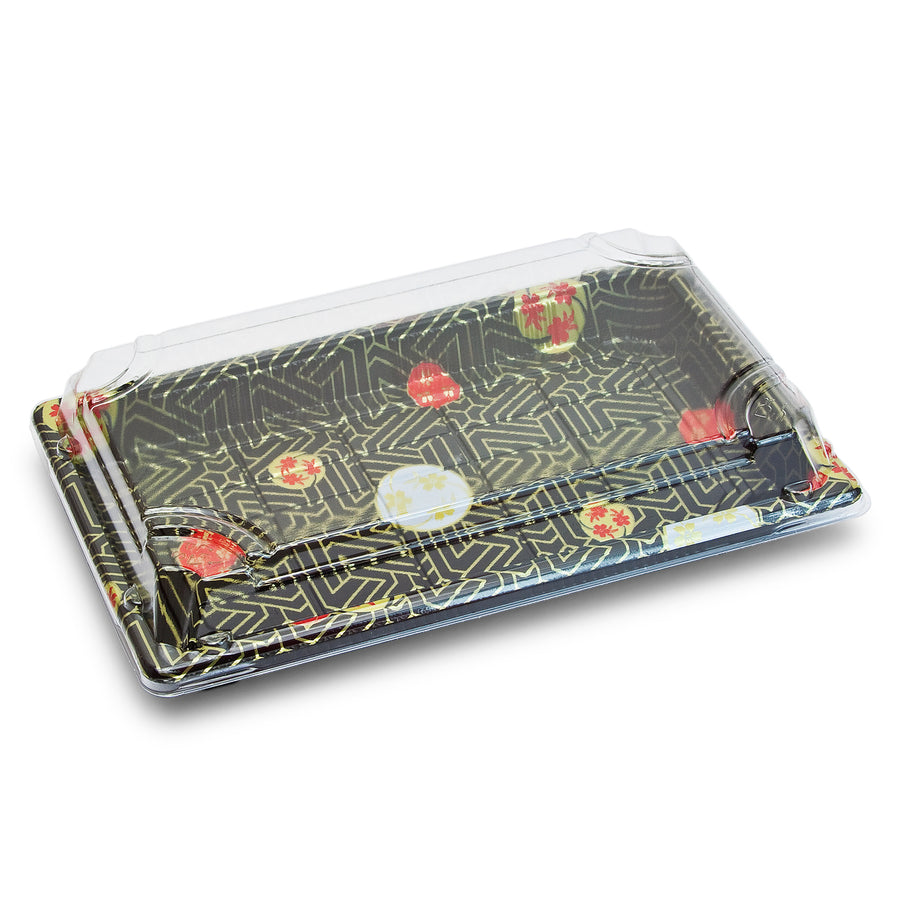
The useful test is loaded and closed. Include the intended food height, sauces and other accompaniments, then apply any label or seal and place the complete order in its bag or carrier. Check lid clearance, stable stacking, visibility and how the customer opens the package. A separate sauce portion can change the usable food field or the way the order stacks.
A party order may comprise several packages with different temperature and handling needs. Keep them associated so the customer receives the complete meal, while preserving the appropriate arrangement for each component. A shared order identifier does not require hot and cold items to occupy the same thermal cavity.
Customer orders and retail stock
Scroll to read all columns
| Destination | The unit being managed | Supporting work |
|---|---|---|
| Pickup | A complete named or numbered order | Assembly, closure, association, suitable waiting and accurate retrieval |
| Delivery | The complete order through a transport interval | Compatible carrier, load arrangement and controlled handoff |
| Self-selected retail | An identified selling pack within an assortment | Product information, customer-access display, reserve and replenishment |
| Customer-finished kit | Several components forming one promised meal | Component containment, identification and intelligible finishing instructions |
Retail display adds decisions that an order-specific pickup position does not have. The customer selects without the same final staff explanation. Product identity and the applicable ingredient, allergen, date and other information need to accompany the actual selling arrangement. Exact labeling requirements depend on the product and jurisdiction.
Assortment and stock depth also differ. More varieties need recognizable display positions; more units of an existing variety may need additional reserve rather than more frontage. Establish how replenishment enters the case and how stock is removed from sale without obstructing customer access or the case's intended operation.
Make room for packing
Provide a working position for food, open bodies and lids, immediate packaging stock and the tools used to finish an order. Bulk cartons and their disposal should not take over that surface. Closed packages then need a separate position where staff can gather companions and verify the complete handoff.
A dine-in restaurant with substantial takeout should account for that work explicitly, even when it shares all upstream rice and seafood production. Packing can consume the same people and counter space needed to complete table orders unless its place is resolved.
The takeout and delivery guide develops order-based production and dispatch; the grocery and grab-and-go guide develops retail stock. For package selection, use the established sushi-container guide, size and shape guide and sushi to-go assortment.
The complete commercial guide
Specify a continuing operation
Care, capacity, purchasing and replenishment.
14 / Flagship & Reference
Washing, care, maintenance and replacement parts
The restaurant's equipment has to return from use in the condition required for its next assignment. That return begins at soiled receipt and continues through cleaning, the required food-contact treatment, drying or draining, inspection, reassembly and protected storage.
Removing visible residue, sanitizing food-contact surfaces and maintaining a material have distinct purposes. The selected manufacturer's instructions and the restaurant's applicable sanitation requirements need to work together. A single wash route will not suit every object described in this guide.
Accommodate the actual articles
The largest or most awkward article can determine the practical washing arrangement. A long board needs support through lifting and drying. A broad hangiri needs room beyond its storage footprint. A boat's projecting ends, a tall bottle's interior and a machine's removable parts each require a usable treatment and return route.
Provide an appropriate place for loose components and clean assemblies. A lid, insert or strainer separated from its body remains necessary to the next use. A machine part should stay identifiable while it is being treated and dried, then return to the correct machine and configuration.
Drying and protected storage deserve capacity of their own. Articles returning together can occupy more space than their compact stacked form suggests. The restaurant needs the selected quantity in a usable condition and position, rather than merely somewhere on the premises.
A non-electric article can still need heat and components
Zojirushi's RDS instructions distinguish the insulated body, lid, sponge holder and removable sponge dew collector. They specify preheating, manual care and complete drying, with separate boiling-water treatment of the removed sponge. The thermal holder is excluded from automatic dishwasher/dryer treatment. RDS instructions.
That creates a real support duty: suitable hot water and handling, the means to perform the specified component treatment and space for separated parts to dry. A cleaned holder body waiting for its component is not yet the complete working article. Where another holder is needed during that interval, its quantity follows the actual overlap in service and care.
This is why “non-electric” is an incomplete description of an item's operating support. The article can still require heat, water, handling tools and replacement components elsewhere in the restaurant.
Different parts of one machine can need different care
The ASM895A manual separates removable washable food-path parts from the wipe-clean main unit and covers, and identifies gentle care for sensors. It also specifies the application of rice-release oil. These are different functions within a single machine, with different treatment and reassembly requirements. ASM895A care instructions.
Provide a clean assembly position large enough for the removed components. Restore the required covers, guards and sensing relationships before returning the machine to its intended work. Lubrication belongs at its specified points and stage; it does not replace cleaning or sanitizing.
Routine operator care should also remain distinct from work requiring qualified service. The installed equipment needs accessible documents and a known support route so that a cleaning task does not drift into unauthorized repair.
Identify parts from the installed equipment
A replacement request should carry the full model and suffix, serial or service identification, fitted configuration and the item needed. The required purchase may be a single component, a complete assembly or a matched set.
Hoshizaki's HNC SLH parts book uses auxiliary-code applicability derived from serial identification and warns that many illustrated assemblies are not sold as complete units. A drawing group and the quantity fitted in a machine therefore do not automatically describe an orderable package. HNC SLH parts book.
The order also needs the means to fit, check and return the replacement to service. A correct spare in storage is useful only within that actual support arrangement. Conversely, buying a whole fitted complement when one eligible component is required can tie up money without improving readiness.
Refrigeration airflow and drains, water treatment and scale, washing equipment and food-contact mechanisms all need appropriate planned attention. Base the work on installed instructions, operating conditions and observed condition. The maintenance, cleaning and parts guide supplies the detailed treatment; capacity planning connects care time to complete clean quantities.
15 / Flagship & Reference
Capacity, specifications and installed fit
State the completed requirement
A useful capacity statement names what must be ready, in what condition and by when. A sequence of hand rolls handed over individually, several table orders completed together and a retail assortment ready before opening are different requirements.
Follow the food through the actual operations. Raw rice enters cooking; cooked rice enters mixing; shari enters forming; a formed base enters topping; a roll enters cutting; a complete presentation enters service or packing. Some operations overlap. Others compete for the same person, vessel, receiver or position.
A faster former can leave completed output unchanged if the same operator must stop to replenish rice, finish toppings and find clean plates. An additional receiving vessel can sometimes release an occupied cooker or mixing operation. More suitable reserve storage can support replenishment without enlarging the visible counter. Identify the task or shared resource actually limiting the required result before selecting the next machine.
Complete sets have a time requirement
Reusable objects remain committed through work, service or transport, soiled return, treatment and return to the place where they are needed. Count complete ready sets through that whole route.
Consider an explicitly hypothetical example: one complete set is issued every ten minutes, and each returns ready after 35 minutes. The issues at minutes 0, 10, 20 and 30 overlap. Four sets cover that assumed schedule because the first returns before the issue at minute 40. Any additional reserve needs its own justification.
The example describes the assumed whole return route, not a measured wash cycle or a standard quantity for every vessel. Where demand and returns are irregular, inspect the actual commitments at the busiest moments. Average issue and return rates can conceal the period when several sets are away together.
Containers also occupy refrigeration according to their actual use. Separate products or destinations may need separate covered trays even when those trays are partly filled. Useful load and required access should remain in the sizing exercise.
Fit receipt, operation, care and service
The restaurant must receive the packaged unit, position and connect it, operate it, remove parts for care and eventually service or replace it. These activities can require different spaces.
Hoshizaki's UR48B-D4 specification gives an overall depth of 31 inches closed, including its bumper, and 52 inches with the drawer fully open. That is the selected cabinet's occupied movement; it does not establish a legal aisle width. UR48B-D4 specification.
Unpowered objects have occupied requirements too. A knife needs its stroke and storage. A loaded tub needs a lifting and washing route. A serving bottle needs to fit under and leave its outlet. A closed platter needs to pass through the carrier opening and rest on its support.
Carry those decisions into a proportionate purchasing specification:
Scroll to read all columns
| Description | Information to preserve |
|---|---|
| Intended work | Food or object, incoming state, task, required result, location and use period |
| Exact article | Manufacturer/item, model and region where relevant, material, geometry, condition and companions |
| Required capacity | Useful load or output, timing, food/container basis and performance conditions |
| Installed arrangement | Support, environment, movement and removal access, utilities, drainage and applicable review |
| Continuing provision | Care, measurement/control supplies, clean replacements, operating supplies and support |
| Supplied scope | Included components and work, responsible parties, documents, usable date and acceptance |
A small utensil order may need only a concise item record. Fabricated counters and connected machinery can require coordinated drawings and technical schedules. Match the documentation to the consequential decisions.
Establish the applicable requirements early
The FDA Food Code is a model offered for adoption by governmental jurisdictions. The restaurant's location and adopted requirements determine its actual obligations. Identify the intended food process and the applicable review before committing to equipment that is difficult to change. FDA Food Code 2026.
Evidence also has a scope. NSF/ANSI 51 addresses food-equipment materials, finishes and components. Electrical product-safety certification concerns the applicable equipment and recognized standards. Site acceptance considers the actual installed use. Preserve the relevant identity and evidence for each rather than treating one material statement as complete-appliance approval. NSF materials scope, OSHA NRTL explanation.
Imported, used, custom or modified equipment deserves the same exact identification and applicable review. The capacity guide develops timing and workload; the specification and commercial-requirements guide develops the technical and food-control evidence. The resulting schedule belongs in the complete equipment checklist.
16 / Flagship & Reference
Equipment cost, supplier evaluation and the complete order
Budget the restaurant being supplied
A limited-menu sushi opening in fitted foodservice premises is a different purchase from a bare-space project, a restaurant with a broad hot menu, a custom chef's counter or a mechanized production kitchen. Retained and shared equipment can remove real purchases when its suitability and availability are established.
The worked example in the equipment-cost guide shows how the scope develops:
Scroll to read all columns
| Stage of the hypothetical purchase | Rounded USD amount |
|---|---|
| Base equipment and opening stock | About $42,200 |
| Base plus specified ready-for-use inputs and purchase-tax planning line | About $57,000 |
| Funding with an additional separately held $2,000 reserve | About $59,000 |
This is a hypothetical limited-menu sushi, sashimi and roll opening with dine-in and takeout in fitted premises. It combines selling prices observed October 13, 2026 with substantial explicitly assumed inputs. The premises retain suitable fixed sinks, building utilities and support. The example does not provide a hot-menu line, tea or ice program, and the wider opening still needs funding for lease costs, guest furniture, ingredients, preopening payroll and working capital. It is a worked budget, not a project quotation or market average.
The additional inputs cover the example's defined freight, placement, site work, startup, review, care provision and tax assumption. The reserve remains available funding rather than an expense already incurred. Keep those boundaries with the figures when using the example to discuss another restaurant.
Compare complete supplied scope
A base machine price, a configured purchase and an installed ready-to-use arrangement are different amounts. Required tooling, receivers, supports, utilities, drainage, delivery and placement, startup and agreed instruction need to appear somewhere in the purchase.
The same completeness matters for small articles. A pan with its cover, a press with its release components, a bottle with a dispensing accessory and a tray with its matching lid are particular supplied units. Compare the complete article selected for the job, including quantities that must be available together.
Responsibility can be divided among the seller, fabricator, carrier, installer, service provider, restaurant and host venue. Make each item of work clearly included, arranged elsewhere or unresolved. An exclusion can be perfectly workable when another party owns the duty. An unresolved connection or receiver can still prevent the entire purchase from being usable.
Dates deserve equal precision. Available for shipment, delivered to a dock, placed in the restaurant and ready for the intended service are different milestones. Approved drawings and site work may precede shipment; connections and staff instruction may follow receipt. Work back from the required service date through those real dependencies.
Use samples and demonstrations to settle the choice
A servingware sample should carry the intended food at the actual place setting and pass through the proposed treatment and storage. A knife evaluation needs the relevant user and cutting work. A machine demonstration needs the offered configuration, prepared input and receiver.
Observe the supporting actions: loading, replenishment, collection, changeover, finishing and return to ready. A rice sheet is an appropriate endpoint for a sheeter demonstration. A business case promising more completed orders also needs evidence that the remaining preparation and handoff can support them.
Arrange permission and terms before using a trial item. ERS's ordinary return policy requires original unopened condition and excludes signs of use; a permitted sample or agreed demonstration is a separate arrangement. ERS return policy.
The supplier and equipment-evaluation guide develops offer comparison and the questions that a useful demonstration should answer. A short, well-defined test with the intended food can settle more than a large collection of unrelated maximum ratings.
Count the economic change
Ownership includes acquisition and readiness, then the relevant operating supplies, energy and water, care, replacement and support over the chosen period. Manufacturer consumption figures can support a comparison with their test conditions intact. They are not measured utility bills for the proposed restaurant.
Automation may change paid workload, overtime, hiring, product capability, output consistency or completed sales. Each benefit needs its own evidence. Reassigning a person within an unchanged paid shift can improve the restaurant without producing a payroll cash saving. Additional capacity creates revenue only when the restaurant can sell, complete and serve the additional food.
Retained equipment, used purchases and phased automation can preserve capital. Account for condition, configuration, restoration and support in a used purchase. Provide a complete manual operation while planning a later machine. Retaining an appliance is valuable when it still covers the intended duty; it should not silently remove required cold reserve, washing or serving objects from the opening scope.
Payment timing also matters. Deposits and pre-delivery payments can precede useful service, while site work and opening stock require funding alongside the equipment invoice. The cost guide develops the bounded examples and sensitivities without treating them as a financing recommendation.
Receive, install and accept the intended work
Receiving should establish identity, counts, supplied components and visible condition against the approved order. Give the receiver that order and the applicable seller/carrier reporting requirements before delivery. Preserve evidence of shortages or damage and use the agreed remedy route.
Installation and startup then establish the fitted operation. Intended-duty checks establish that the selected configuration works with the relevant food, receiver and service. Handover should leave the restaurant with its applicable documents, instruction and support route.
These are distinct checks even when one coordinated team performs them. A signature at the loading dock cannot establish every later operating condition. A complete order makes the responsibilities and the point of usable acceptance clear.
17 / Flagship & Reference
Continuing supply and multi-location consistency
The opening assortment becomes a continuing supply obligation. Packaging is consumed with sales; reusable ware is replaced according to usable stock and condition; operating supplies follow the installed equipment; parts follow the identified unit and service need. A new location adds a dated opening requirement rather than automatically multiplying a mature site's routine order.
Preserve the approved identity in a form people can actually use: item code, material or finish, useful size, pattern or artwork where relevant, supplied pieces, compatible companions and selling unit. Record genuine site differences beside that common information.
Order the complete usable quantity
The ED-8306 pack contains fifty complete black-tray/clear-lid units; four packs make the stated 200-container case. The similar ED-8306B supplies fifty bodies only. Both can be legitimate purchases, but they provide different usable contents for a covered-meal requirement.
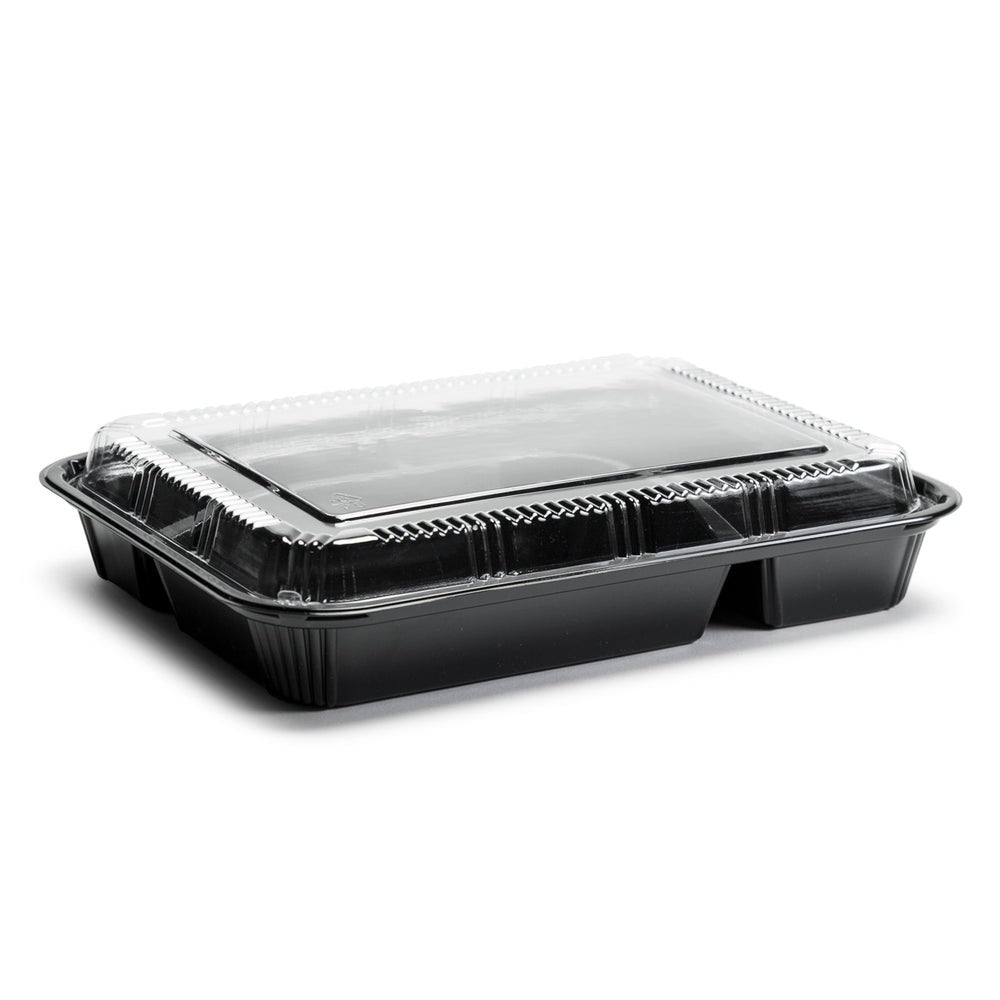
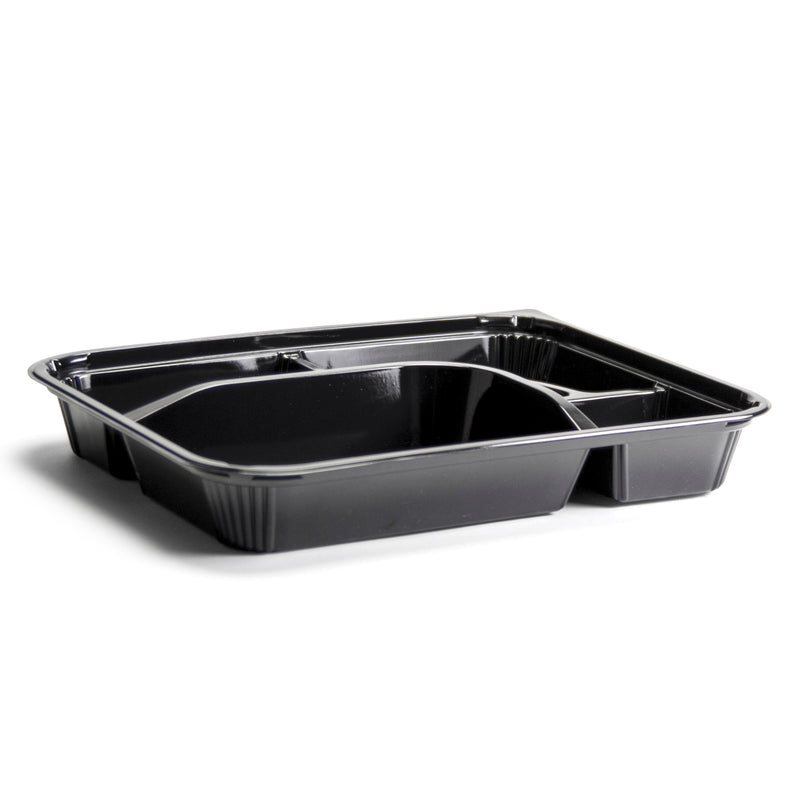
If the restaurant replenishes bodies separately, the existing or separately sourced closures must be confirmed. A familiar code stem and nominal dimensions cannot supply the missing compatibility evidence. The same issue appears in a bowl with an insert, a pot with a strainer and a machine with its required food-path components.
Plan replenishment to the date the goods become usable in the intended place. Handling, transit, receiving, transfers and any fitting or preparation can intervene between placing an order and using it. Compare dated requirements with eligible on-hand stock, confirmed usable incoming supply and existing commitments, then convert the gap into actual packs or cases.
Inspect the dates between deliveries as well as the final total. Goods arriving after a service cannot cover that earlier shortage, however generous the eventual stock position looks.
Standardize what needs to remain consistent
Multi-location programs can standardize presentation, compatible packaging families, approved operating supplies and ordering records while retaining legitimate local differences. Electrical versions, equipment generations, menus and host-provided facilities may vary.
Judge substitutions against the actual duty. A plate can change rack fit or loaded handling; another package can change closure, label position or stacking; a chemical change can alter its verification supply; a machine generation can change component compatibility. Price and nominal dimensions are useful comparison fields within that full decision.
For discontinued ware, establish the components needed to keep complete presentations available, then choose a bounded continuation or an intentional transition. For printed supplies, retain the approved artwork, supplied unit and location allocation. Opening stock, routine replenishment and a special event should remain separate dated commitments.
Receiving closes this continuing purchase. Confirm the approved article, contents and count; keep unusable or incorrect goods out of eligible stock; and record any intentionally changed identity or case conversion. The continuing-supply guide develops the order arithmetic, substitutions and multi-location detail.
The complete commercial guide
Understand the trade
Craft, commercial history and the ERS supply perspective.
18 / Flagship & Reference
Japanese craft, American sushi and the Los Angeles supply trade
Contemporary sushi restaurants draw on accumulated capabilities. Wooden vessels, maintained knives and carefully selected serving objects coexist with controlled cooking, refrigeration, molded materials, prepared supply and precise mechanization. Each can contribute to a different part of the food and service.
The objects reveal that development. A coopered vessel depends on timber preparation, joints and hoops. A lacquered piece brings together its body and surface work. A molded porcelain form can involve deliberate development of texture, glaze, rim and foot. Those are concrete forms of specialist knowledge, with consequences that remain visible when the object enters a commercial restaurant.
Machinery adds capabilities of its own. The Japan Society of Mechanical Engineers identifies Suzumo's 1981 sushi-rice molding machine as Mechanical Engineering Heritage No. 107, describing its portioning and compression work. It is a precise historical example of mechanized rice forming. The wider meal still involves the food selection, preparation, topping, presentation and service around that action. JSME heritage record.
The equipment-evolution guide follows those developments; the craft and objects guide follows the making and materials that continue alongside them.
Los Angeles as a commercial and community setting
Japanese restaurant life in Los Angeles grew within a larger community and commercial history. The National Park Service's Little Tokyo account describes development through Japanese immigration, the forced removal of Japanese American residents during World War II, and return and rebuilding afterward. That history gives the restaurant and supply trade a more substantial setting than a single disputed origin story. NPS Little Tokyo Historic District.
Cooks, diners, businesses and their supporting trades all contributed to the varied restaurants that followed. The American sushi history and Los Angeles history resources develop that account in depth.
ERS's documented roots since 2002 lie in specialty tableware and equipment for Japanese restaurants, within this Los Angeles setting and the wider Asian dining community. The useful supply perspective spans a cup's proportions, a bowl's body and finish, a matching package lid, a knife's construction and a machine's exact configuration. ERS background.
That breadth is the commercial point of this guide. The restaurant needs the right articles to work together through its food, service and continuing use. The ERS supply perspective develops that relationship further.
19 / Flagship & Reference
Explore the sushi restaurant equipment library
Use the specialist guides for the detailed choice in front of you. The equipment resources develop individual categories; the concept guides bring them together for a particular service; the planning resources turn the decisions into a complete, maintainable purchase.
Bring ERS the restaurant you intend to operate
For an opening or change, bring the menu and incoming preparation, service format and workload, site and retained or shared equipment, important article requirements and required date. Identify the selection, fit or supply questions that still need an answer. For a replacement, include the installed model and service identification; for a repeat order, include the current item and ordering unit.
Contact ERS to discuss that defined requirement and confirm the scope of the resulting offer. For a standard item, browse the sushi restaurant equipment and supplies assortment.