

COMMERCIAL SUSHI CONTAINER RESOURCE
Sushi Takeout Containers: Types & Restaurant Buying Guide
Explore the commercial sushi takeout container category—from single-roll trays and rectangular sushi boxes to square trays, round party platters and adjacent meal formats. Compare container types and materials, review ERS purchasing research, understand standardized size and shape systems, and plan an opening or replenishment assortment before choosing current products.
Developed by Eden Restaurant Supply from 24 years of cross-manufacturer sourcing and purchasing evidence covering 3.25B+ units, this resource connects purchasing evidence, the ERS Sushi Takeout Container Standard, restaurant planning guidance and verified product options in one commercial framework.
What this resource covers
Sushi Takeout Containers:Purchasing, Formats & Restaurant Planning
This guide connects ERS purchasing research, standardized size and shape definitions, commercial container formats, assortment planning, replenishment considerations, and current products. Use the evidence to understand purchasing systems, the reference to compare formats, and the planning framework to connect those formats to restaurant needs.
Explore the Size & Shape Guide →- Dataset coverage
- 3.25B+ complete-container units14,794 physical locations · 2002–2026
- Assortment structure
- 4 dominant systems80.03% of mature locations
- Expansion behavior
- 2.07× observed Party adoptionStandard + Large vs. Standard-only rectangular state
THE REPORT
Three connected resource areas

Sushi Container Purchasing Research
See how restaurants combine, retain and expand sushi-container formats over time using ERS purchasing evidence.
Explore resource → RESOURCE 02Sushi Takeout Container Size & Shape Guide
Compare dimensions, shapes, piece counts, manufacturer model systems and corresponding ERS products.
Explore resource → RESOURCE 03
Sushi Container Assortment & Reorder Planning
Turn standardized formats into an opening assortment, par levels, replenishment rules and a practical reorder plan.
Explore resource →Evidence → format → application
What ERS Purchasing Data Shows
ERS purchasing analysis covers 3.25B+ complete-container units across 14,794 physical locations and 9,490 operators from January 2002 through September 2026, across 36 states. Product/SKU identities were normalized into consistent commercial container categories before assortment, concentration, adoption, and reorder analysis.
01 · Recurring systems
Four Systems Describe 80.03% of Mature Locations
| Family | Defining categories | Share |
|---|---|---|
| Rectangular Core | Standard Rectangular Sushi Tray, Compact Rectangular Sushi Tray, Large Rectangular Sushi Tray | 31.11% |
| Standard + Rice / Entrée | Standard Rectangular Sushi Tray, Rice / Entrée Bowl | 26.98% |
| Standard + Narrow / Roll + Bento | Standard Rectangular Sushi Tray, Narrow / Roll Sushi Tray, 5-Compartment Bento Box | 11.67% |
| Rectangular Core + Round Party | Standard Rectangular Sushi Tray, Compact Rectangular Sushi Tray, Large Rectangular Sushi Tray, Round Sushi Party Platter | 10.27% |
Dominant systems: 80.03%. Long tail: 19.97%. Restaurant container programs tend to organize into recurring systems rather than arbitrary collections of sizes. Family names describe observed patterns, not prescribed bundles; the long tail remains varied.
Explore the assortment architecture analysis →02 · Shared backbone
Standard Rectangular Connects the Dominant Systems
- Standard Rectangular
- 84.04%
- Compact Rectangular
- 39.11%
- Large Rectangular
- 30.39%
Among mature sushi-container-buying locations, Standard Rectangular Sushi Tray recurs at 84.04%, compared with 39.11% for Compact and 30.39% for Large Rectangular. Standard appears recurrently in more than 90% of locations within every dominant architecture.
The dominant systems differ mainly in what is built around Standard Rectangular—not whether Standard is present.
Read the backbone and concentration analysis →03 · Expansion pathways
Existing Assortments Relate to Later Additions
- Standard-only rectangular state
- 19.36%
- Standard + Large recurring
- 40.15%
2.07× relative likelihood
Among eligible locations with no previous Round Party adoption, 40.15% of those with Standard and Large Rectangular recurring adopted Round Sushi Party Platter within 24 months, compared with 19.36% where Standard was the only recurring rectangular tier: 2.07× relative likelihood. Other non-Party categories may coexist in both cohorts.
73.87% of qualifying first Round Party adoptions occurred after at least two rectangular tiers were already recurring. This is an observed expansion pattern, not causation or a universal progression. Adoption can occur anywhere within the qualifying 24-month window, not necessarily as the immediately next category.
Examine the conditional adoption pathways →A common comparison language
Understanding Sushi Container Sizes & Shapes
Manufacturer model numbers and nominal labels are not a universal sizing language. Useful comparison requires consistent shape, measured footprint and dimensions, and size-tier terminology. A familiar model number alone does not establish usable space or equivalence.
Shape illustrations are schematic, not dimensions or a standardized size scale. Kraft and other material or presentation attributes sit within format families; they are not separate primary geometries.
Compare Sizes & Shapes →Format → application
Types of Sushi Takeout Containers
Standard Rectangular
A broad everyday rectangular format and the most widely recurring normalized category in ERS purchasing analysis.
Compact Rectangular
A smaller rectangular footprint for orders requiring less presentation area; commonly complements Standard.
Large / Extra-Large Rectangular
Additional rectangular coverage for larger combinations and higher-count presentations.
Narrow / Roll
Longer, narrower geometry for roll-focused and other narrow-footprint applications.
Square
A distinct presentation footprint for particular menu and application needs.
Round Party
A large round presentation format associated with party, catering, and shared-order use.
Compare measured dimensions and usable space for the intended food arrangement in the detailed format reference.
Narrow / Roll

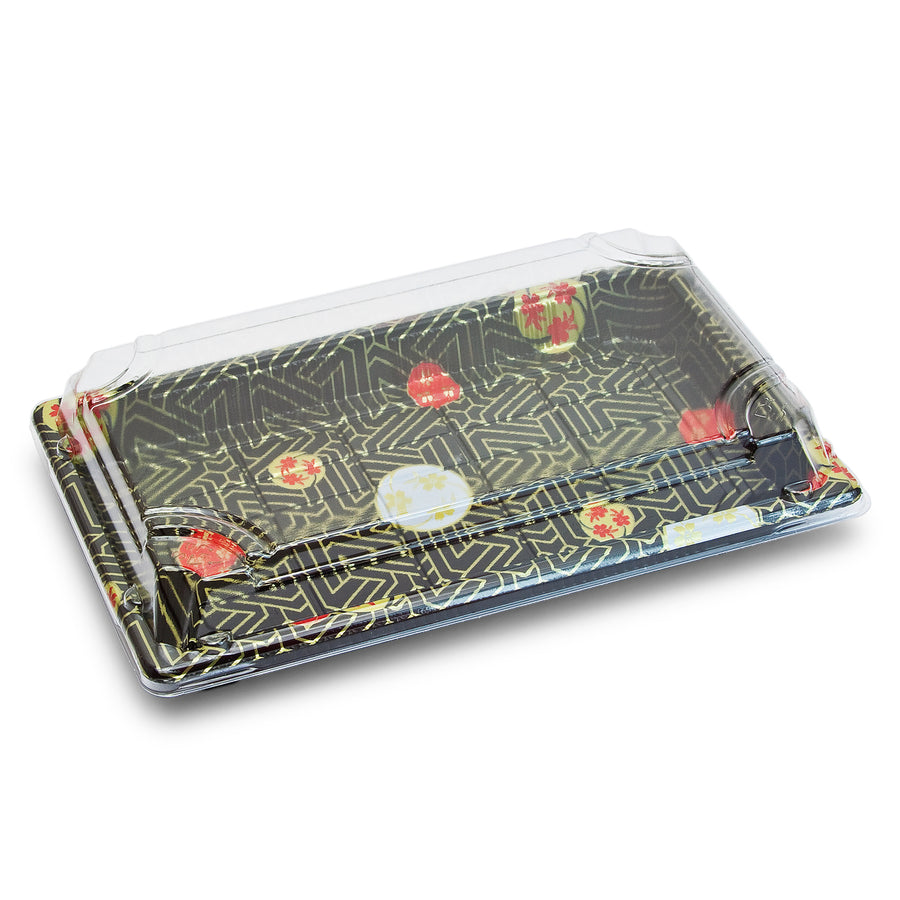
Long Kamon Sushi To-Go Tray with Lid (50 pc) - YP-0.6, 8-5/8"
ED-01
Compact Rectangular

Kamon Sushi To-Go Tray with Lid (50 pc) - YP-1.0, 7-1/4"
ED-05
Standard Rectangular

Kamon Sushi To-Go Tray with Lid (50 pc) - YP-1.5, 8-1/2"
ED-07
Large Rectangular

Kamon Sushi To-Go Tray with Lid (50 pc) - YP-2.0, 9"
ED-09
Round Party

Kamon Round Sushi Party Tray with Lid (20 pc) - ED-65, 15"
ED-65
Square

Black Square Sushi To-Go Tray with Lid (50 pc) - ED-40B, 7-1/4"
ED-40B
Application → assortment
Building a Sushi Container Assortment
Cover the everyday core
Identify the format or formats handling most routine takeout demand. Start with the actual menu and order mix.
Add meaningful coverage
An additional format should solve a distinct order or application gap rather than duplicate existing capacity.
Add specialist formats when needed
Party, Bento, Rice / Entrée, and other formats should address specific menu or service needs.
Median mature assortment breadth is 3 recurring categories. This describes the population; it is not a universal recommendation to carry three formats.
Among mature locations carrying at least four recurring complete-container categories, the median location directs 75.09% of unit volume through its top two recurring categories and 89.85% through its top three, measured over the trailing 12 calendar months. Broader assortments can still operate around a concentrated core.
Build an Assortment →Assortment → replenishment
Ordering & Replenishment
Restaurant-specific reorder planning brings together usage, case pack, operating days, current inventory, safety stock, and supplier lead time. Purchasing history provides context, but those operating inputs determine the local decision.
Standard Rectangular Sushi Tray has a median qualifying purchase interval of 21 days, compared with 52 days for Round Sushi Party Platter.
These population-level intervals provide context; they are not restaurant-specific reorder schedules, consumption rates, or lead-time recommendations.
Plan Inventory & Reordering →Alongside the sushi-tray system
Other Packaging Used by Sushi Restaurants
Sushi restaurants may also package hot entrées, compartmented meals, soups or noodles, sides, and other prepared foods. These are adjacent packaging needs, not additional tiers in the core sushi-tray taxonomy.
- Bento / compartment boxes separate components of a complete meal.
- Rice / Entrée bowls provide a bowl format for rice-based and other entrée dishes.
- Noodle / Broth containers serve a distinct soup or noodle packaging role; check each product’s lid, insert, and use specifications.
- Sides and other prepared foods require their own fit and closure check. Separate sauce packaging, where needed, should be evaluated for that use rather than inferred from a sushi-tray category.
5-Compartment Bento

5-Compartment Bento To-Go Box with Clear Lid (50 pc) - J-8306-2, 10-1/2"
J-8306-2
Rice / Entrée Bowl

Teriyaki To-Go Bowl with Lid, 26 oz (50 pc) - ED-700, Black/Red
ED-700
Rice / Entrée · microwaveable base

Teriyaki To-Go Bowl with Clear Anti-Fog Lid, 24 oz / 700 ml (50 pc) - HD-700
HD-700
Larger Rice / Entrée Bowl

Teriyaki To-Go Bowl with Clear Anti-Fog Lid, 36 oz (50 pc) - HD-1000
HD-1000
Noodle / Broth Bowl

Noodle Bowl with Insert & Lid, 50 oz Microwaveable (90 pc) - GW-NCB502
GW-NCB502
The To-Go Containers collection brings current sushi formats and adjacent meal packaging together. For category boundaries and applications, use the Size & Shape Guide.
Follow your question
Questions & Resource Areas
Sizes & Shapes
What is the standard size for a sushi takeout container? How do I measure a sushi tray? What is the difference between Compact and Standard Rectangular trays? What size sushi container fits two rolls?Types & Products
What is the difference between a sushi tray and a Bento box? When is a Narrow / Roll tray useful? What are Round Party trays used for? What container format is used for sushi catering?Planning & Reorders
How many sushi-container formats should a restaurant carry? How should a new sushi restaurant choose its starting assortment? How many cases should I keep in stock? How often do restaurants reorder sushi containers?See more questions about Planning & Reorders
How do case packs affect reorder planning? How should safety stock be considered? When does it make sense to add a Party Platter? How can a restaurant reduce redundant container SKUs?Research & Evidence
Which sushi-container format is most commonly recurring? Which formats are commonly carried together? How many recurring categories do mature locations typically carry? Do restaurants tend to add Party Platters later?See more questions about Research & Evidence
Which formats reorder most frequently? How did ERS normalize different product SKUs? What counts as a recurring container category? What does the purchasing research not establish?Compare current products
Ready to Compare Current Options?
The collection contains current products corresponding to the format families and adjacent packaging discussed throughout this guide. Compare individual listings for dimensions, included components, and pack quantities.
Browse To-Go Boxes & Containers →