


Sekiryu SR410 Perforated Sashimi Knife, 210 mm Blade


Usually Ships in 1 Business Day
✓ Pickup available at our Los Angeles showroom.About this product
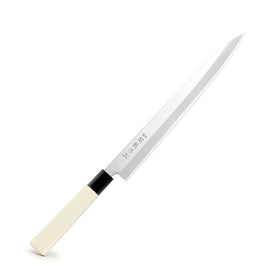
The Sekiryu SR410 combines a narrow 210 mm sashimi blade with a row of circular openings through the steel. Its pointed profile is suited to controlled slices of boneless fish.
- Blade length: 210 mm
- Blade material: 420J2 stainless steel
- Handle: Poplar-wood handle with black nylon bolster
- Blade hardness: HRC 50–53
- Country of origin: Japan; made in Seki
- Overall length: 13 in.
Care: Wash by hand with mild dish soap, rinse and dry promptly. Avoid prolonged soaking and protect the cutting edge during storage.
Product Overview

210 mm perforated blade
A pointed sashimi profile with circular blade openings.

420J2 stainless steel
Japanese stainless-steel blade with HRC 50–53 hardness.

Poplar-wood handle
Natural poplar wood paired with a black nylon bolster.

A wooden grip and Japanese stainless steel

Care for the blade and wooden handle


Compare natural-handle knife profiles
 Current product
Sekiryu SR410 Perforated Sashimi Knife, 210 mm BladeSR410 |
 Sekiryu - Gyuto Knife, Stainless Steel 180mmSR900 |
 Sekiryu SR300 Deba Knife, 150 mm Stainless-Steel BladeSR300 | |
|---|---|---|---|
| Price | $29.50 | $17.75 | $23.75 |
| Product type | Perforated yanagi/sashimi knife | Gyuto kitchen knife | Deba kitchen knife |
| Material | 420J2 stainless-steel blade; HRC 50–53 | 420J2 stainless-steel blade; HRC 50–53 | 420J2 stainless-steel blade; HRC 50–53 |
| Color | Silver blade, natural-wood handle, black bolster | Silver blade, natural-wood handle, black bolster | Silver blade, natural-wood handle, black bolster |
| Listed dimensions | Blade: 210 mm; overall length: 13 in. | Blade: 180 mm; overall length: 12 in. | Blade: 150 mm; overall length: 11½ in. |
| Country of Origin | Japan; made in Seki | Japan; made in Seki | Japan; made in Seki |
| Handle | Poplar-wood handle with black nylon bolster | Poplar-wood handle with black nylon bolster | Poplar-wood handle with black nylon bolster |
| Care instructions | Wash by hand with mild dish soap, rinse and dry promptly. Avoid prolonged soaking and protect the cutting edge during storage. | Wash by hand with mild dish soap, rinse and dry promptly. Avoid prolonged soaking and protect the cutting edge during storage. | Wash by hand with mild dish soap, rinse and dry promptly. Avoid prolonged soaking and protect the cutting edge during storage. |
Complete your tabletop


Related Categories



Sekiryu SR410 Perforated Sashimi Knife, 210 mm BladeSR410
$29.50
Sekiryu SR410 Perforated Sashimi Knife, 210 mm Blade images
