

ERS COMMERCIAL RICE EQUIPMENT RESEARCH
Commercial Rice Cookers & Warmers Explained: What Restaurants Need to Know
Understand the different types of commercial rice cookers and warmers, how capacity translates into actual rice production, how long batches take, how gas, electric and induction systems compare, and when a restaurant needs separate rice holding.
ERS analyzed 24 years of commercial rice-equipment sales representing 11,000+ cookers and warmers supplied to 3,600+ locations across 41 U.S. states, and physically tested every eligible active commercial cooker configuration in its current assortment.
This research covers commercial rice cooker types, raw and cooked capacity, usable output, cook and service-ready time, cooker-warmers vs. dedicated rice warmers, holding, utilities, commercial requirements, production architecture, and restaurant operating considerations.

On this page 7 sections
ERS combines first-party performance testing, manufacturer-primary documentation, equipment selection and specification guidance, rice-holding research, field evidence, operating analysis, and current commercial equipment across the commercial rice cooker and warmer category.
ERS’s documented commercial and institutional experience spans Japanese, Korean, Chinese/Taiwanese, Southeast Asian, Hawaiian/poke, Pan-Asian/fusion, rice-forward fast casual, hospitality, catering, commissary/central production, healthcare, education, workplace dining, retail foodservice, mobile foodservice, and other documented commercial and institutional operations.
ERS has supplied commercial foodservice equipment since 2002, maintains direct relationships with manufacturers across Japanese, Korean and broader commercial rice-equipment categories, and is an authorized U.S. dealer for Hattori Kogyo.
Research by Eden Restaurant Supply · September 2026
01
The Commercial Rice-Equipment Landscape
Commercial rice equipment becomes much easier to understand when two questions are kept separate:
What job is the equipment performing?
and
How is it performing that job?
A gas rice cooker and an electric rice cooker use different energy and control architectures, but both primarily produce rice.
A cooker-warmer and a dedicated rice warmer may both keep rice hot, but only one also performs the cooking cycle.
Those distinctions matter.
The commercial category is not one ladder of small-to-large appliances. It is a set of different cooking, production and holding architectures.
Conventional commercial electric rice cookers
Conventional commercial electric cookers are the familiar single-vessel workhorses of restaurant rice production.
They use electric resistance heating and range from relatively simple one-touch batch machines to electronically controlled cooker-warmers. Some end the active cooking cycle and transition automatically into holding; others are better understood primarily as production equipment.
The important point is not simply that they are electric.
It is that electrical power source alone tells you almost nothing about actual batch output or production speed.
Panasonic’s commercial range demonstrates how wide this category itself can be. The 30-cup SR-GB54 platform uses a 120V, 1,800W architecture, while larger 40-cup commercial equipment in the same broader family moves to 208V and higher power requirements.

Panasonic SR-GB54H
Conventional commercial electric
30-cup / 5.4 L class · 120V · commercial batch production
Commercial gas rice cookers
Gas rice cookers create batch production through a burner system rather than electric resistance heating.
That changes the utility, installation and control architecture, but it does not justify the common shortcut that “gas is faster.”
Individual machines must be evaluated individually.
The Rinnai RER-55AS, for example, is a high-capacity gas batch cooker whose operating procedure includes an important post-burner stage: after the main burner shuts off, Rinnai instructs the operator to leave the rice covered on KEEP WARM for approximately 10–15 minutes to complete cooking.
That distinction matters because burner-off time and service-ready time are not necessarily the same measurement.

Rinnai RER-55AS
Commercial gas batch cooker
High-capacity countertop gas production
Commercial induction-heating rice cookers
Commercial induction heating is a materially different electrical architecture.
Instead of relying only on a conventional resistance heater beneath the vessel, an IH system uses electromagnetic induction to heat the compatible cooking vessel itself.
Commercial IH should not be confused with simply adding more menu buttons to a household appliance.
The Mevience ZEUS-IH54C, for example, is a restaurant-class system rated at 208V, 25A and 4,570W, with up to 10 lb / 4.5 kg of raw white rice and separate operating ranges for white, sushi, seasoned and brown rice and porridge.
The technology label still does not tell you whether it produces more rice per hour, reaches service sooner or yields more usable rice than another architecture.
Those are performance questions.

Mevience ZEUS-IH54C
Commercial induction heating
10 lb / 4.5 kg raw-rice maximum · 208V · 4,570W
Multi-deck and parallel-production systems
At sufficiently high production requirements, the category stops looking like a countertop rice cooker.
Multi-deck systems create capacity by operating several cooking chambers in parallel.
Hattori’s LG-000 platform makes the distinction explicit. The LG-000-100 uses two decks with 14 kg total capacity. The LG-000-150 adds a third deck and increases total capacity to 21 kg. Hattori allows cooking start times to be controlled by deck and positions the system for repeated high-volume production in restaurants, central kitchens, hotels, catering and institutional foodservice.
That is fundamentally different from making one pot larger.
A single larger vessel increases one batch.
Parallel production increases how much can be cooked at the same time.

Hattori LG-000-100
Parallel commercial production
2 decks · 14 kg · natural gas

Hattori LG-000-150
Parallel commercial production
3 decks · 21 kg · natural gas
Integrated cooker-warmers
“Cooker-warmer” describes a function, not an energy source.
An integrated cooker-warmer performs the cooking cycle and then changes operating mode so the finished rice can remain in the same vessel for service.
Zojirushi’s NYC-36 is a clear commercial example. It is rated at 20 cups / 3.6 L, uses a 120V / 1,300W cooking system and automatically enters keep-warm operation after cooking. Zojirushi explicitly defines its capacity using an approximately 180 mL raw-rice measuring cup.
Integrated holding is simple.
It also creates an important system constraint:
Rice that remains in the cooker continues to occupy the cooker.
That matters whenever another batch needs to begin before the current one has been consumed.

Zojirushi NYC-36ST
Commercial cooker-warmer
20 cups / 3.6 L · automatic keep-warm
Dedicated powered rice warmers
A dedicated commercial rice warmer is not a low-powered rice cooker.
It is a different machine with a different input.
The input is already-cooked, already-hot rice.
Its job is to maintain that rice during service.
Zojirushi’s commercial THA warmers make the difference obvious. The current 6 L and 8 L models operate at only 77 watts because they are maintaining an existing thermal state rather than creating a cooked batch from raw rice and water.
A dedicated warmer can therefore take over the holding job while the cooker returns to production.
That separation can matter more to restaurant throughput than changing from one nominal cooker size to another.

Zojirushi THA-803S
Dedicated powered holding
8 L commercial electric warmer · 120V / 77W
Passive thermal rice holders
A thermal rice holder has no active heater.
It begins with the thermal energy already contained in the hot rice and uses insulation to slow the loss of that energy.
That means it solves a different problem from an electric warmer.
It needs no outlet. It can move with service. It can be useful in catering, mobile workflows and sushi-rice applications. But once heat leaves the system, no heating element is present to replace it.
Zojirushi rates its RDS-400 at 4 L with heat retention of 176°F after six hours, and the RDS-600 at 6 L / 180°F after six hours.
Those numbers must be read exactly as published: the manufacturer’s test uses water starting at 203°F in a 68°F room.
It is not a six-hour restaurant rice-quality guarantee.

Zojirushi RDS-400
Passive thermal holding
4 L · non-electric · suitable for vinegared sushi rice
02
What ERS Research Has Established
ERS research shows that the differences that matter operationally are not always the ones emphasized by manufacturer specifications. The findings below summarize the most consequential differences identified across manufacturer documentation, normalized analysis, and first-party testing.
- 01
Batch capacity and production rate are different measurements
Similar rated loads can produce similar usable batch quantities on radically different timelines.
Why it matters: a large cup number does not tell you when the restaurant gets the rice.
- 02
Bigger batches do not create proportional increases in production rate
ERS’s Panasonic commercial-series results show that additional usable batch output and additional time do not scale at the same percentage.
A machine can produce a larger batch without creating a proportional improvement in time-normalized production.
Why it matters: “33% larger cooker” does not automatically mean “33% more production.”
- 03
Production architecture changes how capacity scales
The Hattori two- and three-deck results show approximately proportional output growth with essentially unchanged service-ready timing when capacity is added in parallel.
A third simultaneous cooking deck increased measured usable output by approximately 50.3% while service-ready time moved only from 31.9 to 32.1 minutes.
Why it matters: one larger vessel and more simultaneous cooking chambers are different production systems.
See High-Volume & Multi-Unit Architectures → Commercial Rice Cooker Buying Guide
- 04
Cook completion and service readiness can be different events
The Rinnai RER-55AS demonstrates that the main heating stage can end before the manufacturer-prescribed completion process is finished.
Why it matters: production planning should use the point when rice can actually enter service.
- 05
Cooking capacity and holding capacity are separate decisions
A cooker that is holding a finished batch is still occupied.
A separate warmer produces no additional rice, but it can allow the cooker to return to production while finished rice remains available for service.
Why it matters: cooking capacity and finished-rice inventory can become simultaneous rather than sequential.
- 06
Temperature retention and rice-quality retention are not the same measurement
Rice can remain hot while moisture distribution, texture, aroma and other quality characteristics continue to change during holding.
Why it matters: “still hot” and “still acceptable to serve” answer different questions.
- 07
Not every measurable difference deserves equal weight
Across the 13 primary commercial-capacity configurations in ERS’s first benchmark, mean usable yield clustered tightly at approximately 98.32%–98.58% of finished cooked mass.
The larger differences appeared in batch capacity and time to service.
Why it matters: rigorous testing is as valuable for eliminating weak differentiators as it is for discovering strong ones.
03
How Commercial Rice Equipment Works as a Production and Holding System
Commercial rice production is not a cup-capacity problem. It is a production system.
A cooker determines how much rice can be produced in one cycle.
Time determines when that rice becomes available.
Holding determines how much finished rice can remain available while production continues.
Restaurant demand determines whether the entire system keeps up with service.
Those are different variables.
Treating them as one number is the source of many bad rice-equipment comparisons.
The commercial rice-production sequence
A commercial rice operation can be represented as:
- dry rice
- preparation and water
- cooking
- cook completion
- finishing/rest where required
- service-ready rice
- holding
- portions served
- replenishment
A cooker sits inside that sequence.
It does not define the whole sequence.
Five production quantities
Input capacity
Input capacity describes how much uncooked rice enters one production cycle.
Manufacturers may express it in rice cups, liters, pounds or kilograms.
It is an important equipment specification.
It is not finished production.
Usable batch output
Restaurants serve cooked rice, not raw-rice capacity.
Usable output is the portion of the completed batch actually recoverable for service.
ERS therefore separates manufacturer-rated input from finished cooked weight and usable finished output in the Performance Benchmark.
Service-ready interval
The useful production clock ends when the rice can actually enter service.
That endpoint may match automatic cook completion on one machine.
On another, the manufacturer may prescribe an additional steaming, resting or covered completion stage.
If the rice cannot yet be served, the production cycle is not operationally finished.
Available holding inventory
Once rice has been produced, it becomes service inventory.
Some may remain inside a cooker-warmer.
Some may be transferred to a dedicated powered warmer.
Some may be staged in passive thermal equipment.
Holding determines how much finished production can remain available while the next production event occurs.
Demand profile
Daily rice volume is an accounting number.
Peak demand is an operating number.
A restaurant serving 100 portions evenly over six hours does not have the same equipment problem as a restaurant serving the same 100 portions during one concentrated rush.
The daily total can be identical.
The production requirement can be completely different.
Capacity and production are not synonyms
Batch capacity describes one cycle. Production describes output over time.
ERS uses a time-normalized metric in the Performance Benchmark:
Service-Ready Batch Rate = usable batch output ÷ service-ready interval
That metric allows differently sized batches and differently timed machines to be placed on a common production basis.
It does not claim sustained back-to-back restaurant throughput.
The first benchmark does not separately measure reload labor, washing and preparation, between-cycle cleanup, hot-start recovery or repeated multi-cycle operation.
Rice production is also an inventory problem
At any moment during service:
available rice inventory = previously available rice + newly completed usable batches − rice served − rice removed from service
That identity explains why a restaurant can run out of rice even when its cooker appears to have a large capacity.
The problem may not be batch size.
Demand may simply be removing finished rice faster than the production system replenishes it.
Capacity without time is not production. Production without holding is not availability.
- Raw rice
- Cooker
- Service-ready batch
- Holding inventory
- Service
production events replenish inventory
customer demand depletes inventory
Rice has more than one clock
“Cook time” is often treated as one universal measurement.
It is not.
Preparation time
Measuring, washing or rinsing where required, adding water, loading the vessel and any manufacturer-prescribed soaking or pre-cook preparation.
Active cooking interval
The main heating or burner-controlled stage.
This is the number most likely to be described casually as “cook time.”
Post-cook completion or rest
Some equipment and rice processes require the batch to remain covered after the main heating stage ends.
That interval still occupies the production system.
Service-ready interval
The complete elapsed time to the point at which the batch can actually enter restaurant service.
For production planning, this is often the more useful endpoint.
Holding interval
Time between service readiness and consumption.
This belongs to a different operating phase.
Turnaround interval
Transfer, unloading, resetting, measuring, refilling and whatever else must occur before another production cycle can begin.
Turnaround is one reason a mathematically normalized single-batch rate should never be presented as proven sustained hourly throughput.
The Rinnai RER-55AS makes the timing distinction visible
ERS measured the RER-55AS main cooking stage at approximately 27.5 minutes.
Its measured service-ready endpoint was approximately 39.8 minutes.
Rinnai’s operating procedure instructs the operator to leave the rice covered on KEEP WARM for approximately 10–15 minutes after the main burner shuts off to complete cooking.
The active burner stage therefore ended roughly 12.3 minutes before the tested batch reached the defined service-ready point.
If the rice is not ready to serve, the production clock has not finished just because the burner turned off.
- 0:00Main cooking
- 27.5 minMain burner cycle complete
- 39.8 minERS service-ready endpoint
→ manufacturer-prescribed covered completion stage
Cooking capacity and holding capacity are different systems
Cooking and holding are related.
They are not the same job.
A cooker converts raw ingredients into finished rice.
A warmer manages finished rice after production.
A cooker-warmer can perform both jobs sequentially.
A cooker plus a separate warmer can perform those jobs simultaneously.
That changes the operating architecture.
System A — Cook and hold in the same appliance
Cook → keep warm in cooker → serve → empty → begin next batch
This is operationally simple.
There is no transfer step and no second holding appliance.
But while the finished batch remains in the cooker, that cooking vessel is unavailable for another batch.
The cooker has become holding inventory.
System B — Cook, transfer and restart
Cook → transfer to warmer → begin next batch
At the same time:
warmer → hold → serve
The warmer has not made the cooker faster.
It has done something else:
It has removed holding time from the cooker’s production schedule.
The warmer itself produces no rice.
It can increase system availability for production by allowing the cooker to stop performing the holding job.
System C — Multiple independent cookers
Two or more cookers can overlap production.
That can allow staggered batch completion, different rice preparations, partial off-peak operation, additional peak capacity and redundancy if one machine becomes unavailable.
It also creates more vessels, more utility connections, more cleaning and more operating coordination.
Multiple machines change the timing architecture, not merely the total nameplate capacity.
System D — Parallel-deck production
A multi-deck machine packages concurrent production into one coordinated commercial system.
Each additional active deck adds another simultaneous cooking chamber.
Additional rice therefore does not necessarily require proportionally more elapsed time.
ERS’s Hattori benchmark makes this effect unusually clear: adding a third simultaneous cooking deck increased measured usable output by approximately 50.3% while service-ready time moved only from 31.9 to 32.1 minutes.
System E — Short-hold, high-turnover production
A restaurant does not always benefit from maximizing the amount of rice held in advance.
Another valid operating strategy is:
smaller or staggered production → shorter average holding age → frequent replenishment
That does not eliminate the need for safe holding whenever rice remains in service.
The goal is not to maximize cooked inventory. The goal is to keep enough acceptable rice available when customers need it.
- Cook
- keep warm in cooker
- serve
- empty
- begin next batch
- Cook
- transfer to warmer
- begin next batch
At the same time: warmer → hold → serve
- Cook
- batch completion
- Cook
- batch completion
Two or more cookers can overlap production.
Each additional active deck adds another simultaneous cooking chamber.
- smaller or staggered production
- shorter average holding age
- frequent replenishment
What changes the system from one operation to another?
Commercial sizing depends on demand, menu role, batch turnover, holding limits, rice process, utilities, labor, layout and redundancy—not restaurant size alone.
Demand shape
Peak demand often matters more than daily volume.
Two operations can use the same amount of finished rice per day while requiring completely different production systems because one has steady demand and the other has an extreme rush.
How central rice is to the menu
For one restaurant, rice may accompany a minority of orders.
For another, virtually every entrée may require it.
For a sushi operation, rice can be structural to the menu.
The more central rice is to service, the lower the operation’s tolerance for a missed batch, delayed cycle or unavailable machine.
Batch turnover
A 10 kg usable batch lasting three hours creates one operating system.
A 10 kg batch disappearing in 25 minutes creates another.
The cooker did not change.
The restaurant did.
Acceptable holding interval
Food safety and restaurant quality are separate constraints.
A batch may remain within a valid temperature-control process while falling below the restaurant’s service standard for texture, moisture or aroma.
A shorter quality threshold means less usable holding inventory.
Rice type and process
White rice, sushi rice, seasoned rice, brown rice and porridge cannot automatically be treated as one production load.
The same machine can have different permitted operating ranges by program.
Mevience, for example, publishes a 3.3–10.0 lb raw-rice range for white and sushi rice on the ZEUS-IH54C but only 3.3–6.6 lb for seasoned and brown rice, with still smaller ranges for porridge.
A model’s largest advertised capacity is therefore not necessarily its capacity for every process.
Utilities
Available infrastructure can eliminate entire equipment classes before brand preference should enter the discussion.
Commercial rice equipment in the current ERS assortment spans ordinary 120V countertop equipment, 208V high-demand electric and IH equipment, and natural-gas multi-deck systems.
Utilities do not determine which cooker is “best.”
They determine what equipment can actually be installed and operated correctly.
Labor, transfer and layout
Separate holding means somebody transfers rice.
Multiple cookers mean multiple pans, start times and cleaning cycles.
Production located away from service means rice has to move.
A central kitchen feeding a remote service station creates a different system from a cooker beside the service counter.
Distance can turn holding from an appliance question into a logistics question.
Redundancy
One large cooker and two smaller cookers can have similar aggregate nameplate capacity while creating completely different failure behavior.
One machine creates one production point.
Multiple machines distribute production.
That does not automatically make multiple machines superior.
It means capacity and resilience are separate design questions.
04
Commercial Rice Production in the Field
Specifications describe equipment.
Field operation reveals what the equipment is actually being asked to do.
They are not ERS customer testimonials and are not product rankings.
The first two come from independent field monitoring by Frontier Energy for the California Energy Commission. The third is a named manufacturer case study from Satake and is identified accordingly.
INDEPENDENT FIELD EVIDENCE
Case 1 — The same category of cooker can be doing completely different work
Field evidence: Lin Jia Asian Kitchen and Dabba
A California Energy Commission / Frontier Energy study published in 2021 monitored seven commercial rice cookers across four foodservice sites.
At Lin Jia Asian Kitchen, researchers monitored a Zojirushi NYC-36 and Tiger JNO-A36U, both 120V 20-cup commercial cooker-warmers. The restaurant used them through the day to produce fresh rice for lunch and dinner and used the warming function as needed.
At Dabba, researchers monitored two Town 57137 37-cup commercial rice cookers. The operation typically produced three batches ahead of lunch, adding another when demand required it. Finished rice was removed immediately for seasoning and transfer to the service line, so the cookers spent essentially no meaningful time warming.
The reported average input rates differed substantially between the sites, but the researchers explicitly warned against treating that as a simple equipment-efficiency comparison.
Dabba’s monitored hours were dominated by full-power cooking.
Lin Jia’s operating hours contained much more lower-power warming.
The apparent energy-rate difference was therefore driven substantially by how the equipment was being used.
What this establishes
Equipment runtime is not production duty.
A cooker energized for eight hours may spend much of that time maintaining finished rice.
Another cooker energized for only a few hours may spend nearly all of its operating time producing new batches.
Cooking and holding are different work.
Evidence boundary
This is field-monitoring evidence about how commercial rice cookers were used at those sites.
It is not a controlled head-to-head efficiency test.
ERS also does not carry forward time-sensitive market observations from the study period as current 2026 facts.
INDEPENDENT FIELD EVIDENCE
Case 2 — Production events can matter more than one daily total
Field evidence: Versailles Cuban, Los Angeles
A separate California Energy Commission / Frontier Energy field study examined commercial kitchen equipment at Versailles Cuban in Los Angeles.
At the time of the study, the approximately 1,500-square-foot restaurant served about 600 meals per day, with back-of-house operations running from roughly 9 a.m. to 11 p.m.
Researchers submetered the restaurant’s gas rice cooker for three weeks.
The measured rice-cooking cycle was approximately 25 minutes at a constant 35 kBtu/h input rate. The burner showed essentially no idle gas use between cooking cycles, and researchers estimated six to eight cooking cycles per day.
Six to eight 25-minute cooking cycles represent approximately 150 to 200 minutes of active batch cooking distributed across the operating day.
Rice production appeared as repeated, discrete production events.
What this establishes
Restaurant rice production is temporal before it is volumetric.
A daily meal count or daily rice total does not reveal when another completed batch must become available.
The operational questions are:
How much does one batch provide?
How long does one production event occupy the cooker?
When must the next completed batch become available?
How much finished rice can remain available between those events?
Evidence boundary
The study reports approximately 600 total meals per day.
It does not establish that every meal included rice, and ERS does not convert that meal count into an invented rice-portion estimate.
The useful evidence is the measured production cadence.
MANUFACTURER CASE EVIDENCE
Case 3 — At central-production scale, the rice cooker becomes a process line
Manufacturer case evidence: Don Don-Rice Kumamoto Factory / Satake SILK
The restaurant counter is not the upper boundary of commercial rice production.
At central-production scale, the same core variables—input, preparation, cooking, time, output, holding, labor and demand—become a process-engineering problem.
Satake’s case study of Don Don-Rice’s Kumamoto Factory documents that transition.
The facility replaced an aging continuous gas cooking line with a Satake SILK pressurized-IH rice-cooking line, installed in December 2020. Satake identifies the installation as a 120-pot line.
The SILK architecture integrates:
raw-material receiving → rice washing → soaking → metered seasoning → leveling → pressure-IH cooking → steaming → optional vinegar application → inversion/loosening → pot and lid handling/cleaning
Satake specifies the cooking stage at 1.2 atm and 106°C. Its current standard SILK lineup is organized around 60, 80 and 120 pots per hour, and its published FAQ states a raw-rice range of 3 to 7 kg per pot.
Don Don-Rice reported changes including PC-based quality management, lower waste heat than the prior gas line, improved flexibility for multiple rice varieties and reduced required space.
Those are manufacturer/customer-reported outcomes.
They are not independent ERS measurements.
Sources:
Satake — Don Don-Rice case study
Satake — SILK lineup and process specifications
Satake — SILK FAQ
What this establishes
At sufficient scale, commercial rice cooking stops being an appliance problem and becomes a process-control problem.
At this end of the category, “rice cooker capacity” no longer adequately describes the production system.
The system includes raw-material handling, washing, soaking, dosing, parallel pot flow, controlled cooking, post-cook steaming, downstream seasoning, unloading, cleaning, labor, floor space, heat rejection and quality control.
Evidence boundary
Satake is both the manufacturer of the system and publisher of the case study.
Claims about comparative taste, working conditions, space savings and productivity remain attributed to Satake and its customer rather than presented as independently verified ERS findings.
ERS also does not assume that every specification of Satake’s current lineup is identical to the specific system installed in 2020 unless Satake documents that equivalence.
What the field cases add
The three cases operate at very different scales.
They nevertheless reinforce the same category model.
At Lin Jia and Dabba, operating state changes the meaning of runtime and energy data.
At Versailles, repeated batch timing describes the production day more usefully than the daily meal total alone.
At Don Don-Rice, scale turns rice cooking into a coordinated process line rather than a standalone appliance decision.
Commercial rice production is not defined by the largest number printed on a cooker. It is defined by what the operation must produce, when that production must become available, what happens to it afterward and how the equipment architecture supports that sequence.
05
Commercial Rice Cooker & Warmer Knowledge Base
Equipment types and terminology
What is a commercial rice cooker?
A commercial rice cooker is equipment intended for repeated foodservice rice production rather than occasional household use.
Commercial suitability involves more than capacity. Intended use, duty, applicable listings, utilities, serviceability, parts support and manufacturer warranty all matter.
Complete procurement framework → Commercial Rice Cooker Buying Guide
What makes a rice cooker “commercial”?
Not stainless steel and not a large cup number.
Commercial classification should be supported by the manufacturer’s intended use and the equipment’s applicable foodservice design, listings and support structure.
What is the difference between a rice cooker and a rice warmer?
A rice cooker produces cooked rice from raw rice and water.
A dedicated rice warmer receives already-cooked rice and holds it for service.
Those are different equipment functions.
What is a rice cooker-warmer?
A cooker-warmer cooks the batch and then automatically or manually transitions into a lower-energy holding mode.
The Zojirushi NYC-36, for example, automatically enters keep-warm after cooking.
Is a cooker-warmer the same as a dedicated warmer?
No.
A cooker-warmer occupies the cooking appliance while the finished batch is held.
A dedicated warmer allows the completed batch to leave the cooker so the cooker can return to production.
What is a thermal rice warmer?
A thermal warmer is an insulated holding vessel without active heating.
It slows heat loss from already-hot rice rather than continuously replacing lost heat.
What is an IH rice cooker?
IH means induction heating.
An induction cooker uses electromagnetic energy to heat a compatible cooking vessel rather than relying only on a conventional resistance heater beneath the pot.
Commercial IH performance remains model-specific.
What is a deck rice cooker?
A deck rice cooker is a high-volume system containing multiple cooking chambers or decks.
Each deck can contribute simultaneous production, allowing capacity to scale in parallel rather than through one increasingly large pot.
What is a pressure rice cooker?
A pressure rice cooker performs the cooking process under elevated pressure.
Pressure is a cooking architecture—not proof that the equipment is commercially suitable, faster for every process or appropriate for a particular restaurant installation.
Capacity, output and portions
What does “20 cup” or “30 cup” mean on a rice cooker?
It depends on the manufacturer.
It may describe uncooked rice measured with a manufacturer-defined rice cup and should never be assumed to mean U.S. 8-fluid-ounce measuring cups.
Always read the manufacturer’s capacity basis.
Is a rice-cooker cup the same as a U.S. measuring cup?
Usually not.
Zojirushi explicitly defines the NYC-36’s commercial capacity using an approximately 180 mL / 6.1 fl oz rice measuring cup.
Do not assume every manufacturer uses the same convention unless it says so.
Does rice-cooker capacity mean raw or cooked rice?
Either can appear in the market.
Some manufacturers state uncooked capacity, some provide both uncooked and cooked figures, and others use liters, pounds or kilograms.
ERS preserves the manufacturer’s original capacity statement instead of silently converting unlike claims into false equivalence.
Why can two “30-cup” cookers be different?
Because “30 cups” may not fully define cup size, rice type, approved operating range, finished output, cycle time, heating architecture or holding behavior.
A shared marketing number does not make two machines operationally identical.
How much cooked rice does a commercial rice cooker actually make?
Use model-specific finished-output evidence where available.
A raw-capacity rating alone does not define cooked weight because rice type, water input, manufacturer procedure and usable recovery affect the finished batch.
See ERS measured model results → Commercial Rice Cooker Performance Benchmark
How many portions are in a batch?
That depends on actual usable finished weight and the restaurant’s actual serving size.
A “cup” label is not a universal serving count.
ERS publishes standardized 3 oz, 4 oz, 5 oz and 6 oz mass equivalents in the Benchmark for comparison. They are conversions, not recommended restaurant portion sizes.
Cooking time and production rate
How long does a commercial rice cooker take?
There is no universal commercial rice-cooker time.
ERS’s primary commercial benchmark recorded materially different service-ready intervals across models and architectures, including approximately 31.0 to 57.5 minutes among five machines producing very similar ~10 kg usable batches.
Use the exact model and the correct timing definition.
Is “cook time” the same as service-ready time?
Not necessarily.
A model may require additional resting, steaming or finishing after its main heat cycle.
The Rinnai RER-55AS is a documented example.
Does a larger rice cooker produce more rice per hour?
Not automatically in proportion to its larger batch capacity.
A larger machine can create a bigger batch while also taking longer to make that batch service-ready.
Batch output and time must be read together.
Is gas faster than electric?
The heat-source label alone does not establish production speed.
Compare actual models under comparable production conditions.
“Gas” describes the heat source, not a guaranteed production rate.
Is IH faster than conventional electric?
Not inherently.
Commercial IH changes the heating and control architecture.
Whether it creates faster service-ready production is a model-specific performance question.
ERS measures the result rather than assuming it from the technology label.
Does higher voltage mean faster rice production?
No.
Voltage is an electrical requirement, not a performance ranking.
A 208V appliance may have a much higher power requirement than a 120V model, but batch size, control logic and cooking process still determine production behavior.
Can two smaller cookers outperform one large cooker?
They can create a different production architecture.
Multiple cookers can overlap batches, stagger completion, run different rice preparations and provide redundancy.
Whether that architecture produces more useful output for a specific operation depends on the exact models, batch sizes, cycle times, utilities and workflow.
See One Large Cooker vs. Multiple Cookers → Commercial Rice Cooker Buying Guide
Why do restaurants use multiple rice cookers?
Common reasons include overlapping production, peak capacity, different rice preparations, smaller off-peak batches and redundancy.
Size the system around the operating requirement:
How much usable rice must be available, and at what times?
Restaurant sizing and specification
What size rice cooker does a restaurant need?
Start with peak finished-rice demand—not daily covers and not an arbitrary cup chart.
Then determine normal batch size, acceptable operating range, service-ready production timing, holding strategy, utilities and redundancy.
See the complete sizing method → Commercial Rice Cooker Buying Guide
Should cooker size be based on daily rice use?
No.
Daily volume is useful for purchasing and forecasting.
Equipment production should be driven by when that volume must become available.
A restaurant can have modest daily volume and an extreme one-hour peak.
How many rice cookers does a restaurant need?
Enough production capacity to maintain required rice availability through peak demand while accounting for actual batch output, service-ready timing, holding strategy and required redundancy.
There is no universal cooker-per-cover formula.
Is one large rice cooker better than two smaller ones?
Neither is universally better.
One larger machine can simplify equipment count and bulk production.
Multiple machines can provide overlapping production, operational flexibility and redundancy.
The correct architecture follows the restaurant’s operating envelope.
Rice warmers and holding
Does a restaurant need a separate rice warmer?
Not always.
If one finished batch can remain in the cooker without preventing the next required batch, integrated keep-warm may be sufficient.
Once the restaurant needs to cook again while the previous batch is still being served, separate holding becomes much more significant.
Does a separate warmer make the rice cooker faster?
No.
It can make the system more productive by allowing the cooker to return to cooking sooner.
That distinction matters.
Should warmer capacity equal cooker capacity?
Not automatically.
Warmer sizing should begin with actual finished rice that must be held simultaneously, not a matching cup number printed on another appliance.
Cooker and warmer capacity claims may also use different measurement conventions.
Can a rice warmer cook rice?
A dedicated holding warmer generally cannot.
Its function is to maintain already-cooked rice.
A cooker-warmer is a different appliance class.
Can a rice warmer reheat refrigerated rice?
Do not assume that it can.
Use the exact manufacturer instructions and the applicable reheating process.
ERS’s holding research documents commercial warmer instructions that explicitly distinguish holding from reheating.
How long can rice stay in a commercial warmer?
There is no universal quality answer.
Food-safety requirements, manufacturer operating guidance and the restaurant’s own quality limit are three different constraints.
A machine still maintaining heat does not prove the rice remains at the restaurant’s service standard.
What temperature should cooked rice be hot held at?
The 2026 FDA Food Code model specifies 135°F / 57°C or above for ordinary hot-held TCS food, subject to its stated exceptions.
FDA publishes the Food Code as a model for adopting jurisdictions, so the restaurant’s actual local requirements govern.
Food-safe temperature is not a rice-quality guarantee.
Why does rice dry out in a warmer?
Because holding does not stop moisture movement.
Heat continues to drive evaporation, vapor can condense against cooler surfaces, and water can redistribute unevenly through the rice bed.
“Closed” does not mean thermodynamically static.
Why can rice become wet near the lid while other rice becomes dry?
Because water vapor can leave warmer rice, condense at cooler surfaces and return elsewhere in the vessel.
The same batch can therefore develop dry and wet regions simultaneously during extended holding.
Is a thermal warmer the same as an electric warmer?
No.
An electric warmer actively replaces lost heat.
A thermal warmer only slows heat loss.
That distinction becomes especially important when the lid is opened repeatedly or the vessel becomes partially empty.
How long does a thermal warmer stay hot?
Use the exact manufacturer’s test condition.
For example, Zojirushi publishes six-hour retention values for its RDS line, but those values are based on hot water in a controlled room—not restaurant rice being repeatedly served.
Read the specification literally.
Rice type and cooking process
Can a commercial rice cooker make sushi rice?
Some can.
The correct answer is model-specific.
Mevience, for example, publishes a dedicated sushi-rice program and the same 3.3–10 lb raw-rice operating range for its white- and sushi-rice modes.
Do not assume every rice cooker is approved for every preparation at its maximum white-rice capacity.
Can commercial rice cookers make brown rice?
Many programmable machines can, but operating range and procedure may change.
On the ZEUS-IH54C, for example, the manufacturer reduces maximum raw-rice capacity for brown rice compared with white rice.
Can commercial rice cookers make jasmine or basmati rice?
Often, but the answer depends on the exact model, manufacturer instructions and required process.
Do not assume one water ratio, capacity or program works for every rice.
Why does capacity change by rice type?
Different rice and recipes can require different amounts of water, expansion space, temperature control and cooking programs.
A vessel physically capable of holding a certain white-rice load may not have the same approved load for seasoned rice, brown rice or porridge.
Commercial suitability, certification and installation
Can a restaurant use a residential rice cooker?
The fact that a residential cooker can physically cook rice does not make it equivalent to commercial equipment.
Commercial use can raise separate questions involving intended use, warranty, applicable listings, sanitation acceptance, duty cycle, replacement parts and serviceability.
Verify the exact model and local requirements.
Are smaller cookers ever appropriate in foodservice?
Yes.
Some operations deliberately use smaller-format machines because batch size, menu role, space, utility availability or production cadence makes them operationally appropriate.
ERS includes lower-capacity equipment as a separate Benchmark cohort for exactly that reason.
Are commercial cookers always faster than compact cookers?
No.
“Commercial” is not a universal speed specification.
ERS’s benchmark does show that the tested commercial-capacity cohort operated at a much higher production scale than the compact/lower-capacity cohort, but individual cycle behavior remains model-specific.
What does NSF certification mean on commercial rice equipment?
For commercial food equipment, NSF certification is third-party verification against applicable NSF/ANSI sanitation standards, including considerations such as hygienic design, food-contact material safety and specified performance requirements.
It should not be confused with electrical safety certification.
What does ETL mean?
The ETL Listed Mark indicates that Intertek, an OSHA-recognized Nationally Recognized Testing Laboratory, has tested and certified the product to applicable safety standards.
ETL and UL are certification organizations/marks; the underlying applicable standards and listing scope are what matter.
What is ETL Sanitation?
ETL Sanitation is Intertek’s sanitation certification for equipment tested to applicable ANSI/NSF food-equipment standards.
It addresses a different compliance function from an ordinary electrical-safety listing.
Does every commercial rice cooker require NSF certification?
Requirements depend on the jurisdiction, establishment and exact equipment.
Do not reduce plan review to one logo.
Verify the exact model’s listings and confirm what the local authority having jurisdiction requires.
Does a commercial rice cooker need a hood?
There is no universal answer that applies to every electric and gas rice cooker in every jurisdiction.
Treat hood and ventilation as an installation/code question.
Review the manufacturer’s installation requirements and the locally adopted mechanical, fire and foodservice rules before equipment is purchased or the kitchen is designed around it.
Does a gas rice cooker require more installation planning?
Generally, yes.
A gas appliance introduces fuel type, gas connection, combustion and applicable ventilation/code considerations in addition to the equipment’s normal operating requirements.
The exact installation must follow the model documentation and local authority requirements.
Can any 120V rice cooker use any normal outlet?
No.
Voltage alone is insufficient.
Verify amperage, wattage, plug/receptacle, branch-circuit requirement and manufacturer instructions for the exact model.
Do all large commercial rice cookers require 208V?
No.
The current category includes substantial 120V commercial equipment as well as higher-power 208V systems.
Panasonic’s 30-cup commercial platform is 120V / 1,800W, while its larger 40-cup platform and the Mevience commercial IH system use 208V.
Cleaning, pans, parts and service life
How should a commercial rice cooker be cleaned?
Follow the manufacturer procedure for the exact machine.
Food-contact pans, lids, condensation components and accessible residue areas must be cleaned appropriately, while electrical and burner components must not be treated as though the entire appliance is washable.
See Cleaning & Daily Maintenance → Commercial Rice Cooker Buying Guide
Does the inner pan matter?
Yes.
The pan is part of the cooking system.
Its material, coating, fit and condition affect heat transfer, rice release, cleaning and continued equipment usability.
Use the correct pan for the exact model.
Can a commercial rice-cooker pan be replaced?
Often yes, but replacement availability is model-specific.
For mission-critical equipment, replacement-pan and common-part availability should be checked before purchase—not after a damaged pan interrupts production.
Is a scratched nonstick pan merely cosmetic?
No.
Damage to a coated food-contact surface can affect release, cleaning and the condition of the cooking vessel.
Follow the manufacturer’s replacement guidance rather than treating severe coating damage as cosmetic wear.
How long does a commercial rice cooker last?
There is no universal service-life number.
Actual life depends on equipment architecture, use frequency, maintenance, pan condition, water/residue management, component availability and service support.
A meaningful ownership comparison asks whether the machine can be maintained and repaired—not how many years somebody claims a rice cooker “usually” lasts.
06
How ERS Builds Commercial Rice-Equipment Research
ERS separates four evidence types: manufacturer specifications, normalized values, first-party tested values, and operational interpretation.
Manufacturer specification
What the manufacturer publishes:
capacity, utilities, dimensions, operating range, programs, construction, certifications and operating instructions.
A manufacturer specification remains attributed to the manufacturer.
ERS normalized value
A conversion or common-basis calculation used to make unlike manufacturer conventions easier to compare.
Normalization is not measurement.
ERS tested value
A physical observation recorded during ERS first-party equipment testing.
Tested values remain separate from manufacturer claims.
ERS operational interpretation
ERS operational interpretation explains what documented specifications and tested observations mean in a commercial operating context. It remains distinct from both manufacturer claims and measured values.
Read the published ERS test methodology → Performance Benchmark
Research by Eden Restaurant Supply
September 2026
07
Commercial Rice Cookers & Warmers
Explore commercial rice cookers and warmers across the equipment architectures covered above, including cooker-warmers, commercial IH and gas systems, multi-deck equipment, powered warmers, and thermal holders.
Compare models by batch capacity, service-ready timing, holding role, utilities, and operating fit.
PA RICE COOKER & Warm 30CUP w/NSF Al. Pan
SR-GB54H
Rinnai Commercial Natural Gas Rice Cooker, 55-Cup - RER-55AS
RER55AS
Mevience Commercial Grade IH Commercial Rice Cooker/Warmer 30-Cup / 208V, 60Hz
ZEUS-IH54C
Hattori Natural Gas Deck Rice Cooker, 2-Deck, 14 kg - LG-000-100
LG-000-100
Hattori Natural Gas Deck Rice Cooker, 3-Deck, 21 kg - LG-000-150
LG-000-150
ZO RICE COOKER 20CUP
NYC-36ST
Zojirushi Commercial Electric Rice Warmer, 8L (44-Cup) - THA-803S
THA-803S
Zojirushi Commercial Thermal Rice Warmer, 4L (22-Cup) - RDS-400
RDS-400
The report
Three Connected Resource Areas
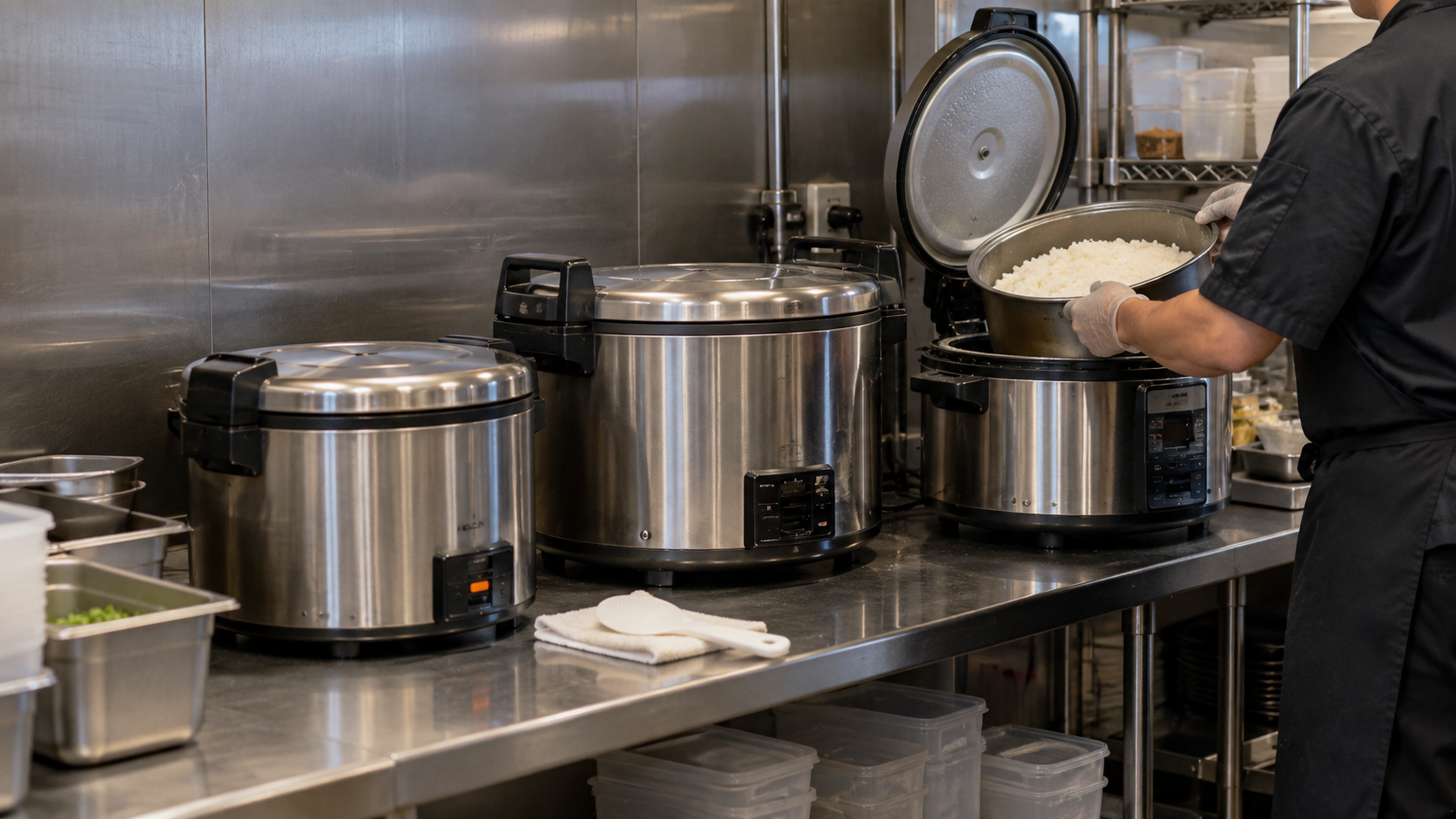
Commercial Rice Cooker Buying Guide
Choose & specify
Determine cooker type, operating range, production requirement, gas vs. electric vs. IH, utilities, commercial requirements, serviceability, one-large-versus-multiple-cooker architecture and what to verify before ordering.
Read the Commercial Rice Cooker Buying Guide →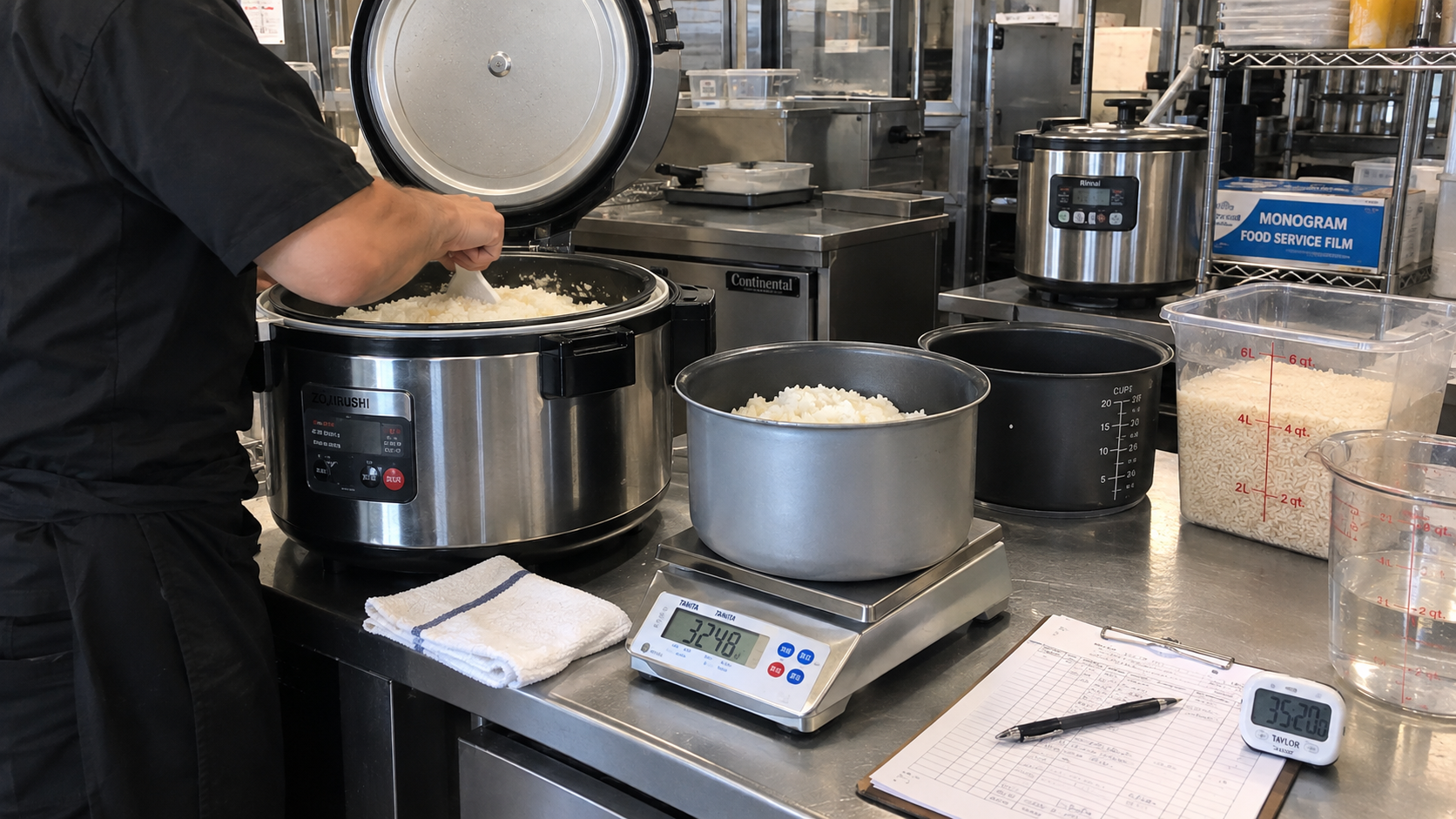
Commercial Rice Cooker Performance Benchmark
Measure & compare
See how manufacturer-rated capacity translates into tested dry-rice load, finished cooked weight, usable output, cook time, service-ready time and time-normalized production.
See ERS-Tested Performance →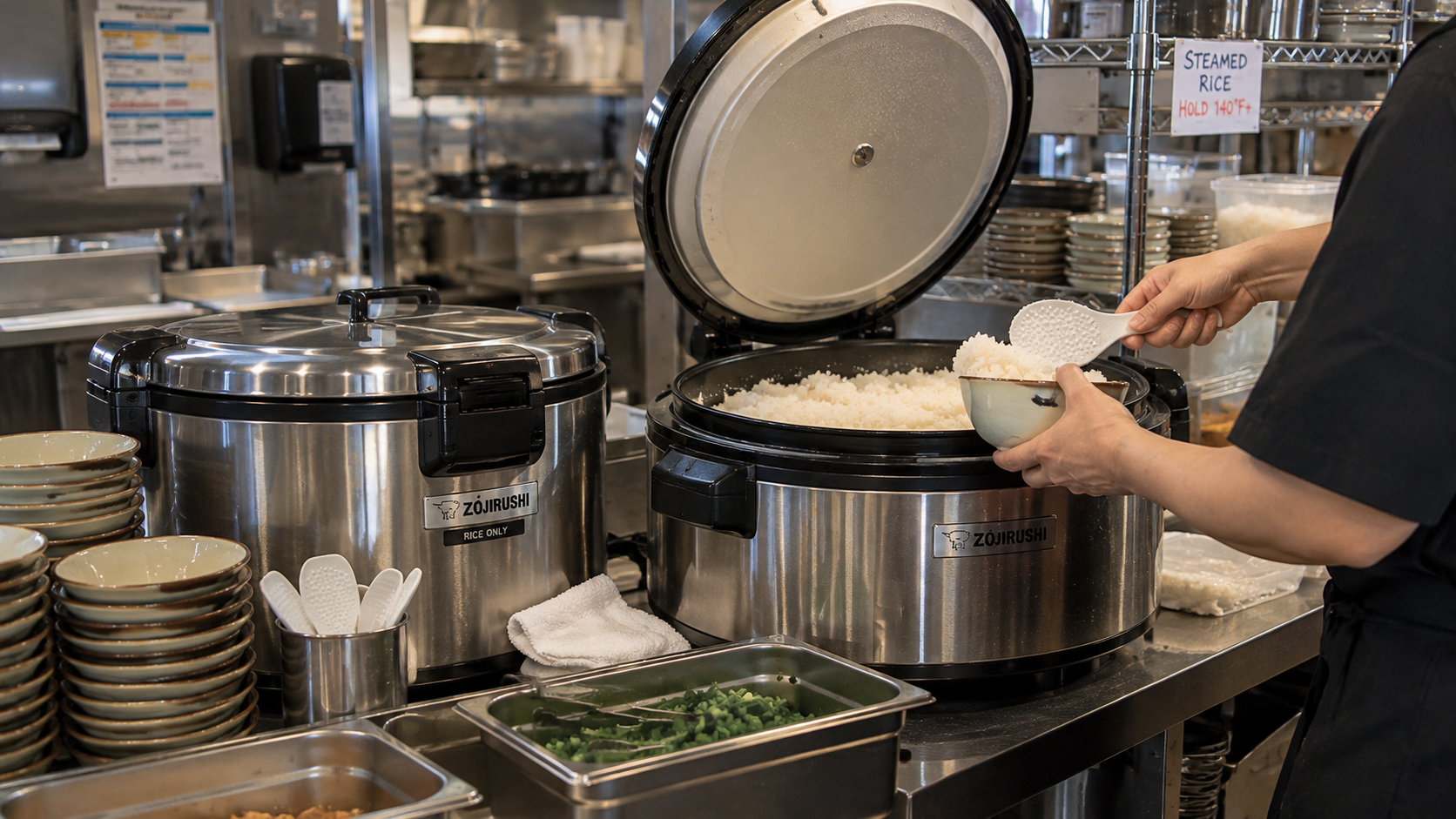
Commercial Rice Warmers & Rice Holding Guide
Hold & serve
Understand integrated keep-warm, dedicated electric warmers, thermal holding, rice-quality change, holding capacity and the relationship between holding and continued cooker production.
Read the Commercial Rice Warmers & Rice Holding Guide →