

ERS COMMERCIAL RICE EQUIPMENT RESEARCH · RICE WARMERS & HOLDING
Commercial Rice Warmers & Rice Holding Guide for Restaurants
How should a restaurant hold cooked rice after production? This guide explains what happens to rice during holding and how to choose between cooker-warmer keep-warm, dedicated electric rice warmers and passive thermal holding—including capacity, food safety, sushi rice, service workflow and equipment ownership.
Since 2002, ERS has supplied and supported 11,000+ rice cookers and warmers across 3,600+ locations in 41 U.S. states. That experience, combined with manufacturer specifications and ERS first-party research, shapes the guidance in this resource.
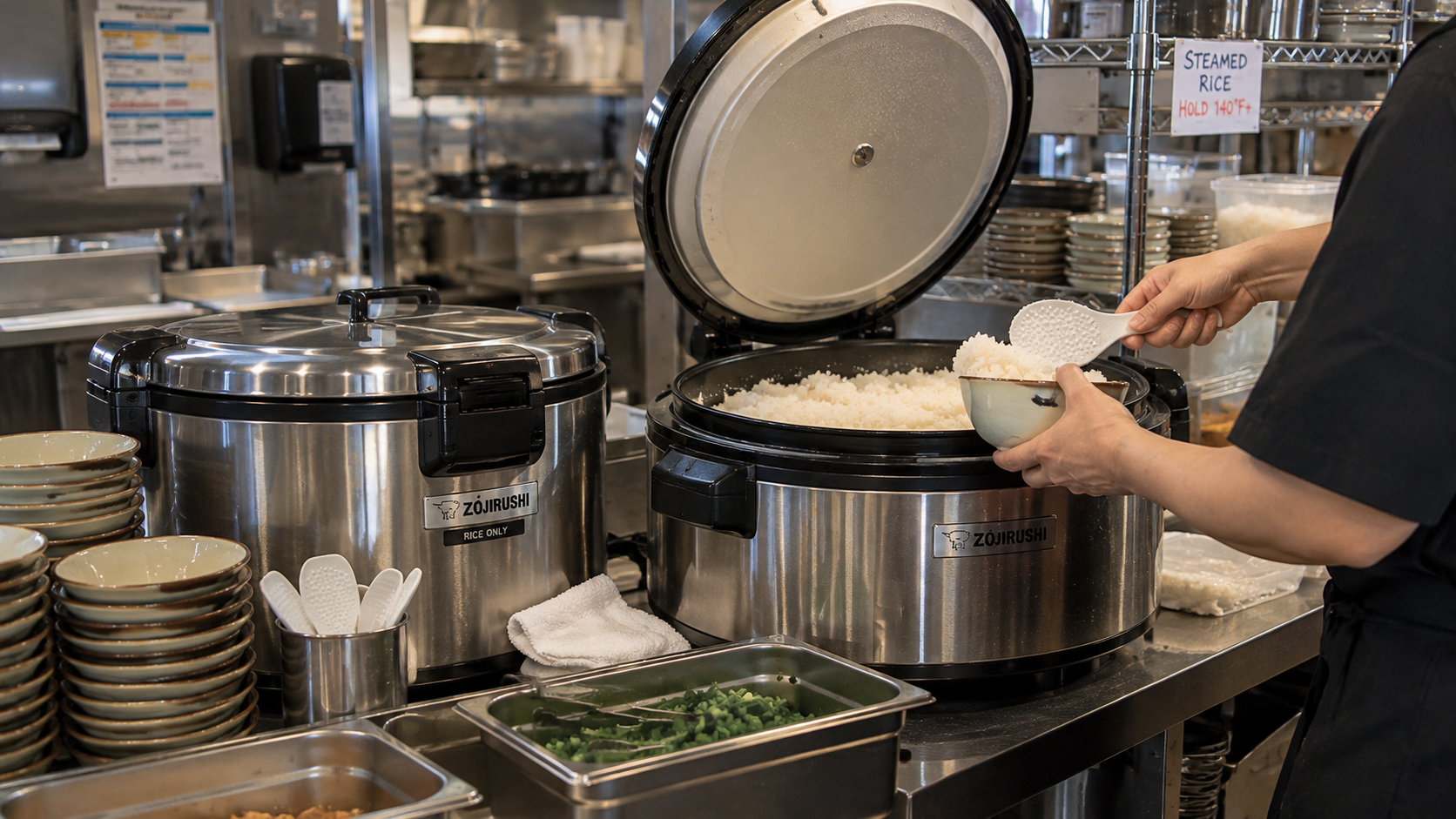
Cooking the rice is only the first half of a commercial rice operation. Once a batch is finished, the problem changes completely: the restaurant is no longer trying to cook rice evenly. It is trying to preserve the temperature, moisture distribution, texture and service quality of already-cooked rice while matching the pace of customer demand.
That distinction matters. A warmer can slow the deterioration of cooked rice; it cannot suspend it. Rice continues to lose and redistribute moisture while it is held. Repeated service changes the environment inside the vessel. Small residual quantities behave differently from a full batch. And every minute a finished batch remains inside a cooker is also a minute that cooker cannot begin another batch.
For a commercial foodservice operation, the correct holding system therefore depends on more than warmer capacity. It depends on how the rice is cooked, how much finished rice each batch produces, how quickly the restaurant consumes it, how long it must remain in service, what rice quality the menu demands, and whether the cooker needs to return immediately to production.
Holding guide / 01
What Happens to Rice While It Is Held
The central technical problem in rice holding is not simply heat loss.
It is water movement.
Freshly cooked rice contains a large amount of water distributed through and around a gelatinized starch structure. Once active cooking stops and holding begins, that water does not remain perfectly stationary. Heat continues to drive evaporation from the rice. Water vapor moves upward, encounters cooler surfaces such as the lid, condenses, and may return to a different part of the rice bed. At the same time, the warmer continues supplying heat from one or more surfaces to compensate for losses to the surrounding room.
That means a covered vessel can produce two apparently contradictory problems at once: some rice can become drier and harder while other rice becomes wetter, softer or swollen from condensed moisture.
Controlled research on electric keep-warm holding has demonstrated exactly this phenomenon. In one study using japonica rice, researchers found that water distribution changed substantially during holding. Under the conventional holding mode studied, rice in the upper-middle region became drier and harder while rice toward the outer upper region absorbed redistributed water, swelled and in some cases broke. Changing the thermal condition at the cover substantially improved moisture and texture uniformity. The study used one rice, one cooker and long holding periods, so its numerical results should not be generalized to every restaurant warmer. Its underlying finding is far more important: rice quality during holding depends not only on how much water remains, but on where that water ends up. [1]
That is why “keep the rice hot” is an incomplete description of what a commercial rice warmer is trying to accomplish.
| Mechanism | What happens | What the restaurant sees |
|---|---|---|
| Evaporation | Holding heat moves water out of portions of the rice. | Surface grains or other regions can become drier and harder. |
| Condensation | Vapor reaches a cooler lid or other surface and becomes liquid. | Moisture can collect and return near the lid or perimeter. |
| Moisture redistribution | Condensed water does not necessarily return to where it evaporated. | Some regions dry while others become wetter, swollen or broken. |
| Service changes | Opening the lid and removing portions change heat, moisture and remaining food mass. | The last portions can behave differently from the original full batch. |
Heat retention is not the same as rice-quality retention
A vessel can maintain food temperature while the rice itself continues to deteriorate.
The rice may become progressively harder. Surface grains may dry. Condensation may make other areas excessively moist. Aroma may change. Yellowing or other discoloration can develop during extended holding. The bottom or perimeter may experience different conditions from the center. The remaining rice can behave differently late in service than the same batch did when the warmer was full.
Manufacturers themselves acknowledge these effects. Zojirushi's commercial THA warmer instructions identify excessive holding time among conditions associated with odor and yellowing. Its NYC-36 cooker-warmer troubleshooting guidance similarly associates extended holding and small residual quantities with drying, discoloration, odor or excessive condensation. [2] [4]
None of this means commercial warming is ineffective. It means that temperature control and eating quality are separate performance questions.
Food safety establishes conditions under which rice may be held. It does not establish that the rice will still meet a restaurant's service standard at the end of that period.
The rice’s starting characteristics also matter; see Rice Type and Holding Quality.
Holding guide / 02
How Restaurants Hold Rice After Cooking
Commercial rice is generally handled one of four ways after production.
| Method | How heat is maintained | Cooker occupied? | Power | Operational strength | Primary limitation |
|---|---|---|---|---|---|
| Integrated keep-warm | The cooker changes to lower holding power. | Yes | Cooker power connection | No transfer, second appliance or second pan. | Finished rice can block the next cook. |
| Dedicated electric warmer | A separate heater replaces heat lost during service. | No | Electrical supply at the holding station | Cooking and service holding can occur simultaneously. | A separate pan, footprint and transfer step; quality still changes. |
| Passive thermal vessel | Insulation slows loss of stored heat. | No | No electrical connection | Portable and suitable for outlet-free service. | No active recovery of heat lost with time or repeated opening. |
| General hot holding | Steam, heated wells, cabinets or other holding systems. | No | Depends on the equipment | Fits an existing general hot-holding operation. | Temperature compliance does not ensure a rice-specific moisture environment. |
A fifth strategy is simply to produce close enough to demand that prolonged holding is minimized. That can be excellent practice where volume and production cadence allow it. But it is a production decision, not a substitute for proper temperature control when rice does need to remain in service.
The crucial point is that these systems do not solve exactly the same operational problem.
A cooker-warmer combines production and holding in one vessel. A dedicated warmer separates those jobs. A thermal warmer sacrifices active temperature maintenance in exchange for portability and zero electrical demand. General hot holding may maintain safe temperature without necessarily reproducing the enclosed moisture environment of equipment designed specifically for rice.
The right choice starts with workflow, not appliance terminology.
Holding guide / 03
Keep Rice in the Cooker or Transfer It?
The most important reason to separate cooking from holding is often not rice quality.
It is production capacity.
A commercial cooker-warmer such as the Zojirushi NYC-36 automatically transitions from cooking into keep-warm operation after the batch is finished. The NYC-36 draws 1,300 watts during its cooking function; Zojirushi's manual lists average keep-warm consumption at only 52 watts under its specified test condition. That dramatic drop reflects the difference between producing cooked rice and maintaining already-cooked rice. [4]
Integrated keep-warm is operationally elegant when it is enough. There is no transfer step, no second appliance, no second pan and no extra holding footprint. For a restaurant whose finished batch comfortably covers demand until the cooker is needed again, leaving rice in the cooker may be the simplest system.
The limitation is equally straightforward:
A cooker holding finished rice is not available to cook the next batch.
- Cook
- Hold
- Serve
- Empty
- Cook again
Cook, then transfer the finished rice to a separate warmer for holding and service. After transfer, the cooker is free to start the next batch.
This is why a warmer should not be sized or justified in isolation. The real question is whether the restaurant's finished batch output, cook cycle and consumption rate require cooking and holding to occur simultaneously.
For the production side of that calculation, use the Commercial Rice Cooker Performance Benchmark rather than nominal cooker labels. The benchmark exists precisely because advertised capacity alone does not establish actual finished output or service-ready production rate.
A separate warmer is not automatically “better.” But once holding begins to block cooking, the operational case for separating the two jobs is no longer subtle.
Holding guide / 04
Dedicated Electric Commercial Rice Warmers
A dedicated commercial rice warmer is not a low-powered rice cooker.
It is a different appliance with a different job.
Its input is already-cooked, already-hot rice. Its job is to replace enough heat lost to the surrounding environment to maintain the rice during service while minimizing drying, scorching and other quality deterioration.
The electrical ratings make the distinction obvious. Zojirushi's current 6 L and 8 L THA commercial warmers each operate at only 77 watts. Thunder Group's 50-cup SEJ22000 is rated at 100 watts. By comparison, Zojirushi's 20-cup NYC-36 commercial cooker requires 1,300 watts during cooking. [5] [9] [4]
These are maintenance-heating loads, not production-heating loads.
That is also why a rice warmer should not be treated as a reheating appliance unless its manufacturer explicitly says it can perform that function. The Zojirushi THA-603/803 commercial manual specifically warns against reheating cold or cooled rice in the warmer. Thunder describes the SEJ22000 even more directly: it is a warmer only and does not cook rice. [2] [9]
Electric warmer examples

Zojirushi THA-603S
6 L / 33-cup commercial rice warmer
- Stated capacity
- 6 L / 33 traditional rice cups
- Power
- 77 W
- Architecture
- Dedicated electric holding
The manufacturer’s current successor-page designation is THA-603SA; its restaurant manual specifically includes THA-603S. [5] [7]

Zojirushi THA-803S
8 L / 44-cup commercial rice warmer
- Stated capacity
- 8 L / 44 traditional rice cups
- Power
- 77 W
- Architecture
- Dedicated electric holding
Removable nonstick pan and detachable washable inner lid. [8]

Thunder Group SEJ22000
50-cup commercial rice warmer
- Stated capacity
- 50 cups / 100 bowls; verify the cup-volume basis
- Power
- 100 W
- Architecture
- Dedicated electric holding
A 1.2 mm coated 3003-aluminum inner pot receives heat beneath a hinged stainless lid. [9]

Narita NRW-2155
20 L / 85-cup commercial rice warmer
- Stated capacity
- 20 L / 85 cups of cooked rice
- Power
- Electric; confirm rated input on the nameplate
- Architecture
- Dedicated electric holding
The manufacturer specifies a 30-minute preheat before loading cooked rice. [18]
Preheating matters when the manufacturer requires it
Putting hot rice into a cold holding vessel immediately forces part of the rice's stored heat into warming the appliance itself. Some manufacturers therefore instruct operators to preheat the warmer before loading.
The Zojirushi THA instructions call for preheating before use, and the Narita NRW-2155 manual specifies a 30-minute preheat before cooked rice is loaded. [2] [18]
That does not justify turning “30 minutes” into a universal rule for every rice warmer. It does establish the broader point: the warmer should be operated according to its actual holding instructions, not treated as a generic hot box.
The pan and lid are part of the thermal system
The inner vessel is not incidental packaging.
The pan receives heat from the warmer and distributes it into the rice. The lid limits heat and vapor loss. Inner lids, condensation collectors, gaskets or other moisture-management components influence what happens to water released from the rice.
Zojirushi's THA uses a removable nonstick inner pan and detachable washable inner lid. Thunder's SEJ22000 uses a 1.2 mm 3003-aluminum coated inner pot and hinged stainless lid. [5] [9]
A damaged pan, improperly seated pan, dirty heater contact surface or poorly closed lid is therefore not merely a housekeeping issue. It can change the way the appliance transfers heat and retains moisture.
Holding guide / 05
Passive / Non-Electric Thermal Holding
A passive thermal warmer solves a different problem from an electric warmer.
There is no heating element continuously replacing lost energy. The vessel begins with a finite amount of thermal energy stored in the hot food and progressively loses that energy to the room.
That makes several variables especially important: the starting temperature of the rice, how full the vessel is, ambient conditions, elapsed time and how often the lid is opened.
The Zojirushi RDS-400 and RDS-600 are the clearest commercial examples in the ERS assortment. They require no electrical connection, are stackable, include a replaceable lid sponge to collect condensation, and are specifically described by Zojirushi as compatible with acidic ingredients such as vinegar and suitable for sushi rice. [12]

Zojirushi RDS-400
4 L passive thermal rice warmer
- Stated capacity
- 4 L / about 22 rice-cup measures
- Power
- No electricity
- Architecture
- Passive thermal holding

Zojirushi RDS-600
6 L passive thermal rice warmer
- Stated capacity
- 6 L / about 33 rice-cup measures
- Power
- No electricity
- Architecture
- Passive thermal holding
Documented compatibility with vinegar and sushi rice. [12]
Read thermal-retention specifications literally
Zojirushi publishes an unusually useful specification for the RDS line:
The RDS-400 is rated at 176°F after six hours and the RDS-600 at 180°F after six hours.
Those numbers sound like a restaurant holding guarantee until the test condition is read.
Zojirushi states that the rating is based on water starting at 203°F in a room at 68°F. [12]
That matters.
Water in a closed vessel under a controlled ambient condition is not the same thermal system as rice that is scooped repeatedly during a dinner service. Every lid opening exchanges hot internal air with the surrounding room. Every serving removes both food mass and stored thermal energy. A partially emptied container no longer has the same thermal mass as a full one.
The correct interpretation is therefore:
That is the standard by which any serious equipment claim should be read.
Where passive holding is genuinely valuable
Passive thermal holding is particularly useful where an electrical outlet is undesirable or unavailable, where the holding vessel must move with service, or where finished rice needs to be transported from production to another location.
Catering and off-site foodservice are obvious examples, and Zojirushi explicitly positions the RDS line for catering and outdoor use. [12]
Its acid compatibility also makes it particularly relevant to sushi operations—but equipment compatibility and food-safety process are separate matters. A vessel being suitable for vinegared rice does not itself establish that the rice has been properly acidified for holding outside conventional temperature control.
Holding guide / 06
How Long Can Cooked Rice Be Held?
There is no universal “rice can stay in a warmer for X hours” answer.
A single number collapses three different questions:
Is the rice being held safely?
That depends on the applicable food-safety control.
How long does the equipment manufacturer intend the product to be used for that purpose?
That depends on the specific model and its instructions.
How long does the rice remain good enough for the restaurant to serve?
That depends on the rice, starting condition, warmer, load, service pattern and restaurant quality standard.
Those are not interchangeable.
Manufacturer numbers do not all mean the same thing
The current market illustrates the problem perfectly.
| Equipment | Published information | How to interpret it |
|---|---|---|
| Zojirushi THA | 12-hour recommended holding limit. | The instructions associate longer holding with odor or yellowing; this is not a universal rice-quality duration. [13] |
| Thunder Group SEJ22000 | The same current page states both “up to 12 hours” and “6–8 hours.” | The source is inconsistent. Confirm the applicable model instructions; do not silently choose one number. [9] |
| Narita NRW-2155 | Marketed “48 Hours Keep Warm Function.” | A control/function claim does not establish unchanged restaurant-quality rice for 48 hours. Instructions separately call for shorter warming with small residual quantities. [10] [18] |
| Zojirushi RDS-400 / RDS-600 | 176°F / 180°F after six hours. | Controlled vessel heat-retention test using water beginning at 203°F in a 68°F room; not a restaurant-rice quality or safety guarantee. [12] |
These statements are all legitimate manufacturer information. They are simply different kinds of information.
Quality usually becomes the restaurant's own limiting question
A restaurant should establish a service standard for its rice rather than assume that the longest number printed on an equipment page is the target holding time.
If the rice is dry, hard, waterlogged, yellowed or otherwise below the operation's standard, the fact that an appliance is still capable of keeping it hot does not make it good rice.
Commercial holding equipment exists to extend useful service life—not to make time irrelevant.
Holding guide / 07
Match Warmer Capacity to Actual Rice Production
A 30-cup cooker and a 30-cup warmer do not necessarily describe the same quantity of rice.
“Cup” is one of the most abused units in the rice-equipment category.
A rice cooker and a rice warmer can both carry a “30-cup” label while describing completely different quantities.
Zojirushi's NYC-36, for example, is a 20-cup cooker based on raw rice input. The manufacturer specifies a 3.6 L maximum cooking capacity and uses the traditional rice-cup convention associated with roughly 180 mL measures. [4]
Narita, by contrast, explicitly describes the NRW-2155 as holding 85 cups of cooked rice. [10]
Thunder publishes a 50-cup / 100-bowl designation for the SEJ22000 but does not establish as clearly on its current product page what exact volume convention underlies that “cup” figure. [9]
The Zojirushi RDS series is primarily specified in liters, which is substantially less ambiguous: 4 L for the RDS-400 and 6 L for the RDS-600. [12]
Start with finished output, not the cooker nameplate
The restaurant's useful sizing question is:
How much finished rice does each production batch actually create, and how much of that batch must be in holding at the same time?
That is why warmer sizing should connect directly to the Commercial Rice Cooker Performance Benchmark.
The Benchmark establishes actual finished output and service-ready production behavior from the cooking side. This guide takes over after that output exists.
Do not assume that a “30-cup cooker” feeds neatly into a “30-cup warmer.” Do not assume every manufacturer's cup means 180 mL. Do not assume a generic 2:1 raw-to-cooked conversion produces an accurate equipment match.
Use the actual finished batch.
Maximum capacity is not the only sizing consideration
An operation also needs to think about what happens late in service.
Narita's NRW-2155 instructions specifically warn that when only a small quantity remains in the warmer, warming time should be reduced to prevent the rice from becoming dry and hard. Zojirushi's cooker-warmer guidance likewise recognizes small residual quantities as a condition associated with quality problems during keep-warm operation. [14] [18]
That does not mean every large warmer performs poorly at partial load.
It means buying solely for the largest conceivable batch ignores how the equipment will spend the rest of its service life.
The right capacity is the one that fits both production and the restaurant's actual service pattern.
Holding guide / 08
Match Holding to Restaurant Workflow
A rice-holding system should follow the restaurant's production rhythm.
Steady, moderate demand
- Operating condition
- One batch covers the service interval.
- What changes
- The next cook can wait until most of the batch is gone.
- Holding implication
- Integrated keep-warm may be sufficient; a separate warmer is not automatically necessary.
Continuous high-volume production
- Operating condition
- The next batch is needed while the current batch is still being served.
- What changes
- Holding occupies the cooker.
- Holding implication
- Transfer finished rice to separate holding so cooking and service can continue together.
Peak-driven service
- Operating condition
- Demand concentrates around lunch or dinner.
- What changes
- Advance production builds a buffer but increases holding age.
- Holding implication
- Stage enough rice to prevent service gaps without exceeding what can be served at the required quality.
Multiple rice preparations
- Operating condition
- White, brown, seasoned or sushi rice share the operation.
- What changes
- Texture targets, manufacturer restrictions, service destinations or safety processes differ.
- Holding implication
- Separate holding vessels may be needed even when total rice volume is modest.
Buffet and self-service
- Operating condition
- The lid opens frequently during service.
- What changes
- Each opening changes the heat and moisture environment; passive vessels cannot replace lost heat.
- Holding implication
- Balance serving access with heat retention.
Catering and off-site service
- Operating condition
- Rice must move with service, sometimes without an outlet.
- What changes
- Mobility takes priority over active temperature recovery.
- Holding implication
- Passive thermal holding avoids cords and powered heating, but insulation only slows heat loss; it cannot reverse it.
For sustained demand and meal-period peaks, actual cook-cycle and service-ready output data from the Commercial Rice Cooker Performance Benchmark matter more than nominal “cup” labels. A buffer is not unlimited advance production: every early batch adds holding age. Treat sushi rice as a distinct holding problem, with its own quality and process requirements.
Holding guide / 09
Rice Type and Holding Quality
Rice texture begins with the rice itself
Cooked rice does not begin with one universal texture. Amylose and amylopectin molecular characteristics affect grain hardness, swelling and stickiness. Research has linked differences in starch structure to measurable differences in cooked-rice hardness and stickiness, including among varieties with similar nominal amylose content. [3]
That means the same warmer can be asked to preserve very different starting textures. A restaurant serving Japanese short-grain rice is not necessarily trying to preserve the same texture as one serving basmati or jasmine rice: cohesive, sticky grains and dry, separate grains have different sensory targets. Brown rice and glutinous rice present different physical structures again. Even if two batches remain equally safe and equally hot, the service-quality threshold can be different.
The available evidence does not justify a universal holding-time chart assigning a duration to jasmine, short-grain or brown rice. There is not enough controlled commercial hot-holding evidence to make those numbers authoritative across equipment, hydration levels and preparations.
Rice variety and preparation affect the starting texture and the way quality changes are perceived. Manufacturer instructions for the specific cooker or warmer still govern, and the restaurant must judge acceptable holding against the rice it actually serves. Temperature alone cannot define acceptable rice holding.
Holding guide / 10
Sushi Rice Requires Different Holding Decisions
Sushi rice needs to be separated from ordinary hot-held rice for two reasons:
its intended eating condition is different, and its food-safety control may be different.
The 2026 FDA Food Code now addresses sushi-rice acidification directly in Annex 6. FDA identifies cooked rice as a time/temperature control for safety food with known hazards and specifically calls out Bacillus cereus. FDA explains that when acidification is used to make cooked sushi rice non-TCS, the process must control the equilibrium pH, commonly below 4.2, and must be carried out as the applicable special process. Adding vinegar merely for flavor without pH monitoring does not convert ordinary cooked rice into non-TCS food. [15]
That distinction is fundamental.
Sushi rice is not rendered safe for uncontrolled holding merely because vinegar was mixed into it.
FDA further notes that once properly acidified rice is combined with other sushi ingredients, the finished sushi product is considered TCS again and requires applicable time/temperature control. The model Food Code discusses variance and HACCP-plan requirements around the specialized acidification process; the restaurant's actual regulatory authority determines what applies locally. [15]
Holding equipment still matters after the food-safety process is established
Acidification does not answer the equipment question.
The vessel still needs to preserve the texture and moisture condition the sushi operation wants while being compatible with acidic rice.
Zojirushi explicitly identifies the RDS-400 and RDS-600 thermal warmers as suitable for acidic ingredients such as vinegar and specifically for holding sushi rice. Their non-electric construction also separates holding from active electrical heating. [12]
That does not mean every sushi operation should automatically use a passive RDS warmer. It means the product is documented for that use, which is very different from assuming that every rice warmer is equally suitable for acidic seasoned rice.
Equipment cannot validate the process
A warmer can be acid-compatible.
A warmer can manage condensation.
A warmer can retain heat.
A warmer cannot establish whether the restaurant's sushi-rice acidification process has reached its required equilibrium pH or satisfies the applicable regulatory approval.
Those are separate responsibilities, and they should never be conflated.
Holding guide / 11
Food Safety: Hot Holding, Time Control, Cooling & Reheating
For ordinary cooked rice, food safety establishes the hard boundary inside which the restaurant's quality decisions must operate.
The 2026 FDA Food Code is FDA's current model code for retail and foodservice. It is not itself federal restaurant law; FDA expressly describes it as a model offered to state, local, tribal, territorial and federal jurisdictions for adoption. Restaurants must follow the code actually adopted by their regulatory authority. [16]
| Process | Model-code provision | Operating distinction |
|---|---|---|
| Hot holding — §3-501.16 | 135°F (57°C) or above for ordinary hot-held TCS food, subject to stated exceptions. | A safety boundary, not a rice-quality target. |
| Time control — §3-501.19 | Written procedures plus applicable time, marking and disposition requirements. | A defined control method; not informal permission to leave rice on a counter. |
| Cooling — §3-501.14 | 135°F → 70°F within two hours; 135°F → 41°F or below within six total hours, unless an approved alternative applies. | Cooling is a separate controlled process, not gradual cooling inside a switched-off warmer. |
| Reheating for hot holding — §3-403.11 | Generally 165°F for 15 seconds within two hours for cooked, cooled food; separate provisions apply to certain commercially processed foods and other cases. | Use equipment capable of meeting the applicable reheating requirement. |
FDA model-code summary; the locally adopted code and applicable exceptions govern. [15]
Hot holding
Under §3-501.16 of the 2026 FDA Food Code, ordinary TCS food being hot held is maintained at 135°F (57°C) or above, subject to the section's stated exceptions. [15]
That temperature is a food-safety control, not a rice-quality recommendation.
Rice can remain above the applicable holding temperature and still become texturally unacceptable to the restaurant.
Why rice requires control
The particular microbiological concern repeatedly associated with cooked rice is Bacillus cereus. Its spores can survive cooking, and when cooked rice subsequently spends enough time under conditions favorable to germination and growth, the food can become hazardous. FDA's new sushi-rice guidance explicitly identifies B. cereus as a key reason acidification must be properly controlled. [15]
The solution is not fear of rice. It is disciplined control of time and temperature.
Time as a public-health control
“It's only going to sit out for a few hours” is not a food-safety program.
The 2026 Food Code permits time to be used instead of temperature control under defined conditions, but §3-501.19 requires written procedures and imposes time, marking and disposition requirements. [15]
A restaurant choosing that route needs to follow the requirements adopted by its jurisdiction. Time control is a specific control method, not informal permission to leave cooked rice on a counter.
Cooling rice for later use
If cooked rice is being saved rather than continuously hot held, cooling becomes a separate process.
The 2026 model Food Code requires cooked TCS food to cool from 135°F to 70°F within two hours and from 135°F to 41°F or below within a total of six hours, unless an approved alternative process applies. [15]
That is why leaving a deep container of hot rice to cool slowly is not an acceptable substitute for a controlled cooling process.
Reheating rice for hot holding
Holding equipment and reheating equipment should not be confused.
For food that has been cooked, cooled and is being reheated for hot holding, the 2026 model Food Code generally specifies 165°F for 15 seconds, reached within two hours, with separate provisions for certain commercially processed foods and other cases. [15]
A 77-watt rice warmer designed to maintain hot rice is not the appliance to assume will perform that reheating process.
Hold with a holding appliance. Reheat with equipment capable of meeting the applicable reheating requirement.
Holding guide / 12
Operating Practices That Affect Held Rice
A commercial rice warmer is simple equipment, but careless operation can defeat much of what it is designed to accomplish.
Should rice enter the warmer hot?
Dedicated warmers are designed around already-cooked rice entering the vessel hot.
The Zojirushi THA manual specifically warns against reheating cold or cooled rice in the warmer. Narita likewise instructs the operator to preheat the NRW-2155 and then place cooked rice into the inner pot. [2] [18]
The correct operating sequence therefore begins upstream—with properly cooked rice arriving at the warmer in the condition the warmer was designed to maintain.
Does this warmer need to be preheated?
Both the Zojirushi THA documentation and Narita's NRW-2155 instructions call for preheating before use; Narita specifies 30 minutes. [2] [18]
Do not turn that model-specific instruction into a universal number. But do not load a cold warmer and then act surprised that the rice immediately begins surrendering heat to the appliance.
Why keep the lid closed between servings?
The lid is part of the moisture and thermal environment.
Zojirushi's commercial warmer instructions identify poor lid closure as one condition associated with holding-quality problems. Research on warm-held rice likewise demonstrates that cover temperature and condensation behavior influence how moisture redistributes through the rice bed. [2] [1]
Service requires opening the vessel. Unnecessary opening does not improve the rice.
What changes when only a little rice remains?
Rice quality near the end of a batch deserves more attention than it usually receives.
Narita specifically instructs operators to reduce warming time when only a small amount remains to avoid drying and hardening. Zojirushi's commercial cooker-warmer troubleshooting likewise identifies small holding quantities among conditions associated with undesirable keep-warm results. [14]
The last few portions are operating in a different physical environment from a full pot: less food mass remains, more rice can be exposed relative to its volume, and the same vessel is still supplying or retaining heat.
Can fresh rice be added on top of held rice?
Zojirushi's THA instructions specifically identify adding fresh hot rice over rice already being held as one condition associated with undesirable odor. [13]
That is not enough evidence to issue a universal prohibition covering every warmer in the market.
It is enough evidence to reject the assumption that continual topping-off is automatically proper rice-warmer practice.
Where the manufacturer's manual addresses batch mixing, follow it. Where batch age matters to the operation, maintaining identifiable batches is operationally clearer than creating one perpetually replenished vessel of unknown holding history.
Can water be added when rice dries out?
Narita's NRW-2155 instructions specifically say that some water may be added during longer warming to replace water lost through evaporation. [14] [18]
That is a Narita instruction for that model.
It is not permission to pour water into every commercial rice warmer when rice starts drying.
Different warmer designs manage heat and condensation differently. A model-specific instruction should remain model-specific unless broader evidence supports it.
Should utensils remain inside the warmer?
Zojirushi's THA guidance identifies a spatula, spoon or other foreign object left in the warmer as a possible contributor to quality problems during extended holding. [2]
There is also a mechanical reason to respect utensils: Narita explicitly warns against hard objects such as metal spoons because they can damage the nonstick inner coating. [14] [18]
Treat the inner pan as a food-contact component, not a generic stockpot.
Holding guide / 13
Cleaning, Inner Pans & Ownership
A warmer cannot preserve rice well indefinitely if its rice-contact and thermal surfaces are neglected.
Protect the inner pan
Many commercial warmers use coated aluminum inner pans.
Zojirushi's THA has a removable nonstick pan. Thunder specifies a 1.2 mm 3003-aluminum pan with nonstick coating for the SEJ22000. Narita also uses a nonstick inner pot and explicitly warns against hard utensils that can damage the coating. [5] [18] [9]
Once a liner is badly damaged, the right answer is not to pretend the pan is an immortal part of the appliance.
Replacement-pan availability should therefore be considered when purchasing commercial holding equipment, not discovered only after the original pan is unusable.
Zojirushi currently supports replacement commercial components through its parts system, including THA pans and RDS condensation components. [17]
Keep the heating interface clean
Narita's instructions specifically warn against water droplets, rice grains, dust and other material remaining between the inner pan and heating surface because poor contact can affect performance and potentially damage the unit. [14] [18]
This is basic heat transfer.
A heater cannot transfer energy correctly through a pan that is sitting unevenly on debris.
Condensation components need maintenance too
Some rice equipment deliberately collects moisture rather than allowing it to return uncontrolled to the food or appliance.
The Zojirushi RDS thermal warmers use a reusable, replaceable condensation sponge and holder mounted in the lid. Replacement sponge disks and holders remain available through Zojirushi. [12]
Zojirushi's NYC-36 commercial cooker-warmer similarly uses a detachable condensation collector, which the manufacturer also sells as a replacement component. [4]
These pieces are not decorative. They are part of how the equipment manages water released during service.
Clean the appliance according to its construction
Do not immerse an electrical warmer simply because its inner pan can be washed.
Narita instructs users to wash the pan separately while cleaning the body with a damp cloth rather than immersing it. Zojirushi's THA likewise separates removable pan/lid cleaning from cleaning of the main appliance. [14]
A commercial sanitation routine should follow the manufacturer's current instructions for the exact model.
What to verify before buying
A rice warmer should be specified against the restaurant's actual holding job—not against the largest “cup” number on the page.
| Verify | Why it matters |
|---|---|
| Electric or passive thermal | Determines whether the equipment actively replaces heat or only slows heat loss |
| What “capacity” actually measures | Raw-rice cups, cooked-rice cups, liters and servings are not interchangeable |
| Finished output of the cooker feeding it | The warmer must accept the real cooked batch, not merely appear numerically compatible |
| Typical amount actually held during service | Maximum-load sizing alone can ignore performance late in the batch |
| Manufacturer holding guidance | Published 6-hour, 12-hour or 48-hour statements may describe different things |
| Electrical load and outlet location | Dedicated electric warmers are low wattage but still require suitable power where service occurs |
| Whether the appliance is holding-only | Do not buy a warmer expecting it to cook or reheat unless that function is explicitly supported |
| Rice/contact material and coating | Matters for cleaning, utensil practice, wear and replacement |
| Acid compatibility | Particularly important for sushi-rice applications |
| Listings/certifications required by the project | Verify the exact model, not a related family |
| Replacement pan and component support | Commercial service eventually wears food-contact and moisture-management parts |
| Physical footprint and service access | Capacity is useless if the lid cannot open or staff cannot serve from the installed location |
The best warmer is not the one with the longest advertised holding time.
It is the one whose capacity, holding architecture, service location and manufacturer instructions actually fit the restaurant's production system.
Holding guide / 14
Commercial Rice Holding FAQ
How long can cooked rice stay in a commercial rice warmer?
There is no universal quality duration. Manufacturer guidance varies by model and does not always describe the same thing. Zojirushi's THA instructions reference a 12-hour recommended limit; Thunder's current SEJ22000 page contains conflicting 6–8-hour and 12-hour language; Narita advertises a 48-hour keep-warm function; and Zojirushi's RDS publishes six-hour thermal-retention data based on hot water under defined test conditions. These numbers should not be treated as interchangeable measures of rice quality. [13] [18] [9]
Hold rice only within the applicable food-safety control and the manufacturer's operating instructions, and remove it from service when it no longer meets the restaurant's quality standard.
What temperature should cooked rice be hot held at?
The 2026 FDA Food Code model specifies 135°F (57°C) or above for ordinary hot-held TCS food, subject to stated exceptions. The FDA Food Code is a model and local adopted requirements govern the restaurant. [15]
That is a food-safety threshold, not a guarantee that the rice remains good enough to serve.
What is the difference between a rice cooker-warmer and a rice warmer?
A cooker-warmer both cooks rice and then maintains it after cooking. A dedicated rice warmer receives rice that has already been cooked elsewhere and holds it for service.
The distinction matters operationally because transferring rice to a dedicated warmer frees the cooker to begin another batch.
Do I need a separate rice warmer if my cooker has keep-warm?
Not necessarily.
If the cooker's finished batch covers service demand until the cooker is free to make another batch, integrated keep-warm may be sufficient. A separate warmer becomes much more useful when the operation needs the cooker to resume production while the previous batch is still being served.
Use the Commercial Rice Cooker Performance Benchmark to evaluate actual batch output and cycle time rather than relying on nominal cooker capacity.
Can a commercial rice warmer cook rice?
A dedicated holding warmer generally cannot. Thunder explicitly identifies the SEJ22000 as a warmer only, and Zojirushi's THA is designed for holding already-cooked rice. [9]
A cooker-warmer is a different equipment class.
Can a rice warmer reheat refrigerated rice?
Do not assume it can.
Zojirushi's THA manual specifically states that the warmer is not intended to reheat cold rice. Reheating for hot holding is also a separate food-safety process; under the 2026 FDA model Food Code, food that has been cooked and cooled generally must reach 165°F for 15 seconds within two hours when reheated for hot holding, subject to the Code's specific provisions. [2]
Should a commercial rice warmer be preheated?
Why does rice dry out even though the warmer is closed?
Because a closed vessel does not stop water movement.
Heat continues to move moisture out of portions of the rice. Vapor can condense at the lid and redistribute elsewhere. Research on warm-held cooked rice has shown that one region of the rice bed can become drier and harder while another absorbs condensed moisture and becomes wetter. [1]
Why can rice become wet near the lid or perimeter?
Condensation can return vaporized water to specific areas rather than distributing it uniformly through the rice.
The scientific literature on electric heat preservation demonstrates that cover temperature and condensation behavior can materially change moisture distribution and texture uniformity. [1]
Why can rice turn yellow during holding?
Extended holding is one recognized contributor. Zojirushi's THA commercial guidance specifically associates holding beyond its recommended period with yellowing and also identifies abnormally high appliance temperature as another possible cause. [13]
Yellowing should therefore not automatically be blamed on the rice variety itself.
Can I add fresh rice on top of rice already in the warmer?
Do not assume that continuous topping-off is recommended.
Zojirushi's THA commercial instructions identify adding fresh hot rice over previously warmed rice as one condition associated with bad odor. [13]
Follow the warmer manufacturer's instructions and maintain enough batch control that staff know how long the rice in service has actually been held.
Can I add water when rice starts drying out?
Why does the last rice in a warmer often become harder?
Small residual loads are exposed to a different holding condition than a full vessel. Manufacturers themselves recognize the problem: Narita instructs operators to shorten warming when little rice remains to avoid drying and hardening, and Zojirushi's commercial keep-warm guidance also identifies small quantities as a condition associated with quality deterioration. [14]
How large a rice warmer does my restaurant need?
Start with the amount of finished rice actually produced by the cooker, then determine how much of that rice must remain in holding simultaneously during peak service.
Do not size by comparing the “cup” label on the cooker to the “cup” label on the warmer. Those labels frequently describe different things.
What does “50-cup rice warmer” mean?
It means whatever the manufacturer has defined for that product—and that definition must be verified before using the number for system sizing.
Some warmer manufacturers explicitly specify cooked-rice capacity. Some use traditional 180 mL rice-cup measures. Some publish liters. Others use “cups” and “bowls” without defining the volume as cleanly.
Liters and verified cooked-rice output are more useful than blindly matching marketing numbers.
Can the same warmer hold jasmine, short-grain, brown or sticky rice?
Potentially, but the manufacturer instructions for the particular warmer and the restaurant's required texture matter.
Rice varieties differ substantially in starch structure and cooked texture; therefore the same holding condition does not necessarily produce the same sensory result across rice types. [3]
There is not enough evidence to justify a universal holding-time chart by rice variety.
Can a rice warmer be used for sushi rice?
Does adding vinegar make sushi rice safe to hold without temperature control?
No.
The 2026 FDA Food Code explicitly distinguishes validated acidification from adding vinegar merely for flavor. When acidification is being used to make cooked rice non-TCS, the equilibrium pH must be controlled according to the applicable special process; FDA discusses a critical limit of 4.2 or less in its sushi-rice guidance. If vinegar is added for flavor without the required pH control, the rice remains subject to TCS food controls. [15]
Local regulatory requirements govern.
What is the difference between an electric and thermal rice warmer?
An electric warmer actively supplies heat during holding. A thermal warmer has no heater; insulation slows the loss of heat already contained in the rice.
That makes thermal equipment portable and independent of an outlet, but it cannot actively recover heat lost when the vessel cools or is repeatedly opened.
Can a thermal warmer safely hold rice without electricity?
Potentially, but the answer depends on the actual food temperature and applicable safety process—not merely the fact that the container is called a thermal warmer.
For example, Zojirushi publishes six-hour heat-retention figures for its RDS models, but those figures were measured with hot water under specified test conditions. A restaurant must control the actual rice according to its applicable food-safety requirements. [12]
Can rice be held in a steam table instead?
General-purpose hot-holding equipment can maintain TCS foods at compliant temperatures when properly operated.
The more difficult question is rice quality. Rice-specific warmers create an enclosed environment designed around the heat and moisture behavior of cooked rice. A steam table may satisfy the temperature-control requirement while producing a different moisture and service environment.
Safe hot holding and good rice holding are not identical specifications.
What should I do with rice left after service?
The restaurant must decide whether the rice will be discarded, remain under valid hot holding, or enter a controlled cooling process for later use.
If it is cooled for later service, the 2026 FDA model Food Code requires cooked TCS food to cool from 135°F to 70°F within two hours and to 41°F or below within six total hours, unless an approved alternative applies. [15]
Do not allow a warmer full of rice to drift slowly toward room temperature and call that “cooling.”
Can cooked rice be cooled and reheated the next day?
It can be handled as a cook-cool-reheat process where permitted and properly controlled, but cooling and reheating requirements apply.
Under the current FDA model Food Code, the ordinary cooling requirement is 135°F to 70°F within two hours and 135°F to 41°F or less within six total hours. Food subsequently reheated for hot holding generally must reach 165°F for 15 seconds within two hours, subject to the Code's specific exceptions and the restaurant's adopted jurisdictional rules. [15]
When should a rice-warmer inner pan be replaced?
There is no universal elapsed-time replacement interval.
Replace or service food-contact components according to their condition and the manufacturer's instructions. Coated pans should not be abused with hard metal utensils, and commercial buyers should confirm replacement-pan availability before purchase. Zojirushi and Thunder both maintain replacement-component ecosystems for their commercial warmer families. [14] [9] [17]
Holding guide / 15
Commercial Rice Warmers & Holding Equipment
Choose holding equipment around the finished rice that actually enters service: how much must be held, where it is served, whether the cooker needs to start another batch, and the quality and food-safety controls the operation must maintain. Match those requirements to capacity, powered or passive holding, and the exact model’s instructions.
Browse the Commercial Rice Cookers & Warmers collection for the complete ERS assortment, or follow the equipment links below to verify current model specifications and select equipment for your operation. [6]
Zojirushi Commercial Electric Rice Warmer, 6L (33-Cup) - THA-603S
THA-603S
Zojirushi Commercial Electric Rice Warmer, 8L (44-Cup) - THA-803S
THA-803S
Zojirushi Commercial Thermal Rice Warmer, 4L (22-Cup) - RDS-400
RDS-400
Zojirushi Commercial Thermal Rice Warmer, 6L (33-Cup) - RDS-600
RDS-600
Thunder Group Commercial Electric Rice Warmer, 50-Cup - SEJ22000
SEJ22000
Commercial Rice Warmer / 85Cup of Cooked Rice
NRW-2155
Sources & specification notes
Source notes distinguish manufacturer specifications and operating instructions from independent research. Thermal-retention figures describe the stated test conditions; they are not ERS rice-holding test results. Confirm current exact-model instructions and locally adopted food-safety requirements.
- Journal of Cereal Science: moisture distribution and texture during electric heat preservation
- Zojirushi THA-603/803 manufacturer operating instructions
- Food Chemistry: rice starch molecular structure, hardness and stickiness
- Zojirushi NYC-36: specifications, instructions and replacement components
- Zojirushi THA: commercial electric warmer specifications
- ERS Commercial Rice Cookers & Warmers collection
- ERS restaurant-equipment catalog: THA-603S listing
- ERS Zojirushi THA-803S product specifications
- Thunder Group SEJ22000 specifications
- Narita NRW-2155 specifications
- ERS Zojirushi RDS-400 product specifications
- Zojirushi RDS: capacities, water-test conditions, acid compatibility and parts
- Zojirushi THA operating instructions: health-protective precautions
- Narita NRW-2155 operating instructions
- FDA 2026 Food Code: §§3-403.11, 3-501.14, 3-501.16, 3-501.19 and Annex 6
- FDA Food Code: current edition and jurisdictional adoption
- Zojirushi THA: specifications, instructions and parts
- Narita NRW-2155 manufacturer operating manual
The report
Three connected resource areas
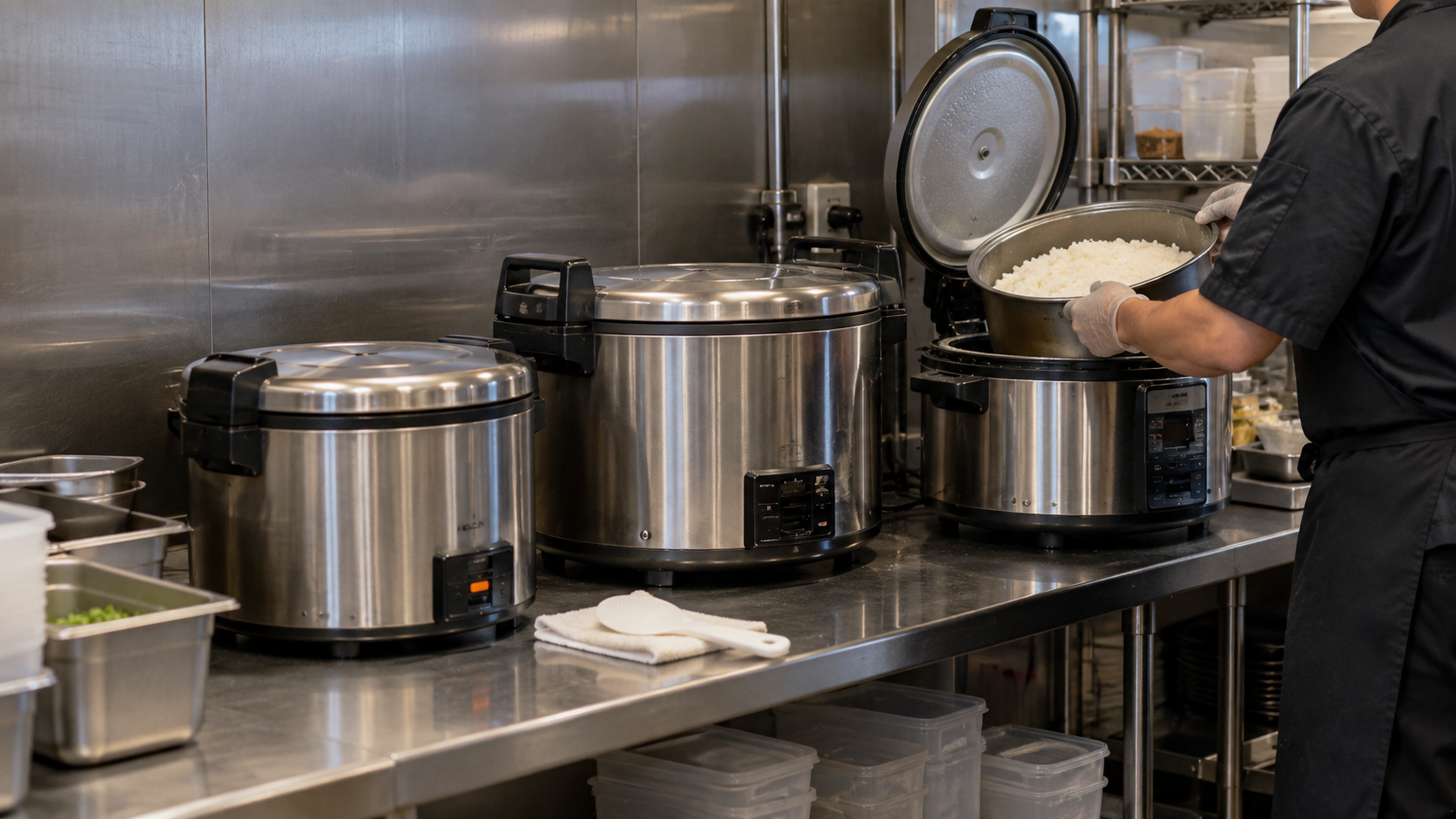
Commercial Rice Cooker Buying Guide
Capacity, Types, Gas vs. Electric, Features, Utilities & What to Verify
Explore resource →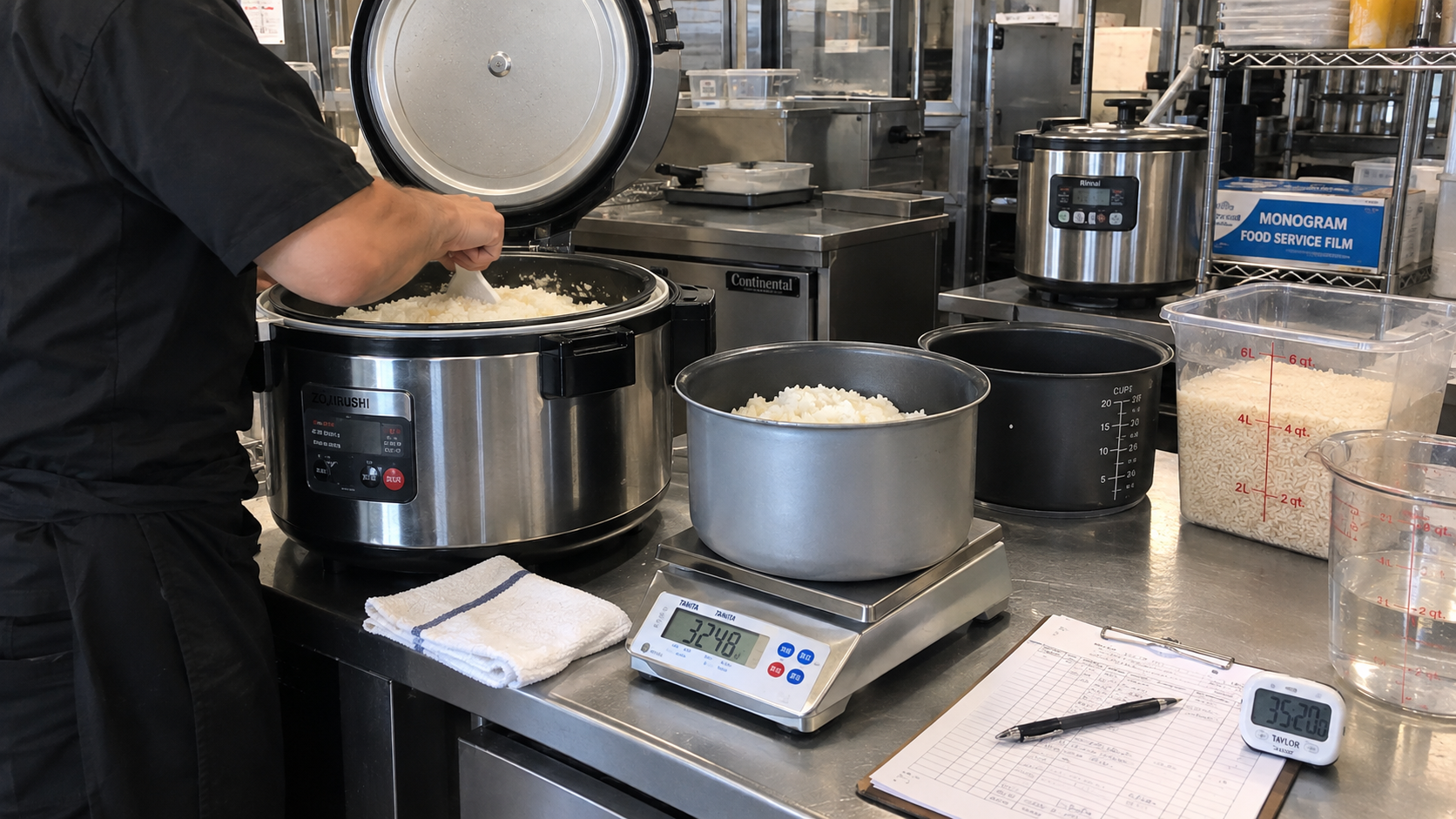
Commercial Rice Cooker Performance Benchmark
Manufacturer-Rated vs. ERS-Tested Capacity, Yield, Cook Time & Production
Explore resource →Commercial Rice Warmers & Rice Holding Guide
Cooker-Warmers, Dedicated Warmers, Thermal Holding & Sushi Rice
Current resource