

KOREAN BBQ RESTAURANT / EQUIPMENT GUIDE
Korean BBQ Grills & Exhaust Hood Ventilation Systems: Complete Guide
A technical reference to commercial Korean BBQ roasters, grill anatomy, updraft and downdraft ventilation, and Korean BBQ grill tables—how the components integrate into a complete dining-station system, how the major configurations differ, and what to know when selecting a system for a Korean BBQ restaurant.

A commercial Korean BBQ grill is not a standalone countertop appliance. At the dining table, the roaster, cooking surface, smoke-capture system, table structure, controls, grease-management components, and exhaust connection function as a single equipment system.
That distinction matters. Two roasters can use the same fuel and appear similar from above the table while requiring completely different table openings, under-table clearances, ventilation components, cooking surfaces, service access, and exhaust arrangements. Likewise, two systems both described as “downdraft” may share only the location of smoke capture; their internal construction can be materially different.
For clarity, this guide uses roaster for the installed cooking appliance and heat system, cooking surface for the removable plate, grate, or mesh on which food is cooked, capture system for the station-level equipment that receives smoke and grease-laden vapor, and table system for the structure that physically integrates those components.
The complete station should be understood from the inside out:
cooking surface → heat-management components → heat source → grease management → roaster body → localized smoke capture → table structure → exhaust connection
Not every system contains every layer, and the order differs by architecture. That is why Korean BBQ equipment should be specified as a coordinated system rather than as an assortment of individually compatible-looking parts.
Grill & dining / 01
Commercial Korean BBQ Grill and Roaster Landscape
The most useful way to classify commercial Korean BBQ roasters is not simply by gas, charcoal, or electric. Fuel is important, but it does not describe how the station is physically constructed.
A more useful classification starts with capture architecture, then considers the heat source, roaster geometry, cooking-surface system, and degree of ventilation integration.
| Classification axis | What it determines |
|---|---|
| Capture architecture | Whether smoke is collected above, at, or below the cooking surface |
| Heat source | Burner/element construction, controls, utility requirements, and heat-delivery method |
| Roaster geometry | Table opening, cooking-surface geometry, burner arrangement, and capture geometry |
| Cooking interface | How heat reaches the food and how grease leaves the cooking surface |
| Ventilation package | Whether filtration and air movement occur at the table or farther downstream |
| Installation form | How the roaster is supported, serviced, connected, and integrated into the table |
These axes overlap. “Round gas downdraft roaster,” for example, describes only part of a system. It still does not establish the cooking-surface design, capture path, filter arrangement, blower location, table opening, exhaust connection, or whether a particular hood/roaster combination has been evaluated as a system.
Updraft roasters
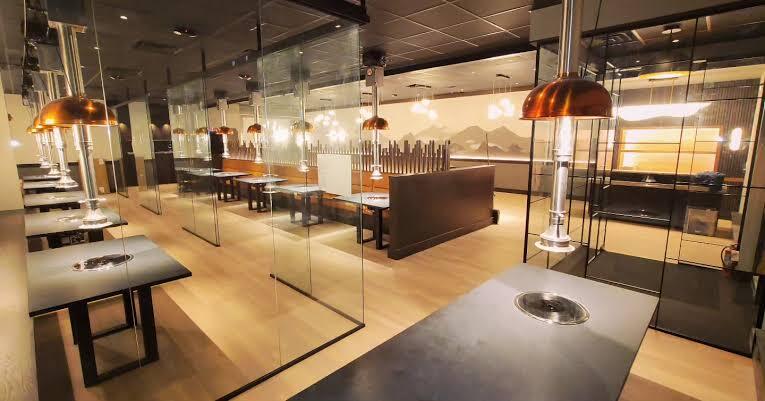
An updraft station separates the cooking appliance from the smoke-capture device.
The roaster is installed in the dining table and provides the heat source, cooking-surface support, controls, and grease-management components. Smoke and grease-laden vapor rise from the cooking surface and are captured by a localized hood positioned above the grill.
That hood may be fixed or vertically adjustable. In retractable systems, the hood typically consists of a lower capture section connected to telescoping exhaust tubing, with filtration and grease collection located higher in the assembly. Current listed commercial systems demonstrate that the localized hood can incorporate separate grease filters, grease collectors, access boxes, telescoping sections, and an exhaust collar before the system connects to the building exhaust.
The defining characteristic is therefore not simply that “the hood is above the table.” It is that the roaster and capture assembly remain physically separate components.
This has practical consequences. Roaster replacement, table construction, hood alignment, cooking-surface position, and capture height must remain coordinated even though the equipment is not contained in one housing.
Downdraft roasters
A downdraft system moves the capture point into or immediately around the cooking station.
Instead of allowing the cooking plume to rise to an overhead hood, the system establishes negative pressure near the cooking surface and draws smoke and grease-laden vapor into an intake surrounding or adjacent to the roaster. The air path then continues below the tabletop.
The important distinction is that downdraft describes the direction and location of capture—not the complete internal architecture.
One downdraft roaster may route the captured air through a casing, baffle, grease collector, or filter before terminating at an exhaust connection that depends on a remote exhaust fan. Another may package filtration and a local blower inside the table cabinet. A third may use a different combination of water pan, filter box, capture ring, and downstream exhaust components.
Current commercial manuals demonstrate these differences directly. Some systems identify separate inner and outer casings, baffle filtration, a water-filled drain pan, and an external exhaust requirement; others package filters and an exhaust blower into the cabinet itself.
Accordingly, “downdraft” is only the beginning of a specification.
Gas, charcoal, and electric heat
The heat system is a second classification layer.
Commercial gas roasters typically use a dedicated burner assembly supplied through a valve and orifice arrangement, with manual or electronic ignition depending on the model. Burner geometry varies: a round roaster may use a circular or centrally arranged burner, while a larger rectangular cooking surface may require a different or multiple-burner layout. Geometry should never be assumed from fuel type alone.
Charcoal capability also requires precision. A gas roaster supplied with an optional charcoal tray is not the same equipment architecture as a dedicated charcoal roaster. In a convertible system, the tray becomes another heat-source configuration within an existing roaster body. A dedicated charcoal system may instead be designed around charcoal placement, combustion-air movement, ash containment, heat shielding, and grease control from the outset.
Electric roasters replace the gas burner and gas controls with an electric heating system, but they do not automatically eliminate the ventilation problem. Cooking grease, smoke, vapor, and particulates remain functions of the cooking process rather than the fuel source alone.
Round, square, and rectangular roasters
Roaster shape is not merely aesthetic.
Geometry can change the burner arrangement, cooking-surface support, capture perimeter, table opening, under-table envelope, and available cooking area. Current U.S. commercial equipment includes both round and rectangular/square roasters, including systems with different burner layouts and removable accessories for alternate cooking modes.
Grill & dining / 02
Anatomy of a Commercial Korean BBQ Roaster
There is no universal exploded view of a Korean BBQ grill.
The useful way to understand the equipment is by functional layers. Different manufacturers solve those functions differently, but most commercial systems must address the same basic problems: support the food-contact surface, generate heat, control how that heat reaches the surface, contain spills and grease, protect the surrounding table, control the heat source, and—on integrated systems—move cooking effluent into the capture path.
Cooking surface
The cooking plate, grate, or mesh is the uppermost functional component, but it should not be treated as a generic accessory.
Its geometry has to match the roaster's support structure. Its underside must be compatible with the heat source or heat mediator below it. Its openings, slope, channels, or drainage features determine where rendered fat and marinade can travel.
A solid plate and an open mesh therefore interact with the same burner very differently. A plate can spread heat across a continuous mass and direct grease toward designated drainage areas. An open grate or mesh exposes more of the food and drippings to the heat source below. Those differences affect the thermal and grease-management behavior of the entire roaster.
Compatibility involves more than diameter or outside dimensions. The seating edge, underside geometry, support points, clearance above the burner or diffuser, and grease path all matter.
The cooking surface is part of the roaster's thermal system.
Heat diffuser or radiant component
Many commercial roasters place another component between the burner and the cooking surface.
Depending on the system, this may be described as a diffuser, hot plate, radiant plate, heat shield, or another model-specific term. These terms should not automatically be treated as synonyms.
A heat-spreading component can reduce direct burner concentration and distribute thermal energy more evenly beneath the cooking surface. A radiant component may be designed as a specific heat-transfer element. A shield may primarily protect another component from direct flame or grease.
Some current commercial roasters explicitly use a separate diffuser beneath a multilayer cooking plate, while other documented systems identify a dedicated radiant plate and stand as separate service components.
The important question is not what the part is casually called, but what thermal function it performs in that particular roaster.
Burner and heat source
Below the cooking surface is the component that actually generates heat.
In a gas system, this includes more than the visible burner head. The functional assembly can include the burner body, orifice, gas tubing or manifold, valve, ignition components, flame-safety devices, and air-adjustment components.
Burner placement is particularly important in Korean BBQ because the cooking surface frequently handles significant quantities of rendered fat and marinades. The burner, grease path, and protective components have to function together; otherwise drippings can foul burner ports, affect combustion, or increase maintenance requirements.
Some commercial systems make the burner assembly removable specifically because the area around it requires access for inspection and cleaning. Commercial manuals also document systems in which clogged burner holes from water, grease, or debris can affect combustion and burner life.
Grease, spill, and water management
Rendered fat does not disappear when it leaves the cooking surface.
The roaster must provide a controlled destination for it.
Depending on the architecture, that may involve a drip pan, drain pan, water pan, grease cup, liner, or a combination of components. These pieces can sit directly beneath the cooking surface or farther along the capture path.
Water-filled pans deserve particular care because their function and required fill level are model-specific. In documented commercial equipment, a water-filled drain pan sits beneath the cooking assembly and is an explicit part of safe operation. That does not mean every drip pan in every Korean BBQ roaster is intended to contain water.
The general principle is simple:
grease-management components are engineered parts of the roaster, not disposable catch trays added after the fact.
Their depth, position, removal path, and relationship to the burner and ventilation intake all matter.
Inner body, liner, and casing
The visible opening in the tabletop represents only a fraction of the appliance.
Below it may be an inner liner, outer casing, main body, burner pan, support stand, filter enclosure, or several nested assemblies. These structures establish the roaster's thermal envelope, support internal components, isolate the table from the cooking system, and create the passages through which air, grease, or exhaust move.
Parts documentation for current U.S.-supported commercial systems shows separate main bodies, liners, liner stands, table trim, drip pans, filters, control boxes, valves, and ignition components rather than one monolithic appliance shell.
This is why the below-table body depth and width are as important as the visible cooking opening.
Controls and ignition
Gas control may be mounted to the roaster body, incorporated into the table base, or housed in a separate control box depending on the system.
The control position affects table construction because the user must be able to reach the control while service personnel must be able to access the valve, tubing, ignition module, wiring, and related safety components without dismantling the entire table.
A control knob visible from the dining room therefore represents only the user interface. The service envelope behind it must also be protected.
Integrated capture components
On downdraft equipment, ventilation begins inside the roaster system itself.
The intake may be formed by openings around the cooking surface, a vented ring, a perimeter channel, or another source-capture geometry. Once the air enters, it can pass through inner casings, baffles, grease-management sections, filters, or dedicated collection components before reaching an exhaust connection.
Grill & dining / 03
Ventilation Architecture at the Dining Station
The ventilation system should be divided into two parts:
station-level capture equipment and building-level exhaust infrastructure.
This section concerns the first.
Above-surface localized capture
Localized overhead systems place the intake immediately above the cooking surface rather than using one large conventional canopy over a group of tables.
A retractable assembly commonly includes a lower capture hood, inner and outer telescoping tubes, a grease filter, grease collector, access box, and exhaust collar. The telescoping section allows the capture point to be positioned close to the active cooking surface and then raised when appropriate.
Current listed commercial assemblies demonstrate that these systems can also include dedicated filter-access doors, liquid-tight housings, grease collectors, minimum telescoping overlap requirements, and provisions for field-installed fire-suppression components.
The hood is therefore not simply a decorative stainless-steel tube hanging over the table. It is a grease-handling exhaust appliance with serviceable internal components.
Capture position matters because localized ventilation depends on intercepting the cooking plume before it disperses into the dining room. Hood height, alignment, cooking-surface dimensions, heat input, and airflow are consequently related parameters rather than independent specifications.
Downdraft source capture
Downdraft systems move the intake to the grill.
Smoke is drawn toward openings at or near the cooking perimeter and routed below the tabletop. This removes the individual overhead capture assembly from the visual field, but it moves substantially more equipment and air-routing responsibility into the table itself.
A typical functional path may resemble:
cooking surface → perimeter intake → internal casing/channel → grease interception → filter or baffle → exhaust connection
The actual order is model-specific.
Some commercial downdraft systems use a baffle and collection path within a slim table cabinet but depend on a remotely located exhaust fan. Others integrate filtration and a local blower within the table base before discharging into downstream ductwork. Both are legitimately described as downdraft systems, but they are not mechanically equivalent.
That distinction affects table volume, electrical requirements, service access, filter maintenance, noise location, and the point at which the station connects to the building exhaust.
“Smokeless” is not the same as ventless
Commercial Korean BBQ equipment is frequently described as smokeless.
The term should be interpreted as a description of smoke-control performance or source-capture design—not as proof that the appliance requires no exhaust system.
Documented commercial “smokeless” roasters still require an exhaust fan and specify minimum exhaust airflow.
Unless a system is specifically designed, evaluated, and approved as a recirculating application, source capture should not be confused with elimination of exhaust.
Capture, filtration, and air movement are separate functions
A precise system description should distinguish three operations.
Capture determines where the plume enters the ventilation equipment.
Filtration or grease separation removes grease from the exhaust stream and collects it in a serviceable location.
Air movement establishes the pressure differential that actually causes the air to flow.
Those functions may occur in one packaged cabinet, or they may be distributed across several components.
A visible hood does not tell you where the fan is. A downdraft intake does not tell you whether a filter is integral. A filter box does not establish that the system contains its own blower.
Each function should be located explicitly when the station is specified.
Airflow is equipment-specific
There is no technically defensible universal “CFM per Korean BBQ table.”
Published commercial systems show materially different airflow values because the capture geometry, cooking appliance, heat input, hood position, filter arrangement, and tested configuration differ. Current and legacy technical documentation includes commercial station values ranging from roughly 90 CFM to well above 200 CFM under their respective conditions.
More importantly, published airflow values are often established under controlled test conditions. A commercial manual may explicitly state that greater airflow can be required in a particular installation.
Airflow should therefore always be attached to:
the exact capture device + exact cooking appliance + exact configuration + applicable technical documentation.
Removing the number from that context destroys much of its meaning.
Listed compatibility matters
Physical fit and evaluated compatibility are not the same thing.
Localized commercial hoods can be tested or listed for use with specific cooking appliances, cooking-surface dimensions, heat inputs, operating temperatures, clearances, and airflow conditions. A hood and roaster that can be physically connected should not automatically be assumed to constitute the same evaluated system.
Similarly, a sanitation certification addresses a different performance scope from a ventilation-hood or gas-appliance safety evaluation.
The relevant question is not simply:
“Is this equipment certified?”
It is:
“What exact model is evaluated to what standard, for what function, and under what configuration?”
Grill & dining / 04
The Korean BBQ Table as Equipment
A commercial Korean BBQ table is not ordinary restaurant furniture with a hole cut into it.
It is the structural chassis of the dining-system equipment.
The table has to support the roaster, maintain the correct finished position at the tabletop, contain the appliance body below the surface, accommodate the capture system where applicable, route utilities, provide service access, and protect all of those components from guest contact.
The visible tabletop is only the upper boundary.
The roaster opening
There is no universal Korean BBQ grill cutout.
More importantly, the nominal hole dimension is only one part of the interface.
A complete tabletop interface includes:
finished cutout geometry + roaster body envelope + supporting lip or flange + table trim + vertical seating position + below-surface clearance
The visible trim can be wider than the opening. The appliance body can extend significantly below it. Controls or exhaust components can project beyond the central body. A cutout can therefore be dimensionally correct while the table remains incompatible with the rest of the appliance.
Flange, trim, and support
The roaster must be mechanically supported at the intended elevation.
Depending on the system, support can occur through a perimeter flange at the tabletop, a dedicated stand or frame beneath the appliance, a liner support, or a combination of structures.
The trim or flange also closes the transition between the cooking appliance and tabletop. It should therefore be treated as part of the appliance interface, not merely as decorative finish metal.
This becomes especially important when replacing an existing roaster. Matching the visible diameter without confirming the support geometry and body dimensions can leave the new appliance sitting too high, too low, unsupported, or obstructed below the table.
The under-table equipment envelope
Every built-in roaster has a three-dimensional service envelope below the tabletop.
For an updraft station, that volume may primarily contain the roaster body, burner, grease pan, control components, and utility connection.
For a downdraft station, the same volume may also contain:
capture passages → filter or baffle assemblies → grease collectors → exhaust connection → control box → possibly a local blower
That difference is substantial.
Downdraft selection therefore affects much more than ceiling appearance. It changes what must physically fit inside the table base.
Current commercial systems range from relatively slim under-table assemblies using external exhaust fans to larger packaged cabinets incorporating filters and local air-moving equipment.
Exhaust connection geometry
On a downdraft table, the exhaust connection becomes a fundamental table dimension.
The connection has a size, shape, orientation, elevation, and required path out of the cabinet. The table base has to accommodate that path without blocking service access or interfering with the grill body, controls, grease components, structural frame, or guest leg space.
The correct question is therefore not:
“Does this table support downdraft?”
It is:
“Does this table provide the exact spatial and mechanical interfaces required by this downdraft assembly?”
Controls and service access
A dining-system table must serve two very different users.
The guest or server needs access to the operational control.
The technician needs access to everything behind it.
Valves, tubing, ignition components, breakers, electrical controls, filters, grease pans, water pans, burner assemblies, and exhaust components may all require periodic access. A table enclosure that makes those components inaccessible converts normal service into table disassembly.
Access panels, removable covers, cabinet openings, and component withdrawal paths should therefore be considered during table fabrication—not after installation.
Tabletop construction
Tabletop material affects more than appearance.
The top has to maintain the grill opening accurately, carry the appliance and localized loads around the cutout, tolerate the thermal environment adjacent to the roaster, withstand repeated cleaning, and retain structural integrity around a large central opening.
The fabrication detail around the opening is therefore as important as the nominal table dimensions.
Stone, engineered surfaces, stainless steel, and other commercial tabletop constructions can all be used successfully when they are fabricated around the requirements of the selected equipment. The roaster should determine the opening—not the other way around.
One grill versus multiple grills
Larger tables may use more than one roaster.
That is not merely a longer version of a single-grill table.
Every additional roaster introduces another appliance body, heat source, control, grease-management system, and ventilation connection or capture position. Under-table routing, structural support, access, and seating clearance must accommodate those systems simultaneously.
A multi-roaster table should therefore be developed as a multi-appliance station from the beginning.
The Grill, Ventilation System, and Table Must Be Specified Together
The central rule of a commercial Korean BBQ dining system is simple:
compatibility is an interface problem.
The cooking surface must match the roaster.
The roaster must match the table opening and support system.
The ventilation architecture must match the roaster and cooking position.
The table must provide the required volume and access for that ventilation architecture.
The exhaust connection must leave the table in the correct location and geometry.
The controls and service parts must remain accessible.
Where equipment has been tested or listed as a combination, the actual configuration must remain within that scope.
A Korean BBQ grill system is therefore not fully specified by naming a grill model.
It is specified when the complete station is resolved:
roaster + cooking surface + heat configuration + localized capture + grease-management components + table opening + support structure + under-table envelope + controls + service access + exhaust interface
That is the physical dining system.
Before the tables are fabricated, that system must be coordinated with the building requirements, including exhaust and make-up air, gas, electrical, fire protection, and site conditions. Those requirements may confirm the proposed equipment configuration or require it to be adjusted.
The grill, ventilation system, table, and building interfaces should therefore be resolved together—not specified separately.
Explore the Korean BBQ resources
Plan a Korean BBQ Project
From concept and site feasibility through design coordination, equipment scheduling, installation and opening.
Explore resource → Resource 02
Korean BBQ Equipment Buying Guide
Build the equipment list, compare complete grill packages, understand equipment costs, evaluate suppliers and quotes, and determine when the purchase is ready to release.
Explore resource → Resource 03
Grill & Dining Systems
Commercial grills, ventilation, cooking surfaces, tables, controls and complete dining-system integration.
Explore resource → Resource 04
Kitchen, Prep & Service Equipment
Meat prep, specialized Korean machinery, rice/soup equipment, tabletop service, grill-plate handling and warewashing.
Explore resource → Resource 05
Replacement Parts & Support
Identify installed equipment, find compatible parts and documentation, and establish long-term support.
Explore resource →