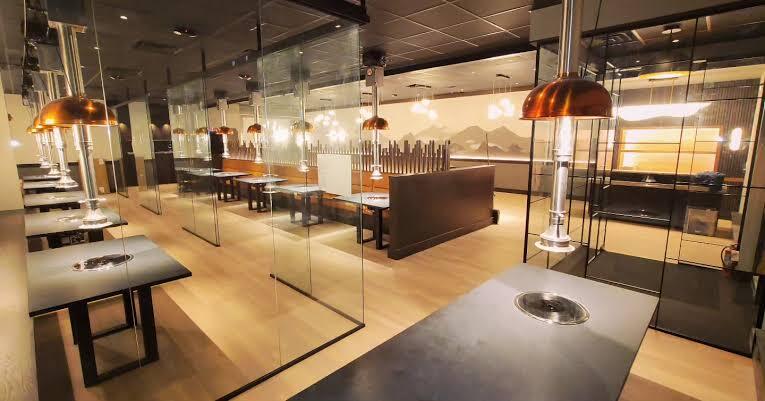
Equipment buying guide / 01
Built on 24 Years of Korean BBQ Experience
300+ Korean BBQ projects · 7,000+ grill stations · $105M+ in equipment · projects across 13 states · 5,000+ replacement and support cases
Since 2002, Eden Restaurant Supply has grown alongside the expansion of commercial Korean BBQ in the United States.
We have supported the category as it evolved from independent tabletop-grill restaurants into larger AYCE concepts, sophisticated full-service operations and growing multi-unit groups.
Across hundreds of openings and thousands of grill stations, ERS has seen which purchasing decisions contribute to delays, budget overruns, inspection problems, operating bottlenecks and difficult replacements—and which specifications remain dependable as restaurants open, operate and expand.
That perspective is different from evaluating equipment only at the point of sale.
ERS works across the full equipment lifecycle:
Specification → Procurement → Project Coordination → Opening → Parts → Replacement → Expansion
We see the equipment before the purchase order, while it is being coordinated into the restaurant, when the restaurant opens, and years later when the same equipment requires parts, service or replacement.
That experience leads to one recurring rule:
Korean BBQ equipment should be purchased as a coordinated operating system—not as a collection of independent products.
The grill affects the cooking surface. The grill and capture system affect the table. Those decisions affect utilities, fabrication, service access, opening quantities, spare inventory and future replacement.
A low-priced grill can become an expensive station after missing components are added. A higher-priced package can be the better purchase when it already contains equipment another proposal leaves out.
This guide distills that experience into the ERS framework for turning an equipment list into a complete, comparable and purchase-ready Korean BBQ equipment package.
Equipment buying guide / 03
II. Choose the Dining System
How to Choose a Commercial Korean BBQ Grill System
Choose the cooking station before you choose the grill.
A commercial Korean BBQ grill is one component of a larger operating system.
Define four things first.
1. Capture architecture
Choose between:
- updraft / overhead capture, or
- downdraft / table-integrated capture.
2. Heat source
Define the commercial heat system:
- gas;
- electric;
- charcoal / solid fuel;
- or another equipment-specific commercial configuration.
3. Table integration
Determine whether the grill will be:
- built into a separately fabricated table;
- purchased with an integrated table;
- coordinated with a system-specific base;
- or installed within another documented commercial assembly.
4. Cooking surface
Identify the surfaces designed for the selected grill:
- solid or ridged plates;
- perforated plates;
- open grates;
- stainless mesh;
- copper mesh;
- other model-specific surfaces.
“Gas grill,” “downdraft grill” and “Korean BBQ table” are categories—not specifications.
Define the complete station first. Compare equipment second.
For airflow, service clearances, table integration and complete tabletop cooking-system mechanics, use the Korean BBQ grill and dining system design guide.
Gas vs. Electric vs. Charcoal Korean BBQ Grills
Heat source should be selected early because it changes the appliance, infrastructure, operating workflow and service model.
Gas
Gas is the conventional commercial baseline for most Korean BBQ tabletop programs.
It provides responsive burner control, a mature commercial equipment ecosystem and familiar service components.
A useful gas specification establishes:
- gas type;
- burner input;
- connection requirement;
- controls;
- applicable listing;
- installation requirement.
Electric
Electric is a system choice—not an automatic substitute for gas.
Use electric when the selected commercial system delivers the intended cooking result and the restaurant's electrical infrastructure is designed for the station load.
A useful electric specification establishes:
- voltage;
- phase;
- amperage;
- controls;
- applicable listing;
- installation requirement.
Charcoal
Charcoal is a concept decision first and an equipment decision second.
Choose charcoal when the fuel and resulting cooking experience are materially part of the restaurant concept.
Charcoal also introduces fuel storage, lighting, replenishment, ash handling and additional operating requirements that should be designed into the restaurant from the beginning.
ERS Rule
Do not change heat source to solve a late-stage procurement problem.
Heat source belongs near the beginning of system selection.
Updraft vs. Downdraft Korean BBQ Ventilation
Updraft puts more capture equipment above the table. Downdraft puts more of the capture system inside and below it.
That difference changes what must be purchased, fabricated and serviced.
| Buyer consideration | Updraft | Downdraft |
|---|
| Capture location | Above cooking surface | At or near cooking surface |
|---|
| Equipment above table | Greater | Usually reduced |
|---|
| Equipment within/below table | Less capture equipment | Greater integration |
|---|
| Table coordination | Grill opening + overhead alignment | Grill + capture + under-table envelope |
|---|
| Major routing zone | Ceiling / overhead | Floor, wall or below-table |
|---|
| Service access | Grill + overhead components | Grill + below-table components |
|---|
| Quote must define | Grill, table, hood/capture, field exhaust | Grill, table, capture package, filters/controls, field exhaust |
|---|
Downdraft does not mean ventless
Downdraft describes capture direction and system architecture.
It does not automatically eliminate exhaust infrastructure.
“Smokeless” does not mean exhaust-free
“Smokeless” is a product or system description. It is not a substitute for the installation requirements of the commercial equipment being installed.
There is no universal CFM-per-table specification
A Korean BBQ ventilation system should not be designed by multiplying table count by a generic CFM number.
The appliance, capture geometry, cooking load and ventilation architecture determine the actual airflow requirement.
For the technical ventilation discussion, use the Korean BBQ grill, ventilation and table-system guide.
How to Compare Complete Korean BBQ Grill Packages
A grill price is not a station price.
Commercial Korean BBQ products that appear to occupy the same category can represent completely different portions of the final cooking station.
ERS currently works across complete downdraft sets, grill-only updraft configurations, built-in hood-based roasters and integrated downdraft systems with dedicated filtration and controls.
Current ERS Commercial Examples
| Model | Architecture | Grill | Cooking surface | Table | Capture package | Current equipment price* | Buyer still needs |
|---|
| JSDR-300 | Round downdraft full set | Included | Included | Included | Integrated downdraft components | $2,500 | Project field infrastructure |
|---|
| JSDR-400 | Square downdraft full set | Included | Included | Included | Integrated downdraft components | $2,600 | Project field infrastructure |
|---|
| JSDR-100 | Square updraft | Included | Included | Separate | Separate | $700 | Table + overhead capture + field infrastructure |
|---|
| JSCR-200 | Round updraft | Included | Included | Separate | Separate | $700 | Table + overhead capture + field infrastructure |
|---|
| HL-BM-320G | Round built-in / hood-based | Included | Separate | Separate | Separate | Quote | Surface + table + capture |
|---|
| HL-BM-340G | Square built-in / hood-based | Included | System-specific | Separate | Separate | Quote | Surface as applicable + table + capture |
|---|
| HL-DB-2017G | Round integrated downdraft | Included | 295 mm / 300 mm options | Tabletop separate | Downdraft + controls + four-stage filtration | Quote | Tabletop + project field infrastructure |
|---|
*Current ERS equipment pricing at the time this guide was reviewed. Equipment pricing is not installed-project pricing.
The differences are substantial.
The JSDR-300 and JSDR-400 are offered as full-set table-and-burner configurations. The JSDR-100 and JSCR-200 are grill units that leave the table and overhead exhaust outside the equipment package. The HL-BM-320G and HL-BM-340G are built-in roasters intended to be coordinated with separately supplied tables and hood-based capture systems. The HL-DB-2017G goes in the opposite direction: the system packages the roaster, below-table support assembly, controls and four-stage filtration while leaving the tabletop separate.
The lesson is not that one system is universally cheaper.
The lesson is:
The $700 appliance and the $2,500 package are not competing scopes until the missing equipment is added.
The ERS Complete-Station Cost Framework
Every Korean BBQ station comparison should normalize the same commercial scope.
Appliance
Grill / roaster
Surface
Primary cooking surface + required spares
Table
Top + base/frame + appliance support
Capture
Hood / downdraft components + filters + grease-management components
Controls
Ignition, controls and system-specific electrical components
Accessories
Diffusers, tripods, supports and required equipment accessories
Field Scope
Utilities, exhaust infrastructure and project-installed work
Logistics
Freight, delivery, handling and assembly
Installation
Installation, startup and commissioning where applicable
Support
Warranty, documentation, parts availability and future compatibility
Normalize the station before you normalize the price.
A lower appliance price does not establish a lower total station cost.
Grill Plate vs. Grate vs. Mesh: Which Should You Buy?
Choose from surfaces that are compatible with the grill first. Among those choices, select for operating behavior and menu fit.
Use this order.
1. Compatibility
The cooking surface must belong on the selected roaster.
Equal diameter does not establish compatibility.
2. Operating behavior
Compare compatible surfaces for:
- direct versus indirect heat;
- heat transfer;
- thermal mass;
- drainage;
- grease behavior;
- food retention;
- cleaning;
- cooling;
- change frequency;
- durability;
- replacement availability.
Once compatibility and operating workload are established, select the surface that best supports the intended proteins, marinades and cooking experience.
ERS Surface-Selection Rule
Compatibility first. Operations second. Menu third.
For detailed grill-surface geometry and compatibility, use the Korean BBQ grill and dining system guide.
Buying Korean BBQ Tables & Custom Tabletops
A Korean BBQ table is an equipment interface—not furniture with a hole cut in it.
Break the station into its actual components:
Tabletop
Base/frame
Grill/roaster
Cooking surface
Capture components
Controls
Grease-management components
Utility connections
Before releasing a table order, establish:
- exact grill/roaster;
- actual equipment cutout;
- support condition;
- installed appliance height;
- under-table equipment envelope;
- tabletop material and thickness;
- base/frame;
- capture components;
- utility routes;
- controls;
- grease/filter access;
- cleaning access;
- equipment-removal access.
ERS Fabrication Rule
Never release a custom tabletop from appliance outside dimensions, a photograph or an approximate opening. Release it from the approved equipment interface/cutout drawing.
A grill can physically enter an opening and still be installed incorrectly.
For deeper table, service-envelope and equipment-integration guidance, use the Korean BBQ grill and table-system guide.
Equipment buying guide / 05
IV. Compare Cost, Suppliers & Quotes
How Much Does Korean BBQ Restaurant Equipment Cost?
For early planning, budget Korean BBQ equipment by grill-station count and purchasing scope—not seat count.
ERS 2026 Korean BBQ Equipment Cost Benchmark
These ranges are built from ERS's Korean BBQ project and procurement history across 300+ projects, 7,000+ grill stations and more than $105 million in equipment, combined with current 2026 commercial equipment pricing.
ERS uses grill-station count and purchasing scope as the primary planning variables because those variables track the actual equipment package more directly than seat count, square footage or a generic restaurant-equipment allowance.
This is not a generic restaurant-industry percentage applied to Korean BBQ.
It is the baseline equipment-planning framework ERS uses for commercial Korean BBQ projects.
| Grill stations | KBBQ-specific equipment package | Broader restaurant equipment procurement |
|---|
| 8–12 stations | $40,000–$80,000 | $75,000–$150,000 |
|---|
| 15–20 stations | $60,000–$120,000 | $110,000–$220,000 |
|---|
| 25–30 stations | $90,000–$180,000 | $160,000–$320,000 |
|---|
| 40+ stations | $140,000–$400,000+ | $250,000–$2,000,000+ |
|---|
These are equipment-planning benchmarks—not full construction budgets.
Why the 40+ station range becomes much wider
Once a Korean BBQ restaurant moves into large-format territory, station count alone no longer describes the purchasing scope.
A 40-station operation may still be a relatively focused grill-and-kitchen equipment package.
A larger flagship or high-volume AYCE project can include:
- extensive refrigeration;
- large custom stainless packages;
- multiple cooking lines;
- high-capacity warewashing;
- significant specialty prep equipment;
- custom table programs;
- large opening-smallwares packages;
- broader service equipment;
- substantial imported or specialty equipment.
That is why the upper end of broader equipment procurement expands materially at this scale.
KBBQ-specific equipment can include
- grills/roasters;
- table systems;
- cooking surfaces;
- equipment-supplied capture components;
- KBBQ-specific prep equipment;
- grill-surface handling;
- specialty service equipment;
- opening accessories.
Broader restaurant equipment procurement can additionally include
- refrigeration;
- stainless tables and sinks;
- conventional cooking equipment;
- general prep equipment;
- warewashing;
- storage;
- carts;
- broader FOH equipment and serviceware.
Construction is a different budget
Unless specifically included, equipment pricing should not be treated as including:
- general construction;
- field ductwork;
- exhaust fans;
- makeup air;
- fire suppression;
- building gas/electrical distribution;
- roof or slab work;
- architecture/engineering;
- permitting;
- contractor labor;
- finish work.
Equipment budget and restaurant build-out budget are not interchangeable numbers.
What Actually Changes a Korean BBQ Equipment Budget?
Station count
More stations add more than grills.
They can also add tables, cooking surfaces, capture components, serviceware and spare inventory.
Dining-system architecture
Updraft and downdraft systems package equipment differently.
A lower grill price does not establish a lower station cost.
Table scope
Standard table components and fully custom fabricated tops produce materially different equipment and fabrication costs.
BOH production scope
Restaurants performing more meat cutting, specialty vegetable preparation, rice/soup production and banchan prep require a larger production package.
Specialty and imported equipment
Freight, lead time, support and replacement-parts availability can materially affect total cost.
Delivery, installation and opening inventory
Freight, inside delivery, assembly, startup, installation and thousands of individual opening pieces can become substantial line items.
How to Evaluate a Korean BBQ Equipment Supplier
A Korean BBQ supplier should be evaluated on the system it can support—not merely the equipment it can sell.
The strongest supplier improves the equipment decision itself.
The ERS Supplier Capability Framework
| Capability | What the buyer should establish |
|---|
| KBBQ project history | Has the supplier repeatedly supported operating Korean BBQ restaurants? |
|---|
| System breadth | Can it work across multiple legitimate dining-system architectures? |
|---|
| Product independence | Is the recommendation driven by the restaurant requirement or by one available product line? |
|---|
| Technical control | Can it produce current drawings, manuals, utility data and listing documentation? |
|---|
| Full-scope capability | Can it support grills only, or broader tables, stainless, prep, refrigeration, warewashing, smallwares and opening supply? |
|---|
| Project coordination | Can it coordinate equipment information with architects, MEP engineers, fabricators, contractors and installers? |
|---|
| Commercial discipline | Are inclusions, exclusions, substitutions and responsibilities explicit? |
|---|
| Manufacturer/importer access | Is there a clear technical, warranty and parts pathway? |
|---|
| Lifecycle support | Can the supplier support parts, replacements, remodels and future locations? |
|---|
Relevant Korean BBQ project history
Restaurant-equipment experience and Korean BBQ project experience are not the same thing.
An experienced KBBQ supplier has repeatedly dealt with:
- tabletop cooking systems;
- custom tables;
- exhaust/capture interfaces;
- specialty Korean equipment;
- project documentation;
- opening packages;
- operating replacements;
- long-term parts support.
The value of experience is not simply knowing what equipment exists.
It is knowing where equipment decisions repeatedly fail.
Product independence
A supplier tied closely to one manufacturer or equipment family can know that system extremely well.
That expertise is valuable.
It is also different from an independent comparison.
The buyer should always know:
Was this system selected because it best fits the restaurant—or because it is the product line available from this supplier?
If a supplier primarily represents one Korean BBQ equipment line, obtain another perspective from an experienced supplier capable of comparing multiple systems and architectures.
A second quote is not only a price check.
It is a specification check.
A broader supplier may identify a different system architecture, table scope, equipment package or support path that a line-specific seller has little incentive to present.
ERS Rule
Product expertise is valuable. Product-line dependence should be visible.
A serious buyer should understand both.
Technical control
For major integrated equipment, the supplier should be able to provide:
- exact model;
- current specification;
- current dimensioned drawing;
- installation manual;
- utility requirements;
- applicable listing information;
- compatible accessories;
- parts information.
If the supplier cannot document the equipment, it should not control the specification.
Full-scope capability
A narrow specialist and a project-wide procurement partner perform different jobs.
A complete Korean BBQ project can involve:
- grills;
- ventilation equipment;
- custom tables;
- stainless;
- refrigeration;
- prep equipment;
- warewashing;
- specialty Korean machines;
- service equipment;
- smallwares;
- opening supply.
The larger and more complex the project becomes, the more valuable it is to coordinate those scopes through fewer knowledgeable procurement relationships.
Project-Team Coordination
The equipment supplier should be able to give architects, MEP engineers, fabricators, contractors and installers the information required to work from the same equipment specification.
The equipment package should function as a reliable project input.
Procurement should reduce coordination risk—not become another information silo.
Commercial discipline
A serious quote should make these answers obvious:
- What exact model is being supplied?
- What is included?
- What is separate?
- What is project-supplied?
- What is field-installed?
- What substitutions are permitted?
- Who owns freight?
- Who owns delivery?
- Who assembles?
- Who installs?
- Who starts up?
- What event starts the lead time?
- Who administers the warranty?
Ambiguity is not a purchasing strategy.
Manufacturer and importer access
For specialty or imported equipment, establish how the supplier connects to the manufacturer/importer.
A useful commercial path exists for:
- technical questions;
- warranty;
- documentation;
- replacement parts;
- substitutions;
- future equipment supply.
Lifecycle support
The supplier relationship should survive:
Purchase → Installation → Opening → Parts → Replacement → Expansion
The least expensive source can become the most expensive supplier when the restaurant needs support later.
A strong Korean BBQ equipment partner should still be useful five or ten years after the original purchase order.
Korean BBQ Equipment Supplier Red Flags
Treat these as warning signs:
- No exact model
- No current technical documents
- No clear package boundary
- Fabrication based on approximate dimensions
- Uncontrolled “or equivalent” substitutions
- Unclear listing claims
- No identified warranty or parts owner
- No credible post-opening support
- One product family presented as the automatic solution
- No meaningful comparison against alternative system architectures
One-System Recommendations Deserve a Second Perspective
If the proposed solution comes from a supplier whose business is primarily tied to one equipment line, obtain a second quote or specification review from an experienced source with broader system access.
That does not mean the first recommendation is wrong.
It means the buyer should establish whether it remains the best recommendation after alternatives are actually considered.
A supplier that cannot define the equipment package should not be defining the project scope.
How to Compare Korean BBQ Equipment Quotes
Normalize scope first. Compare totals second.
A lower proposal total does not mean a lower price when the proposals contain different equipment.
The ERS Quote-Normalization Schedule
| Compare | Quote A | Quote B | Quote C |
|---|
| Manufacturer / equipment source | | | |
|---|
| Exact model | | | |
|---|
| Exact configuration | | | |
|---|
| Quantity | | | |
|---|
| Grill/roaster | | | |
|---|
| Cooking surface | | | |
|---|
| Spare surfaces | | | |
|---|
| Tabletop | | | |
|---|
| Base/frame | | | |
|---|
| Capture equipment | | | |
|---|
| Filters / grease components | | | |
|---|
| Controls | | | |
|---|
| Required accessories | | | |
|---|
| Utility requirements | | | |
|---|
| Freight | | | |
|---|
| Delivery services | | | |
|---|
| Assembly | | | |
|---|
| Installation | | | |
|---|
| Startup / training | | | |
|---|
| Warranty | | | |
|---|
| Lead time | | | |
|---|
| Lead-time trigger | | | |
|---|
| Change / cancellation terms | | | |
|---|
| Parts / support | | | |
|---|
| Explicit exclusions | | | |
|---|
Classify every scope item
Use:
Included · Separate · Project-Supplied · Field-Installed
Those four labels eliminate a large amount of quote ambiguity.
Exact models matter
“20 Korean BBQ grills” is not a useful commercial specification.
The equipment package can change materially based on:
- model;
- cooking surface;
- table;
- capture architecture;
- controls;
- required accessories;
- listing;
- support path.
“Or equivalent” is a new equipment decision
A substitute should be rechecked against:
- dimensions;
- heat input/output;
- utilities;
- surface compatibility;
- table interface;
- capture system;
- controls;
- accessories;
- listing;
- warranty;
- parts;
- package contents.
A substitution does not become equivalent because the quote says “or equivalent.”
Compare lifecycle value
For integrated Korean BBQ equipment, compare:
Purchase price
+ missing scope
+ installation implications
+ documentation
+ replacement parts
+ serviceability
+ future compatibility
—not appliance price alone.
A lower total is not a lower-priced equivalent unless the scopes are equivalent.
New vs. Used Korean BBQ Equipment
Used-equipment risk rises with system integration.
A used stainless table and a used integrated grill/table/capture system do not carry the same purchasing risk.
Integration-Risk Continuum
Lower risk
Shelving / stainless / simple standalone equipment
↓
Standalone prep equipment
↓
Built-in cooking equipment
↓
Table-integrated grill systems
↓
Higher risk
Grill + table + capture + controls + model-specific accessories
The more equipment must interface with the installed restaurant, the more important these become:
- exact model;
- serial number;
- original configuration;
- modifications;
- current condition;
- utility requirements;
- listings;
- drawings;
- accessories;
- replacement-parts availability.
ERS Used-Equipment Rule
The more integrated the equipment is, the less meaningful the low purchase price becomes without documentation and compatibility.
For existing-equipment identification, parts and replacements, use the Korean BBQ replacement parts and equipment support guide.
Equipment buying guide / 06
V. Verify & Release the Purchase
NSF, ETL, UL & Commercial Equipment Listings
Certification is model-specific. Buy the listed model—not the logo.
Do not ask only:
Is this NSF?
Ask:
Is this exact model listed, to what standard, and for what scope?
The same principle applies to electrical and gas safety listings.
NSF
For applicable commercial food-equipment requirements, confirm the exact proposed model in the official directory.
A brand-level statement is not enough.
ETL / UL and Other NRTL Safety Listings
Confirm:
- exact model;
- applicable safety standard;
- testing/listing organization;
- listed configuration.
The useful question is not which recognizable logo appears on the marketing page.
The useful question is whether:
the equipment being purchased is the equipment covered by the listing.
ERS Listing Rule
Listings attach to equipment models and configurations—not to marketing claims.
What Documentation Should Come With Commercial Korean BBQ Equipment?
Major equipment should be documented before the purchase is released.
The purchasing file should contain, where applicable:
- Exact equipment model
- Exact configuration
- Current specification sheet
- Installation manual
- Dimensioned / interface drawing
- Utility requirements
- Official listing record
- Approved cooking surfaces/accessories
- Table-interface requirements
- Warranty information
- Parts documentation
- Service/support pathway
A product-page logo is not equipment documentation.
If major equipment cannot be documented before purchase, it becomes harder to fabricate around, install, inspect, service and replace afterward.
The ERS Korean BBQ Equipment Purchase-Release Checklist
The equipment package is ready to release when every material interface, scope boundary and commercial responsibility has an owner.
System
- Menu and production requirements are defined
- Dining-system architecture is selected
- Heat source is selected
- Exact grill/roaster is identified
- Cooking surface is selected
- Capture architecture is resolved
- Table/appliance interface is resolved
Documentation
- Current technical drawing is in hand
- Utility requirements are documented
- Applicable listings are documented
- Required accessories are identified
- Approved substitutions are resolved
Scope
- Every major item is classified as Included / Separate / Project-Supplied / Field-Installed
- Quantities are confirmed
- Freight responsibility is confirmed
- Delivery scope is confirmed
- Assembly responsibility is confirmed
- Installation responsibility is confirmed
- Startup responsibility is confirmed
Commercial Terms
- Lead time is confirmed
- Lead-time trigger is defined
- Change/cancellation terms are understood
- Warranty owner is identified
- Parts/service pathway is identified
Operations
- Opening inventory is calculated
- Spare cooking surfaces are planned
- Critical spares have been considered
- Equipment records will be retained
Do not release the PO while a material interface, responsibility or scope boundary remains unassigned.
Plan Spares and Equipment Records Before Opening
Spare inventory should be based on operating consequence and replenishment time.
Cooking surfaces
Calculate:
Active surfaces
+ cleaning-cycle inventory
+ next-change inventory
+ operating reserve
= working inventory
Service components
Ask:
- How likely is this item to wear or fail?
- Does failure take a station out of service?
- How quickly can a replacement arrive?
- Can restaurant staff replace it?
- Is it shared across multiple stations?
Stock high-turn and high-consequence components intentionally.
Equipment handover
Retain for each major grill or specialty machine:
- model;
- serial number;
- purchase date;
- supplier;
- approved drawing;
- specification sheet;
- installation manual;
- parts diagram;
- warranty;
- installed accessories;
- photographs of installed condition;
- notes on field modifications.
Your equipment partner should retain the record too
The restaurant should receive its own equipment file.
A capable long-term equipment partner should maintain the project and purchasing history as well.
That creates a much stronger support position years later when the restaurant needs:
- a burner;
- a cooking surface;
- a control;
- a filter;
- a replacement machine;
- a matching unit for another location.
The best replacement conversation starts with the original equipment record—not with someone trying to identify a ten-year-old grill from a cellphone photo.
One advantage of working with a long-term equipment partner is that service, replacement and expansion questions do not need to begin from zero every time the restaurant changes personnel.
For parts, equipment identification and replacement planning, use the Korean BBQ replacement parts and equipment support guide.
Multi-Unit Buyer Note
Multi-unit operators should standardize wherever operating conditions allow.
Good candidates include:
- grill models;
- cooking surfaces;
- table interfaces;
- controls;
- filters;
- specialty prep machines;
- serviceware;
- critical spares;
- purchasing specifications.
Standardize equipment where operating conditions are comparable. Standardize documentation everywhere.
A standardized equipment program improves purchasing, training, parts inventory, replacement planning and future project development.
Equipment buying guide / 07
Korean BBQ Equipment Buyer FAQ
What equipment does a Korean BBQ restaurant need?
A full-service Korean BBQ restaurant starts with the complete tabletop cooking station:
grill or roaster + compatible cooking surface + capture system + table/interface.
Then add the equipment required for meat and vegetable preparation, rice/soup production, refrigeration/storage, warewashing, table service, grill-surface handling and spare inventory.
The final equipment list should follow the menu and operating model—not a generic restaurant checklist.
How do I choose a commercial Korean BBQ grill?
Choose the complete station architecture first.
Define:
- capture architecture;
- heat source;
- table/integration format;
- cooking surface.
Then compare commercial grill models.
Do not choose a grill from BTU, appearance or appliance price alone.
Gas vs. charcoal Korean BBQ grill: which should I choose?
Gas is the conventional commercial baseline for most Korean BBQ programs.
Choose charcoal when charcoal itself is materially part of the food and guest experience.
Do not make the fuel decision late. Heat source affects the appliance, utilities, operating workflow and project design.
What is the difference between updraft and downdraft Korean BBQ ventilation?
Updraft captures emissions above the table. Downdraft moves more of the capture equipment into or below the table.
That difference changes table design, equipment packaging, routing and service access.
Neither “downdraft” nor “smokeless” automatically means exhaust-free.
What should a Korean BBQ equipment quote include?
At minimum, establish whether the proposal includes:
- grill/roaster;
- cooking surface;
- tabletop;
- table base;
- capture components;
- filters;
- controls;
- required accessories;
- freight;
- delivery;
- assembly;
- installation;
- startup;
- warranty.
Anything not clearly included should be classified as:
Separate · Project-Supplied · Field-Installed
How much does Korean BBQ restaurant equipment cost?
ERS uses grill-station count and purchasing scope as the primary early-planning variables.
Its current 2026 Korean BBQ equipment benchmark is:
- 8–12 stations: approximately $40K–$80K in KBBQ-specific equipment
- 15–20 stations: approximately $60K–$120K
- 25–30 stations: approximately $90K–$180K
- 40+ stations: approximately $140K–$400K+
Broader restaurant equipment procurement can range from approximately:
- $75K–$150K for smaller projects;
- $110K–$220K around 15–20 stations;
- $160K–$320K around 25–30 stations;
- $250K–$2M+ for large-format 40+ station projects depending on total equipment scope.
These ranges are built from ERS's experience across 300+ Korean BBQ projects, 7,000+ grill stations and more than $105 million in equipment, together with current commercial equipment pricing.
They are equipment-planning benchmarks—not construction budgets.
How do I evaluate a Korean BBQ equipment supplier?
Evaluate the supplier on more than price.
Look for:
- real Korean BBQ project history;
- ability to compare multiple equipment systems;
- independence from a single product-line recommendation;
- current technical documentation;
- broader equipment/package capability;
- coordination with architects, engineers, fabricators and installers;
- clear commercial terms;
- manufacturer/importer access;
- parts and warranty support;
- post-opening support.
If a supplier primarily sells one equipment family, obtain a second perspective from an experienced source capable of comparing multiple systems.
A strong supplier should be able to explain the system, document the system, coordinate the system and support the system later.
How do I compare Korean BBQ equipment quotes?
Normalize scope first. Compare totals second.
Convert every proposal into the same schedule of:
models + quantities + grills + surfaces + tables + capture equipment + controls + accessories + freight + installation + warranty + support + exclusions.
Classify every major component as:
Included · Separate · Project-Supplied · Field-Installed
Price the missing scope.
Then compare totals.
What certifications should Korean BBQ equipment have?
Do not rely on a generic statement that a brand is “NSF,” “ETL” or “UL.”
Confirm:
- the exact proposed model;
- the applicable standard;
- the listed configuration;
- the current official listing.
Commercial equipment listings are model-specific.
How many spare Korean BBQ grill plates do I need?
Calculate working inventory from the service cycle:
active tables
+ plates unavailable during cooling/washing
+ next-change requirement
+ operating reserve
Restaurants that change plates frequently or have slower cleaning cycles need more working inventory than restaurants with the same table count and a different operating model.
Should I buy used Korean BBQ equipment?
Used equipment can be a good purchase when its identity, condition and compatibility are easy to establish.
Risk rises as equipment becomes more integrated with the table, utilities, capture system and controls.
The more integrated the equipment is, the more important documentation becomes.