

Sushi Restaurant Concepts
Hand-Roll & Temaki Restaurants
Hand-roll equipment should protect the product at assembly and handoff. Hello Nori, for example, connects made-to-order, individually served rolls with crisp nori and warm seasoned rice. For that service, keep the working ingredients ready separately and bring them together for release; the nori supply, rice vessel, chilled fillings, and receiving point must support that sequence. Hello Nori
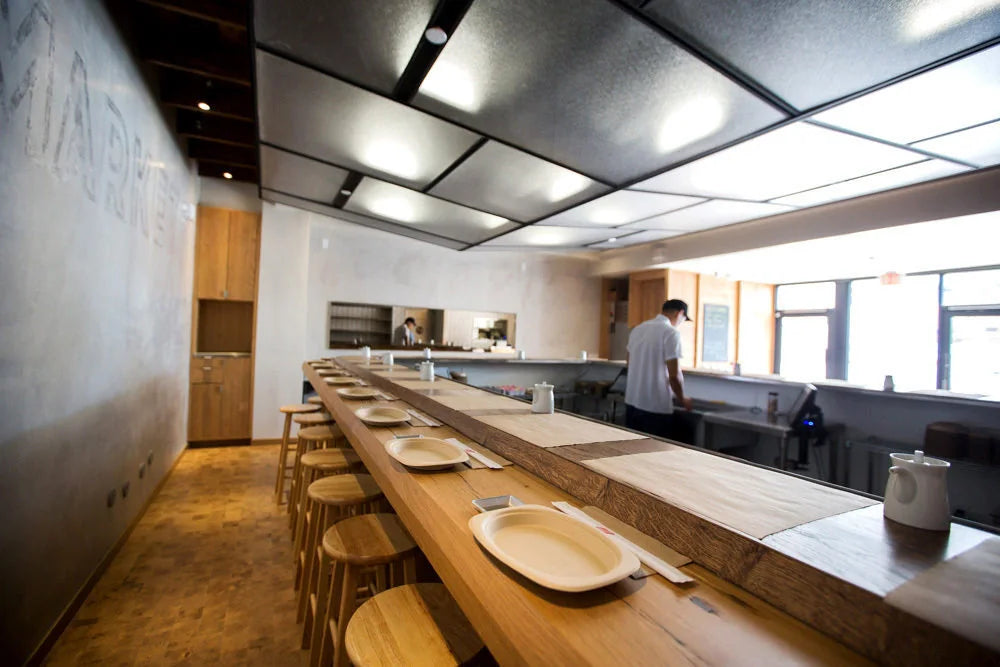
ERS has supplied Japanese and sushi restaurants from Los Angeles since 2002. For a hand-roll operation, the equipment specification starts with the product and its service: roll form, release sequence, destination, and who completes assembly. Those choices determine the working station, supporting kitchen, servingware, and recurring supplies, including the separate requirements of an off-premise offer.
In this guide 07 sections
01 / Service choices
Choose the hand-roll service before the equipment
Settle the service before selecting specialty objects. A cone, an open presentation, an individually released roll, and a guest-assembled kit create different physical jobs. The choices overlap: one restaurant can share preparation across a counter, a lounge, and takeout while needing a different final arrangement for each.
| Decision | Documented example | What it changes in the purchase |
|---|---|---|
| Roll form | Nami Nori identifies its specialty as open-style hand rolls. Nami Nori | Support contact, filled-body clearance, and the guest’s pickup. A cone opening and an open cradle support different shapes. |
| Release sequence | Hello Nori describes made-to-order rolls served individually; KazuNori’s counter menu offers sets. Hello Nori, KazuNori counter menu | The number purchased does not establish how many rolls occupy a serving object at once. Specify the actual release sequence. |
| Service destination | Sushi Saint offers hand rolls at its temaki bar and lounge, with different menu breadth. Sushi Saint FAQ | A carried presentation needs a release point, carrier where used, and a clearing route as well as a suitable serving object. |
| Final assembly | KazuNori’s Los Angeles takeout menu includes finished cut rolls and a hand-roll kit. KazuNori takeout menu | The restaurant either completes the product or portions components for the guest. Tools, packaging, and instructions follow that choice. |
Scroll the table to read all columns
A three-roll menu set is not a specification for a three-position stand. Establish whether the guest receives each roll separately or a combined presentation before choosing the serving object.
ERS’s 2022–2025 review covered final opening or refit specifications for 96 counter-led hand-roll sites, counted once per site. Forty-two briefs included table or lounge service, 60 included an off-premise offer, and 28 included both. Those overlapping groups accounted for 74 of 96 needing a table/lounge release arrangement, an off-premise packout, or both; 22 were counter-only, dine-in specifications. In that cohort, planning the front counter alone would have left a substantial part of the service unspecified. Fix the release destinations before finalizing the equipment occupying them.
Temaki means hand-rolled sushi, and participatory assembly around a table is an established way to serve it. That context is useful when planning a contemporary kit: the guest’s assembly is part of the product being supplied, with portioning, presentation, and instructions chosen accordingly. Kikkoman’s account of temaki
02 / The assembly position
Build the assembly position around nori, rice, and fillings
The working position must accommodate taking nori, accessing rice and fillings, assembling the roll, and releasing it. It also needs a practical way to replace what has been used. Select the objects together: their closed dimensions alone will not show where lids, utensils, refill containers, and hands go during service.
A dry working supply of nori
Separate protected reserve stock from the quantity repeatedly accessed at assembly. Yamamoto Noriten recommends taking the sheets needed from a small dispensing supply and avoiding the return of exposed sheets to the remaining stock. Yamamotoyama likewise identifies moisture, heat, and light as storage concerns. That supports a clear placement decision: keep the working supply clear of splash, steam release, and wet clearing, with a closing and refill action staff can actually maintain. Yamamoto Noriten, Yamamotoyama
The ERS NC-1 is a useful working-container example: a hinged tin with a stainless-steel inner base, made in Japan, measuring 8½ inches long × 5⅛ inches wide × 3¾ inches high. Those exterior dimensions help allocate counter space. Check the actual cut sheet, internal clearance, and reach with the lid open before settling its position.

A hinged working tin does not establish an airtight reserve-storage specification. Keep the bulk package’s protection and the counter’s access requirement distinct. Choose any powered nori appliance for a defined conditioning duty, with its exact electrical and cleaning requirements resolved. Powered equipment should not become an automatic addition simply because the restaurant specializes in hand rolls.
Rice within reach, with the process defined
Cooking, mixing, transferring, reserve holding, and working service are separate duties. The assembler needs access to the intended working quantity, an appropriate utensil, somewhere for the lid, and a replacement method that does not obstruct the rest of the position.
The Zojirushi RDS-400 illustrates a substantial non-electric service vessel. The manufacturer identifies it as suitable for vinegar-containing sushi rice, stackable, and fitted with a replaceable condensation-collecting lid sponge. Its published exterior size is 18⅛ × 15 × 10¾ inches. Account for lid and utensil handling as well as that footprint. Zojirushi RDS, ERS RDS-400

Hasegawa FHO-27 is a smaller, round ohitsu, or rice container, with a plastic surface and foam interior. Its body measures 270 mm in diameter × 120 mm high; its separate lid is 280 mm in diameter. Compared with the larger RDS vessel, it offers a more compact round working form. Allow for the removable lid’s set-down position as well as the body’s footprint. Hasegawa FHO product table, 2026B catalog, PDF page 3
Select the vessel around the process it will serve. Passive insulation does not provide an active temperature setpoint, and the intended eating condition is not itself a food-control procedure. Rice acidification also does not automatically control fish or other ingredients added to the roll. Establish the applicable process and monitoring requirements before treating any vessel as the solution. FDA Food Code overview, 2026 Food Code, Annex 6, Section 4
The ERS commercial rice holding guide covers the equipment-selection problem after cooking. At the hand-roll station, the immediate question is which working object provides the required access and can be replenished during service.
Chilled fillings and a clear assembly surface
Choose working refrigeration around the prepared components and the actual take-and-close motion. A guest-visible display can contribute to the service, but it also has a defined food space, condenser position, operating duty, and access requirement.
The Hoshizaki HNC-120BA-R-SLH makes that distinction concrete. Its published exterior is 47.2 × 13.6 × 11 inches; the interior is 33.3 × 11.3 × 6.2 inches. A nominal four-foot appliance does not provide four feet of ingredient frontage. The maker also specifies 6 inches at the condenser air inlet/outlet, with rear access and space above. Air enters at the rear and exits on the condenser side. Preserve that working and ventilation space when placing adjacent objects. Hoshizaki HNC series specification sheet

The operating instructions call for prechilled ingredients, controlled door opening, and transfer to a refrigerator during shutdown or defrosting. This is working display refrigeration, backed by a reserve arrangement; freshly cooked filling needs its appropriate preparation and cooling process before it reaches the case. The manufacturer also warns against placing tableware or edged tools directly on the glass. Hoshizaki HNC-BA-SLH instructions
Keep a real assembly surface beside ingredient access. Recipes can add components that are easy to overlook in an equipment list: Gonpachi describes a lettuce layer in its nori-temaki, for example. That creates another prepared component to contain and reach. The chosen recipe should be visible in the station specification. Gonpachi NORI-TEMAKI
Tools, handoff, and clearing
Assign utensils to the work performed at that position. Rice transfer, final portioning, filling placement, garnishing, sauce dispensing, and cutting are different tasks. Keep upstream preparation tools upstream when the assembler has no use for them.
A Hasegawa FSOG-40, for example, is a 400 mm-long rice-mixing spatula with a 115 mm-wide head. Its reach makes the distinction between a mixing tool and a utensil selected for a compact working vessel tangible. Choose each for its task rather than expecting one size to serve the whole rice process. Hasegawa 2026B catalog, PDF page 3
Include the replacement movements in the specification: where a fresh working vessel lands, where the emptied one goes, where a clean utensil waits, and how the used utensil leaves. The guest receiving point should remain available for the roll. Required handwashing and sanitation facilities must also remain usable as the station fills with equipment.
Select from the ERS kitchen-tools assortment against those defined tasks, vessel dimensions, and working positions.
Explore the ERS collection
Nori Containers
Compare the assortment for this part of your service.
-
 Image unavailable
Sushi Nori Container 9" Black
View details & options : Sushi Nori Container 9" Black
Image unavailable
Sushi Nori Container 9" Black
View details & options : Sushi Nori Container 9" Black
-
 Image unavailable
Sushi Nori Container 9.7" Red
View details & options : Sushi Nori Container 9.7" Red
Image unavailable
Sushi Nori Container 9.7" Red
View details & options : Sushi Nori Container 9.7" Red
-
 Image unavailable
Sushi Nori Container 8-1/2" Red
View details & options : Sushi Nori Container 8-1/2" Red
Image unavailable
Sushi Nori Container 8-1/2" Red
View details & options : Sushi Nori Container 8-1/2" Red
-
 Image unavailable
Nori Container 8.5", Black
View details & options : Nori Container 8.5", Black
Image unavailable
Nori Container 8.5", Black
View details & options : Nori Container 8.5", Black


03 / Production & replenishment
Keep the counter supplied through the full service
A compact handoff can depend on considerable production behind it. The Sushi Nozawa Group describes continuous rice production, dedicated kitchen tasks, and centralized seafood preparation in its own operation. The relevant lesson for a buyer is the supporting work, rather than the visible simplicity of the final roll. Sushi Nozawa Group’s food account
Size rice production from the menu and service pattern
Start with the actual mix of rolls released during the service period and the finished seasoned-rice portion for each. Include other rice uses on the menu and every assembly position drawing from the same supply. Seat count alone does not tell you how that demand arrives.
Follow the next batch through cooking, subsequent preparation, transfer, and arrival ready for assembly. The cooker’s finishing signal is only one point in that sequence. A cooker can have ample rated capacity while the next usable rice still arrives late because mixing, transfer, or the receiving vessel has not been accounted for.
Specify ordinary service and the peak together. Establish the recurring preparation batch, when the next quantity must be ready, how much goes to each working position, and who moves it. A larger working container is useful only if its extra volume suits access and replenishment. It can otherwise consume space while leaving the transfer problem intact.
Use the ERS commercial rice-cooker buying guide for batch and repeat-production selection, with the holding guide for the separate downstream duty.
Keep preparation and reserve stock behind the working supply
Record the condition in which each component arrives and the point at which it becomes ready for assembly. Receiving portioned seafood creates a different preparation requirement from receiving whole or larger pieces. A cooked filling produced on site creates different work from one received prepared and finished to order. Both still need the appropriate receiving, storage, handling, and replenishment arrangements.
Keep reserve objects distinct from the assembler’s working objects. Suzumo GRC-15, for instance, is a documented 490 × 380 × 220 mm rice container with a listed 10 kg cooked-rice load. It illustrates a reserve or transfer object that can supply a counter without becoming the default vessel beside every assembler. Suzumo rice containers
Apply the same working/reserve distinction to prepared fillings, protected nori, replacement utensils, and containers.
Where a counter and lounge share preparation, account for the demands of both release points. A table order can require carrying and coordination while the counter continues individual handoff. Give the final work a place without allowing it to block the shared supply.
Add machine assistance only to a defined task
Hand assembly can coexist with upstream rice-sheet production. Specify the task before buying the machine: portion and sheet requirements, the chosen roll, rice supply, handling after sheeting, operating space, and cleaning.
Suzumo SVS-FCA-EH is the documented North American example, with AC 110–120V, 60Hz supply. Its published closed dimensions are 350 W × 468 D × 570 H mm; the table-position operating depth increases to 690 mm. Use the operating envelope when allocating space, before allowing for staff access and the objects feeding or receiving the work. Suzumo SVS-FCA-EH
The purchase must fit the actual rice sheet and assembly method. A machine’s sheet-output rating does not describe the restaurant’s finished-roll output: fillings, final assembly, release, replenishment, and cleaning still have to work together.
04 / Servingware & fit
Match the servingware to the roll
Choose the simplest object that supports the intended presentation and lets the guest take the roll cleanly. An ordinary receiving surface, a cone opening, and an open cradle perform different jobs. Position count and finish are secondary to contact, clearance, and pickup.
Flat surfaces, cone openings, and open cradles
| Serving job | Actual comparison object | Selection detail |
|---|---|---|
| Receive a roll without upright restraint | ERS BK-0812, a stackable porcelain plate measuring 6 × 6 × 0.75 inches; ERS lists dishwasher suitability
 |
Check the usable center and rim against the filled roll and the guest’s grip. A dedicated stand adds little if the plate already performs the intended job. |
| Support a cone presentation | ERS WO302, a three-position plastic/lacquer stand, 7 inches long × 3 inches high; made in Japan and listed by ERS as dishwasher suitable
 |
Confirm the full footprint, opening, and spacing with the actual roll. The published length and height do not resolve the support contact. |
| Compare a specified cone opening | PacknWood 210SBAM3, a bamboo three-hole display with 0.8-inch openings and overall dimensions of 6.25 × 3 × 3.5 inches. PacknWood catalog, printed page 149 | The opening is measurable, but the roll’s taper still determines where it sits and whether its tip clears the surface below. |
| Assess an open support | Winco TCHS-23, a brushed-stainless taco holder reversible for two or three positions, measuring 8.13 × 4 × 2 inches | Treat it as a candidate geometry for the chosen roll. Its taco-holder identity and exterior size do not establish temaki compatibility. |
Scroll the table to read all columns
Check the fit with a finished roll
Evaluate a sample with the normal filling, garnish, nori form, and portion. An empty cone or undersized demonstration roll can produce a reassuring answer to the wrong question.
| Check | What must work |
|---|---|
| Contact and support | The object carries the filled roll at the intended point without letting it slip or compressing the body. |
| Lower clearance | A cone tip or lower edge clears the base, underliner, or table. Overall stand height alone does not establish this. |
| Upper and neighboring clearance | The widest filled area and projecting garnish remain clear of the support and other rolls. |
| Grip and removal | The guest can reach the intended pickup area and remove the roll without dragging the nori or lifting the support with it. |
| Changing load | The object works with one roll, the intended full load, and after pieces have been removed. Check each orientation actually used on a reversible holder. |
| Carrying | The loaded presentation works on the selected tray through carrying and set-down, where that service is intended. |
| Complete place setting | The roll presentation, underliner if used, sauce vessel, side, and drink fit together in the guest’s actual receiving area. |
Scroll the table to read all columns
Obtain missing critical measurements or assess the sample before ordering the service quantity. Record the roll forms, portions, object orientation, and carrying arrangement being accepted. Revisit the relevant checks when one of those changes.
In 68 of those 96 project files, a specialty holder had been selected before the final service and filled-roll review. Our review changed or removed 26 of those initial selections. We recorded one primary reason per revision: 11 mismatches with the planned release sequence, nine problems with filled-roll contact, clearance, or pickup, and six incompatible cleaning and return arrangements. These are project-selection outcomes, not a rating of the comparison models above.
The release-sequence cases exposed a recurring purchasing error: the team had matched holder positions to the menu set while intending to serve the rolls individually. The missing specification was the service event. Resolve that before buying the same unsuitable object in sufficient quantity to fill the counter.
Where crisp nori and warm rice are intended to meet at immediate handoff, do not use the holder to build a queue of assembled rolls. Its geometry supports presentation and pickup; it does not establish how long that eating quality lasts.
Choose materials for the actual cleaning cycle
Select the exact construction and its permitted care. WO302’s plastic/lacquer description is not a specification for wood, natural urushi, or a particular resin. Its seller’s dishwasher representation belongs to that product, not every object described as lacquerware.
PacknWood’s bamboo instructions specify handwashing with mild detergent and a soft cloth, and rule out dishwashing, extended soaking, abrasives, and heating. They call for dry storage and the brand’s maintenance routine. That creates a different handling requirement from the machine-washable plate or stand above. Establish a compatible cleaning and sanitation route before making it a repeated-service item. PacknWood Bamboo Care Instructions
Likewise, a metal description is not a substitute for the selected object’s instructions. Check accessible contact areas, the required cleaning method, drying, and storage. Remove damaged pieces when their condition prevents the cleaning the operation requires.
A plain plate can be the stronger purchase when it performs the serving job and fits the existing return process. A more elaborate object should justify its additional handling. Compare the specific objects; broad durability rankings for bamboo, plastic, metal, and porcelain conceal more than they resolve.
Buy for use and wash circulation
First identify what occupies each object. A receiving plate kept through a guest’s sequence stays in use for that interval. A separately plated roll can consume another clean piece at each release. A shared holder belongs to the selected order or party presentation; three positions do not necessarily mean three guests.
Build quantity from simultaneous use, pieces being cleared, pieces in washing and drying, and clean stock needed before those objects return. Include an appropriate replacement allowance for the operation. Side bowls, drinkware, underliners, and carriers have their own timing and should not disappear from the calculation because they are visually secondary.
We time return to ready-to-serve stock, not just the wash cycle. In our walkthroughs, the recurring hidden queue has been handwash-only pieces waiting for attention, drying, or redistribution while machine-washed plates are already back at the counter. The right response may be more supporting stock, a better handling arrangement, or a simpler serving object. A narrow assortment can still need substantial depth in the pieces that return slowly.
Use the ERS sushi and omakase tableware guide for the broader menu-led assortment, and sushi plates and platters for receiving-surface options.
Explore the ERS collection
Sushi Plates
Compare the assortment for this part of your service.
-
 Image unavailable
Melamine Rectangular Platter 13", Shiny White
View details & options : Melamine Rectangular Platter 13", Shiny White
Image unavailable
Melamine Rectangular Platter 13", Shiny White
View details & options : Melamine Rectangular Platter 13", Shiny White
-
 Image unavailable
8-1/2"x5-3/4" Rectangular Plate, White Ceramic
View details & options : 8-1/2"x5-3/4" Rectangular Plate, White Ceramic
Image unavailable
8-1/2"x5-3/4" Rectangular Plate, White Ceramic
View details & options : 8-1/2"x5-3/4" Rectangular Plate, White Ceramic
-
 Image unavailable
Melamine Rectangular Plate 13"x5", Ecus
View details & options : Melamine Rectangular Plate 13"x5", Ecus
Image unavailable
Melamine Rectangular Plate 13"x5", Ecus
View details & options : Melamine Rectangular Plate 13"x5", Ecus
-
 Image unavailable
Melamine Rectangular Plate 10"x4", Bamboo
View details & options : Melamine Rectangular Plate 10"x4", Bamboo
Image unavailable
Melamine Rectangular Plate 10"x4", Bamboo
View details & options : Melamine Rectangular Plate 10"x4", Bamboo
-
 Image unavailable
Melamine Rectangular Plate 7-7/8"x 5-1/2", Matte Black
View details & options : Melamine Rectangular Plate 7-7/8"x 5-1/2", Matte Black
Image unavailable
Melamine Rectangular Plate 7-7/8"x 5-1/2", Matte Black
View details & options : Melamine Rectangular Plate 7-7/8"x 5-1/2", Matte Black
-
 Image unavailable
8.25"X5.5" Rectangular Plate, White Ceramic
View details & options : 8.25"X5.5" Rectangular Plate, White Ceramic
Image unavailable
8.25"X5.5" Rectangular Plate, White Ceramic
View details & options : 8.25"X5.5" Rectangular Plate, White Ceramic
-
 Image unavailable
Melamine Rectangular Slate Platter 12-3/16, Soil Porcelain
View details & options : Melamine Rectangular Slate Platter 12-3/16, Soil Porcelain
Image unavailable
Melamine Rectangular Slate Platter 12-3/16, Soil Porcelain
View details & options : Melamine Rectangular Slate Platter 12-3/16, Soil Porcelain
-
 Image unavailable
10-1/2"x4" Rectangular Dish, White Ceramic
View details & options : 10-1/2"x4" Rectangular Dish, White Ceramic
Image unavailable
10-1/2"x4" Rectangular Dish, White Ceramic
View details & options : 10-1/2"x4" Rectangular Dish, White Ceramic


06 / Takeout & packout
Specify takeout as a separate product
Decide what leaves the restaurant before selecting its container. The off-premise product can differ from the counter roll in form, assembly, and the guest’s final action. Each choice creates a different packing job.
Decide what travels and who finishes it
KazuNori’s Los Angeles takeout menu offers finished cut rolls and a hand-roll kit with rice, nori, fillings, and condiments. Nami Nori describes wrapped nori intended to protect crispness and supplies an unwrapping instruction. Those are three substantive approaches to specifying the offer. KazuNori takeout menu, Nami Nori ordering page
| Off-premise product | Restaurant work | Guest’s final action |
|---|---|---|
| A different finished format, such as cut rolls | Form, cut, arrange, and pack the selected product using its actual production method. | Open the package and receive the finished food. |
| A component kit | Portion and contain the components, protect separate nori, check completeness, and supply the intended assembly instructions and any included utensils. | Assemble the rolls from the supplied components. |
| A wrapped-nori hand roll | Assemble using the selected wrapper’s method, provide the appropriate support and outer pack, and preserve access to the opening features. | Complete the specified opening or finishing action. |
Scroll the table to read all columns
A finished alternate format can add tools and preparation work before packing begins. A kit shifts final assembly to the guest while making component containment and instructions more important. A wrapper introduces a consumable and an opening mechanism that must agree with the way the restaurant builds and packs the roll.
Current supplier documentation also shows a purchasing distinction within the wrapped approach:
| Supply | What is being purchased | Consequence |
|---|---|---|
| Separate nori wrappers | Separate wrappers, listed in a 1,000-piece case. The instructions use one at each end of the restaurant’s nori, with toppings above the plastic. | The described assembly uses two pieces. Specify nori separately and count wrapper consumption by the actual assembly, not by equating case pieces with finished rolls. |
| Marutaka 70601 | A banded hand-roll film-nori item with nori included. The manufacturer describes folding the side bands, rolling and securing the assembly, and a guest seal action. | Ingredient and film are supplied together. Changing that item can change both the packaging and the nori; use its exact assembly and opening instructions. |
Scroll the table to read all columns
These are independent supplier examples of different purchasing forms. Specify the exact item, applicable product documentation, nori format, any separate fastening component, and intended use before treating either approach as a project-ready choice. The wrapper’s separation function does not establish that it supports the roll, protects projecting garnish, or replaces the outer package.
Keep instructions attached to the selected construction. A tab, seal, fold, or opening edge has to remain accessible in the finished order. Do not substitute instructions for a different product merely because both are sold as sushi wrappers.
Fit the complete order, not just the roll
Use the actual filled item to establish the required base area, internal headroom, support, and closure. Include sauces, accompaniments, separate nori, instructions, and utensils where provided. The nominal piece count of a conventional sushi tray does not specify this order.
Of the 60 off-premise specifications in the same 2022–2025 cohort, 48 included a completed ERS fit-and-opening review of one specified full order per site. Seventeen required a packout revision before quantities were finalized. With one primary cause recorded for each revised order, seven involved lid contact or closure, six involved companion containers displacing or obstructing the main item, and four involved guest opening or assembly access. Counting those as 17 demands for a larger box would have misread the findings: the unit under review was the complete order, including its layout and opening action.
Rework the component arrangement before increasing the main tray. A sauce cup that pushes the roll into the dome is a layout problem; a wrapper tab trapped against the wall is an opening problem. Extra volume on its own may solve neither.
Two ERS references illustrate the difference between a product listing and a completed packout selection:
| Reference package | Published information | What to establish with the order |
|---|---|---|
| ED-07 / YP1.5 | Plastic tray with lid; listed at 8½ × 5⅜ × 1¾ inches, with 50 sets per pack and 400 sets per case.
 |
Usable base and internal clearance, the selected food arrangement, and closure with all components loaded. |
| ED-PH-07 | Kraft-paper base with a clear anti-fog dome lid; approximately 8.8 × 5.5 × 2.35 inches overall.
 |
The interior profile and clearance under the engaged lid, including garnish and any support. Overall height alone does not supply that answer. |
Scroll the table to read all columns
An anti-fog lid addresses visibility; it does not establish a moisture barrier for nori or temperature control for the food. Measure clearance beneath the engaged lid with the food and any support in place.
Specify companion components just as precisely. Amhil ASB200, a 2-ounce polypropylene portion cup, is explicitly paired by the manufacturer with ASL2. Both are listed in 2,500-piece cases, but cups have 250-piece inner packs and lids 125-piece inner packs. The exact pairing and purchasing units matter; nominal cup volume alone is not a lid specification. Amhil Portion Cups & Lids
The companion cup still has to fit the selected order. Its rim and lid occupy physical space, and shipping-case dimensions are not individual cup dimensions. Establish where it travels rather than assigning it an apparently empty corner in a tray photograph.
Before buying project quantities, check the complete presentation:
- Load the normal food, garnish, support, wrapper, and every included component.
- Check the actual support contact and clearance beneath the closed lid.
- Confirm that the lid engages as intended without forcing or displacing the contents.
- Assess the arrangement in the intended outer carrier through normal handoff and carrying.
- Open the order as the guest will. Confirm access to opening features and the usability of assembly instructions.
- Repeat the relevant checks for materially different menu forms or a changed component.
Physical fit, eating quality under the operation’s distribution conditions, and food-control validation are separate decisions. A well-fitted package or separated-nori construction does not establish the controls for rice, seafood, or other components.
Give packing its own defined work and release space. Size the usable landing area against the largest intended complete order in its actual arrangement, including companion containers and the outer pack. Portioning components, loading wrappers, matching lids, checking completeness, and adding instructions must be possible while the dine-in counter operates. Reserve consumables and completed orders also need assigned destinations under the selected process.
Buy disposable supplies by the actual order mix and components consumed. Distinguish pieces, matched sets, inner packs, and shipping cases, then account for replenishment timing and available storage. Reusable holders return through service and washing; wrappers and containers create recurring consumption. They need different quantity inputs.
Use the ERS sushi takeout-container resource and size-and-shape guide for the detailed package selection, then the to-go-box assortment for the available product range.
Explore the ERS collection
Sushi To-Go Containers
Compare the assortment for this part of your service.
-
 Image unavailable
Kamon Sushi To-Go Tray with Lid (50 pc) - YP-2.0, 9"
View details & options : Kamon Sushi To-Go Tray with Lid (50 pc) - YP-2.0, 9"
Image unavailable
Kamon Sushi To-Go Tray with Lid (50 pc) - YP-2.0, 9"
View details & options : Kamon Sushi To-Go Tray with Lid (50 pc) - YP-2.0, 9"
-
 Image unavailable
Long Kamon Sushi To-Go Tray with Lid (50 pc) - YP-0.6, 8-5/8"
View details & options : Long Kamon Sushi To-Go Tray with Lid (50 pc) - YP-0.6, 8-5/8"
Image unavailable
Long Kamon Sushi To-Go Tray with Lid (50 pc) - YP-0.6, 8-5/8"
View details & options : Long Kamon Sushi To-Go Tray with Lid (50 pc) - YP-0.6, 8-5/8"
-
 Image unavailable
Kraft Paper Sushi To-Go Tray with Clear Anti-Fog Lid (600 pc) - PH-09
View details & options : Kraft Paper Sushi To-Go Tray with Clear Anti-Fog Lid (600 pc) - PH-09
Image unavailable
Kraft Paper Sushi To-Go Tray with Clear Anti-Fog Lid (600 pc) - PH-09
View details & options : Kraft Paper Sushi To-Go Tray with Clear Anti-Fog Lid (600 pc) - PH-09
-
 Image unavailable
Kamon Sushi To-Go Container with Clear Lid (50 pc) - Large 10-1/2" x 7-3/4"
View details & options : Kamon Sushi To-Go Container with Clear Lid (50 pc) - Large 10-1/2" x 7-3/4"
Image unavailable
Kamon Sushi To-Go Container with Clear Lid (50 pc) - Large 10-1/2" x 7-3/4"
View details & options : Kamon Sushi To-Go Container with Clear Lid (50 pc) - Large 10-1/2" x 7-3/4"
-
 Image unavailable
Long Black Sushi To-Go Tray with Clear Lid (50 pc) - ED-30B, 9-1/4"
View details & options : Long Black Sushi To-Go Tray with Clear Lid (50 pc) - ED-30B, 9-1/4"
Image unavailable
Long Black Sushi To-Go Tray with Clear Lid (50 pc) - ED-30B, 9-1/4"
View details & options : Long Black Sushi To-Go Tray with Clear Lid (50 pc) - ED-30B, 9-1/4"
-
 Image unavailable
Sushi To-Go Tray with Clear Lid (100 pc) - Large Red & Silver
View details & options : Sushi To-Go Tray with Clear Lid (100 pc) - Large Red & Silver
Image unavailable
Sushi To-Go Tray with Clear Lid (100 pc) - Large Red & Silver
View details & options : Sushi To-Go Tray with Clear Lid (100 pc) - Large Red & Silver
-
 Image unavailable
Sushi & Bento To-Go Tray with Clear Lid (100pc) - Small Red & Silver
View details & options : Sushi & Bento To-Go Tray with Clear Lid (100pc) - Small Red & Silver
Image unavailable
Sushi & Bento To-Go Tray with Clear Lid (100pc) - Small Red & Silver
View details & options : Sushi & Bento To-Go Tray with Clear Lid (100pc) - Small Red & Silver
-
 Image unavailable
Kamon Sushi To-Go Tray with Clear Lid (50 pc) - ED-03 / YP-0.8
View details & options : Kamon Sushi To-Go Tray with Clear Lid (50 pc) - ED-03 / YP-0.8
Image unavailable
Kamon Sushi To-Go Tray with Clear Lid (50 pc) - ED-03 / YP-0.8
View details & options : Kamon Sushi To-Go Tray with Clear Lid (50 pc) - ED-03 / YP-0.8


07 / Purchasing specification
Turn the service plan into a purchasing specification
Order against defined jobs and accepted objects. A specialty product belongs in the purchase when it solves the selected service’s requirement and the operation can supply, use, clean, and replace it.
| Required job | Purchase depends on | Check before ordering |
|---|---|---|
| Accessible nori with protected replenishment | Working container; powered conditioning only where justified | Sheet fit, access, care, placement, and any electrical requirements. |
| Finished rice reaching assembly as intended | Production, mixing, transfer, reserve, and service objects by duty | Defined process, usable working quantity, and replenishment during service. |
| Controlled fillings ready for assembly | Working refrigeration; visible display where it serves the plan | Usable space, access, operating duty, installation, reserve, and closing arrangements. |
| A roll the guest can receive and pick up | Ordinary surface, cone support, open support, or another justified object | Filled-roll fit, grip, stability, carrying, and compatible cleaning. |
| Tools and reusable objects available | Quantities and replacements based on circulation | Simultaneous use, return, washing, drying, clean stock, and storage. |
| Supporting work for the rest of the menu | Cooking, drinks, table-service supplies, or task-specific machine assistance | Exact duty, operating footprint, supply, cleaning, serving vessels, and support storage. |
| An off-premise product, if sold | Complete packout and its exact consumables | Fit, closure, carrying, opening or assembly, and the separately established food controls. |
Scroll the table to read all columns
Use these decisions to complete the restaurant’s equipment and supply schedule. Resolve remaining capacities, model-specific requirements, installation needs, and actual service quantities before issuing the order. The result should be a purchase that supports the chosen hand-roll service from preparation through the guest’s pickup and the next replenishment.
Complete the equipment schedule
Complete Sushi Restaurant Equipment & Supplies Checklist