

History, Craft & ERS Heritage
History of Sushi Restaurants in America
History & Commercial Practice
Sushi was being sold in American communities decades before the better-known postwar sushi-bar boom. Its restaurant history runs through neighborhood food businesses, Japanese American families, visiting business customers, immigrant proprietors, seafood buyers and supermarket operators, as well as the chefs whose names became internationally recognized.
The important changes were commercial as well as culinary. Restaurants recruited people who could do the work, assembled dependable ingredient supplies, developed customers and offered different ways to buy a meal. A counter serving nigiri, a family restaurant offering sushi alongside cooked dishes, and a grocery concession could expand the market in different ways at the same time.
This history follows those developments across the United States, including Hawaiʻi in its own historical setting. Eden Restaurant Supply has supplied Japanese and sushi restaurants from Los Angeles since 2002. Understanding the breadth of these businesses is part of understanding the equipment and supplies they require.
In this history: Early businesses · War and rebuilding · Postwar counters · Regional restaurants · People and supplies · Changing menus · Everyday purchasing · Different service formats · The market today
Dated records / selected milestones
Several routes into American sushi commerce
- 1929A Seattle mixed-menu advertisement
- 1942Removal and displacement
- 1963New York’s Restaurant Nippon
- 1967Kamehachi opens in Chicago
- 1986AFC begins with Vons
- 1998Hissho is founded in Charlotte
- 2009Kura’s first U.S. restaurant
Each date belongs to the particular business or record discussed below. Follow a milestone to its source and context.
In this guide 10 sections
01 / History, Craft & ERS Heritage
Sushi businesses before the postwar boom
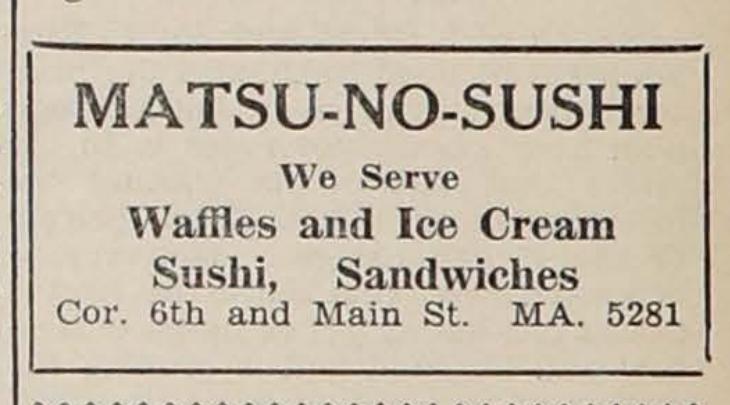
The early commercial record includes businesses whose menus do not fit a modern image of the specialist sushi bar. Densho's newspaper collection identifies a September 1929 Seattle advertisement for Matsu-no-Sushi offering sushi alongside waffles, ice cream and sandwiches. Sushi was one part of an establishment's offering, advertised to potential customers in the ordinary course of business. Densho collection record, Japanese American Courier newspaper file.
Hawaiʻi provides a different early setting. Kristopher Kozlowski's archival research identifies an I. Ogi sushi advertisement in the Hilo Tribune-Herald of June 8, 1932. In an oral-history interview many decades later, Robert Y. S. “Steamy” Chow remembered Ogi on Hilo's Mamo Street serving noodles and cone sushi, within a commercial district frequented by plantation workers. The advertisement supplies a dated business reference; Chow's recollection supplies the remembered street life around it. Kozlowski, Red, White, And Sushi, pp. 25–26, Chow interview, February 25, 1998, p. 7.
The range of preparations also matters. Carey D. Miller's Japanese Foods Commonly Used in Hawaii, published in November 1933, records inari-sushi and maki-sushi. The bulletin is period evidence of food knowledge in Hawaiʻi, then a U.S. territory; it is not a menu from Ogi's restaurant. Alongside the commercial records, it shows why an early sushi business should not automatically be imagined as a later raw-fish counter. Miller, Hawaii Agricultural Experiment Station Bulletin 68, pp. 37–38.
Mixed menus and community preparations establish an existing food economy. Sushi could be part of a meal, a shop's assortment or a neighborhood purchase. The later counter would reorganize preparation and service around a more specialized dining experience.
02 / History, Craft & ERS Heritage
War, displacement and rebuilding
The wartime removal and incarceration of Japanese Americans from the West Coast disrupted the communities in which restaurants, groceries and other food businesses operated. Executive Order 9066, signed on February 19, 1942, authorized military exclusion and became the basis for the removal. The consequences extended beyond a temporary interruption of restaurant service: proprietors were separated from their premises and the communities that sustained them. National Archives, Executive Order 9066.
Maneki in Seattle provides a business-level account. The restaurant's history describes its original premises being ransacked during the wartime removal. Wing Luke Museum's account places the postwar restaurant at a different location, among the businesses returning families helped reestablish. An enduring restaurant name therefore contains a history of dispossession and rebuilding, rather than proof of uninterrupted operation in unchanged premises. Maneki history, Wing Luke Museum, Nihonmachi Alley.
The national geography was uneven. Hawaiʻi experienced martial law and selective incarceration rather than the mainland West Coast's mass-removal pattern. Takeshi Matsui's research into New York's Japanese restaurants records businesses that remained open during the war despite harassment and diminished patronage. These differences are essential to an accurate national account. National Park Service, Honouliuli history, Matsui, “History of Japanese Restaurants in New York City”.
Postwar restaurant development took place within that changed landscape. Rebuilding an establishment, resettling in another city and forming a new business were distinct experiences.
03 / History, Craft & ERS Heritage
The postwar sushi counter takes shape
Shiro Kashiba remembered preparing sushi in the kitchen at Seattle's Tanaka and bringing it out, before his later work at a chef counter. In his memoir, he dates taking a job at Maneki and operating a full-service sushi bar there to 1970. The same account acknowledges sushi rolls in Seattle before his arrival. His counter was a particular development within an existing history of serving the food. Kashiba interview, North American Post, 2019, published memoir excerpt, Seattle magazine, 2011.
In New York, Restaurant Nippon opened in 1963 with sushi and tempura counters as part of a broader Japanese restaurant. Matsui's study connects its development to Japanese corporate business dining. The counter belonged to a restaurant with a particular clientele and range of dishes, rather than an isolated demonstration of an unfamiliar food. Restaurant Nippon history, Matsui's study.
Los Angeles was another important center of counter and trade development. Kozlowski identifies a March 14, 1961 Rafu Shimpo advertisement announcing a new Kawafuku sushi section for the following day, with service and takeout. Kozlowski, p. 58, note 186.
Jonas House's archival study of the years 1945–1970 identifies sushi offerings beyond the best-known Los Angeles establishments, including Chicago and New York restaurants. His findings encompass sushi on larger restaurant menus as well as specialist counter service. House, “Sushi in the United States, 1945–1970”.
The counter brought preparation, selection and service into a shared space with the guest. The chef's work became visible, and the working assortment became part of the dining experience. That arrangement helped give the sushi counter a recognizable restaurant identity. The fuller local account is covered in Los Angeles and the Development of American Sushi Restaurants.
04 / History, Craft & ERS Heritage
Sushi restaurants develop across the country
Four local histories
Different foundations for a restaurant business
- 1967Chicago
- Kamehachi
Family ownership, recruitment and air-freighted fish.
- 1972Atlanta
- Nakato
A broad Japanese offering and family succession.
- 1984Denver
- Sushi Den
Earlier restaurant work and seafood-purchasing connections.
- 1995Rochester
- California Rollin
Market selling and a neighborhood location.
Selected openings and commercial relationships from the dated accounts discussed in this section.
Chicago: ownership across generations
Marion Konishi opened Kamehachi in Chicago's Old Town in 1967. Her daughter Sharon Perazzoli recalls the family's settlement in Chicago after wartime incarceration in Arizona, the Japanese community around Old Town and Japanese business travelers visiting the city. Konishi recruited chefs from Japan and drove to O'Hare to collect air-freighted fish. Perazzoli and her daughter Giulia Sindler describe the subsequent generations of women maintaining the restaurant. Perazzoli and Sindler's family account.
The account places the proprietor at the junction of hospitality, recruitment and procurement. It also connects restaurant formation to postwar resettlement. The business was sustained through ownership and customer relationships.
Atlanta: a broad restaurant with continuing family leadership
Tetsuko Nakato founded her Atlanta Japanese restaurant in 1972. In a 2022 interview, her granddaughter Sachiyo Nakato Takahara described the family's difficulty securing ingredients and Japanese-trained cooks, and its recruitment of chefs who worked with the ingredients available in Georgia. Leadership passed through Hiroe Nakato to Takahara, who continued the hospitality emphasis while adopting newer reservation and ordering practices. Kris Martins's Nakato profile.
Takahara linked customer loyalty to a broad Japanese offering that included teppanyaki and sushi. Maintaining that breadth while changing how customers booked and ordered was part of the family's continuing restaurant business.
Denver: an inland restaurant built through existing connections
Sushi Den opened in December 1984. Amanda M. Faison's later reporting traces Toshi Kizaki's move through Los Angeles restaurant work into Denver and describes the value of his earlier seafood contacts. It also recognizes Japanese community food commerce that preceded the restaurant. Sushi Den developed within an existing regional history while extending its own purchasing relationships and customer following. Faison, “Den Masters,” May 2012.
Rochester: from market selling to a neighborhood restaurant
In 1997, the Rochester Business Journal reported that Tom “Kasai” Beaman had sold sushi at the Rochester Public Market before opening California Rollin Sushi Bar on South Clinton Avenue in September 1995. Beaman explained his choice of the street through its traffic and mix of businesses. Mary Chao's contemporary report.
The regional histories connect restaurant development to family succession, recruitment, procurement and an established place to sell. Relationships crossed regions, but proprietors put them to work in particular local settings: the Japanese community and business visitors around Chicago’s Old Town, an Atlanta restaurant’s returning customers, Denver’s purchasing connections and Rochester’s neighborhood traffic.
05 / History, Craft & ERS Heritage
The people and supply networks behind expansion
Working knowledge moved through several routes
Toshiaki Toyoshima described his path from contracted employment to restaurant ownership in a 2016 interview. Recruited through a chef association, he began work at Tokyo Kaikan in 1973, returned to Japan, came back under another contract and eventually decided to remain. He opened Sushi Gen in 1980. Toyoshima's recruitment account, Sushi Gen opening recollection.
Recruitment, workplace learning and succession carried working knowledge between businesses and generations. The history of sushi restaurant craft and objects is inseparable from that working context.
Distribution had roots beyond the sushi bar
Japanese-food distribution preceded the postwar specialist-counter publicity. JFC's history traces predecessor food businesses to the early twentieth century, before their later combination and corporate changes. These were broader food trades that subsequently served developing restaurant markets. JFC company history.
The relationship could also run from restaurant demand toward a new supply business. International Marine Products explains its 1968 formation through sourcing difficulties encountered after the opening of Tokyo Kaikan in 1963. In the company's account, importing seafood became a response to a restaurant's need for a more dependable supply. IMP, “Our Story”.
The histories reveal trade developing in both directions: established food distributors serving restaurants, and a restaurant's sourcing problem prompting a separate supply business. Finding products and maintaining a purchasing relationship were continuing functions, beyond arranging any single shipment.
Inland procurement could combine local and overseas relationships
Faison's 2012 Sushi Den report follows a purchasing visit to True World Foods in Commerce City. In a separate account published in 2013, Yasu Kizaki described his brother Koichi buying in Fukuoka for Sushi Den and Izakaya Den, negotiating with wholesalers and preparing fish for shipment. The local distributor and the family buying connection were both part of the restaurants' reported procurement. Faison's report, Yasu Kizaki's sourcing account.
The equipment and facilities supporting this trade have their own history, examined in How Sushi Restaurant Equipment & Supplies Have Evolved.
07 / History, Craft & ERS Heritage
Sushi becomes an everyday purchase
Supermarkets organized a different prepared-food service
Everyday sushi commerce had the older community roots already described. Later supermarket operations added a particular organizational arrangement: preparation and selling within a retailer's premises, supported by a specialist operator.
AFC began working with Vons in Southern California in 1986 and subsequently with H.E. Butt in San Antonio. Its corporate account describes retailers providing facilities while the sushi operator supplied ingredients and chefs. The arrangement brought together an existing selling location and a specialized food-service operation. AFC company history, Roseanne Harper's 2011 trade report.
Grocery customers could also request preparation to order. In Harper's report, Tracy Anthony of Clements' Marketplace in Portsmouth, Rhode Island, described customers requesting items that were not already in the case. Displayed selection and preparation to order could coexist in the supermarket setting. Supermarket News, March 28, 2011.
That distinction changes how the channel should be understood. The retailer relationship concerned people and production as well as shelf space. It could put a prepared-food operation inside an established shopping occasion without reproducing a conventional restaurant dining room.
Hissho offers another route into this business. Philip and Kristina Maung founded the company in Charlotte in 1998. Tonya Jameson's 2016 profile identifies Philip's migration from Burma and his earlier sushi-counter work at Harris Teeter. The profile also shows how training entered the retail operation: the reporter observed a trainer supervising cutting, assembly and presentation in a preparation kitchen. Jameson's Hissho profile.
The history of supermarket and grab-and-go sushi operations is therefore part of the restaurant supply economy, even though a grocery concession is not the same establishment as a full-service restaurant.
Affordable restaurants and takeout followed their own paths
Sushi buffets offered another purchasing arrangement. Max Jacobson's 2002 Las Vegas reporting describes Makino, Todai and Blue Wave serving sushi alongside other cold and hot dishes. At Makino, cooks replenished the sushi trays as customers selected their meals. The report records different lunch and dinner offerings and prices. Jacobson, “Fish story,” August 28, 2002.
The fixed-price meal depended on continuing preparation and replenishment, with the customer choosing from a wider assortment. Buffet service was distinct from a conveyor or a made-to-order all-you-can-eat restaurant.
Takeout also has a long record before app-based ordering. Chiba Japanese Restaurant in North Hollywood advertised sushi and takeout in the December 20–27, 1974 Pacific Citizen. That dated advertisement establishes an ordinary service option decades before the pandemic made off-premises operations a central national concern. Pacific Citizen, holiday issue, PDF page 15.
The commercial history includes customers buying food at markets, collecting it from restaurants, selecting it at retail counters and eating fixed-price meals. These settings distributed preparation, service and customer choice differently.
08 / History, Craft & ERS Heritage
Specialist counters, chains and a wider range of service
Wider availability did not produce one uniform restaurant. The modern field continued to differentiate through the menu, the way guests ordered and the organization of service.
Masayoshi Takayama opened Masa in New York in 2004 after his earlier Los Angeles restaurant work. The restaurant's own account places omakase at the center of its offering. Masa biography.
Kura Sushi USA established its U.S. company in 2008 and opened its first Irvine restaurant in 2009. Its fiscal 2025 filing describes revolving dishes alongside separately ordered express-belt service, supported by employee training and teams assisting new restaurant openings. The filing describes a restaurant group reproducing that service through both technology and staff. Kura Sushi USA, fiscal 2025 Form 10-K.
KazuNori concentrated on hand rolls. Matthew Kang's August 2014 opening report describes its downtown Los Angeles counter serving made-to-order sets of hand rolls. The form of the meal centered on successive preparation and service across the counter. Kang's contemporary report. Sushi Nozawa Group developed SUGARFISH, Nozawa Bar and KazuNori as distinct restaurants and dates its expansion into New York to 2016. Sushi Nozawa Group history.
Hatsuhana in New York dates its sushi-specialist opening to 1976. Its menu, checked in October 2026, offers customer-selected à la carte ordering alongside set meals and omakase. Hatsuhana history, Hatsuhana menu.
These restaurants locate choice and preparation differently. A chef-selected meal places the sequence with the chef; à la carte service lets the guest build an order. Hand rolls prepared and served successively and dishes selected from a revolving assortment offer still other ways to compose a meal.
The present operating distinctions between full-service sushi restaurants and omakase and chef's counters should likewise be established from the actual offering, rather than the restaurant's age or reputation.
09 / History, Craft & ERS Heritage
What today's sushi market inherits
The pandemic exposed the consequences of different service arrangements, but also showed that operations could change within the same business. Kura announced closure of its restaurants on March 18, 2020. Its August 24 update described dining and takeout at reopened locations where the primary conveyor remained unavailable and food was prepared to order. Kura's dated operating notices.
SUGARFISH's March 17 notice described pickup and delivery at SUGARFISH and KazuNori. Later notices announced Los Angeles dining-room reopening and then renewed closure, with off-premises service continuing. In a March 2021 oral history, Makino's Julie Kano explained another consequence of altered service: replacing ordinary self-service would require additional people to serve customers. SUGARFISH notices, Kano and Makino interview, p. 8.
The responses were specific to the businesses and their service arrangements. Moving a meal outside the dining room, changing how an order reached the guest and replacing self-service each changed the work required to serve customers.
That is the larger inheritance of American sushi restaurant history. Community food commerce preceded the celebrated counter. Regional proprietors built durable businesses through different relationships. Chefs, employees, buyers and distributors carried knowledge and products between workplaces and places. Restaurant groups and retail operators developed further ways to organize the work, while older forms of service remained part of the field.
The result is a market with several substantial histories, not one culminating format. Equipment and supply decisions should begin with the restaurant that will actually operate: its menu, preparation, service, purchasing and support needs. The Sushi Restaurant Equipment & Supplies Guide follows those requirements across the commercial field this history helped create.
10 / History, Craft & ERS Heritage
Sources and further reading
The sources linked throughout distinguish contemporary records, historical research, participant recollections and company accounts. These works offer useful routes into the underlying history:
- Jonas House, “Sushi in the United States, 1945–1970”, Food and Foodways 26(1), 2018, pp. 40–62.
- Takeshi Matsui, “History of Japanese Restaurants in New York City”, Japan Marketing Journal 42(4), 2023, pp. 16–26. Article in Japanese, with English metadata.
- Carey D. Miller, Japanese Foods Commonly Used in Hawaii, Hawaii Agricultural Experiment Station Bulletin 68, November 1933.
- Kristopher Lee Kozlowski, Red, White, And Sushi, master's thesis, Harvard University Division of Continuing Education, March 2024. The newspaper findings cited above are attributed to this research.
- JANM's Toshiaki Toyoshima interview, April 16, 2016, and UNLV's Kaku Makino and Julie Kano interview, March 22, 2021, for firsthand accounts of restaurant work and business decisions.