

Sushi Restaurant Concepts
Traditional Sushi Bars & Full-Service Sushi Restaurants
A table's sushi assortment, a counter guest's next order and a combination awaiting a cooked component can draw on the same chef, rice supply and refrigeration. The equipment schedule must accommodate those overlapping demands, including where finished food is collected and how its servingware returns.
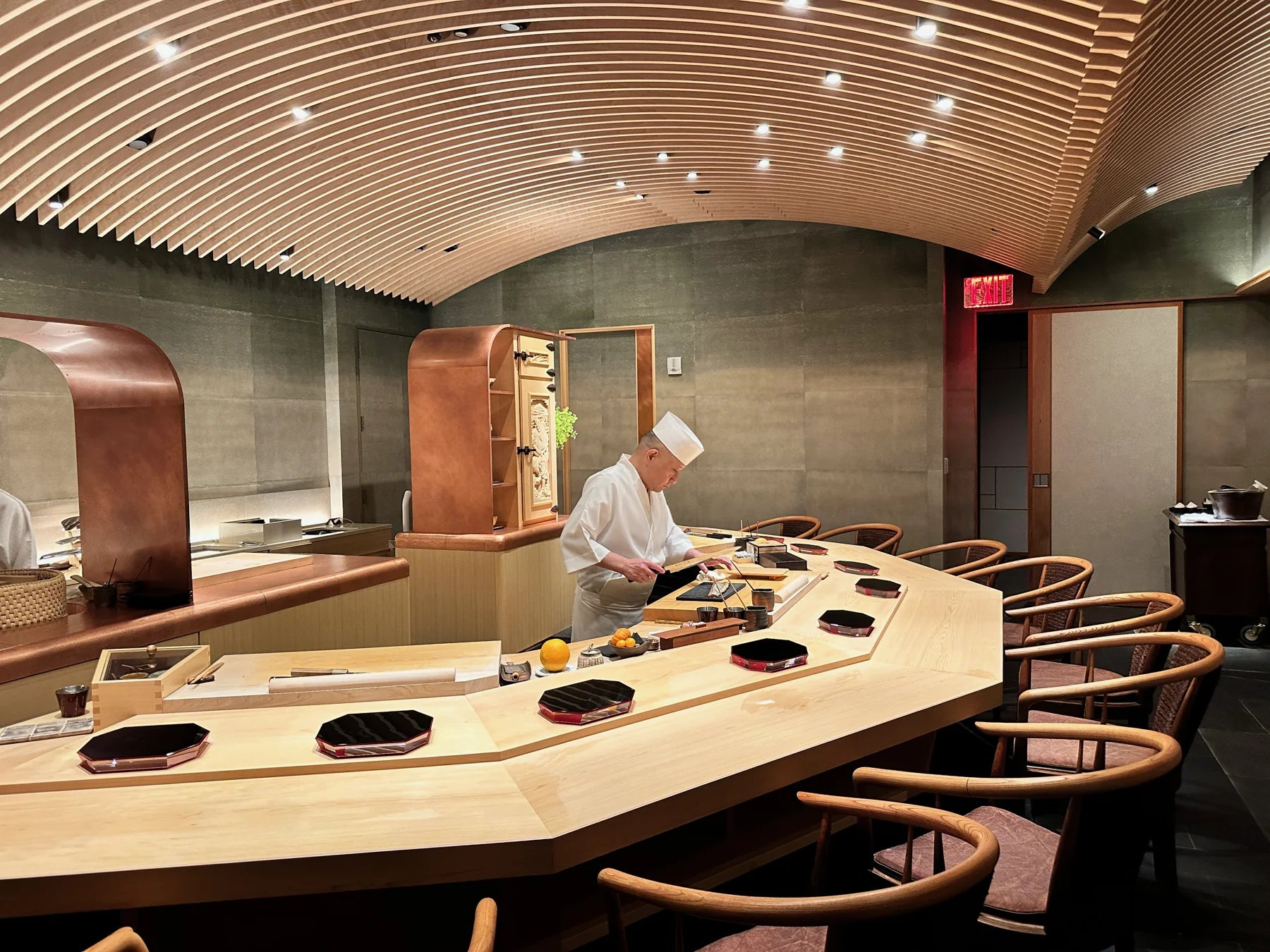
The visible sushi bar is only part of that purchase. Preparation behind it, the supporting hot kitchen, table service, beverages and warewashing determine whether the restaurant can deliver the menu it has chosen. Equip those relationships deliberately. Resolve those supporting duties before buying extra cooking or refrigeration capacity.
Traditional sushi bars and full-service sushi restaurants encompass different menus and room arrangements. The decisive questions are what the restaurant prepares, how it serves the food and which work the equipment must support throughout service.
In this guide 8 sections
02 / Sushi Restaurant Concepts
The counter, the pass and the dining room
Protect the working field from completed orders. A finished table assortment left on the cutting and assembly surface can obstruct the next order before the chef runs out of refrigerated ingredients or rice. Give finished food a deliberate destination.
Active preparation, direct handoff to a counter guest and server collection for the dining room are distinct duties. They do not necessarily require three separate counters. They do require an arrangement in which the chef can complete the next task and the server can identify, grasp and remove the intended presentation.
Brief the collection position with the actual ware. A single rectangle with an accompanying bowl, a divided box and a shared platter need different handling space. Include the carrying support if one is used. A surface that accommodates the empty vessel may still be awkward when that vessel is loaded and adjacent orders are waiting.
Assign the final check where production converges. The order information needs to preserve the selected components, modifications, destination and release intention. If a combination includes a chosen roll, checking the combination's name alone is insufficient. Proximity between the sushi station and hot kitchen does not decide who confirms that the meal is complete.
- 01Preparation
Sushi work and cooked-component completion
- 02Collection
Identify and complete the intended release
- 03Guest service
Direct handoff or carried presentation
Provide a receiving place for the replacement load.
Keep used returns clear of active preparation and finished food.
The actual positions depend on the menu, room and chosen presentation. These duties can share suitable space; the illustration is not a floor plan or a requirement for dedicated stations.
Replenishment belongs in the same layout discussion. Identify where a replacement rice vessel or prepared-ingredient container is received, where the emptied one goes and who makes the transfer while the chef is occupied. The supplier's pack, reserve-storage container and working vessel need not be the same object. Choose the receiving vessel for the work at the station rather than force bulk storage into the chef's immediate space.
Place clean servingware where it first becomes useful. If the hot station needs the final box before its component is ready, account for that movement. If the presentation is assembled beside the sushi station, provide for the cooked component to arrive there. Avoid a sequence in which the empty presentation repeatedly travels between stations simply because no one assigned its starting position.
Used-ware return also needs a destination clear of active preparation and finished-order collection. Its treatment and storage will depend on the chosen assortment; the immediate layout question is where it can arrive without taking over those working surfaces.
Ancillary takeout adds packing work to this arrangement. Assign packaging supply, a packing and checking surface, and the pickup destination when the same production serves both the room and off-premise orders. Assess the actual food in its intended container and closure; a dine-in plate fit establishes neither packaged fit nor performance during collection. Use the sushi takeout-container guide for the packaging selection.
03 / Sushi Restaurant Concepts
Preparation, rice and working refrigeration
Start with the ingredient received
Write the purchased form into the preparation specification. JFC's restaurant listing for bluefin akami saku, item 36351, identifies a prepared block with a frozen temperature field. That starting point differs from whole-fish breakdown; it does not establish that all trimming, portioning or controlled preparation for use has disappeared. JFC item 36351.
The same distinction applies to cooked ingredients. Azuma Foods' U.S. catalog includes cooked egg for sushi and seasoned kanpyo, shiitake and inari. Those products offer different retained work from producing the components entirely on site. Their catalog descriptions are procurement evidence, not complete storage or preparation instructions. Azuma Foods U.S. catalog.
A cooked block can still need portioning, an appropriate support and a destination for the prepared pieces. A component received ready for final assembly still needs controlled storage and accessible working supply. The commercial decision is which preparation has been removed and which remains. Specify the relevant tools, surface and receiving containers accordingly, whether that work occurs at the visible bar or in supporting preparation space.
Separate display, reserve and working access
Buy the reserve and closing provision with the display case. Hoshizaki expressly excludes overnight storage from the stated purpose of its HNC-150BA-L-SLH. That model-specific restriction makes the purchase question clear: where will retained ingredients go, and how will the working assortment be replenished during service? Hoshizaki HNC-150BA-L-SLH.
Specify the food in its actual container at each position. A block awaiting portioning and an arranged working assortment impose different retrieval demands. The display's visible length and the reserve cabinet's nominal volume do not settle container accommodation, access or transfer. Establish those before selecting from the refrigerated sushi-case assortment.
Operating access can materially exceed the closed footprint. Hoshizaki's UR48B-D4 specification lists a closed depth of 31 inches including the bumper and a depth of 52 inches with a drawer fully open, also including the bumper. The second figure describes the equipment in use; it is not an aisle requirement or an allowance for the employee. UR48B-D4 specification.
Check retrieval with the selected container and the surrounding work. An arrangement that fits every closed cabinet can still obstruct server collection when an ingredient drawer opens. Keep the equipment's labeled measurements, the person's task and the applicable site clearances separate in the specification.
Plan rice through the next usable batch
Establish the actual rice preparations and their points of use before combining demand. A broad menu does not automatically justify a separate cooker for each use. The relevant questions are when each batch becomes usable, where it is held and what equipment remains occupied while the next batch is needed.
Town's 57130/57131 sheet lists a 34-minute cook time for the 120 V model and separately calls for a further ten-minute rest before opening and serving. That is a manufacturer-specific cook/rest distinction, not a complete shari-production rate. Town rice-cooker specification.
Allow for unloading, the subsequent rice work and resetting the equipment. Tsuji Culinary Institute's documented sushi class, for example, shows cooked rice mixed with sushi vinegar and spread in a hangiri. Those steps occur after cooking and need their own working provision. Tsuji sushi-production account.
- Unload
- Mix with sushi vinegar / spread in hangiri
- Transfer to working supply
- Reset for the next batch
Cook and rest figures come from Town’s model-specific sheet. Subsequent duties are unquantified here; this is not a complete shari-production rate.
Treat cooking and holding as assigned duties. If the cooker is holding the current batch when the next batch must begin, decide whether separate holding, another cooker or a different production schedule addresses the conflict. A spare inner pan does not supply another powered cooking position. Use the commercial rice-cooker buying guide for equipment selection once those duties are established.
The receiving vessel also deserves a deliberate choice. Zojirushi's RDS range is non-electric and expressly suited to vinegar-containing sushi rice; the RDS-400 provides a 4 L example. Its manufacturer's water-retention test is not a sushi-rice service allowance. Select it for its documented function, then assess its access and replenishment in the proposed station. Zojirushi RDS specifications.
Equipment suitability and food-process control remain separate. FDA's 2026 model Food Code distinguishes vinegar added for flavor from controlled sushi-rice acidification. The establishment's adopted requirements govern; an acid-compatible vessel does not validate the process. FDA Food Code, Annex 6.
Finish the rice brief at the chef's working supply: who performs the transfer, where the receiving vessel stands, where the empty is placed and when the production equipment is available again. The rice holding guide develops the equipment choices. Size the arrangement against the restaurant's actual portions and demand rather than convert a raw-rice rating directly into a promised service output.
Explore the ERS collection
Refrigerated Sushi Cases
Compare the assortment for this part of your service.
-
 Image unavailable
Turbo Air SAK-50R-N 48" Stainless Steel Curved Glass Refrigerated Sushi Case - Right Side Condenser
View details & options : Turbo Air SAK-50R-N 48" Stainless Steel Curved Glass Refrigerated Sushi Case - Right Side Condenser
Image unavailable
Turbo Air SAK-50R-N 48" Stainless Steel Curved Glass Refrigerated Sushi Case - Right Side Condenser
View details & options : Turbo Air SAK-50R-N 48" Stainless Steel Curved Glass Refrigerated Sushi Case - Right Side Condenser
-
 Image unavailable
Hoshizaki HNC-180BA-L-SLH 70.9" Stainless Steel Curved Glass Refrigerated Sushi Case - Left Side Condenser
View details & options : Hoshizaki HNC-180BA-L-SLH 70.9" Stainless Steel Curved Glass Refrigerated Sushi Case - Left Side Condenser
Image unavailable
Hoshizaki HNC-180BA-L-SLH 70.9" Stainless Steel Curved Glass Refrigerated Sushi Case - Left Side Condenser
View details & options : Hoshizaki HNC-180BA-L-SLH 70.9" Stainless Steel Curved Glass Refrigerated Sushi Case - Left Side Condenser
-
 Image unavailable
Hoshizaki HNC-150BA-R-SLH 59.1" Stainless Steel Curved Glass Refrigerated Sushi Case - Right Side Condenser
View details & options : Hoshizaki HNC-150BA-R-SLH 59.1" Stainless Steel Curved Glass Refrigerated Sushi Case - Right Side Condenser
Image unavailable
Hoshizaki HNC-150BA-R-SLH 59.1" Stainless Steel Curved Glass Refrigerated Sushi Case - Right Side Condenser
View details & options : Hoshizaki HNC-150BA-R-SLH 59.1" Stainless Steel Curved Glass Refrigerated Sushi Case - Right Side Condenser
-
 Image unavailable
Turbo Air SAK-60R-N 60" Stainless Steel Curved Glass Refrigerated Sushi Case - Right Side Condenser
View details & options : Turbo Air SAK-60R-N 60" Stainless Steel Curved Glass Refrigerated Sushi Case - Right Side Condenser
Image unavailable
Turbo Air SAK-60R-N 60" Stainless Steel Curved Glass Refrigerated Sushi Case - Right Side Condenser
View details & options : Turbo Air SAK-60R-N 60" Stainless Steel Curved Glass Refrigerated Sushi Case - Right Side Condenser
-
 Image unavailable
Hoshizaki HNC-180BA-R-SLH 70.9" Stainless Steel Curved Glass Refrigerated Sushi Case - Right Side Condenser
View details & options : Hoshizaki HNC-180BA-R-SLH 70.9" Stainless Steel Curved Glass Refrigerated Sushi Case - Right Side Condenser
Image unavailable
Hoshizaki HNC-180BA-R-SLH 70.9" Stainless Steel Curved Glass Refrigerated Sushi Case - Right Side Condenser
View details & options : Hoshizaki HNC-180BA-R-SLH 70.9" Stainless Steel Curved Glass Refrigerated Sushi Case - Right Side Condenser
-
 Image unavailable
Turbo Air SAK-70L-N 71" Stainless Steel Curved Glass Refrigerated Sushi Case - Left Side Condenser
View details & options : Turbo Air SAK-70L-N 71" Stainless Steel Curved Glass Refrigerated Sushi Case - Left Side Condenser
Image unavailable
Turbo Air SAK-70L-N 71" Stainless Steel Curved Glass Refrigerated Sushi Case - Left Side Condenser
View details & options : Turbo Air SAK-70L-N 71" Stainless Steel Curved Glass Refrigerated Sushi Case - Left Side Condenser
-
 Image unavailable
Turbo Air SAS-50R-N 47¼" Straight Glass Refrigerated Sushi Case - Right Side Condenser
View details & options : Turbo Air SAS-50R-N 47¼" Straight Glass Refrigerated Sushi Case - Right Side Condenser
Image unavailable
Turbo Air SAS-50R-N 47¼" Straight Glass Refrigerated Sushi Case - Right Side Condenser
View details & options : Turbo Air SAS-50R-N 47¼" Straight Glass Refrigerated Sushi Case - Right Side Condenser
-
 Image unavailable
Turbo Air SAS-60R-N 59" Straight Glass Refrigerated Sushi Case - Right Side Condenser
View details & options : Turbo Air SAS-60R-N 59" Straight Glass Refrigerated Sushi Case - Right Side Condenser
Image unavailable
Turbo Air SAS-60R-N 59" Straight Glass Refrigerated Sushi Case - Right Side Condenser
View details & options : Turbo Air SAS-60R-N 59" Straight Glass Refrigerated Sushi Case - Right Side Condenser


04 / Sushi Restaurant Concepts
The sushi bar and the hot kitchen
Specify the cooking duty behind the menu item. Cooking a portion from raw, reheating a prepared component and applying a surface finish are different appliance jobs. Earlier component production may occupy equipment outside the busiest order interval while finishing remains part of every order.
Tsuji's sushi class documents anago simmered in advance and surface-finished before nigiri assembly. It is a concise example of those separate duties, not a commercial reheating or holding protocol. Buying a prepared ingredient may remove the earlier task while preserving the finish and transfer that follow. Tsuji's preparation sequence.
Demonstrate cooking equipment with the intended food: its portion, starting condition, coating or sauce, supporting vessel and required result. Browning a surface does not establish the intended internal cook. Include manipulation, removal and the receiving arrangement rather than ending the assessment when the appliance has produced an attractive sample.
Wet-batter work makes that requirement concrete. Pitco's FBG18 specification gives an 18 × 24-inch frying area; the family sheet describes a 3¼–5-inch cooking-depth range and a front provision for batter trays. Those details relate to the work of entering, manipulating and retrieving battered food. They do not establish how many complete sushi combinations the restaurant can serve. Pitco FBG18/FBG24 specification.
Use the same discipline for a grilled component. Its intended support, starting condition and removal matter alongside the appliance's heating method. Where that support occupies equipment shared with other dishes, include the occupied time in the service assessment. The menu's finished item count is not a measure of available appliance positions.
For a mixed combination such as the gozen described earlier, decide where cooked components join the sushi presentation and where the actual selected roll is checked. The hot station can receive the final vessel, or it can deliver its component to a presentation being assembled elsewhere. Choose the arrangement that makes the intended release workable, then locate the empty ware and receiving support accordingly.
A useful collection position lets the responsible person see what is missing and complete the order without moving it back through active stations. Check that access while refrigeration is open, ingredients are being replenished and another finished order is collected. A pass that works only between those activities is inadequately specified for the service.
Coordinate completion rather than start every station simultaneously. A combination intended to arrive together needs the appropriate sequence; deliberately coursed dishes need their separate releases. Do not compensate for an unresolved sequence by assembling food progressively earlier or prescribing a holding device at every handoff. Establish whether the exact food should wait there at all, under what controls and with what acceptable result.
Evaluate repeated orders through collection. Cooking may be adequate while the chosen roll, its presentation vessel or server collection is unavailable. Additional frying area addresses only a limitation in the frying duty. Identify where the work actually waits before increasing equipment capacity.
05 / Sushi Restaurant Concepts
Servingware for the complete meal
Start with the plates and bowls that will carry repeated service. Specialty pieces earn their place through the food and the intended setting; their presence is not a definition of a traditional restaurant.
The black porcelain JX288-B measures 8¾ × 5 inches. The black-and-white ceramic R215-B measures 11¼ × 5 inches across its outside length and width. The longer plate does not provide a greater listed outside width, and neither measurement establishes its usable food field.
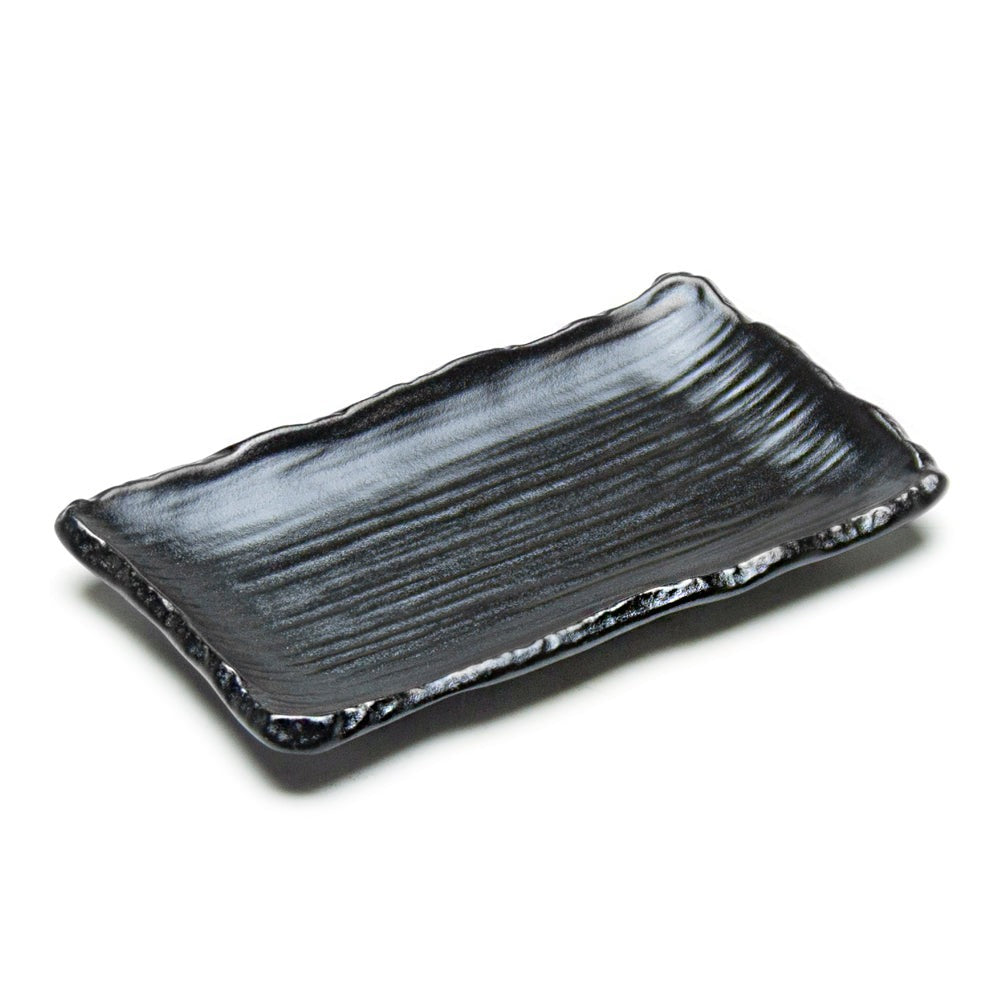
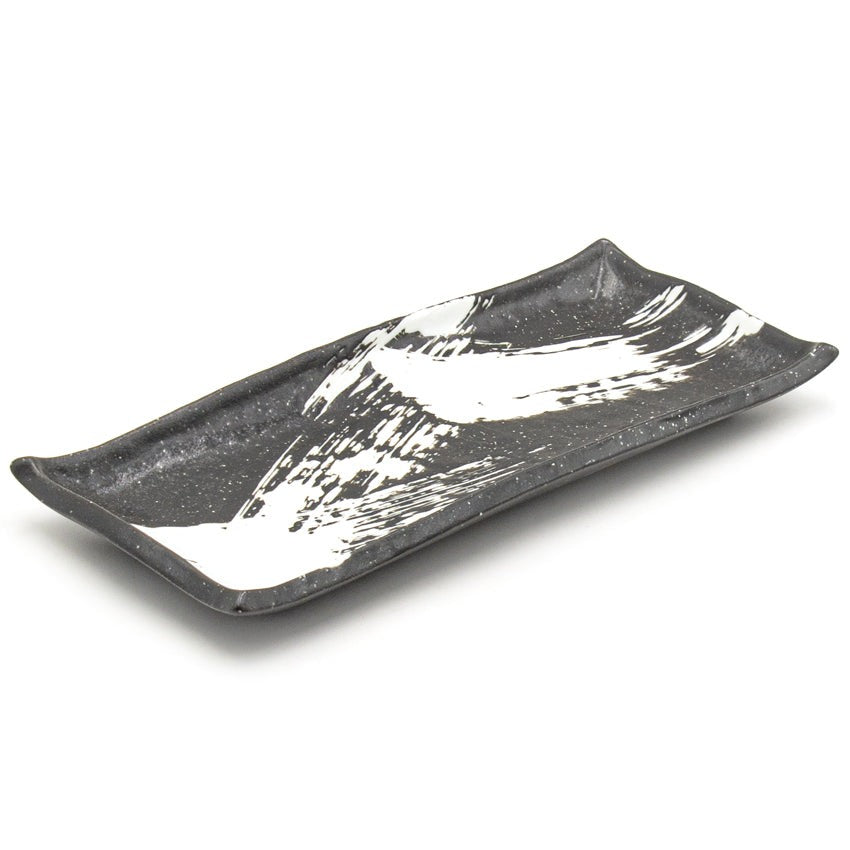
Product photographs shown separately; not to a common scale. Outside dimensions do not establish the usable food field.
| Model | Material | Length | Width |
|---|---|---|---|
| JX288-B | Black porcelain | 8¾ in | 5 in |
| R215-B | Black-and-white ceramic | 11¼ in | 5 in |
Plate the restaurant's actual assortment on the sample, including the garnish and accompaniments intended to share that vessel. Examine the area remaining inside the rim or raised features, access to the food and room to grasp the plate. Approve a repeated plate only after testing the different dishes expected to use it. A model's outside dimensions are not a universal sushi-piece capacity.
Give wet accompaniments their own check. A dressed vegetable, sauced cooked item or small soup service may need a bowl rather than more plate length. Evaluate the portion, room above the food, utensil access and movement of the loaded vessel. Outside diameter and height do not establish serving volume or spill resistance. The sushi and omakase tableware guide develops the wider assortment.
Shared presentations
The WO-17-7 oke provides a concrete shared-serving candidate: a 15½-inch-diameter vessel listed as plastic with lacquer. That specification does not supply a guest count, usable interior or loaded weight.
Assess the complete setting. The center vessel must coexist with the guests' receiving plates, necessary sauces and drinks, and permit the intended access to the food. Consolidating the food presentation does not necessarily consolidate the individual objects in use. Compare complete alternatives for the same meal rather than compare the price of one platter with one plate.
Include carrying and set-down in the sample approval. The loaded vessel must work with the proposed collection position, carrying method and table. These relationships require the actual sample; a catalog diameter alone does not prove them. The specialty sushi-servingware collection is the appropriate place to select the form once its job is clear.
Boxes, inserts and complete presentations
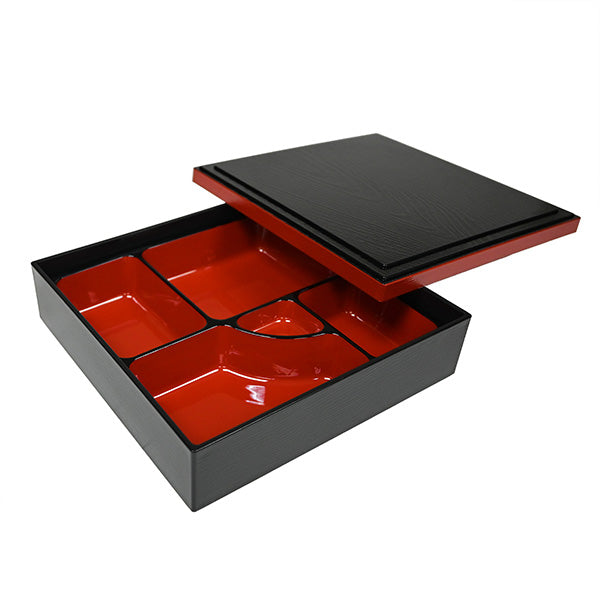
Listing includes lid and dividers.
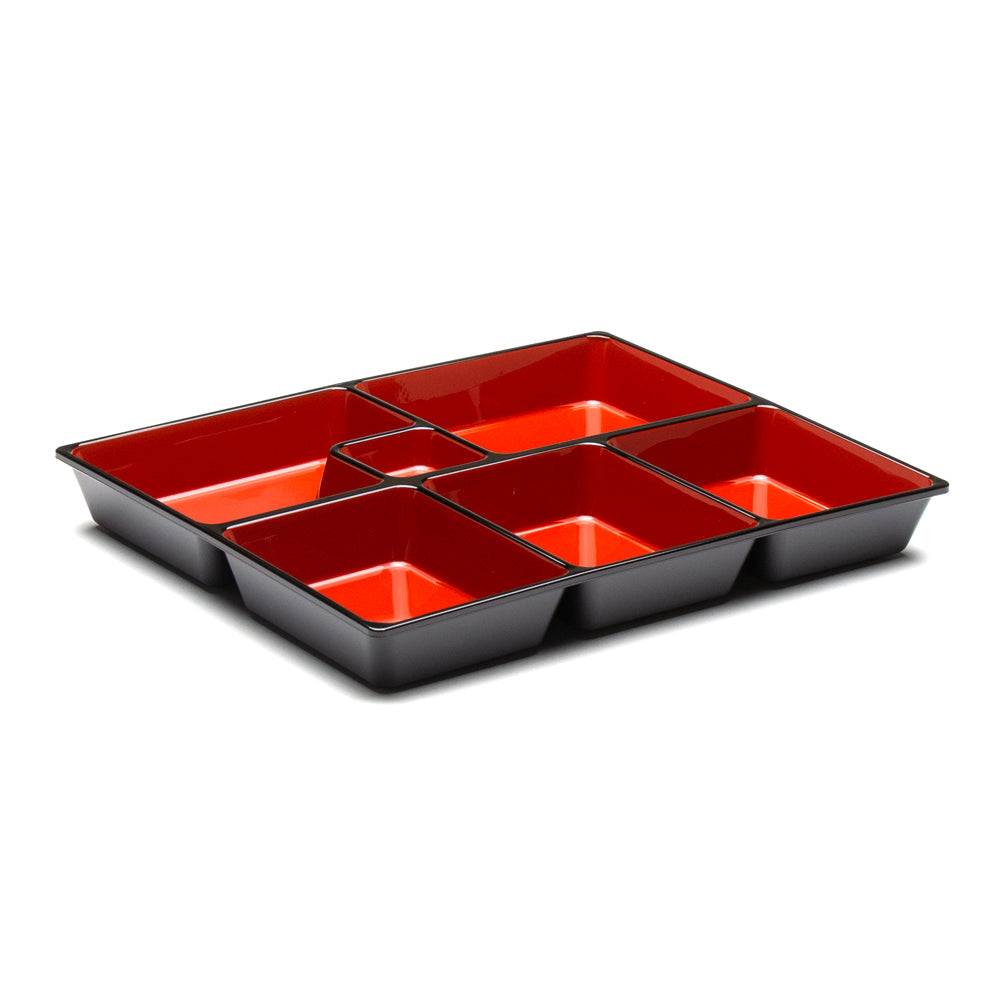
Inner tray identified for WZ12-B.
Different records: package contents and replacement identity. The designs are not established as interchangeable.
Package contents and replacement identity are different purchasing facts. The WT90-BX listing explicitly includes a lid and dividers. In another design, WZ12-B-D is explicitly identified as the inner tray for WZ12-B. These records establish what is supplied in one package and which part is named for another body; they do not make the designs interchangeable. ERS bento-box assortment.
Specify which pieces the intended presentation requires. A lid can be essential to one service and unnecessary to another. A separately listed replacement part does not prove that it is excluded from the original package. Keep the accepted assembly and component identities together in the purchase record, and require a proposed substitute to satisfy the actual serving and mating requirements.
Fixed compartments and separate small vessels also deserve different food trials. A fixed insert constrains the allocation within the box. Separate vessels allow components to change independently but add pieces to assemble, carry and return. Neither a division nor a lid establishes thermal isolation or leak resistance.
Approve the restaurant's intended meal in its actual presentation. A similar-looking commercial box is not evidence of a match to a named restaurant's service, and attractive empty ware is not a completed table setting.
Explore the ERS collection
Sushi Plates
Compare the assortment for this part of your service.
-
 Image unavailable
Melamine Rectangular Platter 13", Shiny White
View details & options : Melamine Rectangular Platter 13", Shiny White
Image unavailable
Melamine Rectangular Platter 13", Shiny White
View details & options : Melamine Rectangular Platter 13", Shiny White
-
 Image unavailable
8-1/2"x5-3/4" Rectangular Plate, White Ceramic
View details & options : 8-1/2"x5-3/4" Rectangular Plate, White Ceramic
Image unavailable
8-1/2"x5-3/4" Rectangular Plate, White Ceramic
View details & options : 8-1/2"x5-3/4" Rectangular Plate, White Ceramic
-
 Image unavailable
Melamine Rectangular Plate 13"x5", Ecus
View details & options : Melamine Rectangular Plate 13"x5", Ecus
Image unavailable
Melamine Rectangular Plate 13"x5", Ecus
View details & options : Melamine Rectangular Plate 13"x5", Ecus
-
 Image unavailable
Melamine Rectangular Plate 10"x4", Bamboo
View details & options : Melamine Rectangular Plate 10"x4", Bamboo
Image unavailable
Melamine Rectangular Plate 10"x4", Bamboo
View details & options : Melamine Rectangular Plate 10"x4", Bamboo
-
 Image unavailable
Melamine Rectangular Plate 7-7/8"x 5-1/2", Matte Black
View details & options : Melamine Rectangular Plate 7-7/8"x 5-1/2", Matte Black
Image unavailable
Melamine Rectangular Plate 7-7/8"x 5-1/2", Matte Black
View details & options : Melamine Rectangular Plate 7-7/8"x 5-1/2", Matte Black
-
 Image unavailable
8.25"X5.5" Rectangular Plate, White Ceramic
View details & options : 8.25"X5.5" Rectangular Plate, White Ceramic
Image unavailable
8.25"X5.5" Rectangular Plate, White Ceramic
View details & options : 8.25"X5.5" Rectangular Plate, White Ceramic
-
 Image unavailable
Melamine Rectangular Slate Platter 12-3/16, Soil Porcelain
View details & options : Melamine Rectangular Slate Platter 12-3/16, Soil Porcelain
Image unavailable
Melamine Rectangular Slate Platter 12-3/16, Soil Porcelain
View details & options : Melamine Rectangular Slate Platter 12-3/16, Soil Porcelain
-
 Image unavailable
10-1/2"x4" Rectangular Dish, White Ceramic
View details & options : 10-1/2"x4" Rectangular Dish, White Ceramic
Image unavailable
10-1/2"x4" Rectangular Dish, White Ceramic
View details & options : 10-1/2"x4" Rectangular Dish, White Ceramic


06 / Sushi Restaurant Concepts
Sake, tea and dining-room beverage service
Brief beverage work by the service offered. Chilled bottle service, warmed sake, routine tea refills and individually prepared infusions need different preparation and replenishment. Position the relevant clean vessels and supplies for the room they serve, and account for their return. A broader beverage offer should not consume sushi-assembly space by default.
The ERS-listed Taiji TSK-150CS uses a five-gallon cubic sake source and has a manual dispensing switch and an overspill tray. Choose the receiving ware and service position alongside the dispenser, allowing for source-container replacement, filling and removal of a filled vessel. Confirm the supplied unit's operating instructions before specifying the service. ERS TSK-150CS specifications.
That mechanism makes nominal bottle capacity an inadequate compatibility check. Demonstrate the chosen receiver with the actual unit under its applicable instructions. Decide whether it will also go to the table or whether the service requires transfer into different ware. A transfer, if chosen, adds a vessel and handling position; it should be an explicit service decision. Select the receiving and serving objects alongside the equipment in the sake-ware assortment, without assuming a bottle is compatible merely because it looks suitable at the table.
Tea adds a distinct assembly. Hario's CHJMN-45T has a manufacturer-labeled practical capacity of 450 ml and combines a glass pot and lid with a removable stainless-steel strainer. That is a defined vessel, not a fixed number of guests or refills. Hario specifications, ERS CHJMN-45T.
Producing hot water does not carry out the infusion service. Provide for the intended tea, preparation method, delivery and used-leaf disposal. A fresh pot, additional water on leaves already in use and a routine cup refill are different promises; choose which the restaurant offers and locate the corresponding work. The complete pot, lid and strainer must also return to use. Compare the wider teapot assortment against that service rather than select by nominal volume alone.
Explore the ERS collection
Sake Cups, Bottles & Warmers
Compare the assortment for this part of your service.
-
 Image unavailable
Taiji TSK-150CS Sake Warmer Dispenser 5-Gallon
View details & options : Taiji TSK-150CS Sake Warmer Dispenser 5-Gallon
Image unavailable
Taiji TSK-150CS Sake Warmer Dispenser 5-Gallon
View details & options : Taiji TSK-150CS Sake Warmer Dispenser 5-Gallon
-
 Image unavailable
Taiji TSK-150C Sake Warmer Dispenser 5-Gallon – Ivory
View details & options : Taiji TSK-150C Sake Warmer Dispenser 5-Gallon – Ivory
Image unavailable
Taiji TSK-150C Sake Warmer Dispenser 5-Gallon – Ivory
View details & options : Taiji TSK-150C Sake Warmer Dispenser 5-Gallon – Ivory
-
 Image unavailable
5-Gallon Electric Sake Warmer & Dispenser - NEC-1
View details & options : 5-Gallon Electric Sake Warmer & Dispenser - NEC-1
Image unavailable
5-Gallon Electric Sake Warmer & Dispenser - NEC-1
View details & options : 5-Gallon Electric Sake Warmer & Dispenser - NEC-1
-
 Image unavailable
Sake Warmer (TS-2)
View details & options : Sake Warmer (TS-2)
Image unavailable
Sake Warmer (TS-2)
View details & options : Sake Warmer (TS-2)
-
 Image unavailable
Sake Warmer (TSK-130B)
Image unavailable
Sake Warmer (TSK-130B)
Currently unavailable online
View details & options : Sake Warmer (TSK-130B) -
 Image unavailable
Plastic Sake Bottle Green Bamboo 13oz
View details & options : Plastic Sake Bottle Green Bamboo 13oz
Image unavailable
Plastic Sake Bottle Green Bamboo 13oz
View details & options : Plastic Sake Bottle Green Bamboo 13oz
-
 Image unavailable
Plastic Sake Cup Green Bamboo 2"x2"
View details & options : Plastic Sake Cup Green Bamboo 2"x2"
Image unavailable
Plastic Sake Cup Green Bamboo 2"x2"
View details & options : Plastic Sake Cup Green Bamboo 2"x2"
-
 Image unavailable
Sake Cup Plastic Green Bamboo 2"Dx1.3"H
View details & options : Sake Cup Plastic Green Bamboo 2"Dx1.3"H
Image unavailable
Sake Cup Plastic Green Bamboo 2"Dx1.3"H
View details & options : Sake Cup Plastic Green Bamboo 2"Dx1.3"H


07 / Sushi Restaurant Concepts
Washing, drying and returning the service
The selected tableware determines work behind the dining room. The JX288-B plate is listed for dishwasher use; the WO-17-7 oke specifies hand washing. Those are item-specific instructions, not rules for every porcelain or lacquered object. JX288-B care, WO-17-7 care.
Provide for the chosen presentation before making it central to the menu. The shared vessel needs an appropriate receiving position, permitted treatment, drying space and clean storage from which it can be retrieved. The correct decision may be to retain that presentation and support it, or to select a different documented object. A dishwasher purchase does not eliminate the other work by assumption.
Keep care permission, physical loading and repeated service distinct. A dishwasher-safe statement does not establish that an object can be suitably supported in a particular rack or loaded through a selected machine configuration. Nor does a nominal opening dimension establish the treatment of the complete assembly. Demonstrate the retained assortment, especially awkward shapes and small components, rather than approve the arrangement using only an easy load of plates.
The return area must accommodate the actual mixture. A broad vessel, a divided insert and a tea strainer belong to different guest presentations and can require different handling. Identify where used pieces arrive, where the permitted routes diverge and where the clean result waits. Keep that work from commandeering the sushi preparation or finished-order collection surface.
- 01At tables
- 02Returning
- 03Permitted treatment
- 04Drying / otherwise unavailable
- 05Ready for use
Use the actual objects and return pattern. No standard drying interval or seat-count percentage is assumed. A usable body alone does not establish a complete matching set.
FDA's 2026 model Food Code addresses manual washing, rinsing and sanitizing provision, accommodation of the largest ware or approved alternatives, and space for accumulated soiled and cleaned items. It also addresses air-drying or the specified adequate-draining provision and protected clean storage. Cloth drying is generally prohibited, with a limited polishing exception for already air-dried utensils. Apply the jurisdiction's adopted requirements and the selected objects' instructions; a catalog care label does not establish local compliance. FDA Food Code, §§4-301.12–.13, 4-901.11 and 4-903.11.
Drying and storage belong in the capacity assessment. They occupy space and keep ware unavailable after the washing step. Use the restaurant's actual objects and return pattern to assess that provision, rather than attach a standard percentage to the dining-seat count or assume an arbitrary drying interval.
Store the assortment so the next complete presentation can be identified and assembled. For a service requiring a matching box insert, a ready body without that insert is incomplete. The same applies to the intended tea assembly when its lid or strainer is unavailable. This is not a requirement to physically assemble every set in storage; it is a requirement to know which components are usable together.
Count availability across the whole interval: at tables, returning, undergoing treatment, drying or otherwise unavailable, and ready for use. A stock count of the largest pieces can overstate the number of meals the restaurant can present. The limiting part may be a less expensive insert or lid.
Add quantities against the demonstrated shortage. More bodies do not resolve an insert shortage. More ware does not automatically correct an unsuitable cleaning arrangement or a clean reserve that has not reached the working position. Follow the object until it is ready for its next intended service; stopping at the dishwasher exit understates the purchase.
08 / Sushi Restaurant Concepts
Buying the complete restaurant
Coordinate the selections that commit the site: counter fabrication, major refrigeration, supporting cooking, warewashing and the associated building services. Preserve the exact configuration and working access in the specification. Reconcile those decisions with the presentation and return assortment before construction assumptions become fixed. Project-specific engineering and applicable requirements still need their own resolution.
Approve the complete service sample before ordering deeply. For a box, that means the food and required components; for the sake dispenser, the actual receiver; for a shared presentation, the loaded vessel, individual ware and carrying arrangement. Include the return route. An attractive sample demonstrates presentation, while the intended repeated service reveals what the purchase must sustain.
Use the restaurant's actual menu mix and destinations for the operating demonstration. Include the replenishment, finishing, collection, beverage duties and returns that overlap. Identify why work waits before adding equipment. A missing receiving position, an occupied cooker and unavailable serving components call for different purchases.
Bring a supplier a brief that contains:
- Menu and preparation: incoming ingredient forms, retained production and order-time cooking or finishing.
- Service: counter and table destinations, combined releases, shared presentations, separate courses and any takeout.
- Working arrangement: preparation, collection, replenishment and return positions, with relevant site and access constraints.
- Equipment duties: reserve and working refrigeration, rice production and holding, and supporting hot-kitchen work.
- The accepted assortment: servingware and beverage assemblies, exact required parts, documented care, and the proposed washing, drying and storage provision.
- The basis for quantities: actual demand and sample/demonstration findings, together with unresolved configuration, order-unit and replacement questions.
Keep the quoted each, set, pack or case distinct from the number of complete presentations the restaurant intends to support. Record what a replacement line actually buys. Do not let similar appearance silently authorize a substitute where fit or equipment operation depends on the selected object.
Bring the complete brief to ERS. Specify the food, the room and the work first; then buy the equipment and supplies to deliver that service.