

Sushi Restaurant Concepts
Supermarket, Grocery & Grab-and-Go Sushi Operations
A retail sushi program is an assortment of complete packs that customers must be able to recognize, select and buy. The equipment has to support the food inside those packs, the space they occupy, the information they carry and the work required to replace them throughout the selling period.
That work varies considerably. An in-store team may prepare rice, assemble rolls and pack the finished assortment. Another outlet may finish supplied components. A receiving-only location may take delivery of sealed, labeled product ready for its retail operation. These arrangements need different equipment orders, even when the customer-facing displays look similar.
Start with the merchandise and the work retained at the outlet. Then select the display, receiving and reserve provision, preparation equipment where required, and the means of keeping every pack correctly identified. The purchase is complete when the operation can refill, clean, handle an interruption and return to readiness, not simply when the cabinet is delivered.
Eden Restaurant Supply has supplied Japanese and sushi restaurants from Los Angeles since 2002. This guide brings the purchasing decisions together through real equipment, package specifications and the operating requirements of customer-selected retail sushi.
Go directly to: Merchandising refrigeration · Receiving and reserve · On-site preparation · Printing and weighing
In this guide 12 sections
01 / Sushi Restaurant Concepts
1. Choose the retail operating arrangement
The most useful first question is what arrives completed. A branded kiosk, supermarket-operated counter and commissary-supplied department can retain very different amounts of preparation, packing and stock handling.
Public programs demonstrate the range. SNOWFOX offers kiosks, direct-store delivery and commissary-based alternatives. Bento distinguishes on-site preparation from supplied grab-and-go products, including shelf-ready packs for locations without on-site chefs. These are genuine alternatives to equipping every outlet as a production kitchen. Their public descriptions do not, however, allocate every outlet duty or define an individual store's installation. SNOWFOX retailer programs, Bento U.S. partnerships.
Scroll to read all columns
| Arrangement | Work retained at the outlet | Equipment and supply consequences |
|---|---|---|
| Preparation and packing in store | The specified ingredient preparation, rice provision, forming/assembly, finishing, closure and identification | Working refrigeration and surfaces, task-specific tools or machinery, complete packing provision, suitable finished-stock handling and display |
| Prepared components received for finishing | The actual portioning, assembly, topping, packing or identification still required | Storage for the supplied component form and equipment for those remaining tasks; not automatically a full production line |
| Sealed shelf-ready packs received | Acceptance, any retained cooling, reserve, transfer, display, refill and withdrawal | Receiving and storage provision, compatible handling, customer-access merchandising and continuing supplies; additional printing only where locally required |
Define the component-finishing arrangement precisely. Prepared fish portions, cooked fillings and completed retail packs are different incoming products. The word “prepared” is not enough to decide which refrigerator, surface, utensil or label process the outlet needs.
Put responsibility into the equipment scope
The actual operating agreement should identify who supplies and controls:
- Premises, utilities and shared preparation or cleaning facilities.
- Equipment, compatible accessories and service access.
- Product specifications, approved ingredient information and applicable dates.
- Retail packs, labels and other required consumables.
- Replenishment, condition checks, markdowns and removal from sale.
- Cleaning, maintenance, repairs and the response to unavailable equipment.
These decisions affect the quote. A display supplied by a program partner may still need electrical work, reserve storage or a retailer-managed refill arrangement. An outlet receiving finished product still needs somewhere to place accepted stock and somewhere suitable for product removed during cleaning.
Specify the retained work before accepting a standard kiosk package. A receiving-only operation should not acquire rice machinery by default. Equally, local finishing should not be treated as equipment-free because the major ingredients arrive prepared.
Customer-specific pickup and delivery orders add a separate production and dispatch requirement, covered in Takeout, Delivery & Sushi-Only Production Kitchens. Upstream manufacture and allocation belong in Sushi Commissaries, Central Kitchens & Multi-Location Production. A broader hotel or food-hall operating arrangement belongs in the hospitality-program reference. Here, the purchase follows the self-selected retail assortment and the work retained at its outlet.
02 / Sushi Restaurant Concepts
2. Define the assortment and retail pack
A topped roll, nigiri assortment and poke bowl place different demands on the same department. H-E-B's published assortment illustrates the distinction: its San Antonio roll is a topped, cooked product; salmon nigiri presents individual fish-and-rice pieces; and its salmon poke bowl brings several components together with separate sauce. These product forms create different finishing, closure, headroom and handling questions. They do not establish a standard assortment for every store. San Antonio roll, salmon nigiri, salmon poke bowl.
Scroll to read all columns
| Selling unit | What the equipment specification must accommodate |
|---|---|
| Topped cut roll | Finished topping height, closure without contact, a usable viewing area and space for finishing before the lid is applied |
| Nigiri or mixed assortment | The actual piece arrangement, interior support, accompaniments and preservation of presentation during transfer and selection |
| Bowl with separate sauce | Bowl height and closure, the complete sauce provision, shelf clearance and a handling arrangement suited to the loaded unit |
Measure the closed selling unit
Package dimensions deserve exact reading. South Plastic Industry lists its SPI-1.5B PS base at 213 × 133 × 20 mm and the matching SPI-1.5F OPS lid at 220 × 140 × 31 mm. The matching lid is wider and longer than the base. A shelf calculation using only the base can therefore be wrong before any food is loaded. The two component heights cannot simply be added to establish closed height; their engagement and overlap also matter. SPI-1.5B, SPI-1.5F.
Approve the actual loaded sample: food arranged as sold, matched closure, included accompaniments and intended labels. Measure its widest external point and closed height. Check that the lid clears toppings, the pack closes securely and the customer can remove it without dislodging neighboring stock.
Visibility also needs the complete sample. A clear lid is useful only where the food and label arrangement preserve a useful view. An anti-fog material description does not establish the appearance of a particular product after packing, reserve holding and display. Sauce movement, moisture, labels and food height can change the result.
The sushi-container buying guide and size and shape guide cover the wider container selection. For retail merchandising, carry the chosen pack's actual external envelope and orientation into the case specification.
Assortment, facings and refill quantity are different decisions
More distinct products require more identifiable positions. More facings give a product more visible frontage. More packs prepared or delivered at once create a larger stock position, which may belong in protected reserve rather than on display.
A cabinet can have sufficient room for the total number of packs yet present the assortment poorly. Conversely, a wide display can show the products well while a large delivery exceeds the available reserve provision. Specify what must be available together, which products need frontage and what quantity must wait between reliable refill opportunities.
The sound purchasing sequence is to settle the complete pack, its intended presentation and the simultaneous assortment before accepting a packs-per-cabinet promise.
03 / Sushi Restaurant Concepts
3. Establish product condition and selling limits
Incoming components, treated rice and finished sushi are different products at different stages. Their handling requirements must survive assembly, packing, receipt and merchandising.
FDA's 2026 Food Code Annex 6 distinguishes vinegar added for flavor without pH monitoring from controlled rice acidification. It also makes clear that acidified rice does not remove the refrigeration requirement of rolls containing other TCS fillings. The Food Code is a model offered for jurisdictional adoption; the applicable local requirements and approved process govern the outlet. FDA Food Code 2026, Annex 6 §4, pp. 565–566.
A cooked filling is not evidence that the completed pack is shelf-stable. Likewise, treating rice does not establish the condition or permissible selling period of the seafood, sauce or finished assortment.
Establish the basis for the selling period
Four considerations can constrain one retail pack:
Scroll to read all columns
| Basis | What it determines |
|---|---|
| Applicable controls and approved process | The conditions under which the actual food can be prepared, held and offered |
| Supplier instructions | The handling and dating basis of the particular supplied product |
| Product-quality acceptance | Whether the completed product remains commercially acceptable within its permitted conditions |
| The operator's merchandising decision | How long the store elects to offer it within those governing limits |
Obtain the supplied product's date definitions and handling instructions, including the required remaining selling period at receipt. A supplier's proprietary product-life claim belongs to that product and process. It cannot be transferred to a store-made recipe or interpreted as a new allowance beginning when a delivery arrives.
Where date-marking provisions apply, preparation or opening, earlier ingredients and safety-based manufacturer dates can constrain the finished food. The FDA model's maximum is not a recommended sushi life. Repacking, assembly or receipt must not erase the relevant product history. FDA Food Code 2026, §3-501.17.
Provide any cooling before merchandising
Identify the condition in which stock enters each appliance. If the process requires a temperature change, provide a suitable method for that actual food, package and load. A storage range, controller setting or rapid-cooling feature does not demonstrate that a delivery or production batch will reach its required condition within the applicable period.
This distinction is especially important with merchandising equipment restricted to pre-chilled loading. Increasing the display's size does not supply a missing cooling process.
California provides a precise display warning. Section 113996(d)'s conditional serving-line and salad-bar allowance above 41°F and no higher than 45°F expressly excludes a display case from the serving-line definition for that provision. A grocery merchandising case cannot borrow that exception. The separate receiving rule is addressed in section 6. California Retail Food Code 2026, §113996(d).
Evaluate the actual product under its permitted conditions
Chilled-rice texture deserves deliberate evaluation. A primary study of vinegar-treated rice found greater textural changes under refrigerated storage, but it examined rice rather than a completed retail sushi pack. It does not establish a finished-sushi life or justify warmer display. Lee, Kim and Song, 2016.
Evaluate the products the outlet will actually sell, in their actual packaging and intended compliant storage/display conditions. Relevant observations include rice texture, topping presentation, moisture or sauce migration, closure and the condition of separate components. Use those findings to improve the assortment and replenishment choice. Appearance and taste do not validate microbiological safety or extend a governing limit.
Provide suitable product-temperature measurement and, where the approved retained process requires it, a suitable pH method with its calibration, cleaning and storage supplies. A cabinet display is not a measurement of every pack. The method must suit the food and package; sealed retail stock does not call for indiscriminate puncturing.
The broader Equipment Specifications, Food-Safety Controls & Commercial Requirements reference addresses detailed approval and control questions. For this purchase, establish the required product condition first and buy equipment that can demonstrably perform the assigned duty.
04 / Sushi Restaurant Concepts
4. Select customer-access merchandising refrigeration
Choose the access arrangement from the merchandise, customer selection and store position. Enclosed upright cabinets, open multidecks and low remote cases are different commercial propositions. Their nominal volumes are not a useful common ranking.
Scroll to read all columns
| Format | Strong reason to select it | Purchase-defining questions |
|---|---|---|
| Enclosed glass-door upright | A contained display with an assortment that can be presented clearly within the available shelf frontage | Door movement, shelf positions, retrieval from depth, readable labels and the actual packaged-food application |
| Open-front multideck | Broad visible frontage and direct selection without opening a door | Air-curtain protection, store ambient conditions, drafts, load limits and the depth consumed by each package orientation |
| Low configured self-service case | A purpose-planned retail installation with application, deck and presentation choices | Exact food application, front/deck/shelf configuration, refrigeration provision and complete site-work scope |
A chef-facing refrigerated neta showcase is a separate equipment category. Its ingredient access and food supports do not make it an automatic substitute for a customer-access packaged-product merchandiser. See Sushi Display Cases & Refrigerated Neta Cases for that counter-facing purchase.
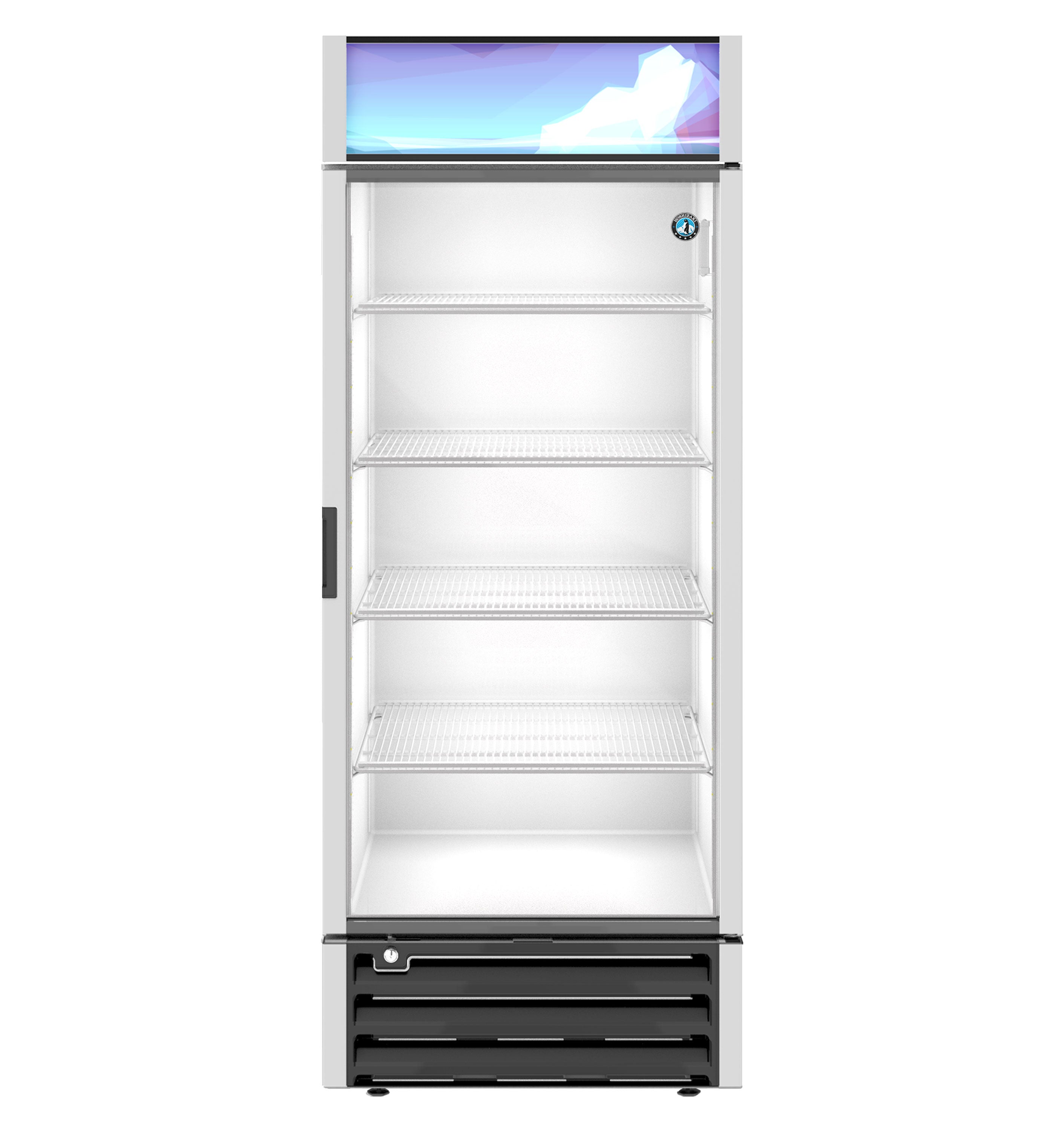
Enclosed display: Hoshizaki RM-26-HC
Hoshizaki identifies the RM-26-HC for packaged and bottled products. Its current-linked sheet provides five shelves with product stops and a nominal 25¾ × 24-inch shelf field. That is the useful starting point for comparing closed packs and shelf positions; bottle capacity is not sushi capacity. Hoshizaki RM-26-HC, model sheet.
Choose an enclosed format when the assortment can remain visible and accessible through the door arrangement and the store can accommodate door travel, refilling and service. Test the deeper positions as carefully as the front row. A pack that fits behind another pack still has to be identified and retrieved sensibly.
The ERS RM-26-HC listing provides an exact commercial route for the silver model. Specify the actual options, application, site requirements and offered scope with the order.
Open multideck: the TOM-60DXB-N technical example
Turbo Air's documented TOM-60DXB-N arrangement has four shelves measuring 57⅛ × 16 inches. Its frontage is substantially different from a single-door upright, but the 16-inch shelf depth remains a real package-orientation constraint. Its stated environment does not exceed 75°F and 55% relative humidity, and the installation documentation warns about airflow from vents, fans and doorways. TOM-60DXB-N, model sheet.
Select open-front merchandising where direct access and assortment presentation justify it, and locate the chosen case where its specified environment can be maintained. A visually attractive position beside an entrance or strong air outlet can be the wrong equipment position. Price signs, added racks and product loading must preserve the case's air paths.
Model purchasing status, checked October 12, 2026: Turbo Air's notice posted October 7 reports a sales halt pending a CEC audit and lists both TOM-60DXB-N and TGM-23SD-N6. They remain technical examples here; a current purchase recommendation requires verification of the applicable release. The CEC program concerns California sales, while the manufacturer's notice does not explicitly limit its pause geographically. It establishes neither nationwide prohibition nor outside-California clearance, and supplies no separate effective date or use prohibition. Manufacturer notice, CEC program scope.
Configured low display: Hussmann Q2-SSM-R
Hussmann's Q2-SSM-R illustrates a different purchase: a remote self-service case with application and presentation choices. The documentation distinguishes deli from meat/sushi applications and offers shelf, deck, front and related options. Specify the application and supplied arrangement together. Q2/Q3 family.
The Q2 application sheet specifies Type I conditions. A family brochure also mentioning Type II does not give every configuration the higher ambient rating. Nor do evaporator or discharge-air figures prescribe the temperature of the food. The selected application sheet and current submittal belong with the quotation. Q2 application data.
A remote arrangement is worth specifying when the store is planning the supporting refrigeration and site work as part of the retail installation. It is not simply a different cabinet to plug into the same position.
Load the product the case was designed to hold
Hussmann specifies pre-chilled product. Hoshizaki's RM manual prohibits warm or hot loading; the TOM manual separately prohibits hot-product loading. These cases require a suitable stock condition before merchandising. Their holding duty must remain distinct from any receiving or production cooling duty. Hussmann manual, Hoshizaki RM manual, TOM manual.
Use the ERS merchandisers collection after defining the application, access and occupied arrangement. For the wider cold-chain purchase, continue with Seafood Refrigeration, Freezers & Cold-Chain Equipment.
Explore the ERS collection
Glass Door Merchandiser Refrigerators
Compare the assortment for this part of your service.
-
 Image unavailable
Turbo Air TGM-22RV-N6 28¾″ One-Door Swing Glass Merchandiser Refrigerator — White
View details & options : Turbo Air TGM-22RV-N6 28¾″ One-Door Swing Glass Merchandiser Refrigerator — White
Image unavailable
Turbo Air TGM-22RV-N6 28¾″ One-Door Swing Glass Merchandiser Refrigerator — White
View details & options : Turbo Air TGM-22RV-N6 28¾″ One-Door Swing Glass Merchandiser Refrigerator — White
-
 Image unavailable
Hoshizaki RM-26-HC-BLK 29.75" Black Glass Door Merchandiser Refrigerator
View details & options : Hoshizaki RM-26-HC-BLK 29.75" Black Glass Door Merchandiser Refrigerator
Image unavailable
Hoshizaki RM-26-HC-BLK 29.75" Black Glass Door Merchandiser Refrigerator
View details & options : Hoshizaki RM-26-HC-BLK 29.75" Black Glass Door Merchandiser Refrigerator
-
 Image unavailable
Turbo Air TGM-50RSB-N 55⅞″ Two-Door Swing Glass Merchandiser Refrigerator — Black
View details & options : Turbo Air TGM-50RSB-N 55⅞″ Two-Door Swing Glass Merchandiser Refrigerator — Black
Image unavailable
Turbo Air TGM-50RSB-N 55⅞″ Two-Door Swing Glass Merchandiser Refrigerator — Black
View details & options : Turbo Air TGM-50RSB-N 55⅞″ Two-Door Swing Glass Merchandiser Refrigerator — Black
-
 Image unavailable
Hoshizaki RM-49-HC 60" Silver Glass Door Merchandiser Refrigerator
View details & options : Hoshizaki RM-49-HC 60" Silver Glass Door Merchandiser Refrigerator
Image unavailable
Hoshizaki RM-49-HC 60" Silver Glass Door Merchandiser Refrigerator
View details & options : Hoshizaki RM-49-HC 60" Silver Glass Door Merchandiser Refrigerator
-
 Image unavailable
Turbo Air TGM-72RSB-N 78″ Three-Door Glass Merchandiser Refrigerator — Black
View details & options : Turbo Air TGM-72RSB-N 78″ Three-Door Glass Merchandiser Refrigerator — Black
Image unavailable
Turbo Air TGM-72RSB-N 78″ Three-Door Glass Merchandiser Refrigerator — Black
View details & options : Turbo Air TGM-72RSB-N 78″ Three-Door Glass Merchandiser Refrigerator — Black
-
 Image unavailable
Hoshizaki RM-65-HC 78" Silver Glass Door Merchandiser Refrigerator
View details & options : Hoshizaki RM-65-HC 78" Silver Glass Door Merchandiser Refrigerator
Image unavailable
Hoshizaki RM-65-HC 78" Silver Glass Door Merchandiser Refrigerator
View details & options : Hoshizaki RM-65-HC 78" Silver Glass Door Merchandiser Refrigerator
-
 Image unavailable
Turbo Air TGM-35R-N 41⅜″ Two-Door Sliding Glass Merchandiser Refrigerator — White
View details & options : Turbo Air TGM-35R-N 41⅜″ Two-Door Sliding Glass Merchandiser Refrigerator — White
Image unavailable
Turbo Air TGM-35R-N 41⅜″ Two-Door Sliding Glass Merchandiser Refrigerator — White
View details & options : Turbo Air TGM-35R-N 41⅜″ Two-Door Sliding Glass Merchandiser Refrigerator — White
-
 Image unavailable
Hoshizaki RM-45-SD-HC-BLK 51" Black Sliding Glass Door Merchandiser Refrigerator
View details & options : Hoshizaki RM-45-SD-HC-BLK 51" Black Sliding Glass Door Merchandiser Refrigerator
Image unavailable
Hoshizaki RM-45-SD-HC-BLK 51" Black Sliding Glass Door Merchandiser Refrigerator
View details & options : Hoshizaki RM-45-SD-HC-BLK 51" Black Sliding Glass Door Merchandiser Refrigerator


05 / Sushi Restaurant Concepts
5. Fit the display to the package and store
4 bases = 532 mm
4 lids = 560 mm · exceeds the nominal width by 13.9 mm
The shelf field is more useful than the cabinet's nominal volume, but even shelf dimensions are only the beginning. Permitted shelf positions, product stops, load boundaries, air paths and customer access determine the usable arrangement. Hoshizaki's RM manual, for example, requires product on properly installed shelves rather than the cabinet floor and calls for space around products for circulation. RM instruction manual.
Two calculations show why the closed pack must be specified with the case. Both use published nominal dimensions. They reject particular straight, nonoverlapping arrangements; they are not measured packouts or approved planograms.
Four bases can appear to fit where four lids do not
The TGM-23SD-N6 sheet gives a 21½-inch shelf width, equivalent to 546.1 mm. Four SPI-1.5B base widths at 133 mm total 532 mm. Four matching SPI-1.5F lid widths at 140 mm total 560 mm.
The base-only calculation appears to leave room. The matching lids exceed the nominal shelf width by 13.9 mm, before allowing spacing or retrieval clearance. This rejects that row. It does not prove that a three-pack row, a staggered layout or any total cabinet capacity is approved. TGM sheet, SPI base, SPI lid.
Frontage cannot repair a depth conflict
The TOM's nominal 16-inch shelf depth equals 406.4 mm. Two 220-mm SPI lid lengths placed end to end need 440 mm, exceeding that depth by 33.6 mm. A wide shelf does not make that orientation fit. Turning the packs changes the frontage they consume, the product presentation and the position from which the label is read. TOM sheet, SPI lid.
These are useful rejection tests before a quotation becomes an order. A positive capacity claim requires more: actual closed height, shelf elevations, allowed occupied field, labels, retrieval movement and permitted accessories.
Approve the merchandise and information together
Load the intended assortment with its actual labels. Check the front and deeper positions, the top and lower shelves, and the movement needed to take a pack out. Preserve required information without forcing repeated lifting or rearrangement simply to identify stock.
Price channels, signs, dividers and risers belong in this check. Hussmann specifically warns against obstructing discharge/return paths and against unapproved racks or shelves that interfere with its air curtain. A sign can obstruct a critical position even when the food remains inside the shelf edge. A reusable tray that helps with back-room movement is not automatically suitable as a display accessory. Q2 loading instructions.
Use model-specific accessories where required. Hoshizaki's RM-26-HC sheet identifies HS-5292 price-tag holders and HS-5317 additional epoxy shelves. Those identities are more useful than a generic request for “extra shelving.” Additional shelves still need an arrangement compatible with the actual pack height, access and circulation. RM-26-HC sheet.
Reserve space for the equipment in use
The RM-26-HC sheet tabulates 29¾-inch closed depth and 58¼-inch depth with the door open; its linked manual calls for at least eight inches behind the cabinet. Door travel and rear provision can therefore consume substantially more space than the closed body suggests. Use the current approved dimensional submittal for final fit: the manufacturer's published dimensional fields are not wholly consistent. RM sheet, RM manual.
Apply the same discipline to projections, spacers, service access and enclosures. The TOM manual and model sheet give different rear/top clearance statements; obtain the model-specific installation requirements rather than selecting the smallest convenient figure.
Place the case where customers can select, staff can refill and service personnel can reach the equipment without defeating its operating conditions. Approve the occupied arrangement and the store position together. A cabinet that physically fits an alcove can still be a poor retail installation.
The manufacturer’s published dimensional fields are not wholly consistent. This diagram identifies planning obligations; it does not resolve the final installation dimensions.
06 / Sushi Restaurant Concepts
6. Receive and stage stock for replenishment
A receiving-only outlet needs a complete route from delivery to retail refill. The supplier may perform preparation and packing; the outlet still has to accept the right product, maintain its condition and identity, and move it into a permitted display arrangement.
California requires inspection as soon as practicable after receipt and before use, storage or resale. Acceptance therefore precedes putting stock into its assigned storage positions. The inspection basis includes the actual source, condition, package integrity and temperature requirements. California Retail Food Code 2026, §114035.
A finished pack can still arrive with a cooling duty
California §114037(a) permits refrigerated potentially hazardous food to be received at 45°F or below if cooled to 41°F or below within four hours, subject to subdivision (b). Subsection (f) separately requires no evidence of previous temperature abuse. This is a receiving provision, not permission for warmer retail display. The FDA model's general refrigerated TCS receiving limit is 41°F or below, with specified exceptions. California §114037, FDA Food Code 2026, §3-202.11.
Set the contracted incoming condition before sizing reserve refrigeration. A supplier's instructions or the approved process may be stricter than a jurisdiction's outer allowance. Where cooling remains necessary, establish that the actual product, package and delivery load can be handled by the specified method. A refrigerator capable of holding cold stock is not thereby demonstrated capable of cooling that delivery on time.
Specify the delivered and handled load
Obtain the information that determines how the stock will occupy the outlet:
- Closed retail-pack dimensions, loaded height and permitted orientation.
- Outer carton or tote dimensions, weight and quantity of packs.
- Whether outer packaging stays in reserve, is removed or must be returned.
- Incoming condition, handling instructions, date definitions and required remaining selling period.
- Actual delivery windows and the stock that will already be present.
- The treatment and location of damaged, rejected or otherwise nonconforming stock.
A delivery carton, a reusable market tray and a sheet pan are different handling units. Their dimensions and support requirements should be settled before choosing shelves or racks.
Standard shelves and sheet-pan racks are different configurations
Turbo Air's M3R24-1-N sheet specifies three shelves measuring 24 × 23½ inches. Its manufacturer page separately lists TSP-2224 and TSP-2250 racks for 18 × 26-inch sheet pans, with listed maxima of six and fifteen pans respectively. M3R24-1-N, model sheet.
An 18 × 26-inch pan cannot lie wholly supported within that standard shelf footprint in either orthogonal orientation: its 26-inch side exceeds both shelf dimensions. The rack option addresses a different support arrangement. Its pan maximum still does not establish the number or height of completed sushi packs that can be stored.
Specify the actual rack, guides, pan rim, loaded height and permitted loading. Do not rely on shelf overhang; the M3 manual restricts front/rear overhang. The model's inconsistent published interior-depth conversion is another reason to use the appropriate current submittal rather than substitute an attractive interior dimension for the actual support arrangement. M3 manual, M3 model sheet.
A smaller reusable tray may suit individual closed packs. Cambro's 1218MT Market Tray is listed at 11½ × 17¾ × 1 inches overall, with fiberglass construction, reinforced rims and commercial-dishwasher suitability. These facts make it a useful handling option to evaluate. They do not establish its usable flat floor, loaded capacity or compatibility with sheet-pan guides. Cambro Market Trays and Pans.
For carts, specify the supported load and its usable footprint, loaded access through doors, route, stability and cleaning. A cart assists transfer. It is not another refrigerated stock position.
Assign the reserve positions that will really be available
Completed refill stock, incoming cases and replenishment ingredients may occupy storage at the same time. Product removed from the display for cleaning creates another real demand. Identify usable positions for the simultaneous stock; do not count a shared refrigerator several times because it appears under several headings in an equipment list.
Protect ready-to-eat food appropriately, including raw fish intended to be eaten without further cooking. The storage arrangement should reflect the intended use of the food, not simply the label “raw.” Suitable shared storage may be practical, but its assigned positions, neighboring stock and handling must support the actual controls.
The receiving route should end with identified stock ready for its next authorized movement: accepted product into suitable reserve, compatible handling along the refill route, and loading within the merchandiser's permitted arrangement. Keep rejected or withdrawn stock clearly distinguishable from product available for sale.
The central-production and cold-chain references cover upstream distribution and wider storage technology. At the outlet, the decisive purchase is the right reserve configuration for the actual delivered load and stock overlap.
07 / Sushi Restaurant Concepts
7. Equip on-site sushi production and packing
Begin the production specification with the condition in which ingredients arrive. Prepared seafood portions, raw ingredients needing further work, cooked fillings and locally produced rice create different requirements. “Made in store” does not establish that the outlet needs whole-fish fabrication, every sauce-making task or a complete hot kitchen.
Provide the specific working refrigeration, cutting/assembly surfaces, utensils and ingredient replenishment needed for the retained work. Then follow the product through finishing, closure, identification and suitable holding. The working arrangement has to finish a retail pack.
An ingredient rail does not complete the packing station
Turbo Air's MST-48-18-N provides eighteen supplied one-sixth-size, 4-inch-deep pans and a removable 9½-inch-deep HDPE cutting board. That is a defined ingredient-access and work-surface provision. MST-48-18-N, model sheet.
Determine which task belongs on that surface and where the next task occurs. An open retail base, formed roll, topping operation, loose lid and label application can compete for the same narrow strip. Clean packaging should be available without occupying the food-working area or interfering with the rail. Completed packs need a distinct destination from packs awaiting a component or label.
Select knives, boards and manual tools for the retained preparation rather than filling a generic sushi-kiosk kit. The specialist references on Professional Sushi Knives, Cutting Boards & Sharpening, Manual Sushi Preparation Tools & Specialty Utensils and Nori Storage, Neta Preparation & Sushi Mise en Place address those purchases in detail.
Match rice provision to the work and refill schedule
Where rice is produced locally, the specification must provide the actual batch preparation, conditioning and permitted holding before forming or assembly. Where suitable prepared rice is supplied, the retained work changes. Use the commercial rice-cooker guide and rice-holding guide for the equipment selection.
Rice provision must support the time at which complete packs are needed, including any later production run. A hopper heater or a machine's ability to handle warm rice does not establish the food-control process. The rice, forming task, downstream work and finished-stock provision must agree.
Buy machinery for the task it performs
Scroll to read all columns
| Machine example | Mechanical contribution | Work still required around it |
|---|---|---|
| AUTEC ASM895A | Produces rice mats | Suitable rice supply, nori/product handling, fillings, forming as applicable, cutting, finishing and packing |
| AUTEC ASM890A | Produces rice sheets and wraps the roll | Operator placement of nori and fillings, removal of the roll, replenishment and downstream completion |
| AUTEC ASM260A | Cuts formed norimaki using the appropriate base/frame configuration | Safe loading/removal, arranging pieces, toppings/accompaniments, closure and identification |
These are three different task choices, not a mandatory equipment line. The operating manuals make the remaining work explicit. ASM895A manual, ASM890A manual, ASM260A manufacturer manual.
The ASM895A's U.S. manual rates 900–1,300 rice mats per hour, including 1,200 at a 100 mm mat length. Preserve that output unit. A mat rate is not the number of finished, labeled packs reaching the merchandiser. Choose the machine when sheeting is the retained task that needs capacity, and provide the downstream work that makes its output useful. ERS ASM895A rice sheeter.

The same manual gives 435 mm closed depth, 595 mm maximum depth and a minimum 50 mm rear gap. That difference matters on a counter. Hopper loading, operating access, removal of food-path parts and the transfer to the next task also need space. An overshelf or prep-table board is not a verified machine support merely because the machine's resting footprint appears to fit.
The broader Sushi Robots & Machines reference covers the technical machine comparison. For this retail operation, mechanize the task that limits completed packs and preserve the full path to the selling unit.
Finish the layout at closure and identification
Provide a secure position for the open pack, finishing and accompaniments, matched closure, label selection/application and movement into the required holding condition. A topped roll, nigiri pack and bowl do not necessarily use the same work sequence or surface space.
Keep clean bases and lids protected and within practical reach. Make incomplete work visible to staff so a closed-looking pack awaiting a label or component cannot join completed stock. The label station needs access without intruding on cutting or exposed-food work.
Cleaning is also part of the station specification. AUTEC's forming-machine manuals distinguish washable food-path parts from wipe-clean bodies and prohibit automatic dishwashing for the relevant forming parts. The cutter adds sharp-frame handling requirements. Access to a store dishwasher alone does not resolve these duties. Provide the compatible washing method, drying and protected clean-part storage the actual equipment needs.
Handwashing and warewashing must be usable during preparation and cleanup, with capacity for the relevant parts. Shared facilities require a real, acceptable arrangement, not an assumption that any sink elsewhere in the store suffices. Los Angeles County's inspection guide treats facility access and accommodation of the items requiring cleaning as substantive requirements. LA County retail inspection guide.
Explore the ERS collection
Sushi Robots & Sushi Machines
Compare the assortment for this part of your service.
-
 Image unavailable
Autec Maki Sushi Maker Rice Sheeter ASM895A
View details & options : Autec Maki Sushi Maker Rice Sheeter ASM895A
Image unavailable
Autec Maki Sushi Maker Rice Sheeter ASM895A
View details & options : Autec Maki Sushi Maker Rice Sheeter ASM895A
-
 Image unavailable
AUTEC Maki Sushi Maker Rice Sheeter & Wrapper ASM890A
View details & options : AUTEC Maki Sushi Maker Rice Sheeter & Wrapper ASM890A
Image unavailable
AUTEC Maki Sushi Maker Rice Sheeter & Wrapper ASM890A
View details & options : AUTEC Maki Sushi Maker Rice Sheeter & Wrapper ASM890A
-
 Image unavailable
AUTEC Maki Sushi Roll Wrapper ASA190A
View details & options : AUTEC Maki Sushi Roll Wrapper ASA190A
Image unavailable
AUTEC Maki Sushi Roll Wrapper ASA190A
View details & options : AUTEC Maki Sushi Roll Wrapper ASA190A
-
 Image unavailable
AUTEC Automatic Maki Sushi Roll Cutter ASM260A
View details & options : AUTEC Automatic Maki Sushi Roll Cutter ASM260A
Image unavailable
AUTEC Automatic Maki Sushi Roll Cutter ASM260A
View details & options : AUTEC Automatic Maki Sushi Roll Cutter ASM260A
-
 Image unavailable
AUTEC Nigiri Sushi Maker Rice Ball Shaper ASM440A
View details & options : AUTEC Nigiri Sushi Maker Rice Ball Shaper ASM440A
Image unavailable
AUTEC Nigiri Sushi Maker Rice Ball Shaper ASM440A
View details & options : AUTEC Nigiri Sushi Maker Rice Ball Shaper ASM440A
-
 Image unavailable
AUTEC Onigiri & Musubi Rice Ball Maker ASM575A
View details & options : AUTEC Onigiri & Musubi Rice Ball Maker ASM575A
Image unavailable
AUTEC Onigiri & Musubi Rice Ball Maker ASM575A
View details & options : AUTEC Onigiri & Musubi Rice Ball Maker ASM575A
-
 Image unavailable
AUTEC Shari Sushi Rice Mixer ASM730A
View details & options : AUTEC Shari Sushi Rice Mixer ASM730A
Image unavailable
AUTEC Shari Sushi Rice Mixer ASM730A
View details & options : AUTEC Shari Sushi Rice Mixer ASM730A
-
 Image unavailable
AUTEC Shari Sushi Rice Mixer ASM780A
View details & options : AUTEC Shari Sushi Rice Mixer ASM780A
Image unavailable
AUTEC Shari Sushi Rice Mixer ASM780A
View details & options : AUTEC Shari Sushi Rice Mixer ASM780A


08 / Sushi Restaurant Concepts
8. Control retail product information
Self-selected retail packs need information suited to packaged sale. FDA's allergen guidance distinguishes food packaged, labeled and offered by retail or foodservice establishments from food placed in a wrapper after the customer's order. A takeout-order sticker is therefore not a ready-made specification for the grab-and-go pack. FDA food-allergen guidance.
Establish the applicable content before buying label hardware. California's prepackaged-food provisions identify product identity, ingredients, quantity, responsible business and nutrition information subject to applicable exemptions; other requirements and the actual product also matter. California Retail Food Code 2026, §114089.
Scroll to read all columns
| Information | What must stay aligned with the pack |
|---|---|
| Product identity and composition | The actual recipe and supplied components |
| Ingredients, subingredients and allergen sources | Current approved supplier and recipe information |
| Quantity and any weight-based pricing | Actual contents, appropriate tare and correct selling record |
| Relevant dates and handling information | The product's real preparation/supply history and governing limits |
| Applicable nutrition and advisory information | The requirements or exemptions established for this product and operation |
| Checkout identity, price and shelf promotion | The item the customer selects and the item charged at checkout |
Maintain the ingredients behind the familiar product name
A roll name is not an ingredient record. H-E-B's San Antonio roll listing includes prepared seafood components, mayonnaise and sauces, illustrating the compound-ingredient work behind a familiar retail item. A purchased sauce or seafood-component change can affect the information even when the menu name stays the same. H-E-B product information.
FDA identifies nine major allergen categories, including sesame; fish and crustacean shellfish require the relevant species identification. Precautionary cross-contact wording does not replace accurate ingredient/allergen information or appropriate controls. Maintain the approved source records instead of constructing an allergen statement from the product's marketing name. FDA allergens.
Assign authority for changes separately from routine printing. When a component or recipe changes, review the affected information, update the supported product record and inspect a newly printed pack before offering it. A printer reproduces information; it does not establish that the information is correct.
Apply exemptions to the actual operation
The retail-prepared-food nutrition exemption in 21 CFR 101.9(j)(3) is conditional, including primary preparation in the establishment, sale there and the regulation's nutrition-claim/information qualifications. A received finished pack cannot simply inherit the exemption associated with primary on-site preparation. Other exemptions may apply, but they must be established on their own terms. 21 CFR 101.9.
A nutrition exemption does not remove the other required label information. Covered-chain menu labeling is a separate applicability question. Avoid either blanket conclusion that supermarket sushi is exempt or that every program requires precisely the same panel. FDA small-business nutrition guidance, FDA menu-labeling requirements.
Raw-animal-food advisories also depend on applicable requirements and permitted presentation. The FDA model recognizes specified effective written means, including labels and deli-case advisories. Establish the actual requirement rather than copying one warning onto every pack. Local handling statements may also apply; LA County's guide addresses refrigeration wording for the relevant refrigerated prepackaged foods. FDA Food Code, §3-603.11, LA County guide.
Preserve dates when prices change
California prohibits concealing or altering the food facility's or manufacturer's dating information. A markdown, replacement price label or promotion must preserve that history and required information. A lower price does not create a new selling allowance. California Retail Food Code, §114090(b).
Specify label placement with this in mind. The pack's identity, dates and checkout information need to remain usable through refilling and promotion, not only when the first label is printed. Carry that complete requirement into the printer and media selection.
09 / Sushi Restaurant Concepts
9. Specify label printers and weighing equipment
Buy the labeling function the outlet retains. If supplied packs already carry the required approved information and checkout identity, local work may be checking and preserving that information. A printer is not mandatory merely because the department sells sushi.
Where local printing is required, distinguish print-focused identification from integrated weighing, price calculation and labeling. Fixed-price packs can use a print-focused arrangement while retaining an appropriate quantity-control method. Weight-based pricing needs the corresponding commercial weighing provision and correct tare/product records.
Scroll to read all columns
| Duty | Representative equipment | What the complete offer must include |
|---|---|---|
| Weigh, calculate price and print | Appropriate Hobart GTi configuration | Correct weighing/printing variant, product and tare records, media, supported data route and applicable commercial-use acceptance |
| Print approved pack information | Avery Dennison 9442 arrangement | Selected print method, associated device/application, approved data, compatible stock and any ribbon, label application and checkout compatibility |
| Preserve supplied identification | The supplier's completed retail pack | Acceptance checks, maintained dates/information and a defined route for any locally required change |
Hobart GTi: name the actual variant
Hobart's March 2026 GTi sheet documents weighing, PLU-based price computation and printing, but the family also includes GTiP printer-only variants. Linerless configurations are separately identified. The family name alone does not establish the function being purchased. Hobart GT series, GTi specification F48875.
The sheet lists accepted label widths of 1.50–3.00 inches, die-cut lengths of 1.00–9.50 inches and a 203 dpi thermal printhead. These are hardware limits, not proof that the longest ingredient record fits legibly.
Have the offered weighing configuration and local commercial-use requirements confirmed with the appropriate provider and authority. A manufacturer's certification reference is not the completed device-selection, inspection or installation process. A printer with an attached scale is not automatically an acceptable price-computing arrangement. California weighing-device resources.
Avery 9442: specify printer, application and supplies together
Avery Dennison currently features the 9442 in its food-products range. Its 2025 sheet distinguishes direct-thermal and thermal-transfer versions and refers to the associated tablet/application provision. Thermal transfer adds a compatible ribbon requirement; the printer body alone is not the full purchase. Avery food-products range, 9442 sheet.
The user manual specifies a maximum 54 mm print width, 15–60 mm paper width, roll diameter up to 130 mm and a 12.5–38.1 mm core range. The newer sheet expressly excludes 2.2-inch supplies in peel mode on the direct-thermal version; the manual limits peel mode to die-cut labels. Accepted paper width, printable width and an available peeling mode are different specifications. 9442 user manual, 2025 model sheet.
The actual offer must identify the device, application/version, licenses, interface and approved data-update route. Avery's 2022 System Overview describes a Freshmarx editing/design/configuration workflow, while the 2025 sheet refers to AD Ops. Do not assume the older workflow proves present software integration or that software is included. Specify how an approved component or recipe change reaches the printed label and checkout record. 9442 System Overview.
Match the media to both the printer and the package
A roll can satisfy the printer's width and core limits and still perform poorly on the retail lid. An adhesive can suit cold service yet require a different temperature or surface condition when applied.
Avery's food-label material comparison makes that distinction concrete. Its Removable family lists a +40°F minimum application temperature despite a service range extending to −65°F. Freeze lists a −10°F minimum application temperature and recommends dry surfaces for best cold-temperature performance. These are material-family descriptions, not a verified GTi or 9442 label SKU. Avery food-label adhesive comparison.
Specify the complete pairing:
- Exact printer and direct-thermal or thermal-transfer configuration.
- Feed, sensing, peel or cutter mode; label size and usable print area.
- Roll/core, backing, thickness, facestock, adhesive and any ribbon.
- The actual base or lid surface, including polymer, texture, coating and label position.
- Surface temperature and condition at application, followed by reserve and display conditions.
- Required retention, readable text and checkout scan performance.
Approve a sample on the actual closed pack. Check feeding, peeling where selected, complete legible information, adhesion, lifting corners, abrasion and scanning through the intended selling period. A general cold-service description is not a substitute for this pairing.
Use the most demanding relevant approved record in the demonstration, not a short product name or the printer's built-in test pattern. Demonstrate an approved data update as well. When weighing or pricing is involved, include tare, quantity and checkout verification. That is the evidence that the proposed arrangement performs the outlet's labeling work.
10 / Sushi Restaurant Concepts
10. Manage the full selling period
The display, reserve and local production arrangement should be selected against the actual reason product becomes unavailable. The remedies are different.
Scroll to read all columns
| Observed constraint | Purchasing or operating response | Necessary supporting provision |
|---|---|---|
| The assortment cannot be presented clearly together | More suitable visible frontage or a better permitted arrangement | Correct pack orientation, identification, access and case environment |
| Completed refill stock has nowhere suitable to wait | More usable protected reserve | Simultaneous-load space, handling-unit fit and the required product condition |
| Finished reserve exists but items remain absent from display | Improve refill frequency, responsibility or route | Available staff, accessible stock and a controlled transfer into the permitted arrangement |
| Packs cannot be completed in the available production window | Address the actual retained production constraint | Ingredient/rice supply and downstream finishing, closure, labeling and holding |
More display space does not make a late delivery arrive. More production machinery does not close a pack awaiting its lid. A small display can be commercially effective with reliable nearby reserve and refill; it becomes inadequate when the refill arrangement disappears before the selling period ends.
Distinguish later refill from later production
For a supplied outlet, the next usable stock is the next accepted delivery or the reserve already held within its product limits. Extra reserve can bridge a supply interval only when the product history and permitted holding support it.
For a locally producing outlet, the meaningful completion point is a closed, correctly identified pack in the condition required for its next holding step. A later refill from completed reserve is different from restarting assembly after the station has been cleaned. Another production run requires the actual ingredients, rice, clean working components, packaging, labeling provision and trained staff.
Use local observations to decide which intervention is justified. Record the item unavailable and whether the cause was supply, incomplete production, refill delay or display constraint. Record withdrawals separately by reason: applicable date, package damage, quality rejection or failure to maintain the required condition. A single waste total cannot explain which equipment purchase will help.
Keep responsibility in place after preparation ends
Assign the duties for the whole period in which stock remains offered: checking conditions, refilling, preserving information, changing prices, removing affected stock and escalating equipment or supply problems.
California requires a person in charge at the food facility throughout its operating hours. That does not require a separate dedicated manager for every sushi kiosk or settle which commercial party performs each duty. The operating agreement must make the retail coverage workable. California Retail Food Code, §113945.
The handover should identify the stock remaining, relevant dates or other limits, refill locations, incomplete work and restrictions already placed on sale. Make the stock arrangement readable enough to preserve those distinctions during replenishment. A familiar first-in routine must not override an earlier applicable date or a restriction on a particular lot.
Cleaning moves stock and removes display capacity
The equipment manuals make this a concrete space requirement. Hoshizaki's RM instructions call for moving products to another cooler, drying the cabinet and letting it return to setpoint before reloading. Hussmann calls for refrigerated relocation in manageable quantities and proper restoration of the cleaned case. TOM's cleaning instructions require product removal and warming the cabinet. RM manual, Q2 manual, TOM manual.
Identify where that removed stock can go while other reserve stock or an accepted delivery still occupies its positions. Count distinct simultaneous stock, not the same packs twice. If cleaning is scheduled when little stock remains, ensure that timing fits the actual selling and disposition requirements. There is no general overnight carryover rule created by the presence of another refrigerator.
The display is unavailable during its relevant cleaning and recovery period. Finishing the wipe-down does not make it ready for food. Include stock relocation, cleaning access and the return-to-readiness check when evaluating the arrangement. The detailed procedures belong with the supplied manuals and Sushi Equipment Maintenance, Cleaning & Replacement Parts.
11 / Sushi Restaurant Concepts
11. Maintain supplies and operating continuity
Specify complete usable selling units in the supply plan. Bases without matching lids, labels without a working print route or machine capacity without its required care supplies can stop the retained task just as effectively as a failed appliance.
Order complete packs and preserve compatibility
The ERS ED-01 / YP-0.6 narrow tray with lid provides a concrete ordering example: 50 trays with lids per pack, twelve packs per case, 600 per case. A pack order and a case order are materially different supplies. These ordering units describe empty packaging, not a finished-sushi supplier's delivery case.
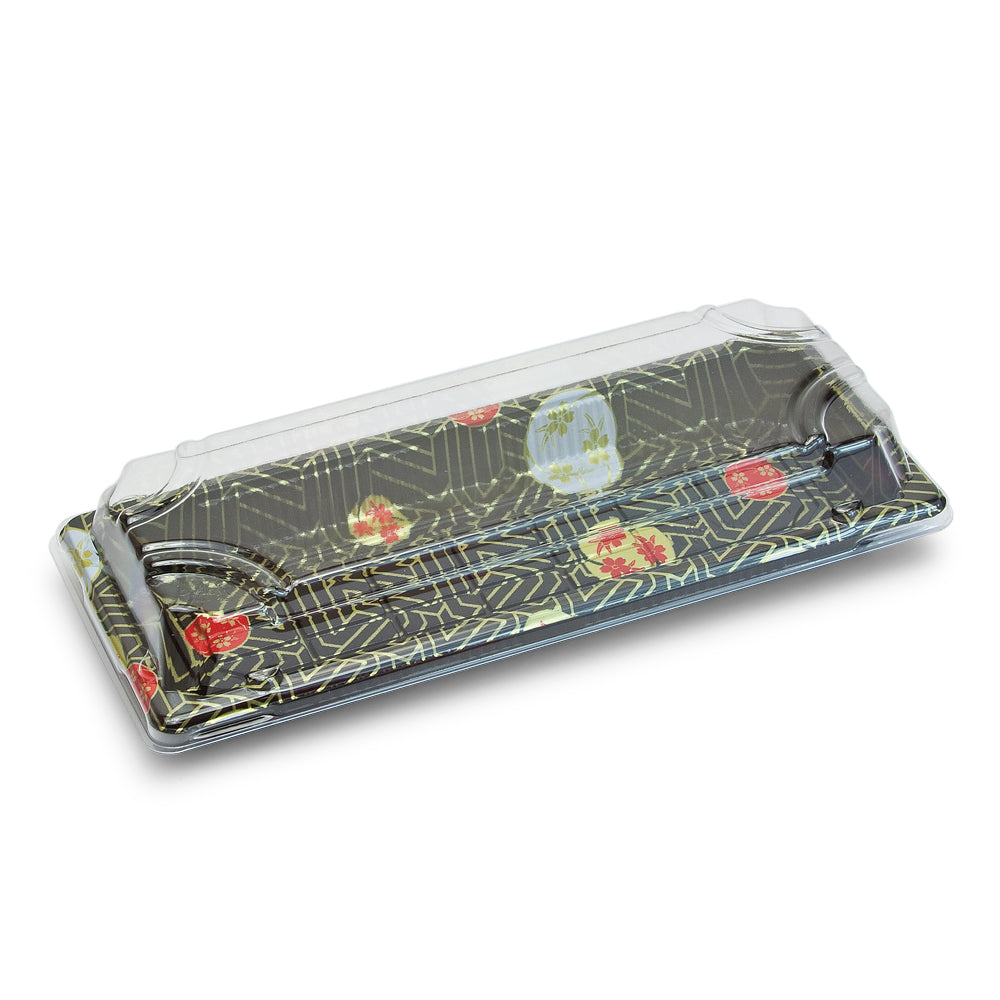
Count the matched components and the accompaniments actually included in the selling unit. Establish any acceptable substitute as a complete arrangement. A different lid or pack can change closure, food clearance, outside dimensions, label surface and display orientation. Similar names or shapes do not establish cross-brand interchangeability.
A media replacement needs the same discipline: printer/mode compatibility, actual package application and complete readable information must survive the change. An ingredient substitution also returns to the approved product record, even if the retail item retains its name.
Include wear, care and variant-specific dependencies
AUTEC identifies AUTEX as its designated oil and warns against substitution. The ASM895A manual also treats coated parts as consumables whose recoating or replacement can be chargeable during warranty. Include these dependencies in the operating purchase rather than expecting the machine warranty to supply every recurring item. AUTEX, ASM895A manual.
Specify replacement parts against the exact model and installed forming or cutting configuration. Determine which changes the operator may perform and which require service. Removable parts do not automatically constitute a sensible spare-parts list, and a store dishwasher does not override a component's washing restrictions.
Measurement and printing also need care provision. Where a pH process is retained, suitable calibration buffers, electrode cleaning and storage supplies belong with the instrument. Printer cleaning supplies and access to the printhead/feed path belong with the label position. These items should follow the actual supplied manuals and approved methods.
Variant details can alter continuity. Hobart's GTi sheet expressly excludes linerless models from its hot-swap printhead and print-roller feature. Do not attribute that feature to every GTi offer. GTi specification.
Establish usable alternatives before an interruption
Scroll to read all columns
| Interruption | Useful provision to establish | What the alternative must preserve |
|---|---|---|
| Delivery is late or rejected | Actual reserve, an agreed assortment reduction and any prequalified alternative supply | Accepted product/source/condition, correct information and its own remaining limits |
| Matched package component is unavailable | Identified ordering units and a demonstrated alternative complete pack where justified | Closure, food clearance, label surface and permitted display fit |
| Printer, application or media is unavailable | An approved alternative route using current data and compatible supplies | Complete correct information, quantity/price where relevant and checkout identity |
| Display is unavailable | Suitable protected holding, withdrawal access and authority to stop affected sale | Product conditions and history; repair does not restore compromised food |
| A retained making task is unavailable | Actual trained manual capacity, reduced assortment or suspension of that task | Controls, safe tools, product specification and completion through packing |
A spare printer body is not a complete fallback without current records, application access, templates and suitable supplies. A manual production fallback requires real trained capacity. Moving stock to reserve may preserve an authorized holding option while eliminating customer self-selection; staff retrieval adds work and must fit the actual operating arrangement.
Do not improvise a new product date, a local-making process or a generic handwritten replacement label to conceal the missing provision. Where required cleaning, measurement or control capability is unavailable, stop the affected work and follow the applicable response procedure, including involvement of the responsible authority where required.
Buy the support scope, not just the warranty headline
Manufacturer terms distinguish equipment coverage from wear, consumables, transport and service. AUTEC's manual addresses registration, repair transport and possible travel charges. Avery's general warranty and separate service arrangements distinguish equipment coverage from consumables, host-communications work and on-site versus depot service. The actual quoted model and agreement must settle the applicable terms. AUTEC manual, Avery warranty, Avery service agreements.
Turbo Air's linked warranty terms exclude consequential food/product-spoilage losses. Its stated next-business-day response to after-hours requests is not a restoration-time promise. The outlet still needs a product-disposition and stock-relocation arrangement. Turbo Air warranty index, linked warranty terms.
Establish who takes the call during the selling period, who authorizes work, what records are required, where service occurs and what costs remain. Set reorder quantities and proportionate spare provision from actual consumption, ordering units, lead times and the consequence of interruption. The broader Ongoing Sushi Restaurant Supply & Multi-Location Standardization reference develops continuing supply across outlets.
Explore the ERS collection
Sushi To-Go Containers
Compare the assortment for this part of your service.
-
 Image unavailable
Kamon Sushi To-Go Tray with Lid (50 pc) - YP-2.0, 9"
View details & options : Kamon Sushi To-Go Tray with Lid (50 pc) - YP-2.0, 9"
Image unavailable
Kamon Sushi To-Go Tray with Lid (50 pc) - YP-2.0, 9"
View details & options : Kamon Sushi To-Go Tray with Lid (50 pc) - YP-2.0, 9"
-
 Image unavailable
Long Kamon Sushi To-Go Tray with Lid (50 pc) - YP-0.6, 8-5/8"
View details & options : Long Kamon Sushi To-Go Tray with Lid (50 pc) - YP-0.6, 8-5/8"
Image unavailable
Long Kamon Sushi To-Go Tray with Lid (50 pc) - YP-0.6, 8-5/8"
View details & options : Long Kamon Sushi To-Go Tray with Lid (50 pc) - YP-0.6, 8-5/8"
-
 Image unavailable
Kraft Paper Sushi To-Go Tray with Clear Anti-Fog Lid (600 pc) - PH-09
View details & options : Kraft Paper Sushi To-Go Tray with Clear Anti-Fog Lid (600 pc) - PH-09
Image unavailable
Kraft Paper Sushi To-Go Tray with Clear Anti-Fog Lid (600 pc) - PH-09
View details & options : Kraft Paper Sushi To-Go Tray with Clear Anti-Fog Lid (600 pc) - PH-09
-
 Image unavailable
Kamon Sushi To-Go Container with Clear Lid (50 pc) - Large 10-1/2" x 7-3/4"
View details & options : Kamon Sushi To-Go Container with Clear Lid (50 pc) - Large 10-1/2" x 7-3/4"
Image unavailable
Kamon Sushi To-Go Container with Clear Lid (50 pc) - Large 10-1/2" x 7-3/4"
View details & options : Kamon Sushi To-Go Container with Clear Lid (50 pc) - Large 10-1/2" x 7-3/4"
-
 Image unavailable
Long Black Sushi To-Go Tray with Clear Lid (50 pc) - ED-30B, 9-1/4"
View details & options : Long Black Sushi To-Go Tray with Clear Lid (50 pc) - ED-30B, 9-1/4"
Image unavailable
Long Black Sushi To-Go Tray with Clear Lid (50 pc) - ED-30B, 9-1/4"
View details & options : Long Black Sushi To-Go Tray with Clear Lid (50 pc) - ED-30B, 9-1/4"
-
 Image unavailable
Sushi To-Go Tray with Clear Lid (100 pc) - Large Red & Silver
View details & options : Sushi To-Go Tray with Clear Lid (100 pc) - Large Red & Silver
Image unavailable
Sushi To-Go Tray with Clear Lid (100 pc) - Large Red & Silver
View details & options : Sushi To-Go Tray with Clear Lid (100 pc) - Large Red & Silver
-
 Image unavailable
Sushi & Bento To-Go Tray with Clear Lid (100pc) - Small Red & Silver
View details & options : Sushi & Bento To-Go Tray with Clear Lid (100pc) - Small Red & Silver
Image unavailable
Sushi & Bento To-Go Tray with Clear Lid (100pc) - Small Red & Silver
View details & options : Sushi & Bento To-Go Tray with Clear Lid (100pc) - Small Red & Silver
-
 Image unavailable
Kamon Sushi To-Go Tray with Clear Lid (50 pc) - ED-03 / YP-0.8
View details & options : Kamon Sushi To-Go Tray with Clear Lid (50 pc) - ED-03 / YP-0.8
Image unavailable
Kamon Sushi To-Go Tray with Clear Lid (50 pc) - ED-03 / YP-0.8
View details & options : Kamon Sushi To-Go Tray with Clear Lid (50 pc) - ED-03 / YP-0.8


12 / Sushi Restaurant Concepts
12. Specify and accept the complete installation
Compare complete scopes. A quotation listing the right cabinet, machine and printer can still omit the supporting site work, storage, consumables or information provision that makes them useful.
Put the retail duty into the quotation
The purchasing brief should include:
- The operation: what arrives completed, what work remains locally, the selling period and responsible parties.
- The merchandise: intended assortment, complete loaded packs, orientations, approved information and incoming/display-ready conditions.
- The exact equipment: model and configuration, application, environment, shelves/racks, accessories, permitted loading and current applicable documents.
- The supporting provision: receiving and any cooling, assigned reserve, compatible handling, preparation/packing surfaces and usable cleaning facilities.
- The information arrangement: weighing/quantity method where needed, printer variant, associated device/application/licenses, approved records, media and supported updates.
- The installed and continuing scope: utilities, site work, delivery/placement, commissioning, initial supplies, operator instruction, service arrangements and exclusions.
Settle current sale eligibility for the exact model and destination as part of the offer. Absence from a model list is not a clearance certificate.
Site work is model specific
A voltage description is not a complete electrical specification. The documented TGM-23 and TOM-60 examples use NEMA 5-15P and 5-20P connections respectively despite both being 115V equipment. RM and M3 manuals call for suitable independent/dedicated supply and prohibit extension cords. The installer must provide the circuit and access required by the actual supplied equipment. TGM sheet, TOM sheet, RM manual, M3 manual.
Delivery access is separate from operating space. The RM-26-HC sheet lists a 34 × 34 × 82-inch crate and 331-pound crated weight. Confirm the actual delivered configuration, unloading route and access into position as well as the final door, service and circulation envelope. RM sheet.
For a remote case, allocate the refrigeration and site-work responsibilities explicitly. Hussmann's Q2/Q3 options include an expansion valve requiring refrigerant selection; its Q2 manual identifies field wiring from refrigeration controls and a supplied drain trap that still must be installed. The complete scope must address refrigeration connection, controls, electrical work, drainage, lineup/end treatment and commissioning. A finished-case photograph does not establish what the cabinet price includes. Q2/Q3 product sheet, Q2 manual.
Preparation and labeling need installation provision too. Moving from finished-pack receipt to local assembly changes preparation, storage and cleaning requirements and can trigger plan review. The label position needs safe placement, the specified power supply, access for supplies, supported connectivity and the actual application/data arrangement. A printer beside a store network is not an integrated labeling operation. LA County plan-review guidance, 9442 manual.
Accept the occupied operation
Set acceptance criteria from the supplied documentation, applicable controls and actual program requirements. Demonstrate the intended retail duty:
- Delivered configuration: correct models, shelves/racks, accessories, documentation and completed site-work scope, with damage and commissioning records retained.
- Occupied display: complete closed-pack fit, permitted shelf positioning, readable identification, customer removal, refill access and unobstructed air paths.
- Product condition: suitable measurements through the actual receiving/production and holding arrangement, with any retained cooling separately established. A controller number alone is insufficient.
- Correct information: the most demanding relevant approved label printed and applied using the selected supplies, with quantity/tare/price and checkout scanning where applicable; include an approved data update.
- Stock movement: the real refill route and a suitable destination for product removed during cleaning or a display interruption, with identity and dates preserved.
- Return to readiness and support: operator-level cleaning and supply changes within the manuals, clear responsibility, accessible support records and a usable bounded fallback.
These demonstrations should use the intended assortment and accessories. An empty cabinet and a printer's sample label leave the central retail questions unanswered. Site approval, food-process validation and commercial-weighing acceptance retain their own requirements.
Bring the operating arrangement, complete pack samples, incoming condition, site constraints and retained work to Eden Restaurant Supply when defining the equipment and supply scope. The supplier-evaluation and commercial-requirements references provide the wider quotation and approval questions.
Buy an arrangement that can support the actual merchandise through the last sale and back to readiness. That is the standard for a complete supermarket, grocery or grab-and-go sushi equipment order.