

Restaurant buyer reference
Disposable Chopsticks with Custom Printed Paper Sleeves
A practical guide to choosing chopstick formats, planning order quantities, preparing artwork, understanding sleeve printing and production, confirming lead times, and ordering.
Direct answer
A reliable custom chopstick order starts with more than a logo.
The order combines a disposable chopstick, a printed paper sleeve, approved artwork, a case quantity and a delivery plan. Keeping those details together is what makes the finished product repeatable.
1 · Understand
Know which part is being customized.
Several distinct products are casually called “custom chopsticks.” A useful specification names the chopstick, sleeve and printing treatment separately.
- Disposable chopstick
- The single-use eating utensil inside the program. Format, material, length, finish and pack configuration can affect service fit and cost.
- Printed paper sleeve
- The paper enclosure around a pair of chopsticks. It creates the primary branding surface and keeps the paired utensils organized.
- Full sleeve
- A long enclosure presenting separate front and back artwork faces. This is the surface modeled by the current ERS designer.
- Direct chopstick printing
- Ink, foil or engraving applied to the utensil itself. This is a different production system from ERS’s current printed-paper-sleeve program.
- Case
- The commercial purchase unit. For the current ERS program: 1,600 pairs per case.
- Proof
- The production instruction submitted for approval. It should show content, placement, colors and product association clearly enough to authorize printing.
Operator interpretation
Always compare quotes at the same specification. “Custom chopsticks” can mean an unprinted stock pair in a printed sleeve, a directly printed utensil, an engraved premium stick, or a complete individually packed set.
2 · Choose
Choose the chopstick before designing the sleeve.
The current ERS program offers Bamboo Twin and Bamboo Tenso. Both use a custom printed full paper sleeve; their functional distinction is the chopstick profile.
| Question | Bamboo Twin | Bamboo Tenso |
|---|---|---|
| Profile | Rounded ends | Tapered square ends |
| Typical decision basis | Handling, presentation, physical sample, current availability and exact product identity | |
| Sleeve branding | Front/back paper-sleeve artwork | Front/back paper-sleeve artwork |
| What to verify | Current availability, case price, physical sample needs and the exact product associated with the proof | |
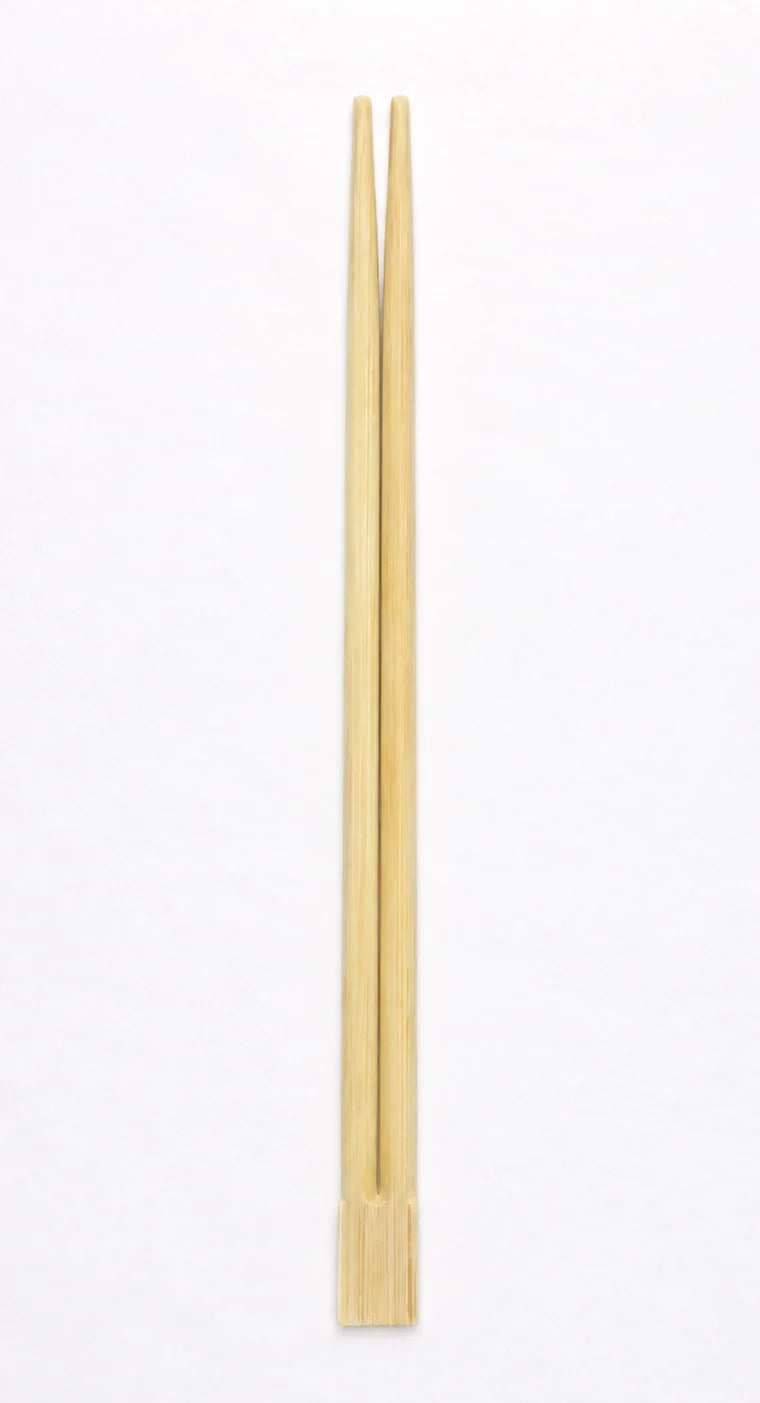
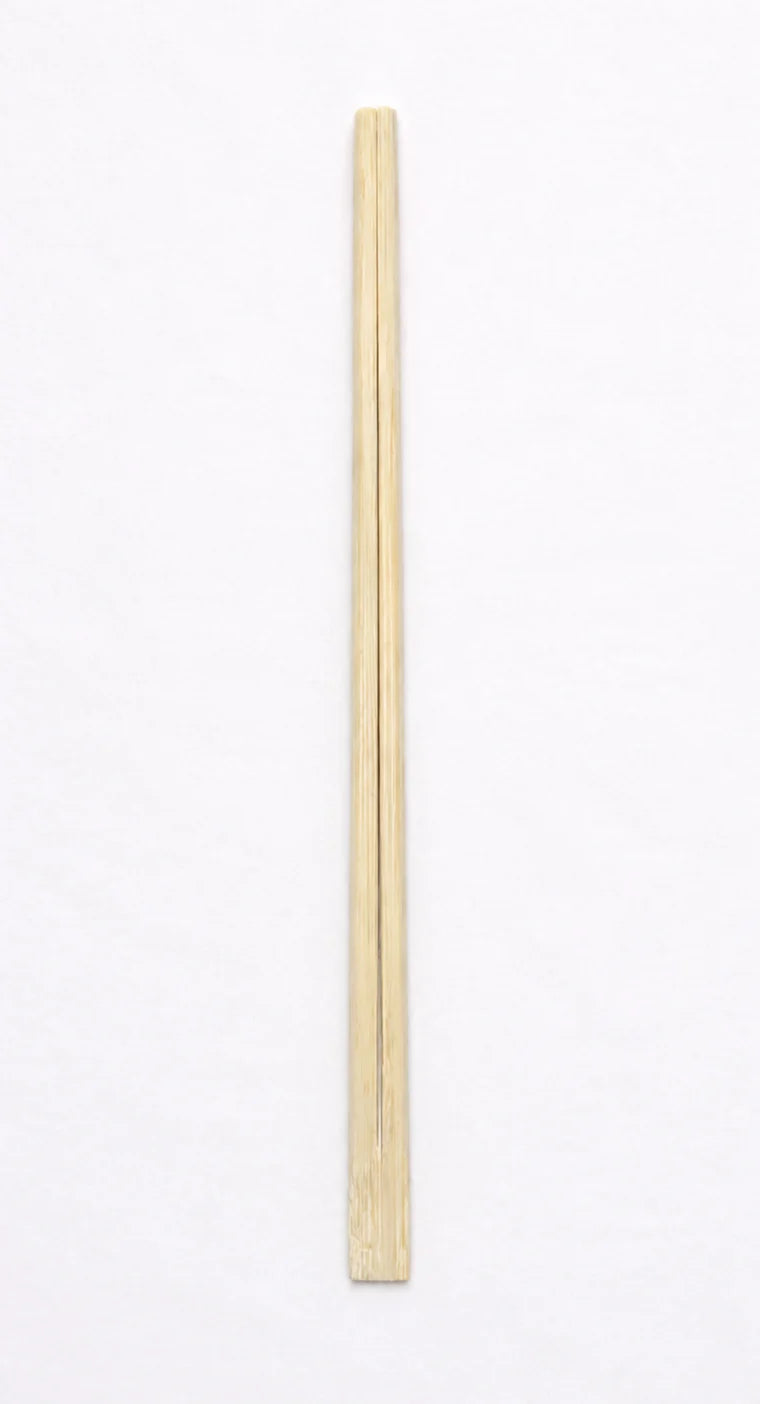
Within the ERS order data, Twin represents 62% of fulfilled pairs and Tenso 38%. This is ERS customer purchasing mix, not U.S. market share or evidence that either format is objectively better.
This pair-volume finding covers the 2002–2026 ERS Benchmark. Review the population, product mapping and limitations.
Use the complete Twin versus Tenso comparisonShould a restaurant choose based on cuisine?
Cuisine can supply context, but service method, handling preference, desired presentation and current availability are more concrete inputs. Generic “best for sushi” or “best for Chinese restaurants” rules should not replace a physical product review.
3 · Quantify
Translate restaurant activity into inventory coverage.
Start with the operation’s own use. The Benchmark is comparison context, not a substitute for demand inputs.
Use actual issue counts when available. Otherwise combine covers or orders with the share that receives chopsticks.
Apply days open, locations, planned openings and any known difference between dine-in and takeout.
Choose safety stock for uncertainty, stockouts and time consumed before a reorder can arrive.
Round up to full cases and compare the result with the current program minimum.
The Benchmark median is a midpoint in historical ERS orders, not a recommended quantity. A small restaurant with limited storage and a multi-location group can need very different order sizes.
Calculate monthly need and reorder point Interpret the current MOQ as inventory4 · Price
Compare program cost, not an isolated pair price.
A complete comparison should identify the physical unit, case quantity, setup treatment, freight responsibility, inventory duration and cost of changing or repeating artwork.
Bamboo Twin: $50.00 per case
Bamboo Tenso: $54 per case. Prices are current commercial information; verify availability and freight before ordering.
$60 one-color setup / $85.00 two-color setup
Current one-color and two-color setup treatment. Confirm the applicable color count from the approved proof.
$0 setup for an unchanged-artwork reorder
The current program does not apply the new-art setup fee when the same approved artwork is reused.
Confirm after order review
Freight and ship quote confirmed after order. Location and order size affect the final freight charge.
Comparable-cost formula
First order: merchandise + new-art setup + freight + any design or special handling. Unchanged reorder: merchandise + freight + any current exception. Add internal storage and allocation costs when they differ between sourcing models.
5 · Design
Design for the production surface and viewing moment.
A sleeve is unusually narrow. The job is not to fit every brand asset; it is to establish a readable hierarchy across two long faces under a controlled color and safe-area system.
Immediate recognition
Prioritize the identifying element a guest should notice first: restaurant name, mark or a short brand statement.
Supporting information
Use the reverse for contact details, a brief message or secondary brand information without reducing legibility.
2 colors maximum
Current custom paper-sleeve artwork may use one or two print colors; a printed background counts as one of those colors. Resolve colors before proof approval rather than treating the preview as a color contract.
Check at physical size
Do not approve a QR code, fine type or line detail solely from an enlarged screen view. Use the minimums and test steps in the technical reference.
6 · Proof
Approve the exact design ERS will prepare for printing.
The digital proof confirms copy, placement, orientation, color assignment and chopstick format. Paper, ink and production variation still cannot be reproduced exactly on a screen.
- Correct restaurant and legal spelling
- Current phone, address, URL and social handle
- Correct front/back orientation
- Intended one- or two-color assignment
- Artwork inside the approved safe area
- Correct Twin/Tenso product association
- Readable fine type and QR treatment
- Named approver and dated approval record
Digital proof vs. physical sample
A digital proof can establish content, geometry and stated colors. It cannot reproduce every paper, ink, screen and production variable. If a physical or pre-production sample is necessary to the purchase decision, confirm availability, cost, timing and approval consequences with ERS before relying on it.
Artwork review usually within 1 business day. This covers the initial artwork review, not proof revisions, production or delivery.
7 · Produce
The approved design must stay attached to the right product.
ERS handles the full custom chopstick sleeve production process in-house, from initial preparation through finished delivery.
The approved front/back file, color count and product association become the working record.
Production plates translate approved artwork into the physical printing process.
Paper stock, color assignment and press setup must match the approved specification.
Registration, placement and repeatability are evaluated against production tolerances.
Printed sleeves and the selected chopsticks resolve into cases and labeled commercial units.
Delivery terms, quantity and destination are confirmed before the order enters restaurant inventory.
8 · Receive
Inspect the order before the cases enter service.
9 · Reorder
Reorder before remaining stock falls below the replenishment window.
Waiting until the last case is opened leaves no room for artwork review, production or freight delays.
Reorder-point formula
Reorder point in pairs = expected pairs used during the assumed lead time + safety-stock pairs. Convert the result upward to full cases. Recheck current product, pricing, setup and timing facts each time.
- Confirm remaining cases and actual issue rate
- Decide whether artwork is truly unchanged
- Verify contact details and QR destination
- Review current ERS program facts
- Account for planned locations or closures
- Preserve the prior proof/order reference
Claims and documentation
Ask what a food-contact or environmental claim applies to.
A claim about chopstick material, sleeve paper, ink, forest sourcing or disposal may have a different scope and evidence requirement.
How information is labeled
Research findings, current terms and specifications answer different questions.
An observation from ERS order history, shown with its population, period and limitation.
A current commercial or operating detail, such as case quantity, setup treatment or artwork review timing.
A production requirement tied to a defined product and document revision.
Practical guidance based on ERS production experience or the research shown on the page.
Related Research