

Commercial Restaurant Furniture Guide
Restaurant Furniture Costs, Specification & Procurement
Restaurant furniture costs depend on the specified product, purchase unit, and delivered scope. Compare documented 2026 prices, itemized restaurant budgets, FF&E schedules, quotations, freight, installation, warranties, and lifecycle costs, with practical requirements for supplier evaluation, approvals, ordering, receiving, and replacement.
In this guide
Restaurant furniture costs extend well beyond the advertised price of a chair, tabletop, or booth. A complete purchasing budget must account for the furniture configuration, quantity, construction, finishes, installation requirements, freight, and long-term operating conditions of the restaurant.
A $68 commercial dining chair, a $409.99 upholstered booth section, and a $118.49 complete dining table each represent a defined purchase. None establishes the cost of a finished dining area without the quantities, compatible components, delivery conditions, and project requirements.
The distinction is substantial. In our 2026 commercial furniture analysis, a 48-position fast-casual purchasing package totals $3,760.86 in furniture merchandise, while a 72-position full-service configuration incorporating dining chairs, upholstered booths, high-top seating, and service furniture totals $11,441.17. Adding the defined freight and installation figures brings the respective project cost scenarios to $5,010.86 and $14,441.17 before taxes and additional reserves.
This reference examines furniture pricing at the product, dining-room, and project levels. It also addresses the specifications, technical evidence, supplier comparisons, fabrication approvals, and purchasing responsibilities necessary to acquire furniture for a functioning commercial restaurant.
Quick reference
| Purchasing question | Key finding |
|---|---|
| What do commercial restaurant chairs cost? | Observed 2026 configurations range from $37.99 for a basic padded metal dining chair to $347 for a substantially different upholstered armchair. |
| How much does a complete restaurant furniture package cost? | Our 48-position and 72-position research packages contain $3,760.86 and $11,441.17 in defined merchandise, respectively. |
| What determines the final purchase price? | Exact furniture specifications, quantities, approved options, supplier terms, freight, installation, and other project-specific responsibilities. |
| What constitutes a purchase-ready furniture specification? | A documented product configuration, dimensions, materials, finishes, quantities, required technical evidence, approvals, and commercially complete quotation. |
1. Commercial Restaurant Furniture Prices: What Products Actually Cost
Commercial restaurant furniture prices reflect a wide range of construction types, materials, finishes, dimensions, and purchasing configurations. The useful comparison is not between the cheapest and most expensive items in a broad category, but between products that satisfy substantially the same requirements.
The following 2026 US market observations establish identifiable furniture prices across major categories. Prices are stated in US dollars and retain the purchasing unit represented by the observed listing.
Commercial Restaurant Furniture Prices by Category
| Dining chair | Metal frame with padded vinyl seat | $37.99 | One chair |
|---|---|---|---|
| Dining chair | Metal ladder-back construction | $68.00 | One chair |
| Dining chair | Contoured metal dining chair | $125.00 | One chair |
| Dining chair | Upholstered bucket-style chair | $180.00 | One chair |
| Dining armchair | Upholstered club-style construction | $347.00 | One armchair |
| Barstool | Metal frame with padded seat | $52.99 | One stool |
| Barstool | Metal ladder-back construction | $91.00 | One stool |
| Barstool | Upholstered premium-height seating | $277.00 | One stool |
| Tabletop | Reversible laminate, 30 × 30 inches | $31.49 | Top only |
| Table base | Cast-iron cross configuration | $48.00 | Base only |
| Table base | Round metal configuration | $70.00 | Base only |
| Table base | Decorative square configuration | $109.00 | Base only |
| Complete table | Laminate top, 30 × 30 inches, with base | $68.49 | One table assembly |
| Complete table | Laminate top, 30 × 48 inches, with base | $118.49 | One table assembly |
| Complete high-top table | Rectangular standing-height configuration | $136.99 | One table assembly |
| Banquette | Plain-back upholstered wall seating | $102.00 | Per linear foot |
| Booth | Upholstered single section, 42 inches high | $409.99 | One booth section |
| Booth | Upholstered double section, 42 inches high | $692.74 | One booth section |
| Upholstered booth | Premium finished configuration | $769.00 | One configured section |
| Outdoor armchair | Powder-coated metal construction | $38.99 | One chair |
| Indoor/outdoor chair | Woven-look synthetic seating | $58.00 | One chair |
| Outdoor table | Folding resin construction | $111.00 | One table |
| Host station | Finished wood-look podium, approximately 46 inches | $222.49 | One podium |
| Service station | Cabinet with storage and drawer | $259.99 | One unit |
| Restaurant high chair | Commercial wooden construction | $52.49 | One unit |
2026 US commercial furniture price observations. These are actual advertised prices for defined products and configurations, not statistical national averages. Freight, tax, assembly, and installation are separate unless expressly included in the purchase.
The price differences are meaningful, but the categories are not interchangeable. The $37.99 metal chair and the $347 upholstered armchair differ in construction, dimensions, upholstery, intended application, and maintenance requirements. The figures establish actual purchasing options—not an automatic quality ranking.
The same applies to tables. A $31.49 tabletop is not comparable with a $68.49 complete table unless the buyer accounts for the base, mounting hardware, assembly, configuration, and intended use.
The restaurant furniture budget should begin with the required configuration, followed by the unit price and quantity. Reversing that order can produce a low merchandise estimate that does not represent a usable furniture package.
Current catalog examples · different seating constructions
-

Metal Restaurant Chair with Black Padded Seat
From $139.57 USD
2 configurations · Select size and finish
-

Dark Brown Finish Bull Horn Regular Chair
$155.00 USD
-

Pumpkin Upholstered Restaurant Chair with Espresso-Finish Metal Frame
$180.69 USD
-

Black Padded Seat Restaurant Armchair with Wood-Grain Metal Frame
$227.42 USD
2 configurations · Select size and finish
-

Aluminum Navy-Style Restaurant Barstool
From $267.92 USD
2 configurations · Select size and finish
-

Taupe Rope Seat Aluminum Patio Chair
$199.38 USD


Current catalog data. Confirm selected dimensions, finish, purchase unit and delivery scope on the product page. Separate components require compatibility approval.
Current catalog examples · components and complete tables
-

Laminate Restaurant Tabletop, 1.5" Thick
From $97.20 USD
22 configurations · Select size and finish
-

Standard Iron Cross Table Base – 22×22×28”H (Regular)
$65.00 USD
-

Round Iron Table Base 18"– Commercial Black Steel
$80.00 USD
-

Black Metal Slatted Patio Table, 28" Square
$129.60 USD
-

Weathered HPL Restaurant Table with Black Aluminum Legs, 24" × 36"
$280.38 USD
-

Stackable All-Aluminum Slat Patio Side Chair
$196.27 USD
6 configurations · Select size and finish


Current catalog data. Confirm selected dimensions, finish, purchase unit and delivery scope on the product page. Separate components require compatibility approval.
Complete Tables, Individual Components, and Furniture Packages
A restaurant table can be purchased as a complete assembly or assembled from separately selected components.
A complete table quotation should identify the tabletop material and dimensions, base model and footprint, height, attachment hardware, and the configuration for which the completed assembly is intended.
Consider two observed 30 × 30-inch configurations:
| Component or package | Advertised cost |
|---|---|
| Reversible laminate tabletop alone | $31.49 |
| Separate cast-iron cross base | $48.00 |
| Combined price of those two independently selected components | $79.49 |
| Complete 30 × 30-inch laminate table/base kit | $68.49 |
The independent combination is $11.00 more expensive at the observed component prices.
That difference does not establish which purchase is preferable. The complete kit and independently selected components may have different base geometry, attachment systems, stability, materials, and finish options. Compatibility must be confirmed before the separately purchased components can be considered an equivalent assembly.
The same principle applies to chair-and-table packages. A five-piece dining set must identify the four chairs, complete table assembly, included options, and any required assembly. Dividing the package price by four produces a purchasing-cost allocation, not the standalone value of each chair.
For complete dining-room projects, a clearly specified table assembly is a more reliable budgeting unit than an unidentified tabletop allowance.
Booth Pricing: Linear Feet, Complete Sections, and Custom Fabrication
Booth and banquette prices require particular attention because suppliers use several different selling units.
A plain upholstered wall bench may be quoted per linear foot. A catalog booth may have a fixed price for a single or double section. Custom banquettes may be priced from approved shop drawings, actual installed length, upholstery requirements, and fabrication conditions.
Consider an upholstered banquette quoted at $102 per linear foot.
Two four-foot runs create eight linear feet of billable seating:
8 linear feet × $102 = $816.00
A separate catalog configuration consisting of two upholstered single booth sections priced at $409.99 each produces:
2 sections × $409.99 = $819.98
The advertised totals are nearly identical. The physical products are not necessarily equivalent.
The linear-foot quotation may exclude custom corner work, finished ends, special back heights, site-specific anchorage, installation, or selected upholstery upgrades. The catalog sections may include different framing, upholstery, dimensions, and delivery conditions.
For custom restaurant seating, the final price must specify:
- Finished linear dimensions and number of sections.
- Seat height, depth, back height, back profile, and end conditions.
- Frame, substrate, upholstery, cushioning, and finish selections.
- Straight, curved, corner, wall-mounted, or freestanding construction.
- Field measurements, fabrication tolerances, and installation requirements.
- Delivery, assembly, anchorage, and site-work responsibilities.
A rate per linear foot is useful for an early cost comparison. The final purchase requires a defined fabrication scope.

What Drives Commercial Furniture Prices?
The largest meaningful differences usually arise from construction, materials, finishes, geometry, and the degree of customization.
For seating, relevant variables include frame material and section thickness, joinery or welded construction, seat and back support, upholstery composition, cushioning, finish durability, and the availability of replacement components.
For tables, the specification extends to surface thickness, substrate, edge treatment, base design, attachment method, finish, environmental suitability, and the completed assembly's stability.
For booths, cost variation extends to internal framing, upholstery seams and patterns, back height, integrated millwork, wall conditions, and custom fabrication.
A premium finish is not necessarily a structural upgrade. Likewise, a heavier base is not automatically appropriate for every tabletop. Cost differences become commercially meaningful only when their corresponding product characteristics are identified.
Order quantities also affect pricing. Minimum orders, production setup, shared finishes, consolidated shipments, and larger purchasing quantities may change the offer. Those conditions belong in the written quotation rather than being inferred from advertised retail prices.
The correct pricing reference is therefore the defined product and its complete purchasing scope, not a broad category label.
2. How Much Does It Cost to Furnish an Entire Restaurant?
A complete restaurant furniture budget begins with an itemized purchasing schedule, not a single allowance multiplied by the number of seats.
The purchasing schedule must identify the furniture assigned to each dining area, its dimensions and construction, its unit of sale, the required quantities, and any related products necessary to make the installation complete.
For a full-service restaurant, that can include dining chairs, freestanding tables, banquettes, fixed booths, barstools, high-top tables, host furniture, service stations, waiting-area furniture, and outdoor seating.
The furniture budget should be distinguished from the broader FF&E and construction budgets. Commercial kitchen equipment, refrigeration, cooking systems, tableware, smallwares, architectural millwork, and building improvements may fall under different schedules or purchasing responsibilities.
48-Position Fast-Casual Restaurant: Itemized Furniture Budget
The first 2026 reference purchasing package represents a 48-position fast-casual dining program with 10 four-person tables and four two-person tables.
| Furniture | Quantity | Unit price | Extended cost |
|---|---|---|---|
| Padded metal dining chairs | 48 | $37.99 | $1,823.52 |
| Complete 30 × 48-inch dining tables | 10 | $118.49 | $1,184.90 |
| Complete 24 × 30-inch dining tables | 4 | $67.49 | $269.96 |
| Host podium | 1 | $222.49 | $222.49 |
| Service station | 1 | $259.99 | $259.99 |
| Total furniture merchandise | $3,760.86 |
The furniture merchandise cost is $78.35 per proposed dining position.
This figure includes the listed host and service furniture in the total, but not separately charged freight, installation, taxes, additional delivery services, or construction work.
It is a useful measure of this particular purchasing package. It should not be applied indiscriminately to restaurants with upholstered seating, larger tables, custom millwork, or equipment-integrated dining furniture.
The 48 positions describe the purchasing program. The actual installed capacity depends on the approved furniture plan, circulation, accessible dining spaces, and applicable building requirements.
72-Position Full-Service Restaurant: Complete Furniture Budget
The second 2026 reference package uses a more varied furniture composition.
Its 72 proposed dining positions comprise 32 freestanding dining-chair positions, 24 positions in six opposed booth arrangements, and 16 high-top positions.
| Furniture | Quantity | Unit price | Extended cost |
|---|---|---|---|
| Metal dining chairs | 32 | $68.00 | $2,176.00 |
| Complete 30 × 48-inch dining tables | 8 | $118.49 | $947.92 |
| Upholstered single booth sections | 12 | $409.99 | $4,919.88 |
| Complete 30 × 42-inch booth tables | 6 | $108.49 | $650.94 |
| Metal barstools | 16 | $91.00 | $1,456.00 |
| Complete rectangular high-top tables | 4 | $136.99 | $547.96 |
| Host podium | 1 | $222.49 | $222.49 |
| Service stations | 2 | $259.99 | $519.98 |
| Total furniture merchandise | $11,441.17 |
The merchandise allocation is $158.91 per proposed dining position.
The comparison with the fast-casual package shows how sharply the cost changes with furniture composition. The 72-position project has 50% more proposed positions, but its merchandise total is approximately three times as large.
The difference is not principally the seat count. It is the inclusion of upholstered booth sections, multiple table formats, higher-priced dining seating, high-top arrangements, and a greater amount of supporting furniture.
The booth and table dimensions must still be coordinated as complete physical arrangements. A proposed four-position booth pairing is not automatically a verified four-position installation merely because two benches and a table have been purchased.
How Seating Mix Changes a Restaurant Furniture Budget
Consider a second furniture arrangement for the same 72 proposed dining positions.
Instead of mixing booths, freestanding seating, and high-top tables, the alternative uses 18 four-person tables with 72 freestanding dining chairs, along with the same host podium and two service stations.
| Furniture | Quantity | Unit price | Extended cost |
|---|---|---|---|
| Metal dining chairs | 72 | $68.00 | $4,896.00 |
| Complete 30 × 48-inch tables | 18 | $118.49 | $2,132.82 |
| Host podium | 1 | $222.49 | $222.49 |
| Service stations | 2 | $259.99 | $519.98 |
| Total | $7,771.29 |
The all-freestanding purchasing package is $3,669.88 less expensive in merchandise than the mixed-seating package.
That is a material difference for the same nominal position count.
It is not evidence that the less expensive arrangement is the better restaurant. The two configurations differ in seating character, flexibility, guest experience, furniture footprint, table access, circulation, and operational suitability.
A full-service restaurant may deliberately allocate more capital to upholstered booths or distinctive furniture, while a high-turnover concept may place greater emphasis on standardized freestanding tables and chairs.
The cost comparison becomes useful when the furniture arrangement is evaluated against the actual operating brief.


Furniture composition examples from the current catalog
-

Solid Beechwood Restaurant Chair with Black Padded Seat
$196.27 USD
2 configurations · Select size and finish
-

Walnut Solid Wood Restaurant Barstool with Black Padded Seat and Back
$218.08 USD
Dark Walnut
-

Select Cherry Finish Solid Beechwood Grid-Back Restaurant Chair
$183.81 USD
Select Cherry
-

White Epoxy Restaurant Tabletop, 1.5" Thick
From $121.50 USD
11 configurations · Select size and finish
-

Black Cast Iron Cross Table Base – 28" Dining Height
From $130.85 USD
2 configurations · Select size and finish
-

Black Steel T Table Base – 28" Dining Height
$68.54 USD
28" Dining Height


Current catalog data. Confirm selected dimensions, finish, purchase unit and delivery scope on the product page. Separate components require compatibility approval.
From Furniture Merchandise to Delivered and Installed Cost
The furniture merchandise subtotal is only one part of the acquisition cost.
Freight, receiving, staging, assembly, installation, anchorage, taxes, applicable import charges, and site-specific work may be quoted separately or included under different contracts.
The two reference packages produce the following defined project cost comparison:
| Cost component | 48 positions | 72 positions |
|---|---|---|
| Furniture merchandise | $3,760.86 | $11,441.17 |
| Freight allocation | $800.00 | $1,800.00 |
| Assembly and installation allocation | $450.00 | $1,200.00 |
| Subtotal before taxes | $5,010.86 | $14,441.17 |
| Additional reserve equal to 5% of merchandise | $188.04 | $572.06 |
| Project budget including stated reserve | $5,198.90 | $15,013.23 |
The reserve is calculated against merchandise alone. It does not represent a universal required contingency percentage.
Additional charges should be included when the actual project requires them. A restaurant without a loading dock, for example, may need different freight and handling services from a newly constructed property with dedicated receiving facilities.
Custom furniture, equipment integration, field modifications, and fixed millwork installations may also have separately assigned costs.
The final purchasing budget must identify which party is responsible for each amount.
Specialty Restaurant Furniture: Equipment-Integrated Dining
Equipment-integrated furniture cannot be budgeted as ordinary dining tables with a modest upgrade allowance.
A cooking-integrated table may include a fabricated surface and support assembly, cooking equipment, controls, utility connections, service access, and required installation work.
The 2026 specialty purchasing reference includes:
| Component | Quantity | Unit price | Extended cost |
|---|---|---|---|
| Built-in commercial induction units | 4 | $986.15 | $3,944.60 |
| Commercial dining chairs | 16 | $68.00 | $1,088.00 |
| Identified component cost | $5,032.60 |
This figure isolates the specified appliances and chairs. It is not a complete fabricated-table price.
The final station budget must also address the table structure, surface materials, appliance openings, electrical requirements, fabrication details, delivery, and installation responsibilities.
The cost of a finished cooking station is determined by the complete approved assembly.


Discuss a complete furniture budget
3. Specify Furniture for the Restaurant's Actual Operations
Restaurant furniture specifications begin with the foodservice operation. The menu, service format, dishware, equipment, guest seating arrangements, and maintenance requirements determine which furniture configurations are suitable.
The same nominal four-person table can perform very differently in a café, sushi restaurant, family-style dining room, or tabletop-cooking operation.
Its usable surface, support system, access requirements, and surrounding furniture must be specified for the intended use.
Dining Format and Service Requirements
A fast-casual restaurant with individual entrées and limited table service has different furnishing requirements from a full-service restaurant serving shared dishes and multiple courses.
A sushi counter must coordinate stool position, guest comfort, counter dimensions, working and presentation surfaces, and the relationship between diners and the preparation area.
A banquet operation must consider stacking, storage, movement, repeated reconfiguration, and replacement inventory.
A tabletop-cooking restaurant introduces equipment, utility and thermal requirements that extend beyond conventional furniture construction.
These distinctions affect the purchased furniture rather than merely the design language surrounding it.
| Operating condition | Furniture specification consequence |
|---|---|
| High-frequency table turnover | Surface cleanability, durable edges, replaceable seating, stable freestanding arrangements |
| Extended seated dining | Seat dimensions, cushioning, support, tabletop relationships, and furniture stability |
| Shared-dish service | Larger or differently shaped usable table surfaces and appropriate supports |
| Tableside cooking | Appliance compatibility, structural support, utility access, heat exposure, and servicing |
| Banquet reconfiguration | Stackability, handling, storage dimensions, compatible tables, and replacement consistency |
| Outdoor operation | Materials, corrosion resistance, environmental suitability, storage, and maintenance |
| Multi-location operations | Standardized specifications, finish references, repeat-order availability, and approved alternatives |
The purchasing specification should reflect these conditions before suppliers are asked to quote.
Tabletop Capacity: Food, Dishware, and Shared Service
Nominal table dimensions provide the starting point for evaluating furniture, but the tabletop must also accommodate the actual service.
A 30 × 48-inch rectangular tabletop has 1,440 square inches of gross surface area.
A 24 × 30-inch top has 720 square inches.
A 48-inch-diameter round table provides approximately 1,810 square inches.
These calculations describe overall surface area, not necessarily usable dining capacity.
The distribution of that area matters. Individual place settings occupy the perimeter; shared platters, condiments, beverage service, hot vessels, and tableside equipment compete for central space.
For example, a family-style table may need to hold individual bowls and plates for every guest while reserving the center for large shared dishes and a rotating serving surface.
Simply increasing the tabletop area does not establish that the arrangement will work. Reach, placement, stability, clearance, and service access must be considered.
The same issue appears in Korean BBQ and hot-pot dining, where the cooking appliance occupies part of the table and additional space is needed for ingredients, side dishes, cooking tools, sauces, beverages, and individual settings.
A table that is adequate for four plated meals may be inadequate for four guests preparing food at the table.

Different dining surfaces and serviceware
-

Natural White Oak Plank Live-Edge Restaurant Tabletop
From $233.65 USD
13 configurations · Select size and finish
-

HPL Patio Tabletop with Aluminum Frame
From $154.52 USD
26 configurations · Select size and finish
-

10"Dx1.5"H Round Porcelain Plate, Reactive Glaze - Blue/Black
$13.95 USD
-

5½″ Matte Black Porcelain Side Bowl — 1¾″ High
$4.25 USD
-

11" x 10.75" Irregular Ceramic Plate, Emerald, Green
$42.99 USD
-

8 oz Pale Ridged Ceramic Teacup — 3¼ in H
$5.79 USD


Current catalog data. Confirm selected dimensions, finish, purchase unit and delivery scope on the product page. Separate components require compatibility approval.
Furniture and Cooking Equipment Interfaces
When a cooking appliance is built into furniture, the appliance specification becomes part of the table specification.
The purchasing team must establish the exact equipment model, the approved opening, support and clearance conditions, control location, service accessibility, and utility requirements.
Tabletops and bases must be assessed as completed assemblies.
The finished furniture may need to provide access to electrical connections, ventilation components, removable cooking equipment, grease collection, maintenance areas, or replacement parts.
An appliance change after furniture fabrication has been approved can affect several previously coordinated components.
For example, substituting an induction unit with a different cutout or electrical specification can require revised tabletop fabrication, new utility coordination, and another technical approval.
A supplier quotation for the cooking equipment alone is not equivalent to a quotation for an installed dining station.
Similarly, a custom tabletop with a prepared opening is not automatically a complete equipment-integrated furniture package.
Operating Conditions and Replacement Requirements
The frequency and manner of use also influence purchasing decisions.
Foodservice furniture is repeatedly exposed to cleaning, abrasion, movement, contact with serving vessels, spills, and staff handling. Certain applications introduce elevated heat, moisture, or chemical exposure.
The purchasing specification should identify any special exposure and require products suitable for it.
A dining chair intended for frequent repositioning may need a different frame and finish configuration from a fixed upholstered banquette. An outdoor table in a coastal environment has different environmental requirements from an indoor laminate dining table.
The operator should also consider the availability of replacement components, matching finishes, upholstery materials, and service parts.
The appropriate furniture specification is the one that satisfies the restaurant's physical, operational, and commercial requirements—not simply the one that matches the desired appearance.
4. Furniture Specifications and FF&E Schedules
A restaurant furniture schedule converts the intended furnishings into defined purchasing quantities and controlled specifications.
For procurement purposes, a furniture item must be identified precisely enough that suppliers can quote the same product or approved equivalent.
A description such as “black metal chair” or “four-person booth” is insufficient for a complete purchasing comparison.
Dimensions, construction, selected finishes, quantities, supporting documents, and commercial terms determine what is actually being offered.
From Product Selection to Purchase-Ready Specification
A furniture selection typically progresses through several distinct states.
A candidate product may be identified from a catalog or manufacturer document. Its dimensions, construction, and options may then be defined for the project.
The relevant technical characteristics and applicable requirements must be checked before the product is approved.
A supplier quotation establishes the offered price and purchasing terms for the identified scope.
Only after the necessary approvals and commercial details have been resolved should the item be authorized for purchase or fabrication.
A product can have a known price without being technically approved. A technically suitable product can also lack a valid supplier quotation.
Both conditions are common in complex restaurant projects.
What a Complete Furniture Specification Must Contain
A commercial furniture specification should identify the exact item, its intended location, physical configuration, required performance, purchasing options, and supporting documents.
| Specification category | Required information |
|---|---|
| Product identity | Item ID, category, product reference, exact model or approved equivalent |
| Project allocation | Dining zone, furniture-plan reference, quantity, and finish variant |
| Dimensions | Overall width, depth, height, seating dimensions, and critical interface measurements |
| Construction | Frame, substrate, joinery, hardware, supports, and anchorage where applicable |
| Surfaces and upholstery | Exact material, finish, color, edge, textile, foam, and relevant options |
| Performance | Intended use, applicable standards, documented ratings, and required verification |
| Compatibility | Table/base fit, mounting, fixed-seating geometry, equipment connections, or other interfaces |
| Commercial terms | Price per purchasing unit, quantities, options, lead time, delivery, and installation scope |
| Approval record | Cut-sheet revision, shop drawings, samples, outstanding comments, and approval status |
| Execution record | Order authorization, acknowledgment, shipment, receiving, and closeout references |
Not every item requires the same supporting information.
A standard metal dining chair may be adequately specified through its exact product configuration, performance documents, finishes, quantity, and purchasing terms.
A custom banquette may require approved field dimensions, elevation and section drawings, upholstery details, anchorage information, and coordination with the finished building.
A cooking-integrated dining table requires additional coordination between its furniture and equipment specifications.
Worked Restaurant FF&E Schedule: 72-Position Project
The reference full-service project contains eight principal furniture purchasing lines.
| Item | Description | Qty. | Unit cost | Extended |
|---|---|---|---|---|
| C-01 | Metal dining chair | 32 | $68.00 | $2,176.00 |
| T-01 | Complete 30 × 48-inch dining table | 8 | $118.49 | $947.92 |
| B-01 | Upholstered single booth section | 12 | $409.99 | $4,919.88 |
| T-02 | Complete 30 × 42-inch booth table | 6 | $108.49 | $650.94 |
| S-01 | Metal barstool | 16 | $91.00 | $1,456.00 |
| T-03 | Complete rectangular high-top table | 4 | $136.99 | $547.96 |
| H-01 | Host podium | 1 | $222.49 | $222.49 |
| V-01 | Service station | 2 | $259.99 | $519.98 |
| Furniture merchandise total | $11,441.17 |
The schedule establishes the purchasing quantities and costs. The controlling specification must also identify each product's dimensions, construction, finish, approved documents, and intended location.
For an actual project, every item should be traceable to the furniture plan and the current approved specification.
A quantity change on the plan should produce a corresponding schedule revision. A product substitution should not silently retain the old product's performance assumptions or cost.
An Example of an Incomplete Purchasing Specification
Consider item B-01, the 42-inch-high upholstered single booth section used in the reference project.
The research price is $409.99 per section, and twelve sections represent $4,919.88 in merchandise.
That price alone does not establish a complete purchasing specification.
The final item record should confirm:
| Item B-01 requirement | Necessary information |
|---|---|
| Selected configuration | Exact booth construction and finish |
| Dimensions | Width, depth, back height, seat height, and critical clearances |
| Seating arrangement | Relationship to opposing section and proposed table |
| Upholstery | Material, color, construction, and applicable performance documentation |
| Mounting | Freestanding, joined, anchored, or site-built condition |
| Compatibility | Verified table dimensions and access requirements |
| Commercial scope | Price, quantity, options, freight, assembly, and installation |
| Approval documents | Selected cut sheet, finishes, and drawings as applicable |
During the pricing investigation, different published records for the same booth family produced a $409.99 versus $403.22 price distinction.
Across twelve sections, that difference amounts to $81.24.
The financial difference is small compared with the complete project, but it illustrates why the exact product revision, finish, and current supplier quotation must be controlled.
The purchasing team should not resolve discrepancies by automatically adopting the lowest published number.
It should establish the precise configuration and obtain a quotation for the approved scope.
Manufacturer Documents, Samples, and Shop Drawings
Different project documents serve different purposes.
A manufacturer cut sheet establishes published product dimensions and characteristics. A finish schedule identifies selected colors, materials, and surface specifications.
A physical sample may be used to approve appearance or material construction. A custom shop drawing establishes fabrication geometry and installation details.
An FF&E schedule connects those records to the project quantities and purchasing information.
The supplier quotation establishes the commercial offer.
The purchase order authorizes the agreed purchase under the applicable terms.
These documents must be consistent with one another.
A change in tabletop size, upholstery, base construction, or installation requirement may affect several documents. The purchasing record must identify the approved revision rather than relying on an older catalog description.
A complete schedule is not simply a list of furniture. It is the controlling record of what is being purchased, where it will be used, what configuration is approved, and what the supplier is obligated to provide.

5. Verify Performance, Accessibility, and Compliance Before Ordering
The description commercial-grade does not establish one universal standard of construction, performance, or compliance.
Commercial furniture must be evaluated against its intended application and the requirements relevant to the specific product and installation.
The documentation required for an upholstered booth differs from that for a metal dining chair, a laminate tabletop, or an induction-integrated cooking station.
Structural Performance and Product Claims
Commercial furniture performance may be supported by recognized testing standards, manufacturer test documentation, or specific product ratings.
For indoor restaurant seating, ANSI/BIFMA X5.4-2020 (R2025) is a recognized public and lounge seating standard that includes dining and cafeteria applications.
ANSI/BIFMA X5.5-2021 addresses commercial desk and table products, including applications in restaurants and cafeterias.
These standards provide useful performance references. Their existence does not mean that every product marketed as commercial furniture has been tested to them.
A chair advertised with a 500-pound load capacity should identify the basis of that claim when it is material to the purchasing decision.
A static loading statement does not automatically establish fatigue performance, stability, or long-term suitability for repeated commercial use.
Similarly, table-base dimensions and weight do not independently establish the stability of a completed table with a particular top.
The relevant evidence must apply to the actual purchased configuration.
Accessible Dining Surfaces
Federal ADA requirements affect restaurant furniture purchasing directly.
Under the 2010 ADA Standards, at least 5% of seating and standing spaces at dining surfaces must comply with the applicable accessible dining-surface requirements. Accessible dining spaces must also be dispersed as required.
Key federal dimensional provisions include:
| Requirement | Federal dimension |
|---|---|
| Accessible dining-surface height | 28–34 inches above finished floor |
| Clear floor space | 30 × 48 inches minimum |
| Forward approach | Required at accessible dining surfaces |
| Knee clearance | 27 inches high minimum and 30 inches wide minimum, with applicable depth requirements |
| Accessible route | Generally 36 inches clear minimum, subject to applicable provisions |
The actual floor plan must also account for approaches, turning conditions, table supports, adjacent seating, circulation, and applicable state or local requirements.
For reference, 5% of 48 proposed dining spaces is 2.4, which produces a minimum count of three under a straightforward rounding-up calculation. For 72 proposed dining spaces, 5% is 3.6, producing four.
Those figures illustrate the baseline arithmetic, not complete approval of either purchasing layout.
A table at an accessible height can still be unsuitable if its base or apron obstructs the required knee and toe clearance.
A high-top seating program also cannot simply be assumed to satisfy the requirements through its conventional high-top furniture alone.
Furniture quantities and configurations must follow the approved accessibility plan.
Upholstery and Fire Performance
Upholstered commercial seating may be subject to federal flammability requirements under 16 CFR Part 1640, which incorporates the applicable upholstered-furniture smolder-resistance standard.
Qualifying products must comply with the relevant requirements, including applicable permanent labeling.
The precise furniture construction and the regulation's product scope determine applicability.
Flammability and abrasion resistance are separate matters.
For commercial high-traffic woven and knit upholstery, published voluntary textile guidelines identify 30,000 Wyzenbeek double rubs or 40,000 Martindale cycles under the relevant tests.
Coated fabrics have different testing guidance.
A higher abrasion-test number does not automatically establish a longer useful life. Fabric construction, coatings, cleaning exposure, seams, foam, appearance retention, and the finished furniture assembly also matter.
A purchasing specification should therefore identify the upholstery material and the actual performance evidence required for that application.
Composite Wood, Surfaces, and Specialty Conditions
Certain composite-wood products and furniture containing them are subject to federal formaldehyde-emission requirements under TSCA Title VI.
Appropriate supplier documentation and labeling should be obtained when applicable.
For tables incorporating cooking equipment, additional requirements may arise from appliance listing, installation instructions, utilities, ventilation, and local regulatory review.
An independently compliant cooking appliance does not automatically make an entire custom table assembly compliant.
Outdoor furniture also needs evidence of suitability for its intended environmental exposure. Corrosion, ultraviolet exposure, moisture, heat, and the manufacturer's limitations can affect product suitability and warranty coverage.
The purchasing approval should record the applicable requirement, the supporting evidence, and any outstanding project review.
| Requirement | Evidence category | Record required | Approval question |
|---|---|---|---|
| Structural performance | Voluntary standard / exact product test | Applicable test documentation | Does it cover the purchased configuration? |
| Accessible dining | Legal project requirement | Dimensioned plan + clearance verification | Are scoping, dispersion and approaches resolved? |
| Upholstery | Applicable regulation + material performance | Labeling, construction and textile records | Does the finished assembly meet its requirements? |
| Composite wood / equipment | Applicable regulation / listed appliance instructions | Supplier and selected equipment documents | Are the actual furniture interfaces approved? |

Dimensional source: U.S. Access Board, 2010 ADA Standards, Chapter 3. Dining-surface provisions: §902; complete scoping and applicable state/local requirements also apply.
6. Custom Booths, Banquettes, and Equipment-Integrated Furniture
Custom restaurant furniture requires a purchasing scope based on the actual fabrication and installation.
Nominal catalog dimensions are useful for preliminary selection, but the completed product may depend on measured walls, finished floor levels, architectural details, equipment openings, utility routes, upholstery construction, and approved shop drawings.
For these projects, the supplier quotation should describe the approved assembly—not merely a product category and approximate dimensions.
Standard, Configurable, and Custom Furniture
Commercial furniture can be divided into three practical purchasing conditions.
Standard stock furniture is generally purchased in defined configurations with published dimensions and finishes.
Made-to-order furniture is produced using established construction options, with selected dimensions, materials, upholstery, or finishes.
Custom furniture is fabricated for the project and may require entirely project-specific geometry, mounting conditions, interfaces, and installation details.
The distinction affects pricing, approval requirements, minimum quantities, production lead times, change orders, and returnability.
Custom production should not be released against unresolved dimensions or incomplete material selections.
Pricing a Custom Booth or Banquette
An upholstered banquette typically requires the following information:
- Finished run length and sectional arrangement.
- Seat height and depth.
- Back height, inclination, and profile.
- Internal frame and substrate.
- Cushioning, upholstery, seams, and welt details.
- Visible and concealed end conditions.
- Wall, floor, or structural attachment.
- Corners, radii, transitions, and adjoining furniture.
- Delivery access and installation scope.
A simple straight run may be quoted on a linear-foot basis.
Curved seating, compound corners, tall backs, contrasting upholstery, unusual substrate requirements, and site-specific millwork frequently require more detailed fabrication pricing.
For example, eight linear feet at an observed $102 per foot produces $816 in basic calculated seating value.
That number must be reconciled with actual sections, ends, upholstery options, and installation obligations before it becomes a finished banquette price.
Field Measurements and Shop-Drawing Approval
Fixed furniture should be coordinated with the completed physical conditions of the restaurant.
An architectural drawing may identify the intended opening or wall length, while field measurement establishes the actual available dimension.
Finished wall treatments, baseboards, floor tolerances, obstructions, electrical devices, columns, and adjacent furniture can affect the installation.
A shop drawing should establish the fabrication dimensions, important tolerances, construction, anchorage, and relationship to the surrounding work.
The approved shop drawing becomes particularly important when the furniture cannot be modified easily after fabrication.
A nominal dimension and a fabrication-approved dimension are not interchangeable.

Equipment-Integrated Dining Tables
A built-in cooking appliance introduces additional requirements.
In the four-station induction dining reference, the selected appliances cost $3,944.60 in total before the custom table structures and related installation.
The purchasing specification must identify the exact appliances and coordinate them with the furniture fabrication.
Required information may include:
- Appliance dimensions and approved openings.
- Manufacturer-required ventilation and thermal clearances.
- Electrical supply and control requirements.
- Tabletop materials and support construction.
- Equipment access and replacement pathways.
- Protection of adjacent furniture components.
- Field connections and installation responsibilities.
Four appliances rated at 1,800 watts each represent a combined nominal equipment rating of 7,200 watts. The actual electrical design and branch-circuit requirements must be established from the appliance documentation and applicable project review.
The furniture fabricator should not be expected to infer those requirements from a preliminary dining-table drawing.
Korean BBQ tables can introduce additional coordination among cooking units, fuel systems, exhaust arrangements, grease collection, table supports, and maintenance access.
The completed purchasing scope must identify which party provides each physical component and who is responsible for the relevant installation work.
A substitution affecting the equipment dimensions or required clearances may require a corresponding furniture revision.

Different actual cooking-system scopes
-

-

-

Square Downdraft Korean BBQ Grill/Roaster - JSDR-400 Full Set
$2,600.00 USD


Current catalog data. Confirm selected dimensions, finish, purchase unit and delivery scope on the product page. Separate components require compatibility approval.
Define the Complete Custom Purchase
A complete custom furniture quotation should identify the approved fabrication documents, finishes, quantities, delivery, assembly, anchorage, responsibilities, and any exclusions.
For integrated equipment, the quotation should also distinguish the furniture assembly from the cooking appliance, utility work, equipment connections, and commissioning where applicable.
A lower quote for an incomplete custom table is not commercially equivalent to a higher quote for an installed and coordinated dining station.
The meaningful comparison is the complete approved scope.
7. Compare Suppliers, RFQs, and Restaurant Furniture Quotations
Restaurant furniture quotations must be compared against a common specification.
A lower supplier total may reflect a genuine purchasing advantage. It may also reflect a different construction, unapproved finish, omitted component, higher freight obligation, installation exclusion, or a substitution that does not satisfy the project.
The comparison must identify those differences before a purchasing decision is made.
What a Restaurant Furniture RFQ Must Include
A serious request for quotation should establish:
| RFQ requirement | Necessary information |
|---|---|
| Project | Restaurant location, purchasing contact, and delivery destination |
| Item schedule | Defined item codes, quantities, configurations, and alternates |
| Technical documents | Product specifications, relevant drawings, finishes, and approval references |
| Commercial scope | Included components, hardware, packaging, assembly, and installation requirements |
| Supplier deviations | Required disclosure of substitutions and exceptions |
| Schedule | Requested delivery dates and applicable production milestones |
| Price conditions | Unit prices, extended totals, validity, minimums, and options |
| Logistics | Delivery terms, receiving conditions, accessorials, and freight responsibilities |
| Warranty | Applicable coverage, exclusions, remedies, and replacement support |
The controlling documents must be consistent across the suppliers being compared.
A quote based on an older specification revision may no longer describe the required product.
How to Compare Furniture Suppliers
The purchasing evaluation should consider the exact product, its conformity to the required specification, supplier capacity, production requirements, delivery arrangements, commercial terms, warranty, and support.
A direct manufacturing quotation and a distributor quotation may represent different scopes.
One may price merchandise at the factory. Another may include domestic distribution, consolidated purchasing, delivery coordination, or other services.
The supplier's position in the distribution chain does not, by itself, determine the lowest complete project cost.
The comparison must establish what each party is actually offering.
Worked Quotation Comparison: 72-Position Restaurant
The reference project provides a detailed example of how an apparent merchandise saving can disappear once the commercial scope is reconciled.
| Quotation component | Offer A | Offer B | Offer C |
|---|---|---|---|
| Merchandise | $11,441.17 | $10,900.00 | $12,100.00 |
| Freight | $1,800.00 | $2,250.00 | $1,000.00 |
| Installation | $1,200.00 | $900.00 | $800.00 |
| Omitted service stations added to comparable scope | — | $519.98 | — |
| Normalized project total | $14,441.17 | $14,569.98 | $13,900.00 |
| Technical status | Subject to final item approval | Subject to final item approval | Material specification deviation |
Offer B's initial merchandise price is $541.17 lower than Offer A.
However, Offer B has a higher freight allocation and excludes two service stations from its original merchandise scope.
Restoring the service stations brings the total to $14,569.98—$128.81 above Offer A.
Offer C has the lowest normalized financial total at $13,900.
But where the offer contains a material specification deviation, its lower amount does not establish that it is an acceptable substitute.
A purchasing decision cannot be made by ranking totals while ignoring whether the quoted products meet the approved requirements.

Technical Deviations, Scope Deviations, and Commercial Deviations
Three categories of differences should be separated.
Technical deviations include changed dimensions, frame construction, upholstery, surface materials, performance evidence, or component compatibility.
Scope deviations include omitted bases, installation hardware, service furniture, assembly, freight, or other required deliverables.
Commercial deviations include minimum quantities, deposit terms, quotation validity, production commitments, cancellation restrictions, warranty remedies, and delivery responsibilities.
Some differences can be reconciled directly through a known cost adjustment.
Others require technical review or a revised supplier proposal.
For example, an omitted service station can be added to the quotation comparison at its defined purchasing price.
An unverified base supporting a heavy tabletop cannot necessarily be made compliant by adding an arbitrary allowance.
The technical question must be resolved first.
Select Against the Approved Scope
Before authorization, the accepted proposal should identify the final product configurations, approved alternatives, quantities, commercial conditions, relevant submittals, freight and installation responsibilities, and confirmed delivery arrangements.
Price validity and supplier acknowledgment should be documented.
The result should be a commercially complete purchase, not merely the lowest number on the original proposal.
Eden Restaurant Supply supports restaurant operators and project teams with equipment and furniture sourcing, specification coordination, and purchasing requirements across complete restaurant projects.
Request specification-matched project pricing
8. Procurement Timelines, Production Approvals, and Purchasing Commitments
Restaurant furniture procurement involves several dates that must not be treated as equivalent.
A supplier may quote a production period, an estimated shipment date, or a delivery window. None independently establishes the date on which the furniture will be installed and available for restaurant service.
The purchasing schedule should separate those milestones and identify the approvals required to proceed.
Stock, Made-to-Order, and Custom Furniture
Stock furniture depends primarily on verified inventory availability, order processing, shipment, and delivery conditions.
Made-to-order furniture may depend on selected finishes, production quantities, materials, and manufacturing capacity.
Custom furniture may also require field measurements, shop-drawing approvals, material samples, special fabrication, and coordination with site work.
The purchasing schedule should reflect those differences.
An in-stock dining chair and a custom upholstered banquette may be procured under the same restaurant project but require different release dates and approval sequences.
From Approved Specification to Production Release
For made-to-order and custom furniture, the order should establish the specific information required before production begins.
This may include signed or otherwise recorded approval of shop drawings, selected upholstery, stain or finish samples, critical dimensions, and agreed commercial terms.
A deposit does not necessarily mean all technical approvals have been completed.
Likewise, a supplier's acknowledgment may confirm an estimated shipping date without guaranteeing installation by the restaurant's required opening date.
The purchase documents must establish the actual commitments.
Production Changes and Financial Exposure
Changes after production approval can have more serious consequences than changes made during preliminary selection.
A revised booth width can affect framing, upholstery, shop drawings, adjoining furniture, and site installation.
A late fabric change can affect material availability, production sequence, and price.
A different cooking appliance may require new furniture openings or utility coordination.
Custom orders can carry cancellation or return restrictions once production has begun.
For these reasons, the purchasing record should preserve the approved specification version and identify the change-order process.
Furniture Procurement and Opening Readiness
A furniture delivery should be coordinated with the actual condition of the site.
Finished flooring, completed wall surfaces, utility work, loading access, receiving personnel, and available installation space can determine when furniture should arrive.
Delivering fragile upholstered furniture before construction conditions permit safe storage or installation can create additional handling and damage exposure.
For a project involving several furniture suppliers, receiving and installation responsibilities should be consolidated into a clear schedule.
| Milestone | Required result |
|---|---|
| Specification approval | Final product and finish requirements established |
| Commercial authorization | Accepted quotation and purchasing terms |
| Production release | Required technical approvals completed |
| Ready to ship | Supplier confirms finished goods available for dispatch |
| Delivery | Goods reach the agreed receiving point |
| Receiving acceptance | Quantities and conditions documented |
| Installation | Required placement, assembly, and fixed work completed |
| Closeout | Outstanding deficiencies and applicable support records resolved |

9. Freight, Receiving, Installation, and Delivered Cost
The price of restaurant furniture is not necessarily the cost of receiving it, assembling it, and putting it into service.
Freight, unloading, storage, assembly, installation, and related project obligations must be defined before the purchasing budget can be considered complete.
A quote described as “delivered” may not include the same services as another supplier's delivered-and-installed offer.
Merchandise, Freight, and Installed Cost
The 72-position reference project contains $11,441.17 in specified furniture merchandise.
Its defined freight allocation is $1,800, with a further $1,200 for assembly and installation.
This produces a $14,441.17 project subtotal before taxes and additional reserves.
| Cost component | Amount |
|---|---|
| Furniture merchandise | $11,441.17 |
| Freight | $1,800.00 |
| Assembly and installation | $1,200.00 |
| Subtotal | $14,441.17 |
| Additional 5% merchandise reserve | $572.06 |
| Budget with stated reserve | $15,013.23 |
Freight and installation account for $3,000 above the merchandise subtotal.
The project should determine whether additional charges are required for special delivery access, storage, after-hours receiving, site conditions, custom anchorage, or equipment integration.
Commercial Furniture Freight
Commercial furniture may ship as individual cartons, palletized loads, consolidated freight, or dedicated deliveries.
The purchasing documents should identify the applicable shipping method and the services included.
A dock delivery may differ from a liftgate delivery. Inside delivery is different from curbside unloading. Installation and final furniture placement are separate obligations unless explicitly included.
The destination's actual receiving capabilities matter.
A restaurant located on an upper floor, for example, may require additional handling and access arrangements that are not reflected in a standard dock-to-dock freight quotation.
Large upholstered sections and fixed furniture may also create constraints involving elevators, doorways, corridors, or finished construction openings.
Domestic and Imported Furniture Terms
Imported furniture may be purchased under commercial terms that allocate freight, risk, unloading, and import responsibilities differently.
Under Incoterms 2020, DAP and DPU provide a useful distinction.
DAP generally requires delivery to the agreed destination ready for unloading. DPU includes unloading by the seller at the named destination.
Other terms allocate responsibilities differently, including import clearance and duty obligations.
The named delivery location and the complete purchase agreement must be read together.
A factory price, domestic merchandise price, destination-delivered price, and fully installed price are not interchangeable financial figures.
Import classification and applicable duties should be established for the actual product and transaction rather than estimated from an assumed universal furniture tariff.
Receiving, Inspection, and Damage Documentation
Furniture receiving should reconcile the order, packing list, physical quantities, item identification, and actual delivery condition.
The receiving record should identify:
- The items and quantities expected.
- The items and quantities delivered.
- Visible packaging or product damage.
- Shortages or incorrect configurations.
- Any concealed damage discovered during unpacking.
- Photographs and delivery documentation.
- Carrier and supplier claim references where applicable.
- Required replacements, repairs, or credits.
Damage and shortage procedures must follow the applicable carrier and supplier conditions.
Furniture should not be treated as complete merely because the shipment has arrived.
Assembly, Installation, and Handover
Freestanding chairs and tables may require assembly and placement.
Custom booths may require anchorage, field fitting, joining, or additional construction coordination.
Integrated cooking furniture may require equipment connections and professional work outside the furniture supplier's scope.
The project must identify the responsible installer and any applicable licensed trades.
At completion, the receiving and installation records should reconcile against the approved furniture schedule.
Outstanding damaged items, missing components, unfinished work, and replacement requirements should remain visible until resolved.

10. Total Cost of Ownership, Warranties, and Multi-Unit Replacement
Furniture acquisition cost is only one component of its long-term commercial value.
The financial result also depends on maintenance, repair, upholstery, replacement frequency, available parts, labor, and the disruption associated with taking furniture out of service.
A higher purchase price can be justified when the additional expense produces meaningful performance, serviceability, or replacement benefits.
It is not automatically justified by material prestige, an advertised load capacity, or an extended warranty headline.
Purchase Price and Ownership Cost
Total cost of ownership can include:
Acquisition: Furniture merchandise, applicable freight, delivery, assembly, installation, and taxes.
Maintenance: Cleaning, finish care, upholstery maintenance, hardware tightening, and preventive repairs.
Repair: Replacement parts, labor, refinishing, reupholstery, and transportation.
Replacement: New furniture, removal, delivery, installation, and associated operating disruption.
End of service: Disposal, recycling, or any recoverable residual value.
A meaningful comparison must use the same evaluation period and clearly identified assumptions.
Eight-Year Furniture Ownership Comparison
Consider two dining chairs with initial purchasing prices of $37.99 and $68.00.
The following eight-year analysis demonstrates how service life affects cumulative acquisition costs.
| Eight-year service-life scenario | $37.99 chair | $68.00 chair |
|---|---|---|
| Lower-priced chair replaced every 2 years; higher-priced every 4 years | $151.96 | $136.00 |
| Both replaced every 4 years | $75.98 | $136.00 |
| Lower-priced chair replaced every 4 years; higher-priced lasts 8 years | $75.98 | $68.00 |
The comparison uses the stated replacement intervals and initial purchasing prices. It excludes additional labor, repair, inflation, financing, and disposal costs.
The financial ranking changes with the service-life conditions.
When the lower-priced chair requires twice as many purchases, the initially more expensive chair can produce the lower cumulative acquisition cost.
When both products have the same service life, the less expensive chair retains a substantial cost advantage.
The result cannot be determined from initial price alone.

What a Commercial Furniture Warranty Actually Covers
A warranty should be evaluated as a set of actual obligations, not simply a stated number of years.
Coverage may differ for frames, welds, finishes, hardware, upholstery, and other components.
Remedies may include repair, replacement parts, complete replacement, or other terms defined by the supplier.
Labor and freight are not necessarily included.
One published commercial furniture warranty provides a one-year period for certain manufacturing defects and a longer period for specified welded-frame failures. Its stated general use conditions include a 40-hour-per-week limitation and user-weight provisions, subject to the applicable product-specific documentation.
The purchasing significance is clear: warranty conditions should be checked against the intended restaurant operation.
A five-year component warranty does not necessarily mean that the complete chair is covered for five years under every operating condition.
It also does not establish that the furniture will require replacement after five years.
Warranty duration and service life are separate measurements.
Maintenance, Repairs, and Replacement Availability
Repairability matters most when a product can be serviced economically.
A replaceable seat, available glide, serviceable frame component, or compatible upholstery material can extend the period during which furniture remains useful.
Conversely, a discontinued finish or unavailable component can make a minor repair commercially impractical.
For upholstered furniture, abrasion-test results do not independently predict useful life. Cleaning exposure, foam performance, seams, coatings, and finished construction also influence appearance and condition.
The purchasing record should preserve the product reference, finish, upholstery designation, replacement components, and warranty documentation for future service.
Multi-Unit Restaurant Furniture Programs
Multi-location operators face an additional purchasing problem: consistency over time.
A furniture specification used for one opening may need to be repeated across several locations or maintained for years.
The purchasing program should preserve the approved product, dimensions, construction, finish, supplier reference, revisions, and acceptable substitutes.
Where products become unavailable, the operator needs a defined replacement standard rather than an improvised visual approximation.
A useful multi-unit record might include:
| Item | Standard specification | Purchasing requirement |
|---|---|---|
| Dining chair | Approved frame, seat, and finish | Match existing location or approved substitute |
| Tabletop | Approved material, edge, and dimensions | Maintain compatible table bases |
| Table base | Approved support configuration | Confirm replacement stability and mounting |
| Upholstered booth | Approved geometry and fabric | Maintain coordinated color, construction, and repair support |
| Outdoor furniture | Approved weather-resistant configuration | Maintain equivalent environmental performance |
Standardization can simplify repeat purchasing, but it should accommodate legitimate differences in building conditions, local requirements, and restaurant operation.
The most economical purchasing program is not necessarily the one with the lowest initial furniture price. It is the one that provides suitable furniture, predictable replacement options, manageable maintenance, and controlled long-term cost.
| Component | Read the actual warranty | Retain in the project record |
|---|---|---|
| Frame / welds | Applicable component period and loading conditions | Exact covered configuration and exclusions |
| Finish / upholstery | Separate cover, care and cleaning conditions | Material, seams, coating and appearance coverage |
| Hardware / glides | Replacement part availability and remedy | Part identifiers and supply period |
| Labor / freight | Whether removal, transport or installation is included | Who pays each remedy cost |
| Outdoor / multi-unit | Environmental and repeat-order limitations | Approved finish and substitute records |
Different constructions for ongoing operation
-

Stackable Plastic Restaurant Chair
$101.56 USD
5 configurations · Select size and finish
-

Stackable Indoor/Outdoor Aluminum Restaurant Chair
$186.92 USD
6 configurations · Select size and finish
-

Stackable Metal Slat-Back Restaurant Armchair
$120.88 USD
2 configurations · Select size and finish
-

Stackable Aluminum Patio Side Chair
$195.02 USD
3 configurations · Select size and finish
-

Stackable All-Aluminum Slat Patio Armchair
$205.62 USD
5 configurations · Select size and finish
-

Walnut Solid Beechwood Slat-Back Restaurant Chair with Wood Seat
$221.19 USD
Dark Walnut


Current catalog data. Confirm selected dimensions, finish, purchase unit and delivery scope on the product page. Separate components require compatibility approval.
11. Restaurant Furniture Procurement in Practice: ERS Projects
Since 2002, Eden Restaurant Supply has supported restaurant and commercial kitchen projects involving equipment planning, specialty sourcing, furniture, tabletop, procurement, logistics, and operational supplies.
The most demanding projects demonstrate why restaurant furniture cannot always be purchased independently from the rest of the restaurant.
Cooking equipment, serving methods, utilities, circulation, and construction conditions can determine the furniture's physical specification and purchasing requirements.
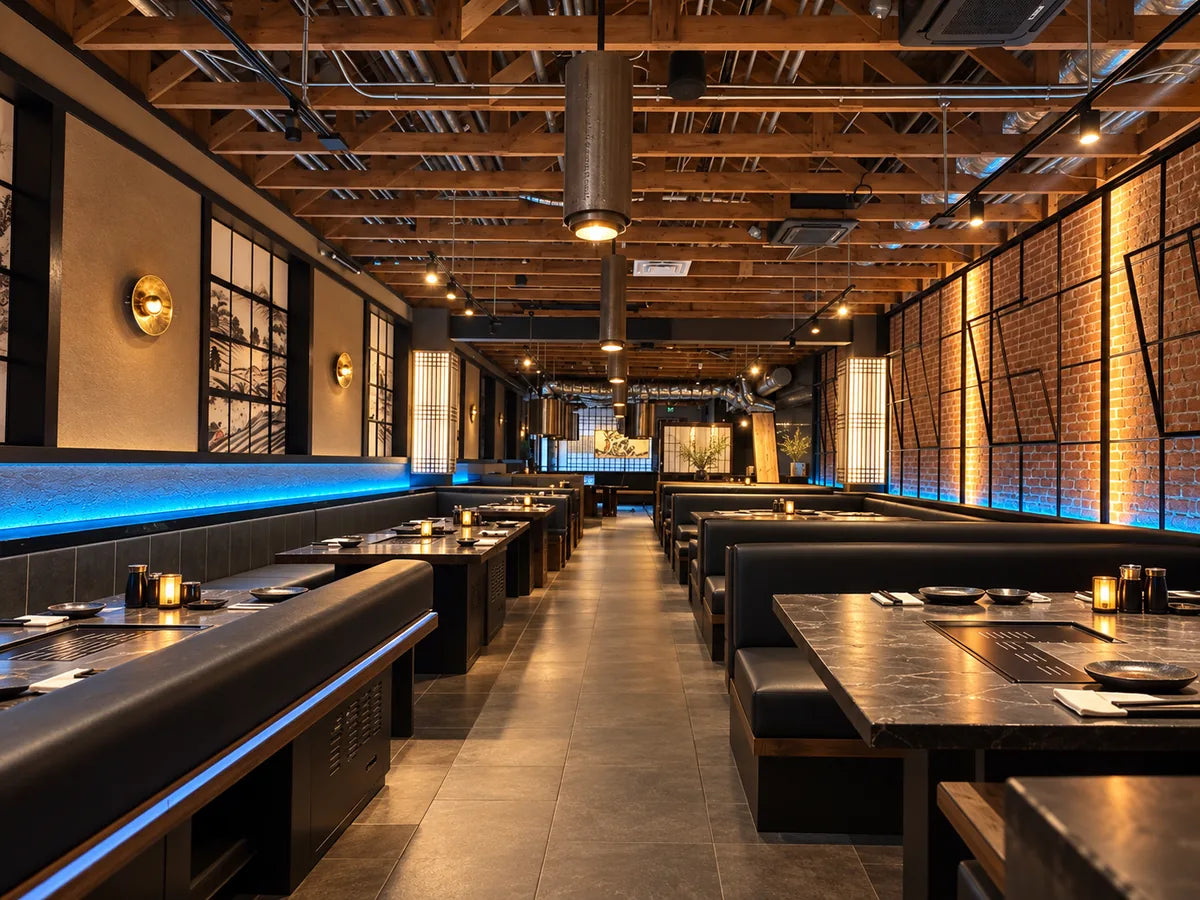
Korean BBQ: Furniture Integrated with Cooking and Ventilation
One documented ERS Korean barbecue project encompassed a large, multi-level restaurant with more than 80 tabletop grilling stations, two distinct ventilation configurations, commercial kitchen and refrigeration systems, bar facilities, dining furniture, and rooftop outdoor dining.
The project included custom grill-integrated dining tables and restaurant seating alongside the specialized cooking and ventilation equipment.
The furniture requirements extended beyond conventional tabletop dimensions.
Each integrated dining station needed to accommodate the selected grill arrangement and its associated physical interfaces. Differences between updraft and downdraft ventilation conditions also influenced the surrounding equipment and furniture coordination.
From a purchasing perspective, the critical distinction is between acquiring a dining table and acquiring furniture intended to function as part of a complete cooking installation.
The latter requires coordination of the equipment specification, table construction, required openings, relevant mechanical interfaces, service access, and installation responsibilities.
That coordination also affects how quotations are evaluated. A table without its required cooking-equipment interfaces is not equivalent to an approved integrated assembly.
Hot Pot: Induction-Integrated Dining Furniture
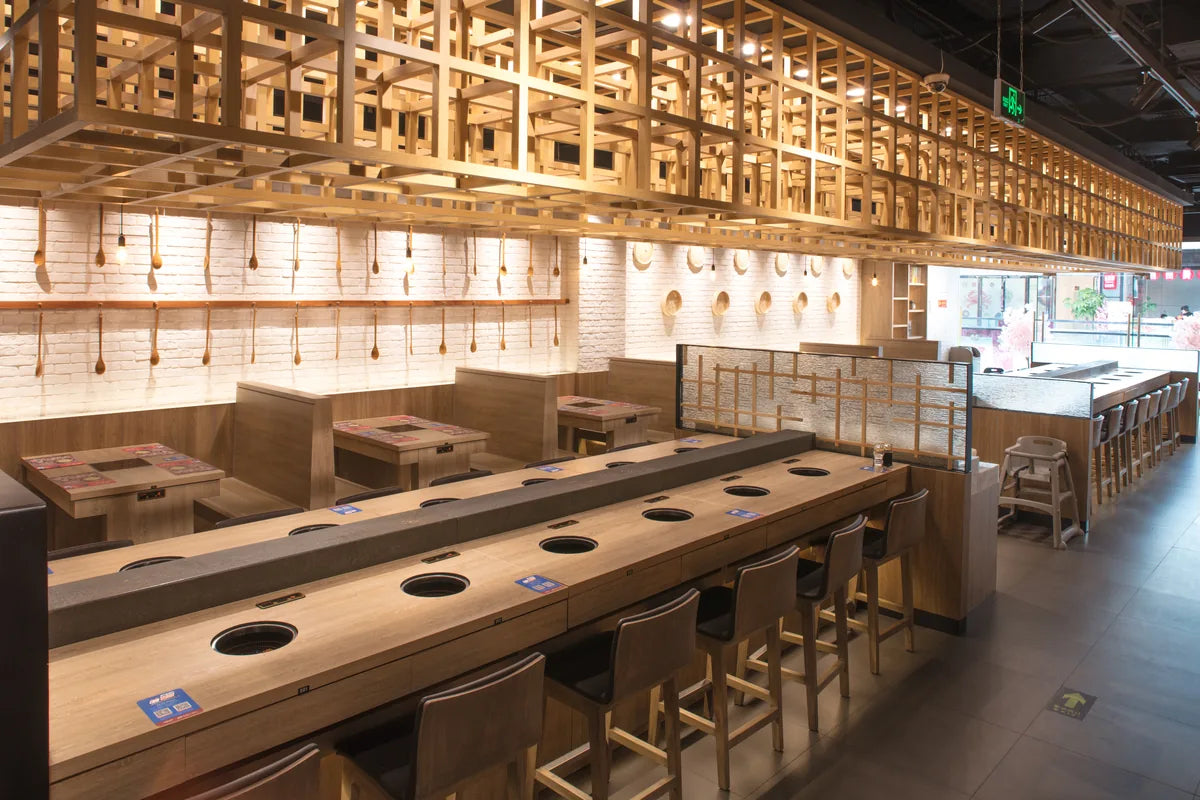
A documented ERS hot-pot project involved more than 40 induction-integrated dining stations, custom furniture, commercial broth-production equipment, refrigeration, ingredient preparation, specialty cookware, and table-service supplies.
The dining tables were coordinated with the electrical cooking equipment and the physical requirements of hot-pot service.
The relevant furniture specification had to account for appliance placement, heat-resistant surfaces, controls, and access to the equipment.
At the same time, tabletop space needed to accommodate cooking vessels, serving utensils, sauces, beverages, individual settings, and the continuous movement of ingredients.
The procurement scope therefore crossed conventional furniture and cooking-equipment categories.
A change in the selected appliance could have affected the required table fabrication or utility requirements. Accordingly, the furniture and equipment specifications needed to be coordinated as part of the same project.
The important purchasing lesson is that a complete integrated dining station must be defined by its approved assembly, not by the separate advertised prices of the appliance and tabletop.
High-Volume Dim Sum and Banquet Dining
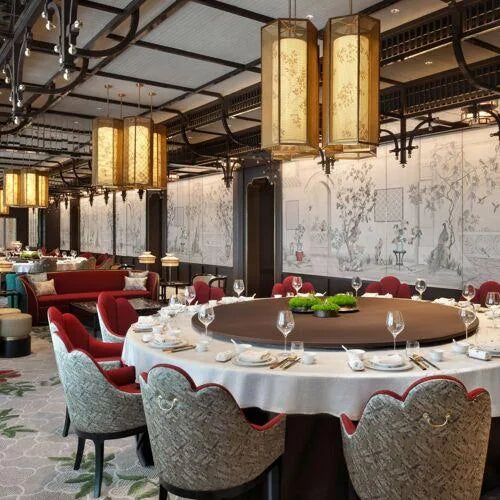
A separate documented ERS dim sum restaurant project involved a 16,000-square-foot, 420-seat operation with dedicated production kitchens, large-format round banquet tables, rotating serving surfaces, upholstered seating, and a fleet of 20 mobile dim sum service carts.
The project also included extensive tableware, tea-service equipment, and high-volume foodservice infrastructure.
This operating format presents a different furniture purchasing problem.
Tables must accommodate group dining and shared presentation, while the furniture arrangement must also support cart circulation and service access.
The use of large-format round tables and rotating serving surfaces changes the tabletop and base requirements compared with conventional rectangular two- and four-person configurations.
For banquet and high-volume operations, the furniture specification must also consider quantities, durability, replacement consistency, and coordination with service equipment.
The procurement objective is a complete furnishings program suited to the scale and method of service.

The Purchasing Implications Across These Projects
These projects illustrate three different relationships between furniture and foodservice operations.
Korean BBQ requires furniture coordination with grill and ventilation systems.
Hot pot requires furniture coordination with integrated electrical cooking equipment and tabletop service.
Dim sum and banquet dining require large-format furniture, shared-service arrangements, cart access, and substantial quantities of coordinated furnishings.
The purchasing consequences follow from those physical requirements.
Dimensions, support systems, materials, equipment interfaces, quantities, fabrication approvals, and supplier responsibilities determine whether furniture is suitable for the intended operation.
For projects involving several equipment and furniture suppliers, that information must remain consistent across the purchasing schedule.
ERS's broader experience in equipment, tableware, specialty sourcing, and restaurant project coordination informs this approach to furniture procurement.
Furniture should be purchased as part of the actual restaurant being built and operated—not as an isolated collection of visually compatible products.
12. Restaurant Furniture Purchasing Checklist and Project Quotation
A complete restaurant furniture inquiry should provide enough information to establish the required products, quantities, specifications, purchasing conditions, and intended delivery.
For a single category purchase, the requirements may be straightforward.
For a complete dining room, custom banquettes, or equipment-integrated furniture, the purchasing brief should include the relevant project documents and identify any unresolved technical requirements.
What to Prepare Before Requesting Furniture Pricing
| Purchasing information | Required detail |
|---|---|
| Restaurant project | Concept, location, new opening, renovation, or replacement |
| Furniture scope | Dining chairs, stools, tables, booths, banquettes, patio, and ancillary furniture |
| Quantities | Furniture by type, dining area, and intended configuration |
| Product specifications | Dimensions, construction, materials, finishes, and required options |
| Supporting documents | Furniture plan, FF&E schedule, product specifications, or relevant drawings |
| Target budget | Desired merchandise or completed purchasing budget |
| Project schedule | Required order and delivery dates |
| Delivery conditions | Receiving location, access, unloading, and installation requirements |
| Special conditions | Custom fabrication, accessibility, cooking equipment, utilities, or environmental requirements |
| Approval status | Outstanding finish selections, drawings, samples, or technical decisions |
Not every project begins with a complete approved FF&E schedule.
Existing drawings, proposed furniture quantities, or a preliminary purchasing list can provide the starting point for sourcing and specification development.
Verify Before Authorizing the Order
Before the final purchasing commitment, confirm that:
- The products and selected configurations match the approved requirements.
- Quantity and price units are consistent.
- Tabletop/base and other physical interfaces are compatible.
- Necessary technical and regulatory evidence has been reviewed.
- Custom dimensions and fabrication approvals are complete.
- Supplier quotations include all required components.
- Substitutions and exclusions are documented.
- Freight, receiving, installation, and site obligations are assigned.
- Production and delivery commitments align with the project schedule.
- Applicable warranty, replacement, and support conditions are understood.
The final order should be traceable to the accepted quotation and controlling specification.
Request Restaurant Furniture Pricing from Eden Restaurant Supply
Eden Restaurant Supply supports restaurants and hospitality operators with commercial furniture sourcing, specialty equipment, tableware, and broader procurement requirements.
For new restaurant projects, expansions, renovations, furniture replacement programs, and specialty dining installations, ERS can work from an existing furniture schedule or help identify the purchasing requirements necessary for a complete sourcing inquiry.
Request Restaurant Furniture Project Pricing
Explore Commercial Restaurant Furniture
Browse Commercial Restaurant Tables
Explore ERS Restaurant Projects
Further catalog categories for a complete sourcing brief
-

Black and Sand Plastic Restaurant Armchair
$161.38 USD
-

Black Walnut Plywood Seat and Back Metal Restaurant Barstool
$261.69 USD
-

Black Walnut Plank Live-Edge Restaurant Tabletop, 1.75" Thick
From $271.04 USD
13 configurations · Select size and finish
-

Black Cast Iron Three-Prong Ornamental Table Base – 28" Dining Height
From $155.77 USD
2 configurations · Select size and finish
-

Coffee Wicker Patio Side Chair
$183.81 USD
-

Round Downdraft Korean BBQ Grill/Roaster - JSDR-300 Full Set
$2,500.00 USD


Current catalog data. Confirm selected dimensions, finish, purchase unit and delivery scope on the product page. Separate components require compatibility approval.
Frequently Asked Questions
How much do commercial restaurant chairs cost?
The 2026 market observations include a basic padded metal dining chair at $37.99, a metal ladder-back chair at $68, an upholstered bucket-style chair at $180, and a larger upholstered armchair at $347.
These are different product configurations. Actual purchasing comparisons should account for construction, dimensions, upholstery, finish, quantities, freight, and intended application.
How much does it cost to furnish a 50-seat restaurant?
The 48-position fast-casual reference package contains $3,760.86 in furniture merchandise, including 48 chairs, 14 complete tables, a host podium, and a service station.
With the defined freight and installation allocations, the subtotal is $5,010.86 before taxes and reserve.
A restaurant using booths, higher-priced seating, specialty tables, or custom furniture will have a different budget.
What is the average restaurant furniture cost per seat?
The cost per dining position depends heavily on furniture composition.
The 48-position package calculates to $78.35 per proposed dining position in merchandise, while the 72-position mixed-seating package calculates to $158.91.
Neither figure should be treated as a universal national average. Complete itemization is the more reliable purchasing method.
How are restaurant booths priced?
Commercial booths may be sold by complete section, single or double configuration, linear foot, or custom fabrication quotation.
The final price depends on dimensions, upholstery, construction, ends, geometry, finish selections, delivery, and installation requirements.
What should a restaurant furniture FF&E schedule contain?
At minimum, the schedule should identify each furniture item, quantity, location, relevant dimensions, materials, finishes, specification reference, price basis, and purchasing status.
Custom or specialty furniture may require approved drawings, samples, equipment compatibility, and additional installation information.
How should restaurant furniture suppliers be compared?
Suppliers should quote a common specification. Compare product construction and dimensions, included components, substitutions, purchasing terms, freight, installation, warranty, and final cost.
The lowest merchandise subtotal is not necessarily the lowest complete acceptable quotation.
Does restaurant furniture pricing include delivery and installation?
Not necessarily.
Advertised prices may exclude freight, unloading, inside delivery, assembly, storage, anchorage, or installation.
These obligations must be identified in the supplier quotation and purchasing agreement.
How long does commercial restaurant furniture last?
Actual service life depends on construction, application, intensity of use, maintenance, repairability, and replacement availability.
Warranty duration and abrasion-test results do not independently establish furniture lifespan.
Long-term purchasing comparisons should use defined service-life and maintenance assumptions rather than a universal replacement interval.
Research Basis and Methodology
This reference incorporates Eden Restaurant Supply's commercial restaurant and equipment procurement experience, publicly documented projects, verified 2026 US commercial furniture pricing, technical product specifications, and applicable performance and regulatory references.
Pricing: Observed product prices are associated with defined configurations and purchasing units. Component prices, complete product prices, configurable rates, and project totals are distinguished throughout.
Project budgets: The 48-position and 72-position purchasing analyses identify quantities, prices, and extended costs. Their physical arrangements remain subject to the applicable final furniture plan and project requirements.
Commercial comparisons: The quotation analysis reconciles merchandise, missing scope, freight, installation, and technical differences using the identified comparison figures.
Technical requirements: Regulatory requirements, voluntary test standards, manufacturer specifications, and project approvals are treated as distinct categories of evidence.
Project experience: ERS project descriptions and quantitative operational details are drawn from the company's documented restaurant-project portfolio. Financial reference models and project case descriptions are maintained as separate records.
Current research edition: October 2026.
Eden Restaurant Supply — Supporting commercial foodservice projects since 2002.
Related technical references: Commercial Restaurant Furniture: The Complete Reference · Commercial Restaurant Chairs, Stools & Seating · Restaurant Tables, Tabletops & Bases · Restaurant Booths & Banquettes · Outdoor & Patio Restaurant Furniture · Furniture Materials, Construction & Performance · Restaurant Furniture Dimensions, Layout & Accessibility · Restaurant Furniture Design, Styles & Applications