

Equipment & Specialty Supplies
Japanese Tea, Water, Ice & Complementary Beverage Service
A small pot of gyokuro, a steadily replenished house tea and a glass of iced sencha place different demands on the same restaurant. They require different concentrations, vessels, preparation time and water delivery. Add chilled table water, a highball and a second dinner rush, and the purchase extends well beyond a teapot and an ice machine.
The equipment should preserve the drink the restaurant intends to serve. That means identifying the tea a dispenser accepts, measuring the liquor a pot actually yields, distinguishing hot-water reserve from recovery, and knowing how much usable ice remains when the next round arrives. It also means choosing objects that can be handled, cleaned and replaced without undermining their culinary purpose.
Eden Restaurant Supply has supplied Japanese and sushi restaurants from Los Angeles since 2002. This reference brings the ingredient, Japanese tea craft, American commercial equipment and the complete service purchase together. Tea leads the discussion; water and beverage ice receive their own technical treatment; nonalcoholic drinks, beer, wine, shochu and highballs complete the supporting offer. “Complementary” here means beverages that accompany the dining program, whether included with the meal or sold separately.
In this guide 13 sections
02 / Equipment & Specialty Supplies
2. Japanese tea types, formats and purchasing specifications
Processing explains more than a premium label
Sencha is generally steamed, rolled and dried. Gyokuro and tencha involve shaded cultivation, but their processing diverges: gyokuro is rolled leaf for infusion; tencha is prepared without that rolling and becomes the material ground into matcha. Shading alone therefore does not make two teas interchangeable. Nor is steaming universal across Japanese tea: pan-fired kamairicha provides a distinct route. MAFF, Japanese tea classification.
Within sencha, leaf condition has immediate preparation consequences. Longer steaming makes the leaf more fragile and produces finer particles. A deep-steamed tea can give a dense green appearance partly through suspended material, not solely a greater quantity of dissolved compounds. Its behavior in a fine mesh, basket or ceramic strainer deserves evaluation with the actual pot. MAFF, tea preparation guide.
Other familiar names describe different aspects of the ingredient:
Scroll to read all columns
| Tea | What the name helps identify | What the buyer still needs to establish |
|---|---|---|
| Sencha | A broad family of steamed, rolled green teas | Leaf condition, producer, intended concentration and preparation |
| Gyokuro | Shaded, rolled leaf commonly prepared in small concentrated servings | The selected tea's dose, temperature, portion and later infusions |
| Hojicha | Roasted tea | Leaf or stem material, roast character and intended drink |
| Genmaicha | Tea combined with roasted rice | Base tea, blend and any additional matcha or other ingredients |
| Kukicha and related stem teas | Stem material selected during processing | Producer terminology, blend and whether roasted |
| Bancha | A name with production and regional variation | The actual product and processing, rather than one assumed recipe |
| Mecha and konacha | Bud or fine-particle fractions associated with tea finishing | Material, particle behavior, straining and intended use |
Marukyu Koyamaen's descriptions of varieties and tea finishing make these distinctions clear. Sorting, firing and blending are part of producing an intended finished tea. A consistent blend can be exactly what a house service needs; stems or fines are not automatically defective versions of a more expensive whole leaf. Marukyu Koyamaen, varieties, tea finishing.
Bancha deserves particular care. MAFF discusses ordinary mature-leaf/stem bancha alongside regional products with different processing, including post-fermented Awabancha. The name cannot establish one invariant method, roast or caffeine level. Microbial post-fermentation should also be distinguished from the oxidation terminology used for other tea families. MAFF, Japanese tea varieties.
Roasted stem tea supplies a more specific regional story. MAFF traces Kaga bocha to Kanazawa in 1902 and describes differences in roasting. A lighter roast and a deeper roast offer different aromatic emphasis. This history belongs to Kaga bocha; it does not mean all hojicha is stem tea or that stem material is inherently a lower-quality choice. MAFF, Kaga bocha.
Four products that should never share an imprecise powder order
Konacha, ground whole leaf, matcha and instant extract can all be described loosely as fine or powdered green tea. They ask different things of the equipment.
Scroll to read all columns
| Product | Actual material | Preparation | Equipment consequence |
|---|---|---|---|
| Konacha | Fine particles separated in tea processing | Infuse, then separate the leaf material | Strainer retention and pouring behavior matter |
| Pulverized whole-leaf tea | Tea leaf ground into fine particles | Disperse in water; it does not fully dissolve | The approved dispenser must handle the particles and resulting residue |
| Matcha | Finely ground tencha | Disperse and whisk or otherwise prepare for its intended use | Dose, wetting, sifting and mixing affect the finished drink |
| Instant tea | Previously extracted tea liquor, dried | Reconstitute a soluble extract | Feedstock, dosing and mixing differ from leaf infusion |
These are preparation identities, not a quality ranking. Ito En explicitly distinguishes the four. A consumable order reading only “green-tea powder” cannot establish compatibility with a machine, and changing from pulverized leaf to extract changes more than the supplier's name on the invoice. Ito En, powder-tea distinctions.
Mugicha and sobacha belong to different ingredients
Mugicha is a barley infusion, not roasted green tea. Sobacha uses buckwheat. Their place on a beverage menu may overlap with tea, but botanical identity, preparation and guest information must remain specific.
Ippodo identifies its pure barley mugicha as caffeine-free while cautioning against treating its bancha teas as caffeine-free or necessarily low-caffeine. Ito En's sobacha information identifies buckwheat and the relevant allergy concern. Blends still require their actual ingredient list. Ippodo, caffeine distinctions, Ito En, sobacha.
Caffeine-free does not mean allergen-free or gluten-free. Barley is among the gluten-containing grains identified by FDA. A menu cannot infer gluten-free suitability from the word “tea,” from zero caffeine or from an unfamiliar imported allergen panel. FDA, gluten-free labeling.
Provenance, grade and pack size need useful definitions
MAFF's account of Uji tea includes qualifying leaves from Kyoto, Nara, Shiga and Mie processed by Kyoto processors using the relevant Uji-origin methods. Translating “Uji” into “every leaf grew inside Uji city” is inaccurate. Ask what the designation establishes for the actual product. MAFF, Uji tea.
“Ceremonial grade” is similarly weak as a standalone purchase specification. Ippodo does not use it and describes it as vague Western marketing terminology. That is a reason to ask for the tea, intended preparation and accepted flavor, rather than buy by an undefined adjective. Ippodo, ceremonial-grade terminology.
A commercially useful tea order identifies composition, producer/origin, roast or blend, leaf condition, intended drink, preparation, pack size and acceptable substitution. Where portioning matters, single-use and pot-size bags are genuine alternatives to loose weighing. Marukyu's catalog, for example, distinguishes 3-g individual bags and larger pot formats. The bag format alone does not establish a quality tier. Marukyu Koyamaen, English catalog.
Opened stock should turn at a rate that preserves the intended drink. Ippodo recommends roughly a month after opening for best aroma and flavor, with protection from air, heat, light and odors; sealed cold-stored tea should return to room temperature before opening. Those are producer-specific quality instructions, not a universal food-safety expiry. Ippodo, opened freshness, matcha storage.
Keep a sensible working quantity at the station and protect the reserve. A tea that sits open beside steam and cooking aromas is not in the same condition as its sealed replacement. When supply changes, approve the substitute through the drink it produces: similar naming does not guarantee similar dose, pouring speed, roast or accepted yield.
03 / Equipment & Specialty Supplies
3. Brewing Japanese tea: extraction, concentration and hot or cold service
- 01Leaf + charged water
- 02Complete contact interval
- 03Straining and final pour
- 04Liquor delivered to the cups
The original recipe comparisons below retain their own leaf, water, temperature and infusion conditions.
Control the complete contact and pour
Tea preparation is selective extraction. Leaf condition, dose, water quantity, temperature, time and agitation change the composition of the liquor, not just its generic “strength.” Separation then determines when that contact actually ends.
Japanese sencha research found that temperature, duration and particle size affected measured soluble components, with the particle-size effect itself depending on temperature. Its multi-minute tests support the mechanism; they are not a prescription for a modern thirty-second or sixty-second service. Ikeda, Nakagawa and Iwasa, infusion conditions.
The practical implication is to control leaf and hardware together. Fine material may extract and pour differently from a more intact leaf. A screen that retains fine particles can accumulate leaf and slow the drain. An open strainer may pour quickly while admitting more particles. Neither is inherently superior without the intended cup.
A nominal sixty-second infusion also needs a defined endpoint. Starting to pour at sixty seconds does not end contact for the liquid still in the pot. Staff using different vessels can follow the same timer and deliver different preparations. Agree on the complete sequence: charge, contact, agitation if any, start of pour and full decant.
Temperature is equally specific. A boiler display does not measure the water when it reaches the leaf, and neither value establishes the temperature at which the guest drinks. Vessel temperature, volume and transfers intervene. A cooling pitcher can make the process reproducible, but “each transfer loses ten degrees” is not a universal rule.
Producer recipes reveal different intentions
The following are producer preparations, not category-wide limits:
Scroll to read all columns
| Tea and producer | Dry tea | Water charged | Temperature | Contact time |
|---|---|---|---|---|
| Ippodo standard sencha | 10 g | 210 mL | 80°C / 176°F | 60 seconds |
| Hibiki-an sencha guidance | 7–8 g | 200 mL | 80°C / 176°F | 60 seconds |
| Ippodo standard gyokuro | 10 g | 80 mL | 60°C / 140°F | 90 seconds |
| Ippodo standard hojicha | 10 g | 240 mL | 100°C / 212°F | 30 seconds |
Sources: Ippodo sencha, Hibiki-an, Ippodo gyokuro, Ippodo hojicha.
The two senchas share temperature and time but use different doses. Gyokuro's small water charge describes a concentrated service, not a full-size refill. Hojicha's hotter, shorter preparation makes a different aromatic choice. A cost calculation that calls all four “one cup of tea” has already lost the drink being compared.
Marukyu Koyamaen offers another useful sencha contrast: 7–9 g for three small servings, either 70–75°C for one minute or 85–90°C for thirty seconds. Its small-serving quantities are approximate; measure recovered liquor before translating them into the restaurant's portions. A producer may offer more than one intended balance from the tea. Marukyu Koyamaen, sencha preparation.
Water charged is not tea served
Some water remains with the leaf; some working space is occupied by leaf and necessary headroom. The vessel's brim capacity is therefore neither its practical brewing fill nor the liquor recovered from an accepted preparation.
Measure the recovered liquor and set the guest portion from that result. A pot promising three servings must produce three actual fills after separation. When serving several cups, alternating the pour distributes the changing liquor more evenly than completely filling one cup before moving to the next. Complete decanting also avoids leaving a pool of liquor in contact with the leaf. MAFF's preparation guide addresses both practices and notes that transfer cooling varies with conditions. MAFF, brewing and pouring guidance.
The recipe record should name the pot or filter, not just the tea and grams. Record charged water, contact temperature, timing and recovered yield. A substituted basket, pot size or fine-leaf tea deserves a new preparation check even if the old grams-per-litre ratio is retained.
Later infusions are different servings
Successive infusions change the composition of the drink. In a Japanese sencha study, amino acids and different catechins did not follow one uniform extraction pattern. Epigallocatechin (EGC) and epicatechin (EC) were appreciably extracted at lower temperatures, while gallated catechins behaved differently. Temperature therefore changes the mixture, not a simple switch between sweetness and bitterness. Caffeine was extracted even at 50°C; lower-temperature brewing should not be represented as decaffeination. Sakamoto and colleagues, successive sencha infusions.
A later Japanese sensory study found a second-infusion preference for selected teas under its particular preparation and panel conditions. That supports taking later cups seriously, not announcing that the second infusion is always best. Its analytical relationships also do not establish a universal target ratio for tea flavor. Yamazawa and colleagues, sencha infusions.
Serve later infusions because they belong to the chosen experience. They require preparation and presentation, and they should not be counted automatically as identical first servings obtained for free.
For sharing, Ippodo provides a practical alternative to an oversized pot: prepare successive infusions and combine them in a pitcher. This creates a deliberately combined drink and separates liquor from the leaf. It does not establish that every tea provides the same number of useful extractions. Ippodo, tea for sharing.
Scaling a batch by multiplication alone can change wetting, basket constraint, heat retention and drain time. Evaluate the resulting liquor when it will actually reach the table, including any hold. Good extraction at the end of brewing does not prove acceptable flavor after a prolonged service interval.
Iced tea has three distinct preparation routes
Hot extraction onto ice, hot extraction followed by controlled chilling and cold extraction produce different preparation tasks. The accepted recipe must identify which route is intended.
Ippodo's iced sencha uses a hot preparation before pouring over ice. Its cold-brew sencha instead uses chilled water for fifteen minutes. The latter is useful evidence that cold extraction does not inherently mean an overnight soak; neither home recipe supplies a commercial holding validation. Ippodo, iced sencha, cold-brew sencha.
The useful volume accounting is:
Final liquid in the drink = recovered tea + deliberately added liquid + ice melted by the evaluation point.
Ice still present has not yet become liquid dilution. Water retained by the leaf is not in the glass. For example, an assumed 180 mL of recovered infusion plus 60 mL of melted ice gives approximately 240 mL at three-quarters of the original concentration. That is a volume illustration, not a prediction that a particular cube will melt by 60 mL.
A hot-over-ice recipe intentionally uses ice for cooling and dilution. A prechilled preparation gives the service ice a smaller initial cooling task. Section 8 explains the physical difference; section 10 addresses commercial preparation and holding.
Matcha requires dispersion, not straining
Sifting breaks up dry clumps before wetting. Measured powder and water establish the intended concentration; the bowl's working space and whisk access help produce a consistent dispersion. For a warm small serving, Marukyu Koyamaen describes a warmed, dried bowl and back-and-forth whisking, with an illustrative thin-tea preparation of about 1.5 g matcha and 70 mL water. The desired drink governs the recipe, not the mere presence of a bamboo whisk. Marukyu Koyamaen, matcha preparation.
Cold-whisked matcha is another preparation again. Ippodo uses 2 g sifted powder with 60 mL water at 5°C and approximately fifteen seconds of whisking; ice is removed from the chilled water before use. This disperses powder in cold water rather than extracting leaf and straining it. Ippodo, cold-whisked matcha.
A mixed-drink base should be specified separately. Ippodo's latte recipe uses 3 g matcha with 100 mL water at 80°C, followed by 100 mL milk. The base and final drink have different concentrations, and the utensil contacting milk may need different cleaning permissions from one intended only for matcha and water. Ippodo, matcha latte.
Grain infusions need their own preparation
Ippodo's One-Pot Mugicha uses a 10-g bag for one litre, with either boiling water for ten minutes or chilled water for one hour. Those instructions belong to that barley product; they are not a sencha recipe or a universal time for every roasted grain. Ippodo, One-Pot Mugicha.
Bagged, loose and differently roasted materials should retain their own dose, contact method and separation. Establish a sobacha recipe from the actual buckwheat product rather than transfer a barley setting. Schedule bag removal or straining, cooling where used and the accepted commercial handling separately. A producer's culinary extraction instruction does not establish a restaurant holding life.
For every preparation, accept the actual final portion: aroma, flavor, mouthfeel, temperature and concentration at service. A gram figure without recovered yield, dilution or intended hold is an incomplete recipe.
04 / Equipment & Specialty Supplies
4. Kyusu, teacups and preparation tools
Form, working volume and the last pour
A kyusu's handle arrangement changes how it is held, tipped and emptied. Side, rear and overhead handles place the hand differently relative to the spout and lid. The useful test is the complete pour with the chosen tea: comfortable grip, controlled lid, adequate leaf space and a clean finish without a large retained pool.
Hohin and shiboridashi bring the small preparation into focus. Their handleless forms and pouring geometry suit a different assignment from a large house-refill pot; grip and water temperature must be considered together. The names do not impose one universal size or strainer design.
A red-clay hohin offered through Tokoname's official store distinguishes 150 mL to the brim from 120 mL in ordinary use. Its fitted lid and body are ground together. Gyokko's S-M14 shiboridashi is listed at just 60 cc; that published volume is not a measured recovered-tea yield. These objects make sense when the intended preparation is genuinely small. Tokoname, red-clay hohin, Gyokko S-M14.
An individually fitted lid also changes replacement. A spare with the same nominal diameter may not mate correctly. Confirm how the maker supplies replacements before treating a craft pot as a body, lid and handle that can all be reordered independently.

Match the strainer to the leaf
Integrated ceramic strainers, metal mesh and removable baskets each create a different contact and cleaning arrangement. An integrated strainer leaves the pot interior open for leaf movement but must be accessible for inspection. A removable basket separates the wet leaf conveniently, yet its usable space and mesh affect expansion, retained particles and drain speed.
Compare them with the actual tea. A fine deep-steamed leaf that builds up against the screen can extend the pour; a larger leaf may behave quite differently in the same pot. A filter that produces a visually clear cup has made a particle-selection decision, not necessarily improved every tea.
Three documented examples show how construction changes the purchase:
Scroll to read all columns
| Object | Documented construction or volume | Commercial distinction |
|---|---|---|
| Hario ChaCha Kyusu Maru CHJMN-30T / -45T / -70T | 300 / 450 / 700 mL practical capacity; borosilicate pot/lid and removable stainless strainer | Visible preparation, removable leaf basket and model-specific replacement part |
| KINTO LEAVES TO TEA 300-mL kyusu | Hasami porcelain with integrated porcelain strainer and hand-finished spout | Integrated filtration with maker-permitted dishwasher/microwave use |
| Ippodo left-handed Tokoname kyusu | 240-mL listed capacity; care-restricted clay pot | Handed pouring and specific prohibitions on detergent, dishwasher, bleach and microwave |
Hario permits microwave use only with the metal strainer removed and excludes oven, induction and open flame. KINTO cautions against abrasive cleaning. These are exact product instructions, not permissions attached to every glass or porcelain pot. Hario ChaCha Kyusu Maru, KINTO LT kyusu, Ippodo Tokoname kyusu.
The Hario family also has model-specific replacement strainers. Match the part to the pot and verify its construction; a brand name or approximate basket diameter is not enough. Hario CHJMN-45 replacement strainer.
Craft is visible in construction
Tokoname's teapot development reaches back to the late Edo period. Local accounts show the making of body, spout, handle and strainer, with forming, molds and hand finishing contributing to modern production. That history explains why the parts and pour deserve attention. It does not support a simplistic division between “authentic handmade” and inferior production ware. Tokoname tourism association, teaware, Tokoname production process.
Clay, firing, glaze and assembly should be specified for the actual object. A traditional claim about a clay's effect on flavor is not a universal scientific guarantee that the pot removes bitterness. Equally, an attractive unglazed surface does not settle commercial cleanability. If permitted care cannot meet the restaurant's required cleaning and sanitizing process, choose a suitable alternative or establish an accepted method before ordering the service set.
An iron kettle and an iron teapot are different equipment
OIGEN distinguishes its water-heating iron kettle from its enamel-lined iron teapot. Its lined teapots are not for direct flame or induction. The shared silhouette and material name do not make the objects interchangeable. OIGEN, kettle and teapot.
Do not apply bare cast-iron cookware seasoning or cleaning practices to an enamel-lined tea vessel. The lining, permitted heat source and care instruction belong to the exact product. OIGEN's professional guidance also addresses enamel care and marks beneath a wet base, details that matter on a restaurant tabletop. OIGEN professional FAQ.
A yuzamashi or suitable cooling pitcher performs a separate job: a controlled transfer before brewing. A sharing pitcher distributes or combines prepared liquor. Buy either because it improves temperature control or service, not because every tea arrangement must include one. The vessel and transfer have to be tested at the actual fill and starting temperature.
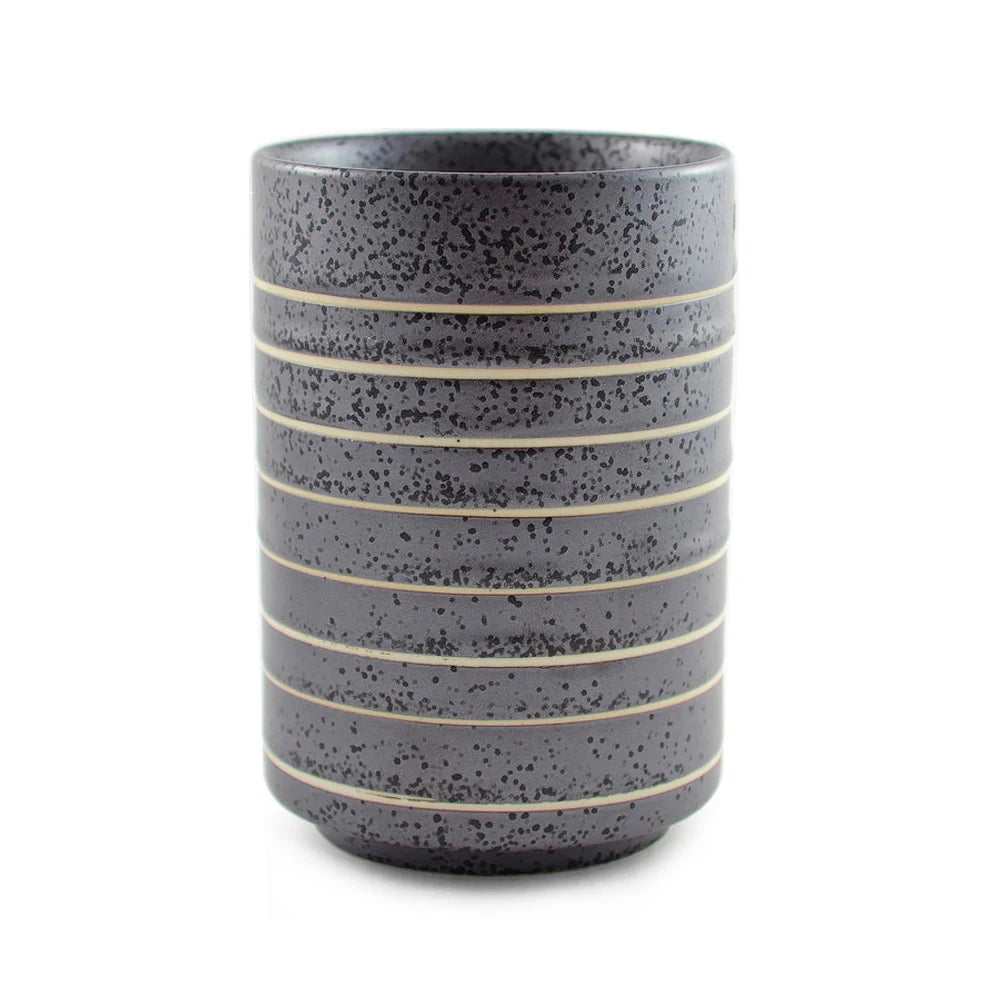
Cups and matcha tools complete the preparation
The cup translates a recipe into a guest portion. Opening, rim, wall, grip and working fill matter more than nominal capacity alone. A concentrated preparation needs a different scale from a freely replenished house tea. Check the cup at the actual delivery temperature and fill, then check how many of those fills the selected pot produces.
KINTO's LT porcelain cup is listed at 160 mL, 80 mm diameter and 55 mm high, with dishwasher and microwave permission. It is a useful scale reference, not proof that 160 mL is a comfortable service fill or that every commercial rack and cycle is suitable. KINTO LT cup and saucer.
Matcha tools require equally specific selection. Ippodo's bamboo chasen is intended for matcha and water; its instructions call for softening the tines, rinsing without soap and air drying outside the storage case. Milk is added after whisking. Deteriorating or broken tines require replacement. Ippodo bamboo chasen.
Its resin alternative performs different work. The polypropylene whisk dismantles, permits detergent/dishwasher cleaning and is described for dairy preparations; its stated heat resistance is 100°C. That is a meaningful option for a repeated mixed-drink task, with its own heating and bowl-use restrictions. It does not approve every plastic whisk or every commercial sanitizer. Ippodo resin chasen.
Order teaware as a working group: accepted pot and cup fills, suitable strainer, sufficient clean pieces, compatible rack/storage and obtainable replacements. ERS teapots and teacups provide the relevant assortment; the specific object's construction and care determine its use. For broader material families and coordination with the meal, see the Sushi & Omakase Restaurant Tableware Guide.
Explore the ERS collection
Teapots
Compare the assortment for this part of your service.
-
 Image unavailable
Tea Pot 4 1/2", White Ceramic
View details & options : Tea Pot 4 1/2", White Ceramic
Image unavailable
Tea Pot 4 1/2", White Ceramic
View details & options : Tea Pot 4 1/2", White Ceramic
-
 Image unavailable
HARIO Tea Brewing Decanter 500ml, Black
View details & options : HARIO Tea Brewing Decanter 500ml, Black
Image unavailable
HARIO Tea Brewing Decanter 500ml, Black
View details & options : HARIO Tea Brewing Decanter 500ml, Black
-
 Image unavailable
Black Melamine Teapot 54 Fl Oz, Black
View details & options : Black Melamine Teapot 54 Fl Oz, Black
Image unavailable
Black Melamine Teapot 54 Fl Oz, Black
View details & options : Black Melamine Teapot 54 Fl Oz, Black
-
 Image unavailable
HARIO Jumping Glass Leaf Pot 600ml
View details & options : HARIO Jumping Glass Leaf Pot 600ml
Image unavailable
HARIO Jumping Glass Leaf Pot 600ml
View details & options : HARIO Jumping Glass Leaf Pot 600ml
-
 Image unavailable
Melamine Teapot 54 Fl Oz, Beige/Green
View details & options : Melamine Teapot 54 Fl Oz, Beige/Green
Image unavailable
Melamine Teapot 54 Fl Oz, Beige/Green
View details & options : Melamine Teapot 54 Fl Oz, Beige/Green
-
 Image unavailable
Tea Pot /W Strainer 40Fl.
View details & options : Tea Pot /W Strainer 40Fl.
Image unavailable
Tea Pot /W Strainer 40Fl.
View details & options : Tea Pot /W Strainer 40Fl.
-
 Image unavailable
Melamine Teapot 54 Fl Oz, Beige/Green
View details & options : Melamine Teapot 54 Fl Oz, Beige/Green
Image unavailable
Melamine Teapot 54 Fl Oz, Beige/Green
View details & options : Melamine Teapot 54 Fl Oz, Beige/Green
-
 Image unavailable
HARIO Cha Cha Kyusu 'Maru' Glass Teapot 450ml
View details & options : HARIO Cha Cha Kyusu 'Maru' Glass Teapot 450ml
Image unavailable
HARIO Cha Cha Kyusu 'Maru' Glass Teapot 450ml
View details & options : HARIO Cha Cha Kyusu 'Maru' Glass Teapot 450ml


05 / Equipment & Specialty Supplies
5. Commercial hot-water, brewing and tea-dispensing equipment
Heating water, extracting leaf, dispensing powder and holding prepared tea are separate duties. One appliance may perform more than one, but the purchase should state which duties are required. A large hot-water tank does not brew tea by itself, and a programmable batch brewer is not automatically a substitute for low-temperature small-pot preparation.
Manual-fill supply has finite reserve and a temperature-change time
Zojirushi's CD-LTC50 illustrates the low-infrastructure route: a 5-L, 120-V, 800-W water boiler/warmer with 175°F, 195°F and 208°F keep-warm settings. It is manually filled. Its advertised twenty-one eight-ounce cups expresses nominal capacity, not an hourly production test or a separate usable-draw rating. Zojirushi CD-LTC50.
The manual gives roughly forty minutes to boil a full tank from 73°F under its stated conditions, and approximately one hour forty minutes for a full boiled tank to cool to 175°F. Quick Temp heats directly to 175°F or 195°F without first boiling. The tank is for water only, and dispensing during boiling is prohibited. Zojirushi operating manual.
The purchase implication is immediate: lowering the keep-warm setting after boiling does not instantly create lower-temperature tea water. A service using several temperatures needs a controlled cooling method or appropriate delivery equipment. Refilling access, steam location and the interruption caused by replenishment also belong in placement. Nominal litres alone do not describe the service available during a refill round.
Equal reserve can conceal very different replenishment
Marco's U.S. MIX UC3 variants make the distinction particularly clear:
Scroll to read all columns
| Exact U.S. variant | Electrical specification | Published immediate draw | Published hourly output |
|---|---|---|---|
| MIX UC3 1001880 | 110 V, 1.4 kW, NEMA 5-15P | 0.8 US gal | 3.6 US gal/h |
| MIX UC3 1000880US | 220 V, 2.8 kW, NEMA L6-20P | 0.8 US gal | 7.3 US gal/h |
The catalog supplies these figures but not all inlet/delivery conditions behind the hot-water output. The boiler and font have separate order codes; the three-button MIX font offers programmed temperature/volume choices, while the UNA interface is different. Marco U.S. catalog, MIX range.
Consider twelve assumed 200-mL draws. Their 2.4 L total fits within approximately 3.03 L of published immediate draw for either version. Dividing that quantity by the published output gives about 10.6 minutes versus 5.2 minutes of equivalent replenishment. This is arithmetic, not a measured waiting-time guarantee: actual conditions and recovery during dispensing matter. It nevertheless shows why two installations can satisfy the first round and perform differently through repeated rounds.
The undercounter arrangement also needs its font, receiver clearance, tray/waste route and service access. Marco's documents contain conflicting pressure and fitting requirements for MIX. The supplied SKU's installation requirements must be reconciled before specifying a regulator, fittings or cabinetry; choosing the more convenient number from two documents is not engineering. Marco U.S. MIX sheet, MIX service manual.
Buttons themselves can be misleading. BUNN's H5E-DV PC provides three programmed portions and continuous dispensing at one adjustable temperature setting. Three buttons do not establish three independently selected water temperatures. Its H5X variants also differ materially in electrical service and supplied connection: the 120-V 43600.0026 sheet specifies no attached cord. Name the exact configuration, not simply a five-gallon boiler. BUNN H5E-DV PC, BUNN H5X 43600.0026.
Conceptual separation described in the BUNN programming instructions. Finished batch volume is different from immediate hot-water draw.
A brewer can control extraction and dilution separately
BUNN ITCB-DV-HV 52300.0100 includes tea capability, a Quick Brew funnel and integrated dilution nozzle; receiving servers are sold separately. Its current sheet rates output at different electrical configurations and a specified 60°F inlet. Those finished-capacity figures are not immediate hot-water draw. BUNN 52300.0100 specification.
Programming separates brew volume, dilution volume, dilution delay and pulse/preinfusion controls. Dilution water enters the receiver rather than passing through the leaf. The documented tank-temperature setting range is 185–205°F, with time needed when temperature changes. BUNN programming manual.
This can be useful for a defined batch of iced tea. It does not automatically reproduce gyokuro brewed at 50–60°C in a small pot. Paper filtration, leaf distribution, batch size and dilution produce a different preparation. Evaluate the accepted final drink before choosing the machine around a nominal tea-capability label.
The operating method uses loose tea in a paper filter and includes brewer/server cleaning and sanitizing, with no overnight retention of brewed iced tea. The current SKU's inlet arrangement also needs to be distinguished from older shared-manual adapter descriptions. BUNN installation and operation.
Automatic leaf-powder service is another architecture
Hoshizaki's Japanese PTE-F250HWA1-BK illustrates how a large cup claim can conceal its conditions. Its approximately 250 hot servings are 90 mL each at four servings per minute, with 30°C ambient, 25°C inlet water and output of at least 70°C. Its seven-litre tank contains 3.8 L usable water and 3.2 L safety reserve. The temperature setting is a tank setting, not guaranteed dispense temperature. Hoshizaki PTE-F250HWA1-BK.
Two hundred fifty such servings total 22.5 L over approximately 62.5 minutes. They are not an instantaneous 22.5-L reserve or 250 large restaurant cups. That is the right way to read a serving rating: portion, pace and required output temperature together.
The feedstock is pre-pulverized leaf, including suitable sencha and genmaicha products. The machine does not grind ordinary loose leaf on demand, and Hoshizaki distinguishes this preparation from extract-based powder. Hoshizaki, pulverized-leaf dispensing.
This Japanese 100-V example establishes an operating method, not U.S. installation suitability. For U.S. service, specify a locally supported model, approved feedstock and its exact cleaning and installation package. A product photograph and an attractive cup count do not establish those conditions.
Complete the hot-water assignment
Specify immediate usable draw, output between rounds, required delivery temperature, fill method, electrical configuration and the vessel receiving the water. Include non-sale draws such as prewarming where used, coffee preparation and warm mixed drinks. Then resolve treatment, dynamic pressure, drainage where required and cleaning access.
Prepared-tea holding remains a separate choice. Receiving strained tea in an insulated server separates holding from leaf extraction; it does not by itself establish how long flavor remains acceptable or what handling rules apply. The service needs both a sensory rejection point and an appropriate commercial process.
Culinary hot water, stock, soup and steam duties belong to the separate Hot Kitchen Equipment for Sushi Restaurants reference. A successful beverage-water arrangement is not automatic approval for every kitchen appliance sharing the supply.
06 / Equipment & Specialty Supplies
6. Water for tea and equipment: chemistry and treatment
The preferred water for a tea and acceptable feed water for an appliance are related specifications, but they answer different questions. Taste the chosen tea under controlled preparation, and separately meet the installed equipment's water requirements. Neither task can be replaced by a single “ideal TDS” number.
Hardness, alkalinity and pH are not substitutes
Hardness principally describes dissolved calcium and magnesium, usually expressed as calcium-carbonate equivalents. Heating hard water can promote carbonate scale. Alkalinity describes acid-neutralizing capacity, commonly associated with bicarbonate and carbonate. Both may be reported in mg/L as CaCO₃, but they remain different measurements. USGS, hardness, USGS, alkalinity.
pH describes acid–base condition, not how strongly the water resists a change. Conductivity measures electrical conduction by dissolved ions; its relationship to dissolved solids depends on composition and conditions. A handheld meter's estimated TDS cannot identify whether the dissolved material is calcium, sodium, bicarbonate, chloride or another constituent. USGS, pH, specific conductance.
Los Angeles supplies make the distinction tangible. LADWP's report for calendar year 2025 gives these treated-source averages:
Scroll to read all columns
| Reported source | Hardness, mg/L as CaCO₃ | Alkalinity, mg/L as CaCO₃ | TDS, mg/L |
|---|---|---|---|
| Los Angeles Aqueduct Filtration Plant | 103 | 105 | 234 |
| MWD Weymouth Plant | 234 | 110 | 536 |
Nearly equal alkalinity accompanies materially different hardness and TDS. These are source averages, not an assignment of either composition to a restaurant tap. The report includes additional sources and ranges. LADWP 2025 Drinking Water Quality Report, Tables II–III.
Begin with the actual provider, existing treatment and sample location. Water measured upstream of a softener does not establish the water reaching a boiler downstream. Keep units and sampling points with the results; “Los Angeles water” is not a complete treatment specification.
More extraction is not automatically better tea
In a study using Chinese green tea, bottled and deionized waters produced more measured epigallocatechin gallate (EGCG) than tap water. The tap-water tea was less bitter, and its liking score exceeded the bottled-water version significantly; the tap-versus-deionized liking difference only approached significance. The study was not a Japanese-sencha optimization trial and does not make tap water universally preferable. It does show why compound yield and preferred flavor should not be treated as the same objective. Franks and colleagues, 2019.
Another green-tea study varied minerals and bicarbonate in synthetic waters. Its results included oxidation, polymerization and browning after preparation, not simply extraction from the leaf; it had no sensory panel. A measured constituent can change between brewing and service. Its numerical water conditions therefore cannot be converted into a universal restaurant flavor threshold. Cabrera and colleagues, 2021.
Compare candidate waters using the actual tea, dose, vessel, contact temperature, time and evaluation interval. Keep those conditions consistent. Record aroma, appearance, flavor and the accepted service result, then reconcile that preference with appliance requirements. A TDS meter is useful information; it is not a tasting panel.
- 01Incoming water analysis
- 02Treatment selected for the job
- 03Delivery and storage
- 04Appliance connection
Hardness, alkalinity and pH describe different properties; a cartridge label does not establish the complete result.
Select treatment by the job it performs
Scroll to read all columns
| Treatment duty | Specify | Do not assume |
|---|---|---|
| Sediment reduction | Particle rating, service flow, pressure loss and access | Removal of dissolved minerals or pathogens from clear appearance |
| Carbon/taste and disinfectant reduction | Exact reduction claim, capacity, flow and feed conditions | Chloramine performance from an unspecified chlorine claim |
| Carbonate-hardness adjustment | Feed analysis, bypass and finished-water result | Comprehensive desalination |
| Ion-exchange softening | Hardness removal, regeneration and appliance compatibility | Low TDS or unchanged ionic composition |
| RO with blending/mineral finishing | Production conditions, storage, delivery, reject route and final composition | Instant flow equal to the daily production rating |
| Scale-control treatment | Actual mechanism and approved appliance use | Hardness removal unless the process actually removes it |
Activated carbon adsorption, ion exchange and reverse osmosis perform different work. NSF listings should be checked for the certified model and reduction claim rather than treated as a blanket promise. EPA, drinking-water treatment technologies, NSF certified treatment directory.
Disinfectant identity matters. EPA explains that standing or boiling should not be relied upon to remove monochloramine and that an RO membrane alone does not supply that removal function. Select the appropriate documented treatment. Removing the residual also makes downstream maintenance important; it is not evidence that compliant municipal water is unsafe. EPA, monochloramine removal, CDC, water-filter selection and maintenance.
Cartridge capacity depends on water and duty
Pentair Claris Ultra 1500-XL EV433983 combines carbonate-hardness adjustment, carbon treatment and 5-micron filtration. Its U.S. sheet gives a maximum 1.0-gpm service flow and capacities of 2,641 gallons for espresso or 3,196 for coffee/OCS at its stated 180-ppm influent-hardness and standard-bypass basis. The head is separate. These are conditional ratings, not a universal calendar life or an automatically applicable tea capacity. Claris Ultra 1500-XL specification.
The adjustable head, bypass setting, flush provision and replacement clearance belong to the installation. A cartridge that physically fits an existing head is not thereby set correctly for the new application. Use the capacity method for the exact market, cartridge and duty rather than borrowing a different regional chart. Pentair Gen2 head, Pentair reference guide.
RO production is not instantaneous delivery
The non-electric EZ-RO 375/5G-BL EV997564 combines RO, calcium/magnesium finishing, adjustable blending and a five-gallon hydropneumatic tank. Its 375-gal/day rating is at 77°F and 60-psi feed; delivery depends on tank water level and pressure. The nominal tank volume is not five gallons of useful draw at every discharge pressure. EZ-RO 375/5G-BL specification.
The installation manual adds feed limits, dynamic/static pressure requirements, cartridge clearance, routing limits and a code-compliant drain air gap that is not included in the kit. Reject flow depends on feed conditions and actual production. An “all-inclusive” package description does not remove those interfaces. EZ-RO hydropneumatic installation manual.
Assess simultaneous demand at the served equipment. A boiler refilling while a water station fills bottles can expose a pressure/flow problem hidden by daily-volume arithmetic. Storage drawdown and recharge belong alongside membrane output.
Finish at the appliance connection
Different branches may be appropriate for table water, tea and ice when verified requirements differ. They are not inherently necessary at every site. A shared branch must satisfy all served equipment under concurrent use.
Scotsman CU50X, for example, requires appropriately post-treated RO water with conductivity of at least 10 µS/cm and discourages deionized water. That is an appliance-specific requirement, not a tea taste target; it also cannot be replaced by an assumed TDS conversion. Scotsman CU50X manual.
Record untreated and finished-water results, cartridge identity, bypass/blend settings, dynamic pressure during representative demand and actual beverage delivery. Keep the accepted tea preparation with that record. Later cartridge or supply changes can then be evaluated against something more useful than “the filter was replaced.”
07 / Equipment & Specialty Supplies
7. Still, chilled and sparkling water service
A sealed bottle, a filled carafe and an installed water tap create different service obligations. The guest's offer comes first: volume, temperature, still or sparkling, bottle or glass, and how refills occur. A takeaway bottle and a table-water carafe can reasonably coexist because they solve different tasks.
Packaged water requires purchasing, case storage, cold stock, opening and empty-package handling. Refillable service adds filling, returned vessels, washing, drying, caps and clean storage. An installed chiller/carbonator adds another maintained appliance and its utilities. None of these arrangements is automatically the cheapest or environmentally preferable without defining the comparison.
The visible tap is only part of the purchase
Vivreau's current North American C-Tap family illustrates the choices:
Scroll to read all columns
| Configuration | Water offered |
|---|---|
| C1 | Unchilled and chilled still |
| C1H | Unchilled/chilled still plus hot |
| C2 | Still plus semi-sparkling and sparkling |
| C2H | All five choices |
These are current C-Tap configurations, not interchangeable specifications from the former ViTap range. Vivreau Extra C-Tap.
The C2 installation guide includes an undercounter unit, tap, cold filtration, ventilation cover, drip tray and piping/insulation; the customer supplies CO₂. C2H adds a boiler and separate hot-water treatment/head. The associated control equipment also needs power. C2 installation guide, C2H installation guide.
A cabinet that accommodates the metal box may still fail the installation. The C2 sheet specifies minimum cabinet space of 24 × 30 × 26 inches, W × H × D, a maximum 35-inch cooler-to-tap tube run and ventilation provisions. The drip tray needs a waste arrangement; an optional wastewater container becomes another item to empty and clean. C-Tap C2 specification.
CO₂ supply is part of the project, including appropriate regulation, secured cylinders and suitable room ventilation. Bulk-supply requirements are not the same as appliance-side regulated pressure. Qualified installation should resolve the selected arrangement. Vivreau Extra-series North America manual.
Ask for consecutive cold fills
The cited C-Tap documents give an advertised 85 L/h without the complete inlet/outlet/ambient test conditions or a drawdown/recovery curve. Marco's U.S. FRIIA sheet is more explicit: 7.9–11.8 gal/h at 59°F inlet and 41–44°F outlet, with its chart specifying 0.3-gpm draw and 68–77°F ambient. The components and bundle must still be identified. Marco U.S. FRIIA sheet.
Those figures do not support a matched ranking of which installation is faster. Ask instead how many of the restaurant's actual bottles can be filled consecutively at the required temperature, then how the system recovers before the next round. A burst of one-litre fills is different from small glasses spread evenly across an hour.
Resolve the supplied package before cabinet fabrication. Current C-Tap documents disagree on some pressure, electrical/output and height details; FRIIA contains an inconsistent pressure-unit equivalence. These are finite installation questions that the approved submittal must settle. A buyer should not construct one apparently precise specification by selecting values from incompatible documents. C-Tap C2H sheet.
Include the vessel return
The carafe or bottle must be clean inside, through the neck and at the closure. Its cap and seal may require separate attention. The return route needs space for used vessels, washing, drying and protected ready stock; it should not deposit dirty bottles beside the filling outlet.
Vivreau catalogs washing trays, clean/used carrying crates, caps and brushes. One bottle-washing tray is 15.5 inches high and 19.5 inches square, making washer clearance a real purchasing question. That accessory does not prove that an arbitrary narrow-neck carafe fits the same arrangement or cleaning method. Vivreau ancillary catalog.
Compare costs at an equivalent guest offer. For one litre, two sealed 500-mL bottles and one filled one-litre carafe share a nominal volume but not a workload. The installed route must include equipment/service, treatment, utilities, gas if used and vessel circulation. The packaged route must include cold inventory and package handling. Add the glasses and refills the actual service requires before accepting a payback claim.
Choose drinkware and carafes for working fill, pouring and the actual return process. In a shared hotel or casino operation, also establish who owns filling, washing and replenishment across departments; the broader Hospitality Sushi Programs reference addresses that concept-level coordination.
Explore the ERS collection
Drinking Glasses
Compare the assortment for this part of your service.
-
 Image unavailable
Drinking Glass Tumbler 15.3oz (454ml)
View details & options : Drinking Glass Tumbler 15.3oz (454ml)
Image unavailable
Drinking Glass Tumbler 15.3oz (454ml)
View details & options : Drinking Glass Tumbler 15.3oz (454ml)
-
 Image unavailable
Libbey 97085 County Fair Mason Drinking Jar 5-1/4"H (16.5oz)
View details & options : Libbey 97085 County Fair Mason Drinking Jar 5-1/4"H (16.5oz)
Image unavailable
Libbey 97085 County Fair Mason Drinking Jar 5-1/4"H (16.5oz)
View details & options : Libbey 97085 County Fair Mason Drinking Jar 5-1/4"H (16.5oz)
-
 Image unavailable
HARIO Hot Glass Cup
View details & options : HARIO Hot Glass Cup
Image unavailable
HARIO Hot Glass Cup
View details & options : HARIO Hot Glass Cup


08 / Equipment & Specialty Supplies
8. Beverage ice: form, temperature, cooling and dilution
Ice is a beverage ingredient with a physical job. Its shape affects fit, contact and presentation; its mass and starting condition affect the cooling available. The drink's starting temperature, glass and time in service determine the heat it must absorb.
Choose the form for the drink
Ordinary cubes and crescents can suit table water, iced tea and a wide range of cold drinks. Larger cubes or spheres create a distinct presentation and may change the rate of exchange in a standing drink. Compressed nugget ice has a different texture and packing behavior; Follett's Chewblet is one documented example, with dispensing and remote-delivery arrangements designed around it. “Nugget” or “cubelet” alone is not a universal specification for geometry, mass or machine compatibility. Follett, restaurant ice arrangements.
Check the actual piece in the intended glass. A large sphere that barely passes the rim, leaves insufficient liquid room or is awkward to retrieve does not become appropriate because its diameter looks impressive on a specification. For specialty presentation, acceptable intact pieces matter alongside total pounds.
Conceptual starting conditions. The drink, ice amount, starting temperatures and losses determine the actual balance.
Cold ice and wet ice start differently
Ice below its melting point absorbs heat as it warms. It then absorbs additional heat when it melts. NIST gives ordinary ice's latent heat of fusion at 0°C as approximately 333.4 kJ/kg; its specific heat near the relevant subfreezing range is roughly 2 kJ/kg·K. Ice starting at −20°C therefore has roughly 40 kJ/kg of warming capacity before fusion, in addition to the much larger melting capacity. NIST, properties of ice and supercooled water.
Liquid water already coating a cube enters the drink without having to melt there. It can still exchange sensible heat, but it does not provide the future latent cooling that the same mass of solid ice would provide on melting. Fresh bin ice, drained ice and subfreezing stored ice are different starting conditions.
None supplies a general promise of zero dilution. A warm liquid or glass still has heat to lose, and a drink standing in a warm room continues receiving heat.
Prechilling changes the initial melting requirement
Consider a deliberately simple model: 250 g of a water-like drink, specific heat 4.186 kJ/kg·K, with enough ice initially at 0°C to leave some solid ice at a final 0°C equilibrium. Assume an insulated system, no warm glass, no surface water and no alcohol/sugar effects.
Scroll to read all columns
| Starting drink temperature | Heat removed | Ice melted in the model |
|---|---|---|
| 20°C | 20.93 kJ | 62.8 g |
| 5°C | 5.23 kJ | 15.7 g |
The colder start requires one-quarter as much melting for that initial cooling task. The calculation uses sensible-heat removal divided by fusion heat. Its 0°C endpoint is an assumption, not a universal serving-temperature recommendation. Real drink composition, glass, surroundings and duration change the result. OpenStax, sensible and latent heat.
This is why a prechilled tea and hot tea poured directly onto service ice need different recipes. In the second preparation, the ice is doing substantial initial cooling and dilution. In neither case should the recipe assume that all charged ice melts, or that none does.
Surface area changes rate, not the required heat removal
One 4-cm cube has 64 cm³ of volume and 96 cm² of geometric surface area. Eight 2-cm cubes have the same total volume but 192 cm² of area. Dividing the ice doubles the geometric area without increasing its mass.
That does not predict exactly twice the melting rate in a glass. Actual wetted area, packing, immersion, flow and temperature differences intervene. Nor is one large cube necessarily equal in mass to a glass filled with smaller pieces. A comparison that changes temperature, mass and form together cannot attribute the whole result to shape.
Dave Arnold's original cocktail-ice experiments found convergence under vigorous shaking with sufficient near-0°C ice and defined conditions. Those experiments are useful evidence against simplistic size claims; they do not establish identical behavior in an undisturbed spirit or standing highball. Cooking Issues, original ice experiments.
Choose a presentation piece for its real effect on appearance, fit, handling and exchange during the intended service. Use chilled components where the drink calls for them. Control ice mass, surface water and preparation rather than asking shape to correct every other variable.
Clarity is a separate attribute. Clear ice is not evidence of potable source water or hygienic handling, and ordinary machine ice is not inferior merely because it lacks a crystal-clear presentation. Purchased specialty ice can be a sensible low-volume choice, provided supply, protected storage and clean transfer are established.
09 / Equipment & Specialty Supplies
9. Ice machines, storage and peak service supply
The ice-machine order has at least four separate quantities: production under site conditions, usable opening reserve, stock at the serving point and replenishment between draws. Specialty presentation adds the number of acceptable pieces. A daily-pound rating cannot answer all of them.
Select the supply arrangement
A self-contained undercounter unit combines production and a bin in one footprint. A modular head needs a compatible bin or dispenser and the correct connecting arrangement. A central machine can supply several stations, but transport and point-of-use stock become part of its effective capacity. A specialty machine may supplement ordinary drink ice rather than replace it.
Dispensing can reduce manual transfer, but the machine, delivery path and outlet still require cleaning. Purchased ice can supply a planned specialty need or backup; it still requires a reliable approved source, suitable storage and protected transfer. FDA distinguishes interstate packaged-ice production from on-site retail production regulated through state/local authorities. FDA, packaged-ice safety.
Compare the same test conditions
These current U.S. self-contained air-cooled examples illustrate different forms and duties. The output columns use 70°F air/50°F water and 90°F air/70°F water. Energy and potable-water use are per 100 lb at the warmer condition.
Scroll to read all columns
| Model | Ice form | Output, cool / warm, lb per 24 h | Published bin, lb | kWh/100 lb | Water, gal/100 lb |
|---|---|---|---|---|---|
| Hoshizaki KM-116BAK | Crescent | 130 / 110 | 53 | 5.2 | 20 |
| Hoshizaki IM-200BAK | Full cube; drawing approximately 28 × 28 × 32 mm | 186 / 150 | 75 | 6.5 | 23 |
| Scotsman CU50GAX-1 / CU50PAX-1 | Tapered gourmet cylinder | 65 / 49 | 26 | 11 | 29.8 |
| Hoshizaki IM-50BAA-Q | Nominal 45-mm sphere | 50 / 45 | 36 | 15.7 | Approximately 153 |
Sources: KM-81/116BAK sheet, IM-200BAK sheet, current Scotsman CU50X sheet, IM-50BAA-Q sheet.
The production reduction across those rating conditions is about 15%, 19%, 25% and 10%, respectively. These are calculations from the specific pairs, not universal derating factors. The models also make different ice; a sphere machine should not be presented as an interchangeable substitute merely because its daily output falls into a convenient size category.
The sphere machine's water figure requires particular care. Its service data give approximately 69 gallons per day at 45 lb/day, equivalent to approximately 153 gallons per 100 lb, consistent with the cut sheet. A product-page presentation using 69 gallons per 100 lb has the wrong denominator relative to those documents. Published piece counts also differ, so establish actual acceptable-piece supply rather than promise inventory from one headline count. IM-50BAA-Q service manual.
At these conditions the sphere example uses roughly 7.7 times the water per unit mass of the crescent example. That matters to the purchase, but it is a comparison of these machines and their different outputs, not a universal penalty for every large-format ice method. Purchased specialty pieces may be worth comparing where the demand is intermittent.
The suffix, drain and service envelope matter
Current Scotsman CU50X documentation describes the R290 generation and distinguishes gravity and pump versions. Older CU50GA/PA literature describes a different generation with different figures. Do not combine the older resource or pressure data with a current GAX/PAX order. CU50X installation/user manual, legacy CU50 sheet.
“Front breathing” is not permission to seal a machine into arbitrary millwork. The IM-200BAK manual specifies access/clearances and R290 installation provisions, including room-area and location restrictions. The sphere machine has a different airflow arrangement, taking air at the front and exhausting at the rear. IM-200BAK installation, IM-50BAA-Q installation.
Gravity drainage needs an appropriate route, slope, venting and connection; a pump changes the requirements and maintenance. Filter replacement, door swing, condenser cleaning and removal for service need space too. Some current manufacturer text and drawings disagree on exact connection or clearance details. Resolve the supplied model's installation submittal before fabrication rather than selecting a convenient dimension from a general family drawing. Hoshizaki KM family installation manual.
Published bin capacity is not opening stock
Storage ratings use defined conventions. Hoshizaki identifies applicable AHRI storage-rating information, including a volume-to-weight basis; it is not a measurement of the ice a restaurant can conveniently retrieve at opening. Hoshizaki KM-116BAK information.
Usable stock changes with piling, shutoff, melting and access to the last ice in the bin. A full remote bin also does not fill the service well by itself. Measure usable opening stock and the amount that can be replenished when staff can actually make the transfer.
For specialty ice, count intact pieces of the required size. Broken pieces may still be useful elsewhere, but they do not fulfill the same presentation promise. Machine output in pounds and saleable presentation pieces are related, not identical.
- 40.00 lbOpening
- 19.17 lbAfter first peak
- 23.75 lbAfter interval
- 2.92 lbAfter second peak
Illustrative 110-lb/day, evenly averaged production example. Actual harvest is in batches; losses and other demands are excluded here.
Two peaks can exhaust an apparently adequate machine
Consider an illustrative service using the KM-116BAK's warm-condition 110-lb/day rating:
- Usable opening reserve is assumed to be 40 lb.
- Two two-hour peaks each serve sixty drinks using 0.5 lb ice per drink: 30 lb per peak.
- One hour separates the peaks.
- For this calculation only, production is averaged evenly at 110 ÷ 24, or about 4.58 lb/h.
- Other uses and losses are initially excluded.
Scroll to read all columns
| Point in service | Calculated ice stock |
|---|---|
| Opening | 40.00 lb |
| After the first two-hour peak | 40 + 9.17 − 30 = 19.17 lb |
| After the one-hour interval | 23.75 lb |
| After the second two-hour peak | 23.75 + 9.17 − 30 = 2.92 lb |
Daily output of 110 lb can look generous against 60 lb of drinks. The actual sequence leaves less than three pounds before melt, spill, other draws or variation. Harvest also occurs in batches, so the hourly average is not guaranteed minute-by-minute availability.
The remedy follows the constraint: more genuine opening reserve, faster replenishment, an appropriate second source, improved transfer timing or a different accepted drink portion. Increasing the bin number alone does not manufacture ice after the supply is exhausted. Planned machine cleaning also interrupts production and belongs in the reserve decision.
Transport can be the missing equipment
Follett ITS700SG-31 combines a published 652-lb bin and 240-lb cart, giving 892 lb combined capacity. Six optional Totes reduce cart capacity to 150 lb. Withdrawal requires at least 42 inches, with 56 preferred; the separately selected ice machine needs a compatible bin top. Follett ITS specification.
Anchoring, drains and covered transport also belong to the installation. This is a useful hospitality example because a corridor, doorway or inadequate cart withdrawal area can defeat an otherwise ample production specification. Follett ITS installation and operation.
Beverage ice remains separate from seafood-contact holding. The Seafood Refrigeration & Cold-Chain reference owns fish-holding ice and refrigeration; the restaurant should not casually share contaminated transfer equipment or exterior-contact ice between those duties.
Compare resource boundaries honestly
Air cooling avoids a once-through water-cooled condenser, but ice making still uses water in the product and in purge/harvest. Remote air cooling and building-loop arrangements have different installed boundaries. Upstream RO reject, room cooling, cleaning and transport may add site burdens beyond the machine rating. EPA WaterSense at Work, ice machines.
ENERGY STAR eligibility applies to defined equipment categories and exact certified models. Its directory independently confirms the KM-116BAK's warm-condition figures; that does not confer certification on every machine in the table. WaterSense's commercial guidance is not a WaterSense product label for ice makers. ENERGY STAR specification, KM-116BAK record, WaterSense label scope.
Use the same boundary when comparing alternatives. A carefully specified everyday-ice machine plus purchased presentation ice may serve one restaurant well; another may justify specialty production. The decision should preserve the intended drink and the supply through service, not merely maximize the advertised daily pounds.
10 / Equipment & Specialty Supplies
10. Clean tea, water and ice service
The quality life of a drink, the cleaning interval of its dispenser and the safety controls for its preparation are different decisions. None should be inferred from the others. A pleasant-tasting tea is not proof of a validated holding process, and a daily cleaning requirement is not permission to keep any drink for a day.
Apply the local rule to the actual process
For the Los Angeles context, California's retail food requirements govern; FDA's Food Code is a national model rather than automatically enacted local law. CDPH retail-food program, FDA Food Code.
California's 2026 code requires iced-tea dispensers to be cleaned and sanitized at least every 24 hours. Ice bins, enclosed ice-making components and beverage-dispensing equipment follow the manufacturer's frequency or, without one, a frequency preventing soil or mold accumulation. Ingredient ice must be potable; ice used as an exterior cooling medium cannot subsequently be used as food. These are equipment and handling requirements, not a universal tea expiry. California Retail Food Code, §§114117, 113990 and 114025.
Where a beverage is classified as potentially hazardous, the applicable holding controls are generally 41°F or below or 135°F or above, subject to the code's exceptions. Applicable cooling is 135°F to 41°F within six hours, including 135°F to 70°F in the first two. Classification depends on the actual product and process; these figures should not be assigned indiscriminately to all plain teas. California Retail Food Code, §§113871, 113996 and 114002.
Tea ingredients are not assumed sterile
Experimental work with inoculated dried tea and herbs found prolonged Salmonella survival under some conditions, and the brewed materials supported growth in the study. That does not estimate contamination prevalence in commercial tea; it establishes why dry botanical ingredients cannot simply be treated as sterile. Keller and colleagues, Journal of Food Protection.
Brewing studies also need careful reading before a time and temperature becomes an operating instruction. In one 2022 experiment, preheated water was added to inoculated tea and the vessels then stood at room temperature. The starting water temperature was not a ten-minute constant-temperature treatment. That work cannot validate a restaurant's cold-steeping schedule or a universal low-temperature tea kill step. Shi and colleagues, methods and findings.
Grain drinks need their own assessment. A Japanese inoculation study found growth of the tested B. cereus strain in barley tea at 25 and 35°C, but not at 4°C under its conditions. It does not establish a safe number of hours for restaurant-brewed mugicha. Goto and colleagues, bottled-drink study.
The operating distinction is practical:
- Immediate preparation: use the accepted culinary recipe without claiming it sterilizes ingredients or utensils.
- Hot-prepared tea that is chilled and held: establish the batch, cooling method, storage and dispensing conditions. A deep warm vessel placed in a refrigerator is not, by itself, a demonstrated cooling process.
- Cold-extracted leaf or grain drinks: use an established commercial process with appropriate ingredients and accepted controls. Cold extraction and refrigeration do not supply a kill step.
- Milk, plant-based, fruit or other mixed drinks: assess the finished formulation and ingredient handling. Plain-tea assumptions do not transfer automatically, and a citrus flavor name does not establish preservative acidity.
Where product classification or process controls are unclear, resolve them with the local food-safety authority using the actual formulation, batch size, preparation and cooling steps, and storage and dispensing conditions.
The recipe needs a justified disposition rule for that product and process. Do not borrow an unopened RTD label, a producer's home recipe or a dispenser-cleaning interval to fill the gap. The BUNN brewer/server arrangement described above also directs that brewed iced tea not be carried overnight; a local minimum cleaning interval does not cancel a stricter applicable manufacturer instruction. BUNN operating manual.
Reach every food-contact surface
Descaling removes mineral deposits. Cleaning removes soil. Sanitizing is a further treatment under the required conditions. Completing one does not establish the other two, and a machine cycle does not necessarily reach a separate bin, cap, nozzle, scoop or drain.
The Scotsman CU50X procedure, for example, separates scale removal from sanitizing and includes the bin/drain, removable curtain and pump-specific steps where fitted. Ice is discarded and the prescribed flushing completed. Use the approved chemical and actual concentration; a generic volume of an unidentified sanitizer is not a transferable recipe. CU50X manual, cleaning and sanitizing.
Installation must permit the work. A spigot that cannot be dismantled in its mounted position, a bottle neck that the wash arrangement cannot reach or a bin inaccessible behind millwork has not been fully specified. Provide the needed access, compatible replacement seals/parts and time out of service. A spare clean dispenser can be more useful than a larger container that never becomes available for proper cleaning.
Care-restricted craft objects require a decision before purchase. Domestic water-only rinsing instructions do not establish an accepted restaurant sanitation procedure. If the object's permitted care and the required commercial process cannot be reconciled, select another suitable vessel or an accepted method. This is not a blanket declaration that every bamboo whisk or unglazed pot is prohibited; it is a requirement to resolve the actual material and procedure. Los Angeles County's inspection guidance treats dirty/moldy beverage and ice equipment as a food-contact issue. Los Angeles County inspection guide.
Protect ice and the clean filling point
The scoop, holder, covered well and transfer container are part of beverage equipment. A drinking glass is a poor ice scoop because breakage can introduce fragments into the ingredient supply. Hands and handles should not contaminate stored ice, and an improvised stagnant-water scoop container is not a cleaning program. Purchased ice needs the same protection during transfer as self-produced ice. Los Angeles County, retail ice.
Keep bottle-chilling ice separate from drink ice after exterior contact. A clean bottle or carafe should reach filling without renewed contamination, and the outlet should not contact a used drinking surface. Caps, seals, necks and drying/storage deserve the same attention as the visible vessel body.
A beverage station is maintainable when its required parts can actually be opened, inspected, cleaned, drained and returned to service. Buy that access along with the equipment.
11 / Equipment & Specialty Supplies
11. Nonalcoholic drinks beyond house tea
A supporting drink should have a clear ingredient identity and a service format the restaurant can sustain. Packaged tea, a sparkling dining bottle, ramune, a concentrate-based drink and a made-to-order citrus soda can occupy the same menu while requiring very different cold stock, preparation and handling.
Packaged tea is a deliberate preparation choice
U.S. Oi Ocha Unsweetened Green Tea is a defined product: a 16.9-fl-oz bottle, with purified water, green tea and ascorbic acid, approximately 60 mg caffeine per bottle and refrigeration directed after opening. These facts belong to that SKU and portion, not every green tea sold under a similar name. ITO EN, Oi Ocha Unsweetened Green Tea.
The packaged route moves extraction and initial packaging outside the restaurant. The restaurant still owns rotation, chilling, opening, presentation and any remainder. A sealed bottle can be the intended offer rather than an inferior substitute for a small-pot service.
Preserve the denominator when comparing it with brewed tea. A roughly 500-mL bottle, a 180-mL house pour with refills and concentrated gyokuro are different guest purchases. Pouring a bottled tea onto ice creates another finished condition. “Unsweetened” also does not mean caffeine-free.
A caffeine-free grain option should be identified as such. ITO EN's Japanese one-litre mugicha example lists barley and malt with zero caffeine. That is a specific Japanese-market formulation; it does not replace the label of a different imported or U.S. product. ITO EN, one-litre mugicha.
Sparkling tea has its own composition and opening plan
Saicho's U.S. Hojicha is a 750-mL dining-bottle example containing 93% cold-brewed hojicha, white grape juice from concentrate, citric acid, vitamin C and CO₂. The producer describes its sparkling teas as containing no alcohol and recommends chilled service. It is a formulated drink, not simply unsweetened tea with bubbles. Saicho Hojicha, Saicho FAQ.
Taste its sweetness, acidity and roast against the food. For by-the-glass service, establish pour, cold reserve, closure and an opened-bottle quality check. A 750-mL bottle gives six nominal 125-mL pours before loss. A bottle for the table creates a different glass count and opening pattern.
Tea-based does not mean caffeine-free, and grape juice makes an automatic sugar-free description inappropriate. The producer's account of cold extraction is also not a recipe validation for restaurant manufacture. Nor should a sparkling-wine preservation device be assumed compatible solely because the tea arrives in a similar-looking bottle.
Ramune's package is part of its service
Sangaria describes ramune's marble-containing bottle and push-down opening method. That physical interaction can be part of the guest's enjoyment, but it creates an actual opening task. Decide whether staff or guests open it, where opening occurs and whether a drinking glass is supplied. Follow the exact bottle's instructions rather than assuming every maker uses identical caps and tools. Sangaria, ramune.
The name does not establish sweetener, caffeine, flavoring, package size or dietary suitability. Those remain label-level details. Its place on the menu should be justified by guest interest and service fit, not merely its Japanese identity.
CALPICO formats are not interchangeable
CALPICO's U.S. range distinguishes ready-to-drink, concentrate and soda. Its FAQ identifies milk in every item and soy fiber in ready-to-drink products, with additional formulation differences among flavors. It describes RTD products as shelf-stable unopened and directs refrigeration after opening. CALPICO U.S. products and FAQ.
A peach or mango flavor name does not make the drink a dairy-free juice. Equally, RTD product and concentrate are not interchangeable quantities in a recipe. Specify the exact concentrate, dilution, added ingredients, final fill and ice. A supplied product's unopened stability is not permission to hold a restaurant's diluted drink at room temperature.
For a matcha combination, retain the distinction between preparing the matcha base and adding milk or another ingredient. Tools permitted only for water and matcha do not gain dairy permission because the finished drink is still called tea. Ingredient substitutions must update the recipe and guest information together.
Yuzu can mean juice, an adjusted blend or syrup
Los Angeles-based YUZUCO distinguishes undiluted 100% yuzu juice from its acid-adjusted Yuzu Super Juice. The latter lists water, cold-pressed yuzu juice, sugar, citric acid and malic acid. These are different recipe inputs. YUZUCO FAQ, Yuzu Super Juice.
Choose by the accepted aroma, acidity, sweetness and final concentration. Pure juice, a blend and a syrup should not be substituted millilitre for millilitre merely because each purchase line says yuzu. The specific ingredient's after-opening instructions remain attached to that ingredient, not automatically to a prepared soda.
A made-to-order citrus soda needs a measured base, any additional sweetener, cold carbonated water, an intended fill and suitable ice. Taste it in that final state. A large bulk package can suit high demand while creating unnecessary opened-stock exposure for a drink sold only occasionally.
Zero alcohol, caffeine and allergens require exact claims
TTB's malt-beverage guidance permits “non-alcoholic” only with the adjacent statement that the product contains less than 0.5% ABV; “alcohol free” is restricted to malt beverages containing no alcohol. This is malt-beverage labeling guidance, not one universal definition for every tea, juice, fermented drink or cocktail ingredient. TTB, malt-beverage alcohol labeling.
Suntory's ALL-FREE provides a specific 0.00%-ABV beer-alternative example. It does not make every nonalcoholic product zero alcohol. If a restaurant makes that claim for a mixed drink, bitters, extracts, premixes and fermented components need their own information. Suntory, ALL-FREE and complementary formats.
Apply the same precision to caffeine and ingredients. Hojicha remains tea; pure mugicha is a different ingredient. Barley, buckwheat, milk and soy require their own relevant information. The menu should preserve distinctions guests may rely on rather than compress all of them into “Japanese soft drinks.”
Coffee can be compact without being incidental
Occasional after-meal coffee, breakfast batch service and repeated espresso-based milk drinks are different equipment assignments. Choose the preparation before acquiring the machine.
A Hario V60 arrangement uses a dripper, matching filter papers, ground coffee, weighing and controlled pouring. It avoids an espresso installation but still occupies staff attention, a hot-water draw, a receiver and a place for the wet filter. Hario, V60 preparation.
Batch coffee moves work into preparation and holding; specify the accepted batch, server and quality-rejection point. Espresso adds a grinder, espresso preparation, steam/milk work, cleaning and appropriate utilities. It is a substantial operating choice, not decoration beside the tea equipment.
Shared hot water must support the combined draw. A brewer capable of both tea and coffee still needs managed funnels, receivers and cleaning so that coffee residue or aroma does not compromise tea. Milk and plant-based ingredients bring their actual handling requirements into the station.
A coherent small offer is stronger than a nominally broad one that cannot be reproduced during dinner service. Select Coffee & Tea equipment and tools and drinkware around those real preparations, not a quota of menu categories.
12 / Equipment & Specialty Supplies
12. Beer, wine, shochu and Japanese highballs
Beer: package, direct draw or remote draft
Packaged beer commits the restaurant to cold inventory, rotation, opening and glass presentation. Direct draw adds refrigerated keg storage, a short dispense path, the correct coupler and gas arrangement, and line/component cleaning. Remote draft adds a designed route between keg room and faucet, including cooling and pressure balance.
There is no universal sales threshold at which taps become the better choice. Turnover, the number of products, the brewer's quality window, installation and service ownership all matter. A slow-moving selection may be more coherent in bottles or cans than in a long permanent line.
The Brewers Association's fourth-edition Draught Beer Quality Manual treats temperature, pressure, components and cleaning as interdependent. Its cooler checks use approximately 36–38°F, and a keg that feels cold may still need time to reach dispensing condition. Those are operating references for the system, not a declaration that every style tastes best at one temperature. Brewers Association, Draught Beer Quality Manual.
Complete assembled fit. True's TDD-1-HC illustrates a one-half-barrel direct-draw cabinet with a cooled insulated column. Its sheet specifies 115 V/60 Hz/single phase, NEMA 5-15P and a dedicated 15-A outlet. The listed 38½-inch cabinet height excludes another 15¾ inches for the draft arm; depth excludes rear mechanical components, and condenser service needs rear access. True TDD-1-HC specification.
A nominally underbar cabinet can therefore conflict with a shelf or service opening once its tower is included. Door movement, keg loading and equipment removal need room too. Identify the actual faucet/tower package, keg coupler, regulator, gas and hoses before calling an order ready to pour. Coupler selection follows the supplied keg's valve, not its national branding.
Gas and flow. Carbonation and driving pressure cannot be set independently. Micro Matic explains that temperature, the brewer's carbonation level and required total pressure determine the appropriate blend. CO₂ partial pressure maintains carbonation; nitrogen can supply additional driving pressure in a suitable mixed-gas design. A stout-oriented blend is not automatically correct for a normally carbonated lager. Micro Matic, blended gases.
Set the gas conditions for the beer, then obtain the desired flow through appropriate restriction. Lowering pressure until a foamy pour appears calmer can change the beer rather than solve the cause. Line length, diameter, rise and warm sections all need consideration. There is no single pressure that correctly specifies every Japanese lager installation. Micro Matic, restriction.
Remote cold continuity. A glycol power pack circulates a glycol/water mixture alongside beer lines in an insulated trunkline and through a compatible cooled tower. Keg-room refrigeration alone does not cool an arbitrary distant extension. Gas/regulation, route, tower and service access belong to the same design; foam-on-beer detectors may form part of the selected arrangement. Micro Matic, glycol-cooled systems.
For a sushi outlet sharing a hospitality keg room, establish who owns line cleaning and repairs. Long lines retain beverage and generate cleaning/changeover losses that do not appear in a keg's theoretical glass count. A proposed payback must use the actual installation and sales, not a promotional assumption borrowed from another venue.
Cleaning ownership. The Brewers Association recommends cleaning lines at least every fourteen days, including faucet disassembly and attention to couplers, with periodic mineral-deposit removal. Stricter applicable rules and exact equipment/chemical procedures still govern. Slow sales are not a reason to leave lines untouched. Draught Beer Quality Manual, cleaning guidance.
Its separate safety guidance emphasizes trained personnel, communication, signage at taps, remaining present and verifying that cleaning chemicals have been rinsed out. Put those duties into the service arrangement and staff handover. Brewers Association, line-cleaning safety.
A nonalcoholic draught product requires its own supported storage/distribution/dispense process. An ordinary alcoholic-beer installation and cleaning schedule do not by themselves validate it. The Association's public January 2024 warning supports that distinction; it does not establish that no safe product-specific protocols exist today. Packaged NA products remain a separate, documented service choice. Brewers Association, January 2024 NA-draught position.
Wine: temperature, opening and preservation compatibility
Wine reserve and wine ready to pour have different duties. A stable cool storage environment does not automatically supply every style at its preferred serving temperature. WSET gives roughly 15–18°C for fuller reds and 10–13°C for fuller whites as style-based guidance; “room temperature” should not mean an uncontrolled warm restaurant shelf. WSET, serving and storage temperatures.
Size reserve storage, ready-temperature stock and table cooling for the actual list and turnover. A small fast-moving list does not inherently need an aging cellar. A table bucket needs room for the bottle and cooling medium and a workable wet-service arrangement. Its exterior-contact ice must remain separate from drink ice.
Preservation is another specification. Coravin's systems illustrate why “wine preservation” is not one interchangeable device:
Scroll to read all columns
| System | How it accesses/preserves the wine | Compatibility that matters |
|---|---|---|
| Timeless | Needle access with argon replacing dispensed volume | Suitable resealing cork; appropriate accessory for supported screw caps |
| Pivot | Original closure removed and replaced with a dedicated stopper; argon-assisted dispensing | Compatible bottle/stopper fit and correct operation |
| Sparkling | Dedicated stopper and CO₂ charging | Sparkling-specific bottle/system compatibility; still-wine components are not substitutes |
Natural and agglomerated corks can suit Timeless needle access; synthetic corks do not reseal in the same way, and glass closures are incompatible with the needle system. Cold corks may take longer to reseal. Bottle condition, fit and the selected system's instructions matter alongside gas capsules, needles, stoppers and cleaning. Coravin, closure compatibility, Coravin, operating methods.
Do not turn a preservation-duration claim into a guaranteed life for every restaurant bottle. Identify whether the wine is conventionally opened, accessed through a cork or sealed with a system-specific stopper. Ordinary reclosure/cool-storage advice and a device's specified storage method are not necessarily the same condition. WSET, preserving opened wine.
The by-the-glass program needs a consistent portion and an accepted drink at its actual turnover. A 750-mL bottle provides five nominal 150-mL pours before tasting and service loss. Five 160-mL pours require 800 mL. Overpouring does not become harmless because a preservation device is present.
For pairing, taste the actual bite: rice acidity, soy, umami, wasabi or chilli, fat, char and sweet glaze. WSET's food–wine teaching treats sweetness, salt, acidity, fat, heat, umami and flavor intensity as meaningful variables. They explain why one grape cannot be declared correct for all sushi. WSET Level 2 specification, food and wine.
Shochu: specify the spirit, dilution and delivery temperature
Shochu is distilled, not another name for brewed sake. Raw material and distillation affect its character; NRIB distinguishes atmospheric and reduced-pressure distillation and identifies sweet potato as the usual meaning of imo shochu. Rice, barley and sweet-potato examples should be selected through the actual bottle and intended preparation rather than treated as one neutral base. National Research Institute of Brewing, shochu.
Neat service, ice, mizuwari, sodawari and warm preparation offer different expressions. The starting ABV, spirit measure and dilution all belong to the recipe. A ratio without bottle strength leaves the finished drink incompletely specified.
For approximate accounting, equal volumes of 25%-ABV shochu and water give roughly 12.5% ABV; six parts spirit to four parts water give roughly 15%. These estimates treat volumes as additive and precede any further ice melt. They are useful recipe arithmetic, not laboratory certification.
Kagoshima Shochu Makers Association's specialist interview explicitly rejects one universal correct order for adding shochu and water. A restaurant can choose and train a sequence after tasting the particular drink; it need not invent a universal chemical explanation for why one order tastes sweeter. The same source describes kantsuke: equal parts shochu and water warmed in a separate vessel, with approximately 50°C in winter and 42°C in summer as its serving recommendations. Kagoshima Shochu Makers Association, preparation.
Those temperatures are culinary choices, not kill-step thresholds. Evaluate the drink delivered in the actual cup. A heavy cold vessel and a prewarmed one can produce different service from identical charged liquids, while a bath setting does not measure the temperature inside the drink.
A water bath and separate warming vessel may share a physical method with sake service. That does not authorize shochu, diluted mixtures or citrus in a through-flow sake machine. The selected vessel's contact material and heating permission must suit the actual beverage; unlined metal should not acquire blanket acidic-drink compatibility from a general material name.
Highballs: the cold preparation is the specification
Suntory's Toki highball method provides a reproducible starting point: chilled glass and components, ice, whisky, a cooling stir, then three to four parts chilled soda and a gentle bottom-to-top stir. It is a producer's recipe, not a universal ratio or mandatory stirring count for every highball. House of Suntory, Toki highball.
The restaurant's work is to reproduce those starting conditions. Identify where the whisky and soda are held, the measure, the ice mass/fit, the glass condition and the handling after carbonation enters. Section 8's thermal explanation applies directly; a large ice piece cannot compensate for every warm component.
A 30-mL whisky measure with three parts soda takes 90 mL soda; four parts takes 120 mL. That 30-mL difference changes fill and strength before melt. Check liquid, ice and headspace together rather than selecting a highball glass solely by its brim capacity.
Small soda packages, larger opened bottles and an installed carbonator create different ready-stock and replenishment patterns. The ability to dispense sparkling water does not prove that its temperature, carbonation or delivery produces the accepted highball. Evaluate the assembled drink through repeated service.
Suntory's account of highball development includes dedicated dispensing machines and overseas use. It establishes an equipment architecture, not an installation specification or independent performance comparison. Suntory, highball development.
A dedicated system needs documented product/recipe compatibility, useful cold output during the peak, gas and water requirements, cleaning, replenishment and local support. A controlled manual preparation can be the better choice at modest volume. Automation earns its place when it delivers the chosen drink at the required pace with a manageable operating burden.
ERS Bar & Beverage and the narrower drinkware assortment support the serving-object choices. For specialized installed equipment, request the complete configuration and confirm supply, installation and ongoing service support.
Sake has its own temperature, preservation and vessel requirements. Continue to Sake Warmers, Dispensers, Cups, Sets & Masu for sake-specific warmers, dispensing, cups and presentation rather than assuming the supporting-spirit equipment is interchangeable.
13 / Equipment & Specialty Supplies
13. Specifying and purchasing the complete beverage program
Buy around the accepted drink and the busiest credible service sequence. The ingredient, portion, preparation and vessel determine what the equipment must deliver. Reserve, recovery and ready stock then determine whether it can repeat that service. The strongest purchase is the one that protects those decisions without adding unnecessary work.
Compare the portion the guest actually receives
A lower leaf price need not produce a lower tea cost. Consider two assumed teas, each accepted for the same 180-mL first-infusion guest serving:
Scroll to read all columns
| Assumed purchase | Accepted dry dose | Leaf cost per served portion |
|---|---|---|
| Tea A at $24 per 100 g | 8 g | $1.92 |
| Tea B at $16 per 100 g | 12 g | $1.92 |
The second costs one-third less per unit dry weight but saves nothing in leaf at those doses. The accepted-drink equivalence is an assumption in the example, not a claim that two named teas were tested. Water, preparation work, rejected portions and warewashing are still excluded.
Use recovered liquor and actual guest fill. Water left in the leaf is not a saleable portion. If later infusions belong to the offer, include their changing drink and additional work rather than count every pour as an identical free first infusion. Apply the same discipline to soluble powders, concentrates and packaged drinks: a bag or bottle price needs a recipe and final portion before it becomes a meaningful comparison.
Opened-stock loss changes the arithmetic again. An assumed $20, 100-g pack at 5 g per portion supplies twenty $1 servings if fully used. Lose or reject 20 g and only sixteen servings remain, at $1.25 each. A 20% quantity loss raises unit ingredient cost by 25%.
That result does not establish a freshness deadline. It explains why pack size and actual turnover belong in the order. A cheaper large pack can be the wrong purchase when much of it fails the intended quality before use.

Count clean vessels through the whole service
Suppose eighteen carafes are at tables, six await washing and four are washing or drying. Twenty-eight are unavailable for immediate filling. Maintaining four clean ready carafes at that instant requires thirty-two in the active pool, before contingency for breakage or other interruption.
This is a service snapshot, not a universal par formula. It exposes what “one carafe per table” can omit. The same principle applies to kyusu, pitchers, cups and highball glasses: guest-hold time, return, washing, drying and inspection determine how many are unavailable when the next order arrives.
A faster dispenser does not create clean bottles. More bottles do not fix a washer that cannot reach their interiors or a station with no clean storage. Buy the compatible return process and the ready stock together.
Test combined demands, not isolated appliances
The hot-water comparison showed equal first-round reserve with different replenishment. The ice example showed how two peaks nearly exhaust an apparently adequate daily output. Those quantities should now be tested alongside the other work in the same interval.
Include prewarming or rinsing where used, coffee, warm shochu, pitcher fills, table-water replacement and the next cold batch. Several tasks may compete for one staff member, work surface, refrigerator, treated-water branch or drain. Preserve the intended preparation while examining the actual order of work; do not assume that every task occurs simultaneously or that its only constraint is appliance volume.
Resolve the complete order before release:
Scroll to read all columns
| Chosen service | Easily omitted part of the purchase | What must work together |
|---|---|---|
| Loose-leaf or whisked tea | Working pot/cup fill, correct strainer/tool, clean spares and replacement parts | Accepted preparation, recovered yield and compatible commercial care |
| Hot water and batch tea | Exact electrical version, font/receiver, separate server, tray/waste and treatment | Immediate draw, repeated output and actual delivered temperature |
| Still/sparkling water | Undercounter package, ventilation, gas, waste, filter access and vessel return | Consecutive required fills and a maintainable cleaning/return route |
| Beverage ice | Form, usable reserve, point-of-use supply, drain/access and backup | Peak demand, site-rated production, transfer and cleaning downtime |
| Packaged/composed drinks | Exact formulation, opened stock, cold space, measures and glasses | Accurate guest information and reproducible final drink |
| Draft beer | Coupler, gas/regulation, cooled route and line-cleaning ownership | Beverage-specific balance, cold delivery and service access |
| Wine by the glass | Closure-compatible preservation, consumables and ready-temperature stock | Accepted portion, turnover, bottle fit and inspection |
| Shochu/highballs | Measures, suitable vessels, cold components or supported warming | Actual ratio, temperature, fill and approved preparation |
A reconciled exact-model installation package belongs before fabrication, particularly where manufacturer documents conflict. So do filter changes, access for cleaning and the availability of replacement parts. These are not finishing details to discover after the visible equipment arrives.
Spend on the tea and craft the guest can experience, the temperature and ice supply that preserve the drink, and the working capacity that keeps the service repeatable. A modest offer with sound ingredients, appropriate objects and adequate support can outperform a much larger equipment collection that cannot deliver its menu consistently.
For an ERS beverage-equipment specification inquiry, provide the beverage offer, intended portions and peaks, selected ice, existing utilities, available water information and the actual service constraint. For the rest of the restaurant, return to the Sushi Restaurant Equipment & Supplies Guide.