

Sushi Restaurant Concepts
Sushi Commissaries, Central Kitchens & Multi-Location Production
A sushi commissary should be specified from the receiving end. What does each location need: trimmed fish, prepared neta, fillings, seasoned rice, formed bases or finished packs? What work stays there, and what must arrive ready to use?
Those choices determine the production equipment, but also the containers, cold storage, loading arrangements and washing provision. A central kitchen that produces faster than it can finish, release and deliver has bought capacity in the wrong place. A plan that removes preparation from restaurants while quietly adding transfers, cleaning and specialized receiving work has not yet accounted for the full operation.
Centralize the functions that justify central production. Then specify the complete route from prepared input to usable outlet supply, including the return of reusable equipment.
In this guide 11 sections
01 / Sushi Restaurant Concepts
Choose what the central kitchen supplies
Allocate central preparation by task. Fish cutting can move upstream while rice cooking stays at the restaurant. Sauces and cooked fillings can be centralized without moving either fish preparation or final assembly. A rice-forming operation can supply bases for local topping rather than manufacture complete nigiri.
Actual operators demonstrate these distinctions. SUGARFISH describes specialized work at its Quality Center alongside sushi preparation in its restaurants. Bento Express describes commissary-made chilled products supplied for retail sale. Banzai Sushi supplies finished frozen products. These arrangements establish different production and receiving duties; their proprietary processes and product-life claims are not interchangeable operating instructions. SUGARFISH, Bento Express, Banzai Sushi
Decide where fish preparation stops
A trimmed block and a tray of neta represent different divisions of work. Blocks retain final slicing, tools, working space and the relevant skill at the restaurant. Prepared neta moves more cutting and sorting to the center, while making arrangement, protection and removal from the transport vessel more important.
Moving the cut upstream is worthwhile only if the product arrives usable in the intended service. A portion that needs rearranging, recutting or excessive handling on receipt has returned work to the outlet. Specify the cut, supplied state, applicable treatment history, grouping and protection together. The container should follow that specification rather than determine it.
Decide separately where rice work belongs
Keeping rice cooking at the outlet can be the right production choice, even in a highly centralized restaurant group. Central seasoning or filling preparation removes different work from central cooking, mixing or forming. Each option should be judged against the intended rice condition when the outlet uses it.
Bulk mixed rice still needs removal, forming and assembly downstream. Formed bases need toppings or other finishing. Finished sushi has a combined-food control requirement that cannot simply inherit the treatment of rice alone. FDA's 2026 Food Code discussion distinguishes vinegar added for flavor from controlled acidification and treats the combined sushi separately. The chosen process and locally adopted requirements govern; an insulated rice container does not establish an ambient distribution procedure. FDA Food Code 2026, Annex 6 §4
Specify retained local cooking and holding deliberately. The commercial rice-cooker guide and rice warmers and holding guide address those equipment choices. Holding capability alone does not validate an intersite transfer.
Treat fillings and vegetables as independent production decisions
A purchased ready-to-use filling, a centrally cooked filling and a filling assembled from prepared ingredients do not require the same equipment. Central cooking may add a temperature-changing process, portioning and clean-up that an assembly-line quotation omits.
For sauces, define the outlet-sized unit and how its contents are removed. Batch production does not complete the dispensing task. For vegetables, specify the useful cut, length and condition. A general slicing or shredding capacity does not establish suitable roll-filling output.
Scroll to read all columns
| Supplied form | Central work selected | Work and capability retained downstream |
|---|---|---|
| Prepared fish blocks | Chosen trimming, grouping, treatment where applicable and protection | Slicing or portioning, controlled storage and assembly |
| Portions or neta | More cutting, sorting and arrangement | Protected receiving, careful removal, holding and final assembly |
| Seasoning, sauces or fillings | Recipe-specific preparation and any required process | Rice production where retained, dispensing, assembly and specified finishing |
| Bulk mixed rice | Cooking, mixing and controlled vessel loading | Specified holding, removal, forming, rolling or topping |
| Formed rice bases | Rice preparation, forming and tray arrangement | Topping, finishing and packing or service |
| Finished chilled packs | Assembly, primary packing and relevant conditioning/release | Acceptance, controlled storage and the agreed sale or service function |
| Qualified finished frozen product | Product-specific manufacture, freezing and packing | Frozen receiving/storage and the specified transition to use |
The specification should name these outputs product by product. “Central sushi production” is too broad a description for an equipment order.
02 / Sushi Restaurant Concepts
Establish the operating and approval basis
Describe the actual activities and destinations before finalizing the premises and process specification. Identify what each location prepares, transforms, packs, stores and distributes; whether the center serves consumers directly; and whether it supplies its own outlets, other businesses or both.
Common ownership does not produce one regulatory answer. FDA's seafood-HACCP guidance discusses central kitchens supplying their own stores, but retail treatment under that rule does not automatically establish a restaurant or retail-food-establishment exemption from federal facility registration. Separate non-seafood operations also need their own consideration; the relevant preventive-controls exemption is activity-specific. FDA Seafood HACCP and FSMA guidance, Q9–11, registration definitions, 21 CFR 117.5
The purchasing consequence is concrete. The food and process may require different separation, process equipment, monitoring, record access or installation provisions. Preservation-related packaging and specialized controls must be part of that description before equipment is selected around them.
The FDA Food Code's 2026 commissary discussion is useful model guidance; the jurisdiction's adopted requirements govern the project. Establish the applicable review and process basis with the responsible authority and qualified advisers, then carry its requirements into the equipment proposal. A commercial description on a lease or catalogue page does not settle them. FDA Food Code 2026, Annex 3
03 / Sushi Restaurant Concepts
Plan production around outlet deadlines
Work backward from the receiving commitment and departure. The required output is food in its specified vessel or pack, identified, released and available to load. A completed machine cycle is only one part of that commitment.
The investigated cooker expresses capacity in uncooked rice; the mixer handles cooked-rice mass; the sheeter produces mats; the tray former produces bases. None directly states completed outlet supply. Even the timing boundaries differ: the Zojirushi NYC-36 manual's cooking-time chart excludes a further steaming stage. Preparation, unloading and the next operation still have to fit the schedule. NYC-36 manual
Production planning must also account for what occupies the facility between operations:
- Incoming materials and ingredients prepared for the next run.
- Components waiting for another ingredient or operation.
- Product undergoing its required conditioning process.
- Completed stock awaiting release or allocation.
- Loads assigned to a departure but still occupying staging.
- Empty vessels, cleaned parts and returned equipment at different stages of availability.
These loads can overlap. In an illustrative operation, an earlier shipment awaiting pickup can occupy the space needed to protect the next run's output. A late assortment change may add a changeover, different portioning or another pack format without materially changing the day's food mass. Daily totals conceal both problems.
Identify where each load waits and what releases the position. Include replenishment, cleaning, drying and reassembly in equipment availability. Some removable rice-machine parts have automatic-washing restrictions, so their recovery cannot simply be assigned to the general warewasher.
Delivery frequency changes the same calculation. Smaller, more frequent deliveries create more allocations, loading and receiving events. Larger, less frequent deliveries require more destination stock and can keep containers away longer. Specify the real receiving pattern before buying production or reusable capacity around an assumed route.
General capacity calculations belong after these inputs are defined. The useful question is how much acceptable supply can be completed for the required departures, including the work between the main machine and the outlet.
04 / Sushi Restaurant Concepts
Specify the production cells
Manual preparation remains a production choice
A central fish or assembly station needs a receiving side, a working position and protected output space. A filled tray must be removable and replaceable without displacing the incoming food or the next operator's work. Used tools and removable parts need a practical route to cleaning.
The base and access arrangement matter. An undershelf can hold supplies; an open base can accommodate the intended movable equipment. A backsplash changes rear access. Advance Tabco's poly-top range illustrates these configuration choices, but a table's nominal length or a generic steel-table load rating does not specify an entire production cell. Select the surface, supports and removable parts around the actual task and cleaning method. Advance Tabco poly-top specification, manufacturer load guidance
Vegetable preparation needs the same discipline. Robot-Coupe's CL60 Workstation combines feeding, tool selection and receiving-pan handling. Buy the useful cut and the means of presenting the ingredient; a general vegetable-processing rate does not establish the result on the proposed assortment. Pan changes and tool cleaning remain work. Robot-Coupe CL60 Workstation
Rice cooking, mixing and discharge are separate duties
Suzumo's MCR-ASB-ET takes prepared cooked rice and vinegar, mixes/aerates and discharges. Its March 2025 brochure specifies a maximum 13 kg cooked-rice batch. That is a production input/output specification, not a cooking capacity or validated chilling process. Suzumo MCR brochure
The receiving vessel belongs in the original selection. Suzumo lists GRC-15 for 10 kg of cooked rice and GRC-20 for 15 kg. The smaller rating does not accommodate the mixer's maximum batch. The larger rating answers only the mass question: the inspected MCR instructions describe an adjustable receiving-box guide but do not name GRC-20 as the approved discharge vessel. Require the exact receiving object, support and removal arrangement before relying on that combination. Suzumo rice containers, manufacturer-authored MCR manual reproduced on Manuals.plus
Receiving-box availability, manual loading and part cleaning affect the cell's usable output. Mixer aeration does not establish the condition required for storage or shipment; any necessary food process must be provided separately.
A rice mat, a roll and a rice base leave different work
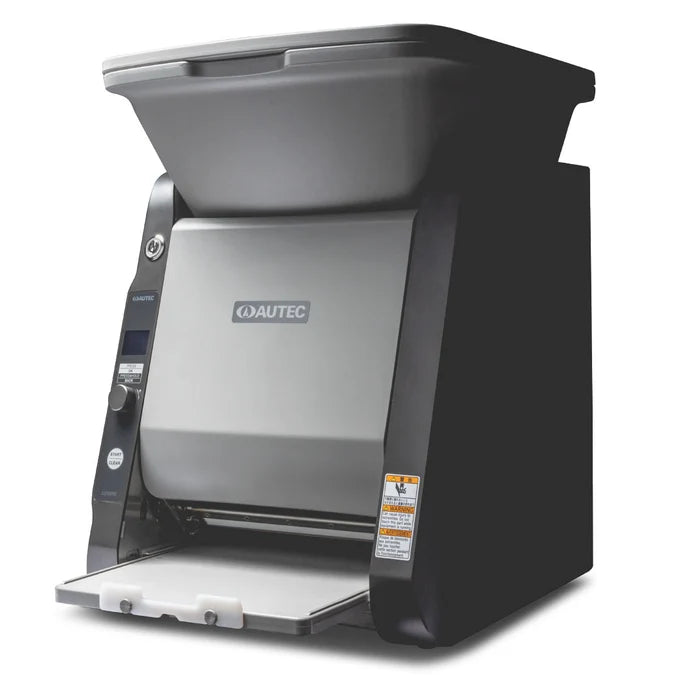
Rice mats. The AUTEC ASM895A is useful where repeated sheeting is combined with retained manual assembly. Fillings, wrapping, cutting where required and packing still need provision. The operating and cleaning envelope extends beyond the smallest body footprint. Its manufacturer-authored manual also restricts automatic washing of relevant parts. Specify the current supplied forming configuration rather than deriving an operating procedure from a feature label on a newer product page. AUTEC manual reproduced by AQ
Continuous rolls. Suzumo's SVR-SAE-W represents a different arrangement: rice feeding, nori/film handling, a topping position, forming and length cutting. The topping conveyor still needs the chosen ingredients presented correctly. Its presence does not establish automatic deposition of every filling. Replenishment, forming changes and downstream handling remain in the production commitment. Require the exact regional configuration, options and electrical submittal; the inspected North American and global brochures do not provide one reconciled electrical specification. North American SVR-SAE-W brochure, W/S brochure
Rice bases in trays. Suzumo's STF-MFA forms and arranges rice bases. Its standard automatic-feed KHS trays and optional manual-fed GRT trays are different operating provisions. If GRT trays are selected for the subsequent container arrangement, that feed method must be quoted and planned accordingly. The automatic-feed headline rate is not a demonstrated rate for the manual option. The output still needs topping or other finishing. STF-MFA
Choose among these functions according to the product range and the work retained around them. They are not an automatic progression from small to large, nor an already engineered line when placed next to one another.
Forming does not complete packing
A formed product still needs its selected primary package, identification, secondary protection and destination allocation. Suzumo's PNR-SVC illustrates a specific downstream wrapping function with automatic film feed and wrapping around compatible prepared products. Labelers are optional, film compatibility matters, and the referenced output conveyor should not be presumed included. Confirm loading, open-cover access and output collection as part of the cell. Suzumo PNR-SVC brochure
A wrapper does not establish shelf life or validate a preservation process. Nor does a higher forming rate remove finishing and packing work unless the proposed downstream equipment and labor actually perform it.
For every cell, require the prepared input, actual output, remaining manual work, receiving object, replenishment method and cleaning/service access. An equipment rectangle is not an operating layout. Covers, doors, detachable assemblies and the people handling full vessels need their working space in the installed arrangement.
Explore the ERS collection
Sushi Robots & Sushi Machines
Compare the assortment for this part of your service.
-
 Image unavailable
Autec Maki Sushi Maker Rice Sheeter ASM895A
View details & options : Autec Maki Sushi Maker Rice Sheeter ASM895A
Image unavailable
Autec Maki Sushi Maker Rice Sheeter ASM895A
View details & options : Autec Maki Sushi Maker Rice Sheeter ASM895A
-
 Image unavailable
AUTEC Maki Sushi Maker Rice Sheeter & Wrapper ASM890A
View details & options : AUTEC Maki Sushi Maker Rice Sheeter & Wrapper ASM890A
Image unavailable
AUTEC Maki Sushi Maker Rice Sheeter & Wrapper ASM890A
View details & options : AUTEC Maki Sushi Maker Rice Sheeter & Wrapper ASM890A
-
 Image unavailable
AUTEC Maki Sushi Roll Wrapper ASA190A
View details & options : AUTEC Maki Sushi Roll Wrapper ASA190A
Image unavailable
AUTEC Maki Sushi Roll Wrapper ASA190A
View details & options : AUTEC Maki Sushi Roll Wrapper ASA190A
-
 Image unavailable
AUTEC Automatic Maki Sushi Roll Cutter ASM260A
View details & options : AUTEC Automatic Maki Sushi Roll Cutter ASM260A
Image unavailable
AUTEC Automatic Maki Sushi Roll Cutter ASM260A
View details & options : AUTEC Automatic Maki Sushi Roll Cutter ASM260A
-
 Image unavailable
AUTEC Nigiri Sushi Maker Rice Ball Shaper ASM440A
View details & options : AUTEC Nigiri Sushi Maker Rice Ball Shaper ASM440A
Image unavailable
AUTEC Nigiri Sushi Maker Rice Ball Shaper ASM440A
View details & options : AUTEC Nigiri Sushi Maker Rice Ball Shaper ASM440A
-
 Image unavailable
AUTEC Onigiri & Musubi Rice Ball Maker ASM575A
View details & options : AUTEC Onigiri & Musubi Rice Ball Maker ASM575A
Image unavailable
AUTEC Onigiri & Musubi Rice Ball Maker ASM575A
View details & options : AUTEC Onigiri & Musubi Rice Ball Maker ASM575A
-
 Image unavailable
AUTEC Shari Sushi Rice Mixer ASM730A
View details & options : AUTEC Shari Sushi Rice Mixer ASM730A
Image unavailable
AUTEC Shari Sushi Rice Mixer ASM730A
View details & options : AUTEC Shari Sushi Rice Mixer ASM730A
-
 Image unavailable
AUTEC Shari Sushi Rice Mixer ASM780A
View details & options : AUTEC Shari Sushi Rice Mixer ASM780A
Image unavailable
AUTEC Shari Sushi Rice Mixer ASM780A
View details & options : AUTEC Shari Sushi Rice Mixer ASM780A


05 / Sushi Restaurant Concepts
Separate processing capacity from cold storage
List temperature-changing processes separately from ingredient holding, finished-product storage and allocated departure loads. These duties may share equipment at different times, but the same occupied cabinet cannot be counted as simultaneously available for each of them.
Irinox's retained U.S. MultiFresh Next S Rev. 12 sheet demonstrates why process capacity needs its conditions. The stated 55 lb chilling/freezing yield is associated with a two-inch food layer and 2¾-inch tray spacing. Its arrangements distinguish four full-size 2½-inch steam-table pans from five half-size sheet pans. Those are defined manufacturer load arrangements, not a validated result for an arbitrary sushi load. The exact current model, options and process basis still belong in the purchase submittal. Irinox MultiFresh Next S and technical-document route
Once a process cabinet is holding a completed load, it is occupied until that load moves. Provide receiving storage and a physical transfer that frees the machine for its next required process. A holding mode is useful, but it is not an extra cabinet.
Ordinary storage must receive product in the appropriate condition. Hoshizaki's A-series refrigerator instructions caution against hot/warm loading and obstructed circulation. The required heat removal belongs in a suitable controlled process, not in an assumed storage-refrigerator duty or an improvised ambient wait. Hoshizaki A-series refrigerator manual
Cold storage also has an access specification. A roll-in cabinet can be valuable when compatible rack-organized loads are already part of the operation. The Hoshizaki RN1A example has a rack-height limit, separate rack supply, a ramp/floor limit and an operating approach beyond its cabinet volume. Door clearance, rack clearance and the space needed to maneuver a loaded rack are different requirements. RN1A/RN2A specification
Choose shelving, roll-in storage or another arrangement around the actual output and access pattern. A rack-ready cabinet only reduces handling if the load can reach it, enter it and be removed without creating a new transfer elsewhere.
06 / Sushi Restaurant Concepts
Match containers to the complete transfer
Specify the food-contact vessel or primary pack, its lid, any separate support, the carrier, the handling equipment and the outlet position together. A documented match between two objects settles that interface alone. A dimension that passes an initial check still leaves loaded stability, access, removal and the food process to establish.
Component boxes
Cambro's 12183CW and matching-size 1218CCW lid provide a concrete 12 × 18-inch component-box example. The CD1826H dolly family explicitly supports 12 × 18-inch food boxes for internal handling. These are useful named relationships; they do not establish a leakproof closure, approved stack height or road restraint. Camwear boxes, flat lids, CD1826H family
The next purchase decision is at the destination. If the box enters outlet storage, its shelf access, lid clearance and withdrawal matter. If the contents are transferred, provide the surface, receiving vessel and labor. If a cart remains, account for its space and time away from the center.
Prepared neta, a block and a wet component can need different arrangements within a nominally similar box. Presentation, exudate, raw-food separation and allergens are reasons to specify the load, not fill every available liter indiscriminately.
Rice trays and containers
Suzumo explicitly matches five GRT-20 trays with GRC-20. That named match is a sound basis for investigating supported rice-base supply. It does not establish clearance above a particular topping, the closure's transport performance or the permitted care method. The rounded dimensions published for the two objects cannot be used to invent their nesting geometry or override the manufacturer's stated fit. GRC-20, GRT-20
Carry the production method into the container decision: these are the GRT trays associated with the STF's optional manual-feed arrangement. Confirm the actual filled tray, cover and handling method. Bulk seasoned rice, formed bases and finished sushi remain different loads with different downstream work and process requirements.
A process load is not a carrier load
The Irinox Rev. 12 arrangement holds four full-size 2½-inch steam-table pans. Cambro's 100MPC lists three full-size 2½-inch pans stacked with lids. Process support and airflow are a different loading basis from lidded transport. The common pan description does not establish one-to-one transfer capacity. Irinox technical-document route, Cambro 100-Series carriers
Vollrath's 30022 pan and 77250 solid cover are a specific pan/cover candidate, not an established Irinox-to-Cambro combination. Check the complete covered load, support, handle profile and removal. Nominal depth does not describe lid seating or usable headroom. Vollrath 30022, 77250 cover
A pan can remain with the product across several stages only where the process and physical arrangement permit it. Transport lid use is not a cooling instruction. At a top-loader, retrieving a lower pan can require moving the pans above; allocation by outlet and unloading order therefore influence usable capacity as well as convenience.
Finished packs need a second handling specification
The package sold to the customer is only the first layer. Tray support, lid protection, movement during stops, destination access and secondary containment determine how many finished packs can actually travel.
Cambro's 1826MTC lists six full-size sheet-pan positions and identifies CD1826MTC and CD1826MTCHB dollies. These are different named products from the food-box CD1826H. Six positions are not a count of finished sushi packs: the selected pack height, tray arrangement and any accessories determine the useful load. Cambro 1826MTC
For this carrier, obtain a current dimensional and assembly submittal before assigning vehicle or washing clearances. Its published exterior dimensions are inconsistent between unit systems, and its gasketless description conflicts with the model-specific gasket parts listing. Do not choose whichever field makes the proposed installation fit. Cambro model-specific parts
Use the sushi takeout-container guide for the primary package. The intersite specification must then account for that package as a loaded object. Insulation does not supply a universal journey allowance or prove that the food inside has already reached its required condition.
Rack support and cabinet entry are separate checks
Cambro's Ultimate Sheet Pan Rack accepts full- and half-size sheet pans. Its brochure requires food pans to be supported on sheet pans rather than placed directly on the rails. That adds a support object to handling, washing and inventory. Caster selection also changes duty: the brochure distinguishes metal casters excluded from freezer use from plastic casters intended for freezer/blast-chiller environments. Cambro rack and manufacturer documents
The full-height plastic-caster UPR1826FP20 exceeds the Hoshizaki RN's stated 72-inch maximum rack height under both published Cambro height figures. The refrigerator's taller door opening does not override its rack limit. The lower metal-caster UPR1826F20 passing a height screen does not establish complete fit, and changing caster type cannot ignore the intended environment. Cambro rack brochure, Hoshizaki RN specification
Nor does the rack's 350 lb load rating override the refrigerator's 150 lb ramp/floor limit. Confirm how the receiving limit applies to the complete rolling load, including rack and vessels. Do not treat it as an extra food allowance or calculate a payload while the complete fit remains unresolved. Rack guides, caster movement, ramp transition and the loaded approach still have to work.
Vollrath 30022 with 77250 cover remains a specific candidate requiring complete loaded fit, support, handle-profile and removal checks. A transport lid is not a cooling instruction.
07 / Sushi Restaurant Concepts
Complete the delivery and receiving handoff
Specify transport against the condition to be maintained. Thermo King's V-520 Revision B manual calls for preconditioned product and compartment, appropriate airflow and loading checks. The investigated equipment maintains the loaded condition; it is not the upstream pull-down process. Electric standby and other functions belong to particular configurations, so a parked refrigerated vehicle does not automatically provide the required stationary duty. Thermo King V-520 operator manual
The route specification should include dwell and openings, loading order, separation, restraint/handling, any stationary operation and the receiving window. An insulated carrier inside a refrigerated vehicle is not evidence that its contents have reached the required condition. The two enclosures serve different purposes.
Choose the receiving unit explicitly:
Scroll to read all columns
| Receiving arrangement | Practical opportunity | Provision required at the outlet |
|---|---|---|
| Whole rack | Avoid some individual pan transfers | Verified rack/storage/approach/load interface and space for its dwell |
| Whole carrier | Keep the secondary load together | Storage/access space and acceptance of the carrier's longer absence from the center |
| Individual boxes or pans | Release the carrier earlier | People, a receiving position, supports, storage and additional handling |
An outlet needs an available position for the actual delivered form, not merely spare refrigerated volume. Frozen product needs its specified frozen receiving and storage duty. If the destination must perform a controlled transition before use, that task belongs in its equipment and staffing plan.
Acceptance also needs an authorized recipient, identifiable food, relevant condition checks and a decision path for discrepancies. A signature or return-air display does not answer every food-release question. A delayed or unsuitable load needs a controlled holding/disposition arrangement instead of becoming the next team's unresolved problem.
Applicable transport responsibilities depend on scope, roles and any qualifying waiver. Common ownership may permit integrated written procedures under the federal rule; it does not perform the loading, receiving or exception assessment. For covered material failures, the required qualified determination cannot be replaced by an instruction simply to refrigerate the food again. 21 CFR 1.908, FDA food-establishment waiver guidance
08 / Sushi Restaurant Concepts
Design the return and washing operation
Reusable stock is specified by its complete cycle. A delivered carrier, an empty carrier at an outlet and a cleaned carrier ready for filling are three different availability conditions.
List every object that returns: boxes and lids, rice trays, containers, pans and covers, supporting sheet pans, carrier components, racks and dollies. Assign where each is emptied, held dirty, cleaned and inspected. If outlets wash, the center still needs acceptance criteria. If the center washes, the outlets still need dirty holding and return handling. Food and clean supplies must be protected from dirty returns through collection and arrival.
Select the washing arrangement from the objects
Manual, batch and conveyor washing serve different object mixes and arrival patterns. Size alone does not decide between them.
Manual washing. Bowl geometry and working clearance matter alongside the permitted cleaning method. Advance Tabco's FC-3-2424-18RL has 24 × 24-inch bowls; FC-3-2028-24RL has 20 × 28-inch bowls. A full-size sheet pan warrants examining the longer bowl rather than treating those geometries as equivalent. Nominal dimensions still do not prove immersion, hand access or effective washing. Advance Tabco FC specification, August 2026
Provide accumulation space as well as wet compartments. Dirty returns, detached lids and cleaned items awaiting drainage can occupy more positions than the washer itself. The FDA model separately addresses manual-washing accommodation and sufficient soiled/clean accumulation space; the applicable local arrangement and any approved alternatives must be established. FDA Food Code 2026, §§4-301.12–.13
Batch prep washing. Hobart PW10 offers a different rack and loading arrangement. Its sheet-pan capacity does not establish permission for every pan material: the retained PW manual expressly excludes aluminum utensils. That restriction can change the support-pan purchase before any throughput comparison begins. Exact racks, spray exposure, utilities, loading/service space and ventilation configuration also matter. Hobart PW resources, PW operating manual
Conveyor tote washing. Hobart's CL64T illustrates a more specialized return operation. Its drawing distinguishes the entry opening from the wider chamber and the opening above the support rail. The object must pass, remain supported and expose the surfaces that need cleaning. Load/unload and service provision extend beyond the wash section; identify any optional blow-off and the supplied loading/unloading rail lengths. An object resembling a tote is not thereby approved for this machine. Hobart CL64T and specification
Wash-stage minutes are not the clean-return rate. Sorting, preparation, loading, unloading, drainage, drying and inspection remain in the cycle.
Preserve the material-specific care routes
The rice-machine parts are a useful warning against buying one large washer for everything. The MCR and ASM manuals restrict automatic dishwashing of relevant plastic parts. GRC/GRT-specific care was not established by the inspected material, so those vessels need their own correct instructions before a washing arrangement is selected. Permission for a Camwear box or rack does not transfer to another material or assembly. Reproduced Suzumo MCR manual, reproduced AUTEC manual, Cambro box information
The clean side must accommodate separate lids and trays, drainage, inspection and protected storage. FDA's 2026 model requires air drying or the specified adequate draining before food contact and generally excludes cloth drying of newly sanitized utensils/equipment. Generic cloth-drying instructions for an equipment body should not be copied into a food-contact sanitation procedure. FDA Food Code 2026, §§4-901.11 and 4-903.11
Count what is actually available
Reusable units can be filling or staged, traveling, retained at outlets, awaiting collection, queued dirty, being washed, drying, or held for repair. Count lids, supports and trays as well as carrier bodies. A missing lid can make the whole unit unavailable.
Unloading pans at the outlet may release a scarce carrier earlier, but it adds outlet handling and support requirements. Keeping the carrier there preserves the load arrangement but extends the time before reuse. Both choices belong in the cost and stock calculation.
There is no universal spare-container multiplier. Required stock follows the real route, outlet retention and cleaning recovery, with appropriate provision for the actual interruption exposure. More vessels can cover time away; they cannot make an inadequate dirty holding or drying arrangement function indefinitely.
Vehicle return, completion of a wash cycle and availability at the consuming position are separate events.
09 / Sushi Restaurant Concepts
Preserve product identity through release and receipt
A production batch, a traceability lot, a shipment and a reusable container are different things. One lot can supply several outlets; one carrier can contain several lots and carry different food tomorrow. Their identifiers must remain connected without being treated as interchangeable.
Keep the connection from received materials through the applicable production event to usable units, destination allocation and receipt. The critical moment may be when the outlet opens a carrier and separates its contents. If only the outside is identified, the usable food units can lose their connection as work begins.
An internal food label, shipment record and consumer-package label have different jobs. The operator needs the applicable identity, instructions and status at the place of use. Transfers and new route labels do not reset food history or create a fresh shelf life.
Where the additional traceability rule applies, central transformation and inter-address supply can require records that differ from direct consumer service. Ordinary shipping alone is not a basis for replacing the applicable traceability lot code. Corporate recordkeeping can support several locations, but required access remains with the covered operation. Buy the necessary linkage and retrieval capability; the rules do not prescribe one software platform. FDA traceability FAQs, 21 CFR 1.1320, record requirements
Measure what the decision depends on
Scroll to read all columns
| Evidence | What it describes | What still needs to be established |
|---|---|---|
| Refrigeration return-air display | Air/equipment condition at its sensor | Food condition and relevant product history |
| Internal-sensor transport logger | Recorded conditions at its location under its configuration | Placement, response, load identity and the food/process relationship |
| Infrared reading | The viewed surface under suitable conditions | Conditions below a lid, inside a package or within food |
| Suitable penetration probe | Food temperature at the selected position and time | Appropriate geometry, access, hygiene and sampling/disposition |
| Process and release records | Documented observations and decisions for identified food | Any omitted measurement, untested load or separate food lot |
Testo's non-Bluetooth 104-IR illustrates the difference between surface and penetration methods. Its manual explains surface/optical limitations and suitable insertion, and calls for contact confirmation where values are critical. A response figure obtained in moving liquid is not a guaranteed reading time in every sushi component. Thin neta and small fillings need suitable sensing geometry; FDA's model specifically addresses small-diameter probes for thin foods. Testo 104-IR manual, FDA Food Code 2026, §4-302.12
Testo's 184 T3 illustrates the journey record. Its internal sensor, record interval, start/stop conditions, alarm behavior and report time zone are configuration choices. More frequent recording does not make the sensor respond instantly. A green indication reports against that configuration; it does not approve the food. Basic PDF reporting also differs from further analysis or a required integration. Testo 184 T3, 184 manual
Tie measurements to the actual load and decision, with the appropriate instrument calibration/verification and probe-care requirements included. A missing record and an out-of-criterion result require different assessments, but either can require a controlled hold. Keep the affected food identifiable, preserve the evidence and assign competent disposition. For sealed saleable packs, define verification and the disposition of sampled product rather than puncturing packs casually and returning them to sale.
Specify the label at application as well as in service
Cold-service performance does not establish cold-surface adhesion. Zebra's Z-Ultimate 4000T sheet lists a 50°F/10°C minimum application temperature while its service range begins at −40°F/−40°C. The difference affects where and when the material can be applied. It is a label-selection problem, never a reason to warm food. Zebra Z-Ultimate 4000T U.S. specification
A permanent vessel identifier and a changing food label also serve different purposes. Specify the substrate, surface condition, adhesive, print/ribbon where required, exposure and removal method together. Long-term adhesion may be useful for an asset ID and troublesome for a label changed on every trip. Indirect-food-contact language is not blanket permission for direct food contact, and label chemical resistance cannot override the vessel's care restrictions.
Require readability and the correct food-to-record connection after the expected handling and return cycle. A barcode carries or links an identity; it cannot correct the wrong identity.
10 / Sushi Restaurant Concepts
Compare the full operating cost and failure consequences
Cost the chosen stopping point. Shipping blocks retains slicing; shipping neta adds central arrangement and protection; shipping bases retains topping; shipping finished packs concentrates assembly and packaging. Frozen supply adds its own receiving, storage and transition work. These are different financial comparisons.
Include the costs that actually change: premises and installed services; machines and manual stations; process/storage/staging; packaging and vessel stock; production, packing and loading; transport and stationary duty; outlet receiving and retained preparation; return, washing and drying; maintenance; measurement and records; and losses or disrupted supply.
Credit an outlet saving only where an expense or commitment is genuinely removed or avoided. A station retained for backup, special assortment or finishing remains a cost. Moving a task changes its address and management, but does not automatically reduce its total labor. Benefits such as consistent preparation, specialized work, portion control or productive reuse of outlet space should be supported by the operator's own data.
Compare accepted usable supply at the destination. A damaged pack or unusable tray is not the same result as a satisfactory delivery, even if it passed a production counter. Evaluate complete runs and handoffs, including replenishment, changeovers, cleaning and receipt. Multiplying a brochure maximum by an assumed wage produces an attractive number, not an investment case.
Restore the function that stops supply
The critical dependency may be clean vessels, correct film, ready-load storage or release information rather than the principal production machine.
Scroll to read all columns
| Interrupted function | Response to evaluate | Qualification needed |
|---|---|---|
| Rice preparation | Retained outlet cooking or alternate production | People, equipment, ingredients, control and useful output |
| Forming or wrapping | Trained manual work or another configuration | Compatible inputs/outputs, materials, process and actual capacity |
| Process cooling | Qualified alternate process capacity | Evidence for the food and load; ordinary storage or transport cooling is not a substitute |
| Ready-load storage | Compatible available storage | Condition, support/fit, identity and access |
| Clean vessel availability | Complete compatible reserves or an alternate container | Lid, support, handling, care and transport suitability |
| Vehicle or stationary refrigeration | Qualified alternate transport or revised supply | Actual food duty, load arrangement and receiving commitment |
| Identity or release evidence | Hold affected food while evidence and authority are restored | Protected holding, reliable linkage and competent disposition |
A duplicate machine can share the same unavailable power, people, ingredients, output boxes, cooling capacity or route. Count it as continuity only when it restores the necessary function. A reduced menu can be sensible, but its remaining products must still be producible, deliverable and usable under their requirements.
Require current supplied manuals, exact options, service access and the parts or consumables needed to recover. Technical documentation is not evidence of local technician coverage, response time or available spares. Resolve those commercial commitments separately from the equipment's advertised capability.
11 / Sushi Restaurant Concepts
Require an equipment proposal for the whole operation
A serious proposal should make the following requirements explicit. The point is the evidence behind the selection, not the length of the equipment schedule.
Scroll to read all columns
| Proposal topic | Required basis |
|---|---|
| Supplied product and outlet work | Exact form/state, usable pack or vessel, destination use and retained capability |
| Operating and process requirements | Actual premises, activities and destinations; requirements that affect the installation and process |
| Departures and output | Completion/receipt commitments, genuine output units, residual work and overlapping loads |
| Production cells | Prepared inputs, useful outputs, manual tasks, regional configuration/options and operating/service access |
| Processing and storage | Food/load-specific process basis and accommodation for intermediate, finished and allocated stock |
| Complete transfer | Named vessel, lid, support, carrier and handling unit; documented matches and loaded confirmations still required |
| Vehicle and reception | Conditioned loading, required transport/stationary duty, receiving unit, storage and exception responsibility |
| Measurement and identity | Suitable methods, food/load linkage, configurations, labels and accessible records |
| Return and clean availability | Every component, permitted care, dirty accumulation, drying/inspection and protected complete stock |
| Cost and continuing support | Project quotations, work at both ends, consumables, maintenance and substantiated benefits |
| Acceptance and continuity | Evidence for the actual configuration/process, responsible acceptance and a qualified functional fallback |
Some interfaces can be settled by a manufacturer's named match. Others require current drawings, a loaded check or product-specific process evidence. Keep those distinctions visible before committing to the installation.
The right extent of central production is the one that supplies the required usable product while leaving each outlet equipped for its agreed work. Buy that operation, including its receiving and clean-return requirements.