

TRADITIONAL JAPANESE TABLEWARE RESEARCH · HERITAGE & STYLE
Traditional Japanese Restaurant Tableware: Styles & Buying Guide
Traditional Japanese restaurant tableware draws on established pottery, porcelain, pattern and seasonal references. It can be everyday and practical, pottery-led, classically painted or refined; traditional does not mean one rustic finish.
This guide helps owners, chefs and buyers coordinate rice bowls, soup service, plates, small dishes and servingware around the menu. Compare form, glaze, motif, portion scale, material, care and supply continuity. ERS organizes these visual choices through commercial Japanese tabletop specification and sourcing experience. Use the guide to select a clear restaurant identity while keeping documented product origin, manufacturing method and operating suitability distinct.
Traditional Japanese tabletop design is far more than rustic pottery. Precise porcelain, expressive painted decoration, lacquer and seasonal ceramic forms all belong to its vocabulary—provided each has a clear role in the meal.
Explore four distinct expressions of traditional Japanese restaurant tableware: Everyday Washoku, Pottery-Led, Classic Porcelain & Painted Ware, and Refined Seasonal service. Compare rice and miso soup bowls, mukozuke and kobachi dishes, sushi and serving plates, indigo-patterned porcelain, pottery-inspired glazes, black and vermilion lacquerware, and sake and tea service. Discover how traditions associated with Arita, Hasami, Kutani, Shino and Oribe contribute different forms, finishes and visual identities to Japanese dining.
Whether specifying a teishoku restaurant, traditional sushi counter, soba shop, izakaya or kaiseki-influenced dining room, learn how to combine material character, pattern, color, asymmetry and seasonal presentation around the food. Eden Restaurant Supply translates these design traditions into coordinated commercial assortments, with guidance on vessel selection, durability, handling, opening quantities and long-term replenishment.
In This Guide 14 buying decisions
Traditional Japanese tableware is not one look. It can be restrained or highly decorative, porcelain or pottery, precise or irregular, quiet or strongly seasonal. A traditional Japanese tabletop may combine ceramic, porcelain, lacquerware, wood, glass, metal, painted ware, shaped plates, small dishes and specialized serving vessels without looking remotely accidental.
The quality of the tabletop comes from what is selected, what repeats, what is allowed to vary, how each vessel supports the food, and whether the entire assortment makes sense for the restaurant operating it.
This guide explains how to build that tabletop for commercial restaurant service—from everyday washoku and traditional sushi to soba, izakaya and highly refined multi-course Japanese dining—and how to translate the aesthetic into pieces that can actually be purchased, operated, replaced and replenished.
Explore Traditional Japanese Styles · Shop Japanese Tableware · Get Help Selecting Your Tabletop
01TRADITIONAL JAPANESE / definition
What Makes Japanese Tableware Traditional?
The first mistake in specifying a traditional Japanese tabletop is treating “traditional Japanese” as a single visual style.
It is not.
Rough clay, irregular glaze and muted earth colors are part of the tradition, but they are only one part. Japanese tableware also includes refined white porcelain, blue-and-white painted ware, vividly decorated porcelain, glossy black and vermilion lacquer, lidded bowls, highly shaped ceramic forms, clear glass, wood and bamboo. Japanese dining has long drawn from different production centers, materials, shapes, motifs and uses rather than depending on one uniform dinnerware line.
Arita porcelain and Shigaraki pottery can look almost unrelated. They are both legitimate parts of Japanese ceramic history. Mino alone encompasses multiple traditions with radically different glaze languages, including Shino and Oribe. Hasami built a major history around practical everyday porcelain. Kutani proves that traditional Japanese ware can be brilliantly colored and heavily decorated rather than restrained.
The more useful definition is this:
Traditional Japanese restaurant tableware uses Japanese-rooted vessel forms, materials, craft languages and presentation principles to support the food, service context and guest experience.
That is how ERS uses the term throughout this guide.
It also means that “traditional” should not be confused with “old-fashioned.” Japanese dining culture has continuously absorbed new materials, production methods, imported objects and changing restaurant formats. Even historically, Japanese diners used both domestic and imported ware, and tableware traditions changed as food culture changed.
A traditional Japanese restaurant therefore does not need to recreate a museum table. It needs to understand the visual and functional vocabulary well enough to use it deliberately.
Traditional Japanese Is Not Another Name for Wabi-Sabi
Wabi-sabi is useful when discussing certain tea-influenced, rustic and materially expressive directions. It becomes useless when applied indiscriminately to every Japanese tabletop.
A blue-and-white porcelain sushi plate does not become less traditional because it is precise. A highly decorated Kutani bowl is not less traditional because it is colorful. Lacquerware does not become less authentic because its surface is glossy and refined. Japanese tableware has always been broader than the narrow beige, brown and reactive-glaze palette commonly marketed as “Japanese style.”
The restaurant should decide which part of that heritage it wants to emphasize.
That decision comes before the products.
 Plate12.75" x 6.25" Ceramic Plate, Green — Oribe DesignCeramic · 12.75" x 6.25"View Product
 Rice Bowl4.25"Dx2.5"H Porcelain Rice Bowl, WhitePorcelain · 4-1/4"D x 2-1/2"HView Product
 Plate8.5" x 5" Rectangular Ceramic Plate, White, Blue — Floral DesignCeramic · 8.5" x 5"View Product
 Miso Soup BowlLacquer Miso Soup Bowl with Lid 4", BlackPlastic Lacquer · 4"DView Product
 Soup & Salad Bowl4.75" x 3.3" Radish Ceramic Bowl, White, GoldCeramic · 4.75" x 3.3"View Product
 BowlCeramic Rice Bowl — 10 fl. oz.Ceramic · 4.5 in diameter, 2.5 in height · 10 fl. oz.View Product
TRADITIONAL JAPANESE / experience
24 Years of Restaurant Tableware Experience
- Years
- 24
- Restaurant & hospitality locations
- 24,000+
- Organizations
- 14,000+
- U.S. states
- 45+
- Cumulative tabletop purchasing
- $230M+
- Pieces supplied
- 55M+
For 24 years, Eden Restaurant Supply has specified, selected, sourced, evaluated, and supplied commercial tableware for more than 24,000 restaurant and hospitality locations operated by 14,000+ organizations across 45+ U.S. states—representing more than $230 million in cumulative tabletop purchasing and 55 million+ pieces supplied.
ERS's experience spans independent restaurants, chef-driven concepts, Michelin-recognized dining, hotels, institutional foodservice, high-volume operations, and regional and national multi-unit restaurant groups. Its particular depth in Asian-influenced foodservice includes sushi bars, omakase restaurants, ramen and udon shops, izakaya and yakitori concepts, Korean BBQ and Korean restaurants, hot pot and shabu-shabu, Chinese and dim sum restaurants, Vietnamese and pho concepts, Thai restaurants, and Asian-fusion and pan-Asian dining.
Experience Beyond the Sale
ERS's recommendations are informed by 24 years of first-party transaction and reorder history, hands-on product evaluation, direct manufacturer and importer relationships, and real restaurant specification work.
That experience encompasses decisions involving:
menu fit · portion presentation · plate and bowl size · shape · material · color · finish · assortment coordination · presentation level · durability · weight and handling · dishroom workflow · stacking and storage · replacement availability · reorder continuity · opening quantities · budget
ERS therefore sees restaurant tabletop not as a collection of individual products, but as a complete operating system that must work visually, commercially, and operationally.
First-Party Restaurant Tableware Intelligence
ERS's purchasing history provides a direct view into what restaurants actually buy and continue to use.
Across 55 million+ pieces supplied to 24,000+ restaurant and hospitality locations, ERS can analyze patterns such as:
most-purchased product families · common sizes and shapes · colors and finishes · material preferences · concept-specific assortments · products purchased together · opening assortment breadth · repeat purchasing · replenishment behavior · replacement patterns · changes in presentation level · changes in restaurant tabletop preferences over time
This allows ERS recommendations to be informed by observed commercial purchasing behavior, rather than trend reporting or manufacturer claims alone.
Direct Sourcing & Supply-Chain Knowledge
ERS's tableware expertise extends upstream into the supply chain through decades of direct manufacturer, factory, importer, and distributor relationships.
That includes practical knowledge of:
factory capabilities · custom decoration · custom colors and finishes · custom shapes and molds · production minimums · lead times · commercial availability · pricing architecture · discontinued patterns · replacement compatibility · replenishment risk · alternative sourcing
A tabletop specification is only successful if the restaurant can purchase it, operate with it, replace it, and continue sourcing it as the business grows.
Full Restaurant Tabletop Lifecycle
ERS has worked with restaurant tabletop throughout its complete commercial lifecycle:
- Concept & Design Determining the desired restaurant identity, guest experience, menu presentation, and appropriate tabletop investment level.
- Specification Selecting the pieces, dimensions, shapes, materials, colors, finishes, and combinations appropriate for the menu and service model.
- Purchasing Coordinating manufacturers, sourcing, pricing, availability, minimums, and project requirements.
- Opening Quantities Determining practical opening pars around seat count, menu usage, service volume, dish cycles, storage, and backup requirements.
- Operation & Replenishment Supporting ongoing purchases as pieces break, disappear, wear, or simply require additional inventory.
- Replacement & Discontinuation Finding exact replacements, compatible alternatives, or coordinated substitutes when products or patterns become unavailable.
- Expansion Reproducing or adapting established tabletop systems as restaurant groups add locations.
- Assortment Refresh Updating individual pieces or complete tabletop programs as menus, concepts, presentation standards, or restaurant positioning evolve.
What This Experience Means for the Buyer
ERS does not simply know which tableware exists.
It knows:
what restaurants buy · what different concepts actually need · what pieces work together · what is repeatedly reordered · where higher tabletop investment is worthwhile · where economical workhorse pieces make more sense · what can survive commercial service · what can be replenished later · and how to build a complete assortment around a restaurant's menu, operation, aesthetic, and budget.
That combination of 24 years of specification experience, 24,000+ locations, 14,000+ operators, $230M+ in commercial tabletop purchasing, 55M+ pieces supplied, first-party reorder evidence, hands-on product knowledge, and direct sourcing expertise is the foundation of ERS's restaurant tableware research and recommendations.
Selection basis
ERS's traditional Japanese directions are commercial buying categories for the 2026 assortment. They compare pottery, porcelain, pattern and seasonal references through the complete meal and its recurring vessel roles. Documented origin and production method belong to the individual product; visual coordination, working quantities and replenishment determine the complete specification.
02TRADITIONAL JAPANESE / composition
How Traditional Japanese Tableware Is Actually Composed
A strong Japanese tabletop does not begin by finding a plate pattern and buying every matching shape.
It begins with the food.
Japanese culinary culture has historically treated the vessel as part of the presentation rather than as a neutral container. Current Japanese cultural scholarship likewise describes food and tableware as complementary, with the vessel contributing materially to how the food is seen and experienced.
For a restaurant buyer, that principle has practical consequences.
Choose the Vessel for the Food Before Choosing It for the Room
A plate that matches the interior perfectly but fights the food is the wrong plate.
Start with what will actually be served:
How large is the portion? How much visible surface does the dish require? Does it contain broth or sauce? Does the presentation need depth? Is the plate carried one-handed or two-handed? Does the food need a broad horizontal field, a tighter frame or vertical containment? Is temperature part of the experience? Does the dish need to be shared?
Food color matters as well. Pale sashimi behaves differently against black pottery than against patterned blue-and-white porcelain. A dark braised item can disappear into an equally dark bowl. A highly decorated plate may be exceptional under restrained food and disastrous under a visually complicated dish.
The restaurant buyer should know exactly what the vessel is being asked to do.
Specialized Forms Should Have a Reason to Exist
Japanese dining developed a much broader vocabulary than “dinner plate, salad plate and bowl.”
Large dishes and bowls have been used for shared service. Mukōzuke served individual portions. Small choku handled condiments and delicacies. Lidded vessels protected color, moisture, aroma and warmth while also creating a reveal when opened. These forms developed around actual service and presentation functions.
That is the standard a restaurant should still use.
A lidded bowl is worthwhile when the lid materially improves the dish or the service experience.
A highly shaped plate is worthwhile when its geometry improves presentation.
A tiny specialty dish is worthwhile when the menu uses it frequently enough to justify purchasing, washing, storing and replacing it.
Traditional Japanese ware is full of highly specific forms. That is not permission to fill the dish room with every one of them.
Repetition and Variation Belong Together
The common advice that “Japanese dishes should not match” is too crude.
Traditional Japanese dining has long used both repetition and contrast. Historical settings might use the same style of mukōzuke for every guest while changing other vessels across the meal. Teiichi Yuki of Kitcho famously selected tableware with both harmony and contrast in mind from one course to the next.
The commercial lesson is straightforward:
Repeat enough to establish order. Vary enough to create depth.
A restaurant may repeat the same rice bowl and soup bowl every service, keep several small-dish families within a related palette, and introduce stronger variation only in the main presentation plates.
Another restaurant may use a consistent tray or dark lacquer base to organize otherwise different vessels.
Uniformity is not the goal. Neither is randomness.
Different Materials Can Belong at the Same Table
Japanese tableware has historically included earthenware, porcelain, lacquer, wood, bamboo, metal and glass.
That material range is useful precisely because the materials do different visual work.
Porcelain can introduce precision, brightness and painted detail.
Pottery can introduce mass, tactility, irregularity and kiln character.
Lacquer brings saturated color, smoothness and strong contrast.
Glass can visually cool and lighten a setting.
Wood and bamboo can break up hard surfaces and introduce natural texture.
The question is not whether these materials match.
The question is whether the total table has a clear visual hierarchy.
Shape Is Part of the Composition
Japanese plates and bowls are not limited to round forms. Historical tableware includes square, rectangular, floral, leaf-like, fan-shaped and other silhouettes.
Shape can accomplish more than decoration.
A long rectangular plate can give nigiri, sashimi, yakimono or a composed appetizer room to progress horizontally.
A compact square plate can give a small portion more visual weight.
An irregular rim can soften a highly structured presentation.
A quiet round bowl can stabilize a table already carrying several angular pieces.
Do not choose shapes because they appear “more Japanese.” Choose them because they improve the composition.
Seasonality Should Be Understood, Not Imitated Mechanically
Traditional Japanese dining can use tableware to reinforce season through color, motifs, material, transparency, texture, shape and the relationship between food and vessel. Highly refined restaurant practice may change individual vessels according to the season, menu or occasion.
That does not mean every American Japanese restaurant needs four complete tabletop inventories.
The relevant question is how much seasonal expression the concept can support without creating unnecessary purchasing and operating complexity.
We address that directly later in this guide.
Rice Bowl4.25"Dx2.5"H Porcelain Rice Bowl, WhitePorcelain · 4-1/4"D x 2-1/2"HView Product
 Dinner Plate10"Dx1.5"H Round Porcelain Plate, WhitePorcelain · 10"D x 1-1/2"HView Product
 Plate4.75" Ceramic Plate, Blue — Fubuki Tokusa DesignCeramic · 4.75"View Product
 Plate3.75" Ceramic Plate, White, Blue — Crab DesignCeramic · 3.75" · 2.5 fl. ozView Product
 Sauce Plate4" x 2.5" Rectangular Ceramic Sauce Dish, WhiteCeramic · 4" x 2.5" · 2ozView Product
 Sake BottleSake Bottle 5"H, Blue Flower5”H · 6ozView Product
These are individual product photographs, not an assembled restaurant installation. A repeated bowl, a broad presentation plate and contrasting smallware establish different jobs at the same table.
03TRADITIONAL JAPANESE / directions
Choose the Traditional Japanese Direction That Fits the Restaurant
There is no useful reason to ask whether a restaurant wants “traditional Japanese tableware” without asking which traditional Japanese expression actually belongs in the concept.
For commercial buying, four directions cover most of the meaningful territory.
They are not historical Japanese classifications. They are practical ERS buying directions built from real Japanese vessel and craft traditions.
Everyday Washoku
Everyday heritage relies on clarity, repetition and familiar vessel relationships, not spectacle.
The strongest assortments usually begin with dependable rice bowls, soup bowls, small dishes, main plates or bowls and a limited number of contrasting accents. The pieces can still carry glaze, painted detail and shape variation, but the tabletop should feel easy to operate repeatedly.
This direction fits particularly well for:
teishoku · neighborhood Japanese dining · casual restaurants · high-volume concepts · restaurants that want recognizably Japanese service without maintaining dozens of low-use shapes
Hasami's historical importance as a center of practical everyday porcelain is a useful reminder that Japanese heritage is not synonymous with rare or expensive craft.
The strongest version of this tabletop is not “simple because the budget is low.”
It is simple because the concept benefits from consistency.
 Rice Bowl4-1/2"D Rice Bowl, White CeramicCeramicView Product
 BowlCeramic Rice Bowl — 10 fl. oz.Ceramic · 4.5 in diameter, 2.25 in height · 10 fl. oz.View Product
 Miso Soup BowlLacquer Miso Soup Bowl , Black/RedPlastic, Lacquer · 4-1/2"D x 2-1/2"HView Product
 Plate5-1/4" Round Ceramic Plate, White, BlueCeramic · 5-1/4"View Product
 Soup & Salad Bowl5.5" Ceramic BowlCeramic · 5.5" · 8 ozView Product
 Plate11" x 5" Rectangular Ceramic Plate, Beige — Bamboo Leaf DesignCeramic · 11" x 5"View Product
 Sauce PlateMelamine Round Sauce Dish 3-1/4", EggplantMelamine · 3-1/4"DView Product
 Serving TrayLacquer Tray (13"X 9-1/2"), BlackLacquer · 13"L x 9-1/2"WView Product
Pottery-Led Traditional Japanese
Pottery-led tabletops shift more of the visual work into the material itself.
The surface may show variation in glaze, exposed or visually apparent clay character, kiln effects, irregular edges, brushed decoration or stronger tactile relief. Japanese ceramic traditions such as Shigaraki, Bizen, Shino and Oribe demonstrate how broad this territory actually is—from earthy firing effects to pale surfaces and saturated greens.
The mistake is using dramatic pottery everywhere.
If the entrée plate, rice bowl, small dishes, serving bowl and sauce dish are all highly irregular, heavily textured and aggressively glazed, nothing has visual priority.
A better pottery-led tabletop uses several quieter pieces to support the pieces carrying the strongest surface character.
This direction can work especially well for:
soba · udon · izakaya · traditional sushi · yakimono-focused menus · chef-driven Japanese dining · restaurants where material character is part of the concept
 BowlCeramic Rice Bowl — 12 fl. oz.Ceramic · 5 in diameter, 2.5 in height · 12 fl. oz.View Product
 Plate9.75" Square Ceramic Plate, Brown, Green, GoldCeramic · 9.75"View Product
 Plate3.25" Ceramic Dish, SapphireCeramic · 3.25" · 2 fl. ozView Product
 Plate9" Round Ceramic Deep Plate, Dark Brown, Brown, GrayCeramic · 9" · 28 fl. ozView Product
 Plate7" Square Ceramic Plate, Dark Brown, GreenCeramic · 7"View Product
 Soup & Salad Bowl9.75" Ceramic BowlCeramic · 9.75"View Product
 Plate4.75" Square Ceramic Plate, Brown, Green — Oribe DesignCeramic · 4.75"View Product
 Sake CupWooden Sake-Small 2 1/2" x 2 1/2"Wood · 1.8"L x 1.8"W x 1.6"H (inner size)View Product
Classic Porcelain & Painted Ware
Traditional Japanese tableware can be crisp, bright, precise and heavily decorated.
Arita developed a major porcelain tradition spanning blue-and-white underglaze work and more elaborate decoration. Hasami became particularly important for practical porcelain. Kutani established an unmistakably color-rich overglaze tradition.
For restaurants, porcelain-led heritage is exceptionally useful because it can deliver a strong Japanese identity without requiring every piece to look rustic or handmade.
This direction can use:
white or lightly toned foundations · blue-and-white dishes · painted bowls · shaped porcelain · restrained patterned smallware · lacquer as contrast · selective decorative pieces
It can feel more formal or more casual depending on which patterns and shapes are selected.
For sushi and washoku especially, clean porcelain can also keep the food visually dominant while allowing smaller pieces to carry more pattern.
 Rice BowlPorcelain Rice Bowl 4.5", Blue FlowerPorcelain · 4.5"D x 2"HView Product
Dinner Plate10"Dx1.5"H Round Porcelain Plate, WhitePorcelain · 10"D x 1-1/2"HView Product
Rice BowlPorcelain Rice Bowl 4.5", Blue FlowerPorcelain · 4.5"D x 2"HView Product
Dinner Plate10"Dx1.5"H Round Porcelain Plate, WhitePorcelain · 10"D x 1-1/2"HView Product
 Plate9" Square Ceramic Plate, White, Blue, Brown — Arabesque DesignCeramic · 9"View Product
 Plate3.65" Ceramic Plate, White, BlueCeramic · 3.65" · 1.5 fl. ozView Product
 Plate3.5" x 2.5" Rectangular Ceramic Plate, White — Floral DesignCeramic · 3.5" x 2.5" · 2 fl. ozView Product
Rice Bowl4.25"Dx2.5"H Porcelain Rice Bowl, WhitePorcelain · 4-1/4"D x 2-1/2"HView Product
Plate3.5" x 2.5" Rectangular Ceramic Plate, White — Floral DesignCeramic · 3.5" x 2.5" · 2 fl. ozView Product
Rice Bowl4.25"Dx2.5"H Porcelain Rice Bowl, WhitePorcelain · 4-1/4"D x 2-1/2"HView Product
 TeapotTea Pot 4 1/2", White CeramicCeramic · 4-1/2"H · 24 Fl OzView Product
Sake BottleSake Bottle 5"H, Blue Flower5”H · 6ozView Product
TeapotTea Pot 4 1/2", White CeramicCeramic · 4-1/2"H · 24 Fl OzView Product
Sake BottleSake Bottle 5"H, Blue Flower5”H · 6ozView Product
Refined Seasonal Japanese
At the highest level of traditional Japanese presentation, the tabletop can become part of the progression of the meal.
Vessel selection may respond more aggressively to course, season, guest, ingredient and occasion. Materials can shift from pottery to porcelain to lacquer to glass. Specialized forms become more defensible because the restaurant is deliberately creating different experiences from course to course. Japanese culinary history and refined restaurant practice provide extensive precedent for this level of variety and seasonal attention.
The critical distinction is discipline.
A refined tabletop is not created by buying the most unusual plate in every category.
The quiet pieces become more important because the statement pieces need space to register.
This direction fits:
kaiseki- or ryotei-influenced dining · premium Japanese restaurants · chef-driven tasting menus · restaurants where the tabletop is intentionally part of the guest experience

 Plate9.65" Square Ceramic Plate, Beige, Green — Oribe DesignCeramic · 9.65"View Product
 Plate3.75" x 3.5" Leaf Ceramic Plate, Green, GoldCeramic · 3.75" x 3.5" · 2.5 fl. ozView Product
 PlatterPorcelain Leaf Platter, 16.25"x7"Porcelain · 16.25"x7"View Product
Soup & Salad Bowl4.75" x 3.3" Radish Ceramic Bowl, White, GoldCeramic · 4.75" x 3.3"View Product
PlatterPorcelain Leaf Platter, 16.25"x7"Porcelain · 16.25"x7"View Product
Soup & Salad Bowl4.75" x 3.3" Radish Ceramic Bowl, White, GoldCeramic · 4.75" x 3.3"View Product
 BowlCeramic Bowl with Lid — 14 fl. oz.Ceramic · 6.25 in diameter, 4.25 in height · 14 fl. oz.View Product
 Sake BottleCeramic Sake Bottle - 8 fl. oz. / 6.25"HCERAMICView Product
 Sake CupPorcelain Sake Cup 2"Dx1.5"H - 2 Oz, Chun Tenmoku - Blue/Dark BrownPorcelain · 2"D x 1-1/2"H · 2 ozView Product
 Sake BottleBlue Bulb Glass Sake Bottle 6.25"HGlass · 6.25"H , 8.25ozView Product
 Sake CupGlass Sake Cup with Blue Streak 2-1/2"HGlass · 2-1/2"HView Product
 Teapot4" H Ceramic Teapot (SH10-2)Ceramic · 4" H · 25 ozView Product
 Soba TraySoba Tray w/Plastic Lacquer Mat 9", Black9"LView Product
 Plate10" x 4" Oval Ceramic Plate, WhiteCeramic · 10" x 4"View Product
04TRADITIONAL JAPANESE / applications
Match the Tabletop to the Restaurant
The same traditional Japanese vocabulary changes dramatically depending on what the restaurant serves.
A kaiseki-influenced restaurant, sushi bar and soba shop should not be buying the same tabletop simply because all three want a “traditional Japanese” look.
Kaiseki & Ryotei-Inspired Dining
This is where greater vessel diversity, stronger seasonal variation and specialized serving pieces can be justified most easily.
The tabletop may change materially across a meal. One course may rely on pottery, another on lacquer, another on porcelain or glass. Lidded service can become meaningful. Stronger decorative pieces can appear without dominating the entire table because they are seen in sequence rather than simultaneously.
The visual standard is high, but the real distinction is specificity.
The vessel should feel selected for that dish.
Go deeper: Japanese Restaurant Tableware Guide
Sushi & Traditional Omakase
For sushi, plate length, usable surface, food spacing and restraint matter more than filling the table with overtly Japanese decoration.
Traditional direction may come through:
- long and rectangular presentation ware;
- dark pottery;
- restrained porcelain;
- blue-and-white;
- textured small dishes;
- sake ware;
- quiet rice/soup support;
- carefully chosen accent vessels.
The sushi plate often carries more visual responsibility than the rice bowl or condiment dish. Spend accordingly.
Go deeper: Sushi & Omakase Restaurant Tableware Guide
 Sushi Plate13.35" x 4" Rectangular Ceramic Sushi Plate, Beige, Blue, BrownCeramic · 13.35" x 4"View Product
Sauce Plate4" x 2.5" Rectangular Ceramic Sauce Dish, WhiteCeramic · 4" x 2.5" · 2ozView Product
Sushi Plate13.35" x 4" Rectangular Ceramic Sushi Plate, Beige, Blue, BrownCeramic · 13.35" x 4"View Product
Sauce Plate4" x 2.5" Rectangular Ceramic Sauce Dish, WhiteCeramic · 4" x 2.5" · 2ozView Product
 Sake BottlePorcelain Sake Bottle 6.25"Hx2.75"D - 10 Oz, Chun Tenmoku - Blue/Dark BrownPorcelain · 6-1/4"H x 2-3/4"D · 10 ozView Product
Soba & Udon
Noodle service concentrates the visual identity into fewer, larger pieces.
The bowl or serving vessel dominates. A tray, dipping cup, condiment service and small supporting dishes can complete the direction, but the concept does not benefit from unnecessary vessel proliferation.
Pottery-led and restrained porcelain directions both work exceptionally well.
Go deeper: Ramen, Udon & Soba Restaurant Tableware Guide
Izakaya & Yakitori
Izakaya is the opposite problem.
Many smaller portions arrive over time. Small plates, kobachi-type bowls, sauce dishes, sake ware and shared serving pieces all matter. Variety is useful, but uncontrolled variety becomes visual clutter quickly.
Use repeated smallware families to establish order, then allow stronger shifts in shape, glaze or pattern where the menu benefits from it.
Go deeper: Izakaya & Yakitori Restaurant Tableware Guide
Everyday Washoku & Teishoku
This is one of the cleanest environments for a stable traditional tabletop.
A rice bowl, soup bowl, main vessel and smaller sides create a recognizable structure. A tray can organize multiple pieces and allow more variation inside the setting.
The tabletop does not need a large number of expensive statement pieces. The quality comes from scale, proportion and the relationship between the repeated vessels.
Donburi, Rice & Curry
A bowl-centered concept needs fewer pieces fighting for attention.
The principal bowl should carry the identity. Smaller sides, pickles, soup and utensils should support it rather than competing with it.
This is often a good place to spend more on the dominant bowl and less on secondary pieces.
Go deeper: Donburi & Japanese Rice/Curry Tableware Guide
05TRADITIONAL JAPANESE / vessels
Traditional Japanese Tableware: The Pieces That Matter
A restaurant does not need to know every Japanese vessel name.
It needs to know which pieces perform recurring jobs, which pieces are worth specializing, and which pieces can cover multiple menu applications without weakening presentation.
Rice Bowls
The rice bowl is one of the highest-frequency pieces in traditional Japanese service.
That makes it a poor place for unnecessary operational difficulty.
Prioritize:
comfortable diameter · appropriate portion · reliable stacking · durable rim · easy handling · strong reorder potential
Visual distinction can come from color, glaze, foot, painted decoration or material without turning the bowl into the most expensive piece on the table.
For concepts serving rice with most meals, the rice bowl usually belongs among the most stable pieces in the assortment.
 BowlCeramic Rice Bowl — 10 fl. oz.Ceramic · 4.5 in diameter, 2.5 in height · 10 fl. oz.View Product
 BowlCeramic Rice Bowl — 9 fl. oz.Ceramic · 4.5 in diameter, 2.5 in height · 9 fl. oz.View Product
 BowlCeramic Rice Bowl — 10 fl. oz.Ceramic · 4.5 in diameter, 2.5 in height · 10 fl. oz.View Product
 BowlCeramic Rice Bowl — 14 fl. oz.Ceramic · 5 in diameter, 2.75 in height · 14 fl. oz.View Product
 Rice Bowl4-3/4" Melamine Rice Bowl, TenmokuMelamine · 4-3/4"D X 2-3/8"H · 11 ozView Product
 BowlCeramic Rice Bowl — 10 fl. oz.Ceramic · 4 in diameter, 2 in height · 10 fl. oz.View Product
Soup Bowls
Soup bowls are a particularly useful material decision.
A restaurant may choose ceramic or porcelain, but traditional Japanese service also has a deep lacquerware history. Modern commercial restaurants can further choose synthetic lacquer-look or melamine/resin alternatives where volume, handling and dishroom requirements make them more appropriate.
The correct answer depends on the concept.
Miso served hundreds of times per day does not need the same vessel specification as a carefully presented soup course in a high-touch dining room.
 Miso Soup BowlMelamine Miso Soup Bowl with Cover 3-3/4", Black/RedMelamine · 3-3/4"D x 2-1/2"HView Product
 Miso Soup BowlLacquer Miso Soup Bowl with Lid 4", RedPlastic Lacquer · 4"DView Product
 BowlCeramic Bowl 12 oz (SF551-WV)ceramic · 5.25 in D x 2.25 in H · 12 OZView Product
 Miso Soup BowlLacquer Miso Soup Bowl, RedPlastic, Lacquer · 4-1/2"D x 2-1/2"HView Product
Kozara & Small Plates
Small plates are one of the easiest ways to give a Japanese tabletop range without destabilizing the larger assortment.
They work for:
pickles · small sides · condiments · appetizers · amuse portions · sauces · garnishes
They are also relatively economical places to introduce:
pattern · glaze · color · shape · seasonality
For many restaurants, the small-plate assortment can carry more visual variety than the high-par bowls and main plates.
 Plate6.85" Round Ceramic Plate, Dark Brown, EmeraldCeramic · 6.85"View Product
 Plate3.75" Ceramic Plate, White, Blue — Flatfish DesignCeramic · 3.75" · 2.5 fl. ozView Product
 Plate3.5" x 2.5" Rectangular Ceramic Plate, Black, WhiteCeramic · 3.5" x 2.5" · 2 fl. ozView Product
 Plate3" x 2-1/4" Rectangular Ceramic Plate, White, Gold, BrownCeramic · 3" x 2-1/4" · 2 fl. ozView Product
 Plate4.75" Round Ceramic Plate, Orange, Blue, WhiteCeramic · 4.75"View Product
 Plate5" Ceramic Plate, Green — Floral DesignCeramic · 5"View Product
Kobachi & Small Bowls
Depth changes the job.
A kobachi-type small bowl can hold preparations that would spread, leak or visually flatten on a small plate: dressed vegetables, cold appetizers, tofu, simmered items, sauces and other small portions with moisture or volume.
These pieces are especially valuable in restaurants serving numerous sides or small courses.
They are also natural accent pieces because the lower purchasing quantities can support greater visual variation.
 Small Bowl4-1/8"x2-1/2" Boat Bowl, White CeramicCeramic · 4-1/8"L x2-1/2"WView Product
 Small Bowl3.5"Dx1"H Porcelain Bowl Shallow, Black OribePorcelain · 3-1/2"D x 1"HView Product
Plate3.25" Ceramic Dish, SapphireCeramic · 3.25" · 2 fl. ozView Product
Small Bowl3.5"Dx1"H Porcelain Bowl Shallow, Black OribePorcelain · 3-1/2"D x 1"HView Product
Plate3.25" Ceramic Dish, SapphireCeramic · 3.25" · 2 fl. ozView Product
 Sauce BowlMelamine Octagonal Sauce Bowl 4-1/4", Autumn GrassMelamine · 4-1/4"DView Product
 Sauce PlateGlass Sauce Plate with Blue Streak 3.5"x2.75"Glass · 3-1/2"L x 2-3/4"W x 1"HView Product
Medium Bowls
The medium bowl is often more commercially important than its taxonomy suggests.
It can bridge:
salads · side dishes · shareable appetizers · smaller rice preparations · simmered items · vegetables · secondary noodle/rice use
A good medium bowl can eliminate several low-use specialty SKUs.
Do not overspecialize this category unless the menu requires it.


Main Presentation Plates
The main plate should be chosen around the menu's most important presentation demands.
This is often where a restaurant can justify greater spend.
Look at:
usable surface · rim width · plate depth · food color · plate color · portion footprint · server handling · table size
The plate that carries the restaurant's signature sashimi, grilled fish or composed main course deserves more attention than a generic support plate.
 Plate10" Round Ceramic Plate, BlueCeramic · 10"View Product
 Plate10.85" x 10.5" Irregular Ceramic Plate, Turquoise, AquaCeramic · 10.85" x 10.5"View Product
 Plate10" Square Ceramic Plate, White — Sakura DesignCeramic · 10"View Product
 Dinner Plate10"x8-1/2" Wavy Rectangular Coup Plate, White CeramicCeramic · 10"L x 8-1/2"WView Product
Rectangular, Oval & Shaped Plates
Shape is one of the strongest ways to create a recognizably Japanese tabletop without relying on decorative motifs.
Long rectangular plates are especially useful for linear presentation. Smaller rectangular plates can organize appetizers, sushi, grilled items and composed side courses. Oval and irregular pieces can soften an assortment dominated by circles and squares.
The important question is not whether the shape looks Japanese.
It is whether the food uses the shape well.
 Plate8" x 5.5" Leaf Ceramic Plate, Sapphire, Dark BrownCeramic · 8" x 5.5"View Product
 Sushi Plate8.65" x 5" Rectangular Ceramic Sushi Plate, Black, White — Black & White Brush Stroke DesignCeramic · 8.65" x 5"View Product
 Plate6.85" x 4.75" Rectangular Ceramic Plate, BlueCeramic · 6.85" x 4.75"View Product
 Plate14-3/8" x 5" Ceramic Plate, GreenCeramic · 14-3/8" x 5"View Product
 Dinner Plate9-3/8"x7-1/4" Fan Plate , White CeramicCeramicView Product
Plate12.75" x 6.25" Ceramic Plate, Green — Oribe DesignCeramic · 12.75" x 6.25"View Product
Dinner Plate9-3/8"x7-1/4" Fan Plate , White CeramicCeramicView Product
Plate12.75" x 6.25" Ceramic Plate, Green — Oribe DesignCeramic · 12.75" x 6.25"View Product
Mukōzuke-Type Presentation Ware
Historically, mukōzuke refers to individually served vessels positioned on the far side of a tray arrangement and used for dishes such as sashimi or vinegared foods. Their forms became a major field for ceramic expression.
A modern American restaurant does not need to label every sashimi dish “mukōzuke.”
The useful lesson is that individual presentation ware can carry significantly more shape and ceramic character than generic support pieces.
When a restaurant wants a stronger traditional identity, this is one of the places to look.

Lidded Vessels
A lid should earn its place.
Lidded vessels historically helped preserve heat, moisture, aroma and color while creating a moment of reveal.
They remain powerful when the dish benefits from those qualities.
They become expensive clutter when added merely because they look traditional.
If the menu has a real use, buy them deliberately and in the quantity that use requires.
Shared Bowls & Platters
Not every Japanese restaurant serves everything individually.
Shared appetizers, vegetables, grilled items, sashimi presentations and group dining may justify larger serving pieces.
These pieces can also carry stronger decoration or form because their quantity is usually lower than individual place-setting ware.


Trays
A tray does more than carry dishes.
It can give visual order to a group of bowls and plates that otherwise vary considerably in material, color and shape.
This is especially useful for:
teishoku · breakfast · tasting presentations · set meals · tray-based service
A repeated tray can stabilize a tabletop without forcing all the vessels on it to match.


Sake Ware
Sake cups and servers can materially affect the character of a traditional Japanese tabletop, especially in izakaya, sushi and more refined Japanese dining.
This is a good place to introduce stronger craft language because the pieces are small, guest-facing and often purchased at lower quantities than basic tableware.
Match cups and servers when that strengthens the service, but do not assume they need to be a literal matching set.
 Sake CupPorcelain Sake Cup, Stony BlackPorcelainView Product
 Sake CupSake Cup 2"H, White CeramicCeramicView Product
 Sake BottleCeramic Sake Bottle - 5"LCeramicView Product
 Sake CupPorcelain Sake Cup 2"Dx1.5"H - 2 Oz, Ocean Blue/BrownPorcelain · 2"D x 1-1/2"H · 2 ozView Product
 Sake BottleGlass Sake Bottle 6"H, ClearGlass · 6"HView Product
 Sake CupClear Glass Sake Cup 2.25"Dx2.5"HGlass · 2-1/4"D x 2-1/2"HView Product
Tea Ware
Tea cups and teapots can reinforce a traditional direction strongly, but only when tea service is genuinely part of the restaurant.
A tea program should be specified with the same rigor as any other beverage service:
volume · refill behavior · handle/heat · cup capacity · server workflow · washing · storage
Do not select tea ware merely to complete the visual story.


Specialty Pieces
Chawanmushi cups, soba service, nabe, sushi-specific servingware, tempura pieces and other specialty vessels should be specified where the menu earns them.
The more specialized the piece, the higher the standard should be.
If it improves the dish materially, use it.
If a more versatile vessel performs the job just as well, do not create another SKU simply to look authentic.

06TRADITIONAL JAPANESE / coordination
How to Mix Japanese Tableware Without Making It Look Random
The quickest way to ruin a traditional Japanese tabletop is to overcorrect against matching dinnerware.
Buying twelve unrelated plates because each one looks individually “Japanese” does not create sophistication. It creates inventory noise.
The table needs hierarchy.
Keep the Highest-Use Pieces Stable
The pieces used constantly should carry the greatest continuity.
For many restaurants that means:
- rice bowls;
- soup bowls;
- core side dishes;
- recurring small plates;
- one or two main vessel families.
These pieces establish the restaurant's baseline.
ERS's first-party purchasing and reorder history consistently shows the commercial importance of these repeat-use pieces: they absorb high opening quantities, frequent replenishment and the greatest replacement exposure. Statement and specialty pieces are typically purchased more selectively.
That purchasing pattern should influence the design.
The most frequently handled pieces should not all be operational experiments.
Let a Few Pieces Carry the Look
A restaurant does not need twenty statement pieces.
Choose where the identity should be strongest:
- main entrée plate;
- sashimi plate;
- signature bowl;
- prominent serving piece;
- occasional lidded vessel;
- distinctive sake or tea service.
A good anchor makes the quieter pieces look intentional.
Ten competing anchors make the entire table look cheaper.
Use Smallware for Controlled Contrast
Small plates and bowls are one of the best places to vary:
glaze · pattern · shape · color · material
They are visible, often lower-cost, and can be rotated or replenished more easily than high-par main pieces.
If the major vessels are visually restrained, smallware can carry surprisingly strong decoration.
If the major vessels are already aggressive, the smallware should calm down.
Change One or Two Things at a Time
Controlled variation works because something remains constant.
Examples:
Use the same general color family across different shapes.
Use a common shape vocabulary with different glazes.
Use quiet pottery with one painted porcelain family.
Use clean porcelain with selected lacquer contrast.
Use a dark tray to organize otherwise varied pieces.
What rarely works is changing shape, color, pattern, texture and material simultaneously on every product.
Specialty Ware Must Still Solve a Problem
A shaped lidded bowl is not automatically superior to a standard bowl.
A tiny sauce dish is not valuable if the menu never needs it.
A soba vessel should exist because soba is being served.
The visual language remains stronger when every unusual object has a clear reason to be there.
Example: Quiet Porcelain + Painted Smallware
Start with restrained white or lightly toned bowls and major plates.
Introduce blue-and-white or painted ware through small plates, sauce dishes and perhaps one serving piece.
Keep the beverage service restrained.
The result reads as traditional without letting pattern overwhelm the food.
Rice Bowl4.25"Dx2.5"H Porcelain Rice Bowl, WhitePorcelain · 4-1/4"D x 2-1/2"HView Product
Dinner Plate10"Dx1.5"H Round Porcelain Plate, WhitePorcelain · 10"D x 1-1/2"HView Product
Plate4.75" Ceramic Plate, Blue — Fubuki Tokusa DesignCeramic · 4.75"View Product
Plate3.75" Ceramic Plate, White, Blue — Crab DesignCeramic · 3.75" · 2.5 fl. ozView Product
Sauce Plate4" x 2.5" Rectangular Ceramic Sauce Dish, WhiteCeramic · 4" x 2.5" · 2ozView Product
Sake BottleSake Bottle 5"H, Blue Flower5”H · 6ozView Product
Example: Pottery + Lacquer
Use tactile ceramic for the main presentation and smaller bowls.
Introduce black or red lacquer/lacquer-look through soup, tray or a selected service piece.
Keep the remaining smallware quieter.
The contrast between matte/tactile ceramic and smooth saturated lacquer does more work than adding another glaze.
 Sushi Plate8.85" x 5" Rectangular Ceramic Sushi Plate, Black, BlueCeramic · 8.85" x 5"View Product
 Small Bowl5.5"Dx1.75"H Porcelain Bowl, Matte BlackPorcelain · 5-1/2"D x 1-3/4"HView Product
Miso Soup BowlLacquer Miso Soup Bowl with Lid 4", BlackPlastic Lacquer · 4"DView Product
Small Bowl5.5"Dx1.75"H Porcelain Bowl, Matte BlackPorcelain · 5-1/2"D x 1-3/4"HView Product
Miso Soup BowlLacquer Miso Soup Bowl with Lid 4", BlackPlastic Lacquer · 4"DView Product
 Plate3" Square Ceramic Plate, Dark Brown, GreenCeramic · 3"View Product
 Serving TrayMini Lacquer Tray 7-1/2" X 5-1/4", Black/GoldLacquer · 7-1/2"L x 5-1/4"WView Product
 Sake CupLacquer Sake Cup, Maru, 3-1/8" Sq, Black/RedPlastic, Lacquer · 3"SQView Product
Example: Everyday Washoku with One Strong Presentation Piece
Repeat the rice bowl, soup bowl and sideware.
Keep those pieces cost-effective and easy to replace.
Put the visual money into the main plate or bowl.
This is often the most intelligent tabletop for a high-volume restaurant.
 Rice BowlMelamine Round Bowl 4-7/8", Autumn GrassMelamine · 4-7/8"D x 2-3/8"H$2.50 current selling priceView Product
 Miso Soup BowlMelamine Round Bowl 4-3/4", Black/RedMelamine · 4-3/4"D x 2-1/4"H$3.25 current selling priceView Product
Sauce PlateMelamine Round Sauce Dish 3-1/4", EggplantMelamine · 3-1/4"D$1.10 current selling priceView Product
Plate5-1/4" Round Ceramic Plate, White, BlueCeramic · 5-1/4"$5.79 current selling priceView Product
Miso Soup BowlMelamine Round Bowl 4-3/4", Black/RedMelamine · 4-3/4"D x 2-1/4"H$3.25 current selling priceView Product
Sauce PlateMelamine Round Sauce Dish 3-1/4", EggplantMelamine · 3-1/4"D$1.10 current selling priceView Product
Plate5-1/4" Round Ceramic Plate, White, BlueCeramic · 5-1/4"$5.79 current selling priceView Product
 Plate11.25" x 8.25" Rectangular Ceramic Plate, Green, Brown, GoldCeramic · 11.25" x 8.25"$52.99 current selling priceView Product
 SpoonMelamine Soup Spoon 5-1/2", Autumn GrassMelamine · 5-1/2"L$0.75 current selling priceView Product
Example: Refined Mixed-Material Service
Use quiet recurring vessels as the base.
Allow greater change among:
- presentation plates;
- seasonal smallware;
- lidded pieces;
- lacquer;
- glass;
- sake/tea;
- serving ware.
The more the table varies, the more important the quiet pieces become.
Soup & Salad Bowl4.75" x 3.3" Radish Ceramic Bowl, White, GoldCeramic · 4.75" x 3.3"View Product
 Plate10.25" Triangular Ceramic Plate, Green, Gold, BrownCeramic · 10.25"View Product
BowlCeramic Bowl with Lid — 14 fl. oz.Ceramic · 6.25 in diameter, 4.25 in height · 14 fl. oz.View Product
Sake BottleBlue Bulb Glass Sake Bottle 6.25"HGlass · 6.25"H , 8.25ozView Product
Sake BottleCeramic Sake Bottle - 5"LCeramicView Product
Sake CupPorcelain Sake Cup 2"Dx1.5"H - 2 Oz, Chun Tenmoku - Blue/Dark BrownPorcelain · 2"D x 1-1/2"H · 2 ozView Product
Dinner Plate9-3/8"x7-1/4" Fan Plate , White CeramicCeramicView Product
Plate10.25" Triangular Ceramic Plate, Green, Gold, BrownCeramic · 10.25"View Product
BowlCeramic Bowl with Lid — 14 fl. oz.Ceramic · 6.25 in diameter, 4.25 in height · 14 fl. oz.View Product
Sake BottleBlue Bulb Glass Sake Bottle 6.25"HGlass · 6.25"H , 8.25ozView Product
Sake BottleCeramic Sake Bottle - 5"LCeramicView Product
Sake CupPorcelain Sake Cup 2"Dx1.5"H - 2 Oz, Chun Tenmoku - Blue/Dark BrownPorcelain · 2"D x 1-1/2"H · 2 ozView Product
Dinner Plate9-3/8"x7-1/4" Fan Plate , White CeramicCeramicView Product
07TRADITIONAL JAPANESE / materials
Materials & Japanese Craft Traditions: What They Actually Change
A restaurant does not need a ceramics lecture.
It needs to understand what different materials and craft traditions contribute to the finished table.
Pottery & Ceramic
Pottery brings physical presence.
The surface may be:
- smooth or coarse;
- heavily glazed or lightly glazed;
- regular or visibly varied;
- pale, dark, earthy or strongly colored;
- precise in shape or intentionally irregular.
Mino is particularly useful as a reminder that “Japanese pottery” is not one look. Its recognized traditions include Shino, Oribe, Kizeto and Setoguro, each with distinct visual characteristics. Shigaraki is associated with strong clay character and natural firing effects.
Pottery works exceptionally well when the food benefits from:
texture · visual warmth · irregularity · stronger material character
It becomes weaker when every plate is chosen for glaze drama rather than food fit.
Plate4.75" Square Ceramic Plate, Brown, Green — Oribe DesignCeramic · 4.75"View Product
Plate10.85" x 10.5" Irregular Ceramic Plate, Turquoise, AquaCeramic · 10.85" x 10.5"View Product
Plate9" Round Ceramic Deep Plate, Dark Brown, Brown, GrayCeramic · 9" · 28 fl. ozView Product
BowlCeramic Rice Bowl — 12 fl. oz.Ceramic · 5 in diameter, 2.5 in height · 12 fl. oz.View Product
 Plate6.25" Square Ceramic Plate, White, Gold, BrownCeramic · 6.25"View Product
Plate8.5" x 5" Rectangular Ceramic Plate, White, Blue — Floral DesignCeramic · 8.5" x 5"View Product
Plate6.25" Square Ceramic Plate, White, Gold, BrownCeramic · 6.25"View Product
Plate8.5" x 5" Rectangular Ceramic Plate, White, Blue — Floral DesignCeramic · 8.5" x 5"View Product
Porcelain
Porcelain can produce a cleaner edge, more precise shape and strong painted detail.
That makes it particularly useful when the table needs:
- brightness;
- refinement;
- blue-and-white pattern;
- cleaner food contrast;
- stronger decorative line work.
Arita, Imari and Hasami are useful reference points, but actual ERS products should only be labeled by those origins when product/vendor data support the claim.
Rice Bowl4.25"Dx2.5"H Porcelain Rice Bowl, WhitePorcelain · 4-1/4"D x 2-1/2"HView Product
Rice BowlPorcelain Rice Bowl 4.5", Blue FlowerPorcelain · 4.5"D x 2"HView Product
 Noodle & Donburi Bowl6.5"Dx3.25"H Porcelain Bowl, WhitePorcelain · 6-1/2"D x 3-1/4"HView Product
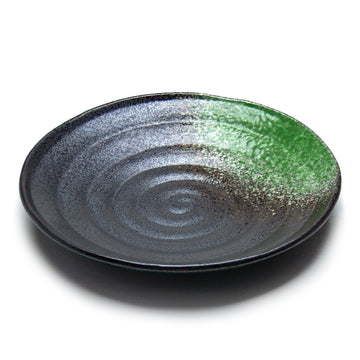 Dinner Plate8.75"Dx1.25"H Porcelain Plate, Black/GreenPorcelain · 8-3/4"Dx1-1/4"HView Product
Small Bowl3.5"Dx1"H Porcelain Bowl Shallow, Black OribePorcelain · 3-1/2"D x 1"HView Product
Dinner Plate8.75"Dx1.25"H Porcelain Plate, Black/GreenPorcelain · 8-3/4"Dx1-1/4"HView Product
Small Bowl3.5"Dx1"H Porcelain Bowl Shallow, Black OribePorcelain · 3-1/2"D x 1"HView Product
 Sauce Plate3.25"X2.25" Porcelain Rectangular Sauce Dish, Black OribePorcelain · 3-1/4" x 2-1/4"View Product
PlatterPorcelain Leaf Platter, 16.25"x7"Porcelain · 16.25"x7"View Product
Sauce Plate3.25"X2.25" Porcelain Rectangular Sauce Dish, Black OribePorcelain · 3-1/4" x 2-1/4"View Product
PlatterPorcelain Leaf Platter, 16.25"x7"Porcelain · 16.25"x7"View Product
Decorative Ware
Japanese heritage does not require restraint.
Kutani's tradition is explicitly color-rich, using overglaze painting and a wide decorative vocabulary.
Decorative ware works best when the table gives it room.
Use it as:
- presentation plate;
- accent bowl;
- sake ware;
- dessert/special course;
- selected smallware.
Do not make every plate compete for attention.

Lacquerware
Lacquerware predates the widespread dominance of ceramics in Japanese tableware and remains one of the strongest traditional material languages. Contemporary Japanese cultural scholarship describes lacquerware as a major part of Japanese food culture, while regional traditions range from highly refined decorative Kyoto lacquer to simpler, sturdy everyday Kishu lacquerware.
For restaurants, lacquer can contribute:
- saturated black or red;
- visual depth;
- low visual noise;
- material contrast against ceramic;
- traditional soup and lidded-service language.
The operating difference between natural lacquer, synthetic lacquer and lacquer-look resin matters enormously. We address that in Section 10.
Wood & Bamboo
Wood and bamboo are useful when they solve an actual role:
- trays;
- selected serving pieces;
- beverage accessories;
- presentation boards;
- chopsticks.
Their value is not simply “natural Japanese feeling.”
They introduce a softer surface and can separate ceramics visually.
Keep the application controlled.
Glass
Glass can lighten a traditional tabletop substantially.
It is particularly valuable when the restaurant wants a cooler seasonal impression, visibility through the vessel or a deliberate break from heavier ceramic surfaces.
Use it selectively.
A table full of glass stops reading as ceramic-led heritage quickly.
Metal
Metal belongs only where the service needs it.
Do not add metal for eclecticism.
08TRADITIONAL JAPANESE / seasonality
Seasonality Without Rebuilding the Entire Tabletop
Seasonality is real in traditional Japanese dining.
The commercial mistake is assuming that honoring it requires purchasing a new complete dinnerware program four times per year.
It does not.
For High-Volume Restaurants: Keep the Table Stable
If the restaurant serves hundreds of covers every day, the foundation should normally remain stable.
Use seasonal change through:
- food;
- garnish;
- menu;
- limited accent ware;
- beverage service;
- occasional specialty pieces.
The guest can perceive season without the dish room carrying four complete sets of bowls.
For Elevated Restaurants: Keep the Foundation and Rotate Selected Pieces
This is the strongest strategy for many restaurants.
Keep:
- high-use rice bowls;
- soup bowls;
- core main vessels;
- frequently used smallware.
Rotate selected:
- small plates;
- serving pieces;
- sake ware;
- glass;
- stronger patterned ware;
- seasonal statement plates.
The result can change meaningfully while most of the operation stays intact.
For High-Touch Dining: Rotate More Deeply
Restaurants where tableware itself is a major part of the meal can justify more variation.
The rotation may include:
- shaped presentation ware;
- course-specific ceramic;
- lidded vessels;
- lacquer;
- glass;
- decorated ware;
- sake/tea;
- specialty serving pieces.
The more deeply the restaurant rotates, the more disciplined inventory control becomes.
Seasonality does not excuse losing track of what can be replaced.
The recurring foundation


Painted detail
Surface & glaze
09TRADITIONAL JAPANESE / investment
Where to Spend More—and Where Not To
A traditional Japanese tabletop does not become more legitimate as the unit cost rises.
The correct question is where the guest can perceive the difference and where the operation can support it.
ERS purchasing and reorder history consistently shows that restaurant tableware does not carry equal commercial importance across every SKU. High-use workhorse pieces carry the largest opening and replacement burden. Lower-par presentation pieces can absorb more variation and higher unit cost without exposing the entire tabletop budget.
Spend accordingly.
Value / High-Volume
A strong high-volume tabletop should spend money on:
- correct proportions;
- appropriate bowl/plate size;
- consistent color and finish;
- reliable supply;
- pieces that stack and wash well.
It does not need expensive craftsmanship on every piece.
Commercial ceramic, porcelain, melamine and synthetic lacquer-look ware can produce a convincing traditional Japanese direction when selected intelligently.
The mistake is buying cheap pieces that have no relationship to one another.
Economical does not have to mean generic.
Everyday
This is where many restaurants should live.
The core pieces remain practical, but stronger material character and better presentation begin to appear.
Spend more selectively on:
- main plates;
- principal bowls;
- smallware with strong visual effect;
- sake/tea where guest-facing.
Keep high-par support pieces operationally simple.
Elevated
At the elevated level, the tabletop can carry more of the restaurant's identity.
Increase:
- material depth;
- distinctive shape;
- more specialized presentation;
- stronger ceramics/porcelain;
- selected lacquer;
- more deliberate smallware variation.
The additional spend should be visible.
If the $24 plate does not materially improve presentation over the $12 plate, buy the $12 plate and spend the difference elsewhere.
Premium / Statement
Premium tableware should earn its price through:
- craft;
- surface;
- form;
- scarcity;
- specialized function;
- presentation impact;
- course-specific experience.
This is where natural lacquer, more individual craft, lower-par statement ware and deeper seasonal rotation become easier to justify.
It is still possible to overspend.
A premium restaurant does not need a premium sauce dish if the guest never notices it and the dish room destroys it.
Compare the Same Job at Different Investment Levels
The most useful way to understand these tiers is not four unrelated moodboards.
Compare the same function.
Rice bowl: workhorse → everyday → elevated → statement
Main plate: workhorse → everyday → elevated → statement
Small dish: workhorse → everyday → elevated → statement
Soup: workhorse → everyday → elevated → statement
That makes the buying decision visible.
Rice bowl
Workhorse → Everyday → Elevated → Statement
Rice BowlMelamine Round Bowl 4-7/8", Autumn GrassMelamine · 4-7/8"D x 2-3/8"H$2.50 current selling priceView Product
BowlCeramic Rice Bowl — 10 fl. oz.Ceramic · 4.5 in diameter, 2.25 in height · 10 fl. oz.$1.79 current selling priceView Product
BowlCeramic Rice Bowl — 12 fl. oz.Ceramic · 5 in diameter, 2.5 in height · 12 fl. oz.$5.09 current selling priceView Product
BowlCeramic Rice Bowl — 10 fl. oz.Ceramic · 4.5 in diameter, 2.5 in height · 10 fl. oz.$4.29 current selling priceView Product
Main plate
Workhorse → Everyday → Elevated → Statement
 Dinner Plate8-1/4" Melamine Round Plate Gold OrchidMelamine · 8-1/4"D x 1-1/4"H$10.25 current selling priceView Product
Plate11" x 5" Rectangular Ceramic Plate, Beige — Bamboo Leaf DesignCeramic · 11" x 5"$15.99 current selling priceView Product
Plate12.75" x 6.25" Ceramic Plate, Green — Oribe DesignCeramic · 12.75" x 6.25"$37.99 current selling priceView Product
Plate9.75" Square Ceramic Plate, Brown, Green, GoldCeramic · 9.75"$47.99 current selling priceView Product
Dinner Plate8-1/4" Melamine Round Plate Gold OrchidMelamine · 8-1/4"D x 1-1/4"H$10.25 current selling priceView Product
Plate11" x 5" Rectangular Ceramic Plate, Beige — Bamboo Leaf DesignCeramic · 11" x 5"$15.99 current selling priceView Product
Plate12.75" x 6.25" Ceramic Plate, Green — Oribe DesignCeramic · 12.75" x 6.25"$37.99 current selling priceView Product
Plate9.75" Square Ceramic Plate, Brown, Green, GoldCeramic · 9.75"$47.99 current selling priceView Product
Small dish
Workhorse → Everyday → Elevated → Statement
 Sauce Plate3-1/2" Melamine Round Sauce Dish, TenmokuMelamine · 3-1/2"D X 5/8"H$6.40 current selling priceView Product
Plate3.75" Ceramic Plate, White, Blue — Crab DesignCeramic · 3.75" · 2.5 fl. oz$4.29 current selling priceView Product
Plate3.75" x 3.5" Leaf Ceramic Plate, Green, GoldCeramic · 3.75" x 3.5" · 2.5 fl. oz$8.59 current selling priceView Product
Soup & Salad Bowl4.75" x 3.3" Radish Ceramic Bowl, White, GoldCeramic · 4.75" x 3.3"$8.59 current selling priceView Product
Sauce Plate3-1/2" Melamine Round Sauce Dish, TenmokuMelamine · 3-1/2"D X 5/8"H$6.40 current selling priceView Product
Plate3.75" Ceramic Plate, White, Blue — Crab DesignCeramic · 3.75" · 2.5 fl. oz$4.29 current selling priceView Product
Plate3.75" x 3.5" Leaf Ceramic Plate, Green, GoldCeramic · 3.75" x 3.5" · 2.5 fl. oz$8.59 current selling priceView Product
Soup & Salad Bowl4.75" x 3.3" Radish Ceramic Bowl, White, GoldCeramic · 4.75" x 3.3"$8.59 current selling priceView Product
Soup service
Workhorse → Everyday → Elevated → Statement
Miso Soup BowlMelamine Miso Soup Bowl with Cover 3-3/4", Black/RedMelamine · 3-3/4"D x 2-1/2"H$3.75 current selling priceView Product
BowlCeramic Bowl 12 oz (SF551-WV)ceramic · 5.25 in D x 2.25 in H · 12 OZ$7.19 current selling priceView Product
BowlCeramic Bowl with Lid — 14 fl. oz.Ceramic · 6.25 in diameter, 4.25 in height · 14 fl. oz.$11.49 current selling priceView Product
Miso Soup BowlLacquer Miso Soup Bowl, RedPlastic, Lacquer · 4-1/2"D x 2-1/2"H$2.95 current selling priceView Product
Current selling prices belong to the specific products and selling units shown on their PDPs. These selections compare service roles and visual investment; they do not define price thresholds or imply documented regional craft provenance.
Compare Restaurant Tableware by Price & Presentation Level →
10TRADITIONAL JAPANESE / operation
What Survives Commercial Restaurant Service
The most beautiful traditional Japanese tabletop in the world is a failed specification if the restaurant cannot wash it, store it, replace it or keep buying it.
This is where commercial buying separates from styling.
Verify the Product. Never Assume from the Look.
An irregular, hand-finished Japanese ceramic can still be dishwasher-safe and stack efficiently.
A clean, factory-produced piece can still require care.
Commercial melamine can reproduce the texture and appearance of ceramic while offering lower weight and much greater resistance to physical and thermal shock. Some current Japanese restaurant melamine is dishwasher-safe but not microwave-safe.
The material name is not the specification.
The exact product is.
POTPURRI's current restaurant wholesale guidance makes the same point directly: size, depth, stacking, equipment and care routine all matter, and dishwasher/microwave compatibility must be checked by item.
Warewashing
Before a product becomes a core restaurant recommendation, verify:
dishwasher compatibility · temperature limitations · detergent restrictions · hand-wash requirements · microwave compatibility where relevant · oven use where relevant
If the information does not exist, say that it is not verified.
Do not convert silence into a specification.
Weight & Handling
A 12-ounce bowl and a 2-pound bowl do not operate the same way over a 300-cover dinner service.
Weight affects:
- server handling;
- tray load;
- dish rack load;
- shelf load;
- staff fatigue;
- breakage when pieces are stacked or separated.
Heavy pottery can be excellent.
It should be selected intentionally.
Stackability & Storage
An unusually shaped plate that looks exceptional on the table may be disastrous on a 12-inch shelf.
Restaurants buying dozens or hundreds of pieces need to know:
- stack diameter;
- stack stability;
- overall stack height;
- whether rims or handles interlock safely;
- whether the shape consumes excessive shelf area.
Japanese commercial suppliers explicitly treat stacking and the restaurant's equipment as specification criteria rather than afterthoughts.
Chipping, Scratching & Finish Wear
Do not make blanket claims based on “stoneware,” “porcelain” or “handmade.”
Edge profile matters.
Glaze matters.
Decoration technique matters.
Dishroom practice matters.
The only reliable conclusion is product-specific.
A product that will serve as a high-par foundation deserves more scrutiny than a six-piece specialty accent.
Variation
Reactive glazes, hand finishing and kiln variation can make a table feel materially richer.
They can also surprise the buyer when the reorder does not look identical to the first case.
That is not automatically a defect.
The restaurant should decide whether variation is:
desirable · acceptable · unacceptable
before buying the product in volume.
Reorder Continuity
This is one of the most underestimated tableware decisions.
The restaurant is not buying only for opening day.
Pieces will:
- break;
- disappear;
- chip;
- wear;
- be added as volume increases.
Core pieces need a credible replenishment path.
A lower-par accent can tolerate more sourcing risk.
A 200-piece rice-bowl specification should not.
ERS's supplier relationships and replacement experience matter most at this stage: when the original product disappears, the job becomes finding the exact replacement, compatible substitute or coordinated alternative without making the tabletop look patched together.
Craft Where the Guest Can See It
There is no virtue in putting the most difficult-to-maintain craft piece into the highest-cycle position on the table merely because it is “authentic.”
Craft investment makes the most sense when:
- the vessel is highly visible;
- the food presentation benefits materially;
- the quantity is manageable;
- staff can care for it;
- replacement exposure is acceptable.
Use repeatable commercial ware where:
- pars are high;
- turnover is high;
- dish cycles are constant;
- consistency matters;
- storage is constrained;
- replacement must be easy.
For many restaurants, the strongest traditional Japanese tabletop is a commercially dependable core with more expressive presentation pieces layered around it.
No apology is needed for that.
It is good restaurant specification.
Ceramic & Porcelain vs Melamine
The wrong question is:
Which material is more authentic?
The useful questions are:
What does the food require?
How visible is the piece?
How frequently is it handled?
Does it need microwave compatibility?
How much weight can the operation tolerate?
What is the replacement exposure?
How strong does the material character need to be?
Current Japanese-made commercial melamine can imitate ceramic texture closely while remaining lightweight, dishwasher-safe and highly resistant to physical and thermal shock; those products are explicitly marketed for busy restaurants.
Use it where those advantages matter.
Do not use it where the restaurant wants the tactile and visual depth of real ceramic enough to justify the tradeoff.
Natural Lacquer vs Commercial Lacquer-Look Ware
Natural lacquer can provide extraordinary surface depth, tactile quality and material authenticity.
It also demands the operating conditions appropriate to the actual piece.
Commercial resin and synthetic lacquer-look products can reproduce much of the visual language with lower handling exposure.
Again, the correct answer depends on the role.
A low-par specialty soup service in a premium restaurant and a 300-piece miso-bowl program should not automatically receive the same specification.
Compare Real Alternatives for the Same Job
Soup: ceramic vs commercial lacquer-look vs higher-craft lacquer
Small bowl: ceramic vs porcelain vs melamine
Main plate: repeatable commercial ceramic vs stronger hand-finished presentation piece
Tray: synthetic vs wood where appropriate
Soup service: verified alternatives
| Product / SKU | Construction | Care information |
|---|---|---|
| Ceramic Bowl 12 oz (SF551-WV) SF551-WV | ceramic | Care compatibility not documented; confirm before specifying |
| Lacquer Miso Soup Bowl with Lid 4", Red WF200-R | Plastic Lacquer | Care compatibility not documented; confirm before specifying |
Small bowl: verified alternatives

| Product / SKU | Construction | Care information |
|---|---|---|
| 4-1/8"x2-1/2" Boat Bowl, White Ceramic A2519 | Ceramic | Dishwasher Safe, Microwave Safe. |
| 3.5"Dx1"H Porcelain Bowl Shallow, Black Oribe JX-26-B | Porcelain | Dishwasher and Microwave Safe |
| Melamine Petal Bowl 4-5/8", Autumn Grass 605D-J | Melamine | Dishwasher Safe |
Main presentation: verified alternatives

| Product / SKU | Construction | Care information |
|---|---|---|
| 11" x 5" Rectangular Ceramic Plate, Beige — Bamboo Leaf Design B211-LBS | Ceramic | Care compatibility not documented; confirm before specifying |
| 10.5" x 6.65" Rectangular Ceramic Plate, Turquoise FDKN-9 | Ceramic | Dishwasher safe; Microwave safe |
Tray: verified alternatives

| Product / SKU | Construction | Care information |
|---|---|---|
| Lacquer Rectangular Tray 15.5"x11.25", Black WZ155 | Construction not specified | Care compatibility not documented; confirm before specifying |
| Lacq Tray-Plastic 14" x 12" OS16-M | Plastic / lacquer-look | Care compatibility not documented; confirm before specifying |
11TRADITIONAL JAPANESE / tabletops
Complete Traditional Japanese Tabletop Directions
A restaurant should not have to assemble its tabletop by opening fifteen collection tabs and guessing which pieces belong together.
The following directions use current ERS merchandise selected for the restaurant’s service, presentation and operating requirements.
Current ERS merchandise, coordinated by service role. These are editorial selections, not fixed bundles or photographed customer projects. Confirm food fit, care, safe stacks, opening packs and project replenishment before releasing the specification.
Everyday Washoku Tabletop
This assortment should feel stable, clearly Japanese and easy to replenish.
The core should include:
- rice bowl;
- soup bowl;
- recurring small plate;
- small bowl;
- main plate or bowl;
- sauce/condiment ware;
- chopsticks/spoon where relevant;
- tray if appropriate.
Then add only enough variation to keep the service from becoming generic.
The highest-par pieces should be the quietest and easiest to replace.
One stronger main vessel or smallware family can carry much of the identity.
 Plate11" x 5" Rectangular Ceramic Plate, Beige — Bamboo Leaf DesignCeramic · 11" x 5"$15.99 current selling priceFood presentation with a distinct shape or surface.View Product
BowlCeramic Rice Bowl — 10 fl. oz.Ceramic · 4.5 in diameter, 2.5 in height · 10 fl. oz.$3.99 current selling priceRepeated rice service; keep this role consistent.View Product
Plate11" x 5" Rectangular Ceramic Plate, Beige — Bamboo Leaf DesignCeramic · 11" x 5"$15.99 current selling priceFood presentation with a distinct shape or surface.View Product
BowlCeramic Rice Bowl — 10 fl. oz.Ceramic · 4.5 in diameter, 2.5 in height · 10 fl. oz.$3.99 current selling priceRepeated rice service; keep this role consistent.View Product
 Miso Soup BowlLacquer Miso Soup Bowl 4.5", Black/Red - Kikko4-1/2"D x 2-1/2"H$2.75 current selling priceSoup service alongside the rice bowl.View Product
BowlCeramic Rice Bowl — 10 fl. oz.Ceramic · 4 in diameter, 2 in height · 10 fl. oz.$1.79 current selling priceRepeated rice service; keep this role consistent.View Product
Plate5-1/4" Round Ceramic Plate, White, BlueCeramic · 5-1/4"$5.79 current selling priceFood presentation with a distinct shape or surface.View Product
Soup & Salad Bowl5.5" Ceramic BowlCeramic · 5.5" · 8 oz$3.99 current selling priceMenu-specific supporting service.View Product
Sauce BowlMelamine Octagonal Sauce Bowl 4-1/4", Autumn GrassMelamine · 4-1/4"D$2.25 current selling priceCompact support for condiments and dipping.View Product
SpoonMelamine Soup Spoon 5-1/2", Autumn GrassMelamine · 5-1/2"L$0.75 current selling priceFunctional support for the vessels and food.View Product
Serving TrayLacquer Tray (13"X 9-1/2"), BlackLacquer · 13"L x 9-1/2"W$15.50 current selling priceA defined footprint for the individual service.View Product
Miso Soup BowlLacquer Miso Soup Bowl 4.5", Black/Red - Kikko4-1/2"D x 2-1/2"H$2.75 current selling priceSoup service alongside the rice bowl.View Product
BowlCeramic Rice Bowl — 10 fl. oz.Ceramic · 4 in diameter, 2 in height · 10 fl. oz.$1.79 current selling priceRepeated rice service; keep this role consistent.View Product
Plate5-1/4" Round Ceramic Plate, White, BlueCeramic · 5-1/4"$5.79 current selling priceFood presentation with a distinct shape or surface.View Product
Soup & Salad Bowl5.5" Ceramic BowlCeramic · 5.5" · 8 oz$3.99 current selling priceMenu-specific supporting service.View Product
Sauce BowlMelamine Octagonal Sauce Bowl 4-1/4", Autumn GrassMelamine · 4-1/4"D$2.25 current selling priceCompact support for condiments and dipping.View Product
SpoonMelamine Soup Spoon 5-1/2", Autumn GrassMelamine · 5-1/2"L$0.75 current selling priceFunctional support for the vessels and food.View Product
Serving TrayLacquer Tray (13"X 9-1/2"), BlackLacquer · 13"L x 9-1/2"W$15.50 current selling priceA defined footprint for the individual service.View Product
 Coffee Mugs & TeacupTea Cup 3", White CeramicCeramic$1.95 current selling priceTea service within the complete assortment.View Product
Rice BowlPorcelain Rice Bowl 4.5", Blue FlowerPorcelain · 4.5"D x 2"H$2.50 current selling priceRepeated rice service; keep this role consistent.View Product
Coffee Mugs & TeacupTea Cup 3", White CeramicCeramic$1.95 current selling priceTea service within the complete assortment.View Product
Rice BowlPorcelain Rice Bowl 4.5", Blue FlowerPorcelain · 4.5"D x 2"H$2.50 current selling priceRepeated rice service; keep this role consistent.View Product
Pottery-Led Traditional Japanese Tabletop
This assortment should establish material character immediately without turning every vessel into a glaze demonstration.
Use:
- quieter ceramic bowls;
- one or two stronger pottery presentation pieces;
- shaped smallware;
- at least one visually calmer support family;
- lacquer or another contrasting material if the catalog supports it.
The tabletop should look collected deliberately, not purchased from one reactive-glaze filter.
 Plate11.25" x 8.25" Rectangular Ceramic Plate, Black, Brown, GoldCeramic · 11.25" x 8.25"$52.99 current selling priceFood presentation with a distinct shape or surface.View Product
BowlCeramic Rice Bowl — 10 fl. oz.Ceramic · 4.5 in diameter, 2.25 in height · 10 fl. oz.$1.79 current selling priceRepeated rice service; keep this role consistent.View Product
BowlCeramic Rice Bowl — 12 fl. oz.Ceramic · 5 in diameter, 2.5 in height · 12 fl. oz.$5.09 current selling priceRepeated rice service; keep this role consistent.View Product
Plate11.25" x 8.25" Rectangular Ceramic Plate, Black, Brown, GoldCeramic · 11.25" x 8.25"$52.99 current selling priceFood presentation with a distinct shape or surface.View Product
BowlCeramic Rice Bowl — 10 fl. oz.Ceramic · 4.5 in diameter, 2.25 in height · 10 fl. oz.$1.79 current selling priceRepeated rice service; keep this role consistent.View Product
BowlCeramic Rice Bowl — 12 fl. oz.Ceramic · 5 in diameter, 2.5 in height · 12 fl. oz.$5.09 current selling priceRepeated rice service; keep this role consistent.View Product
 Plate9" Ceramic Deep Plate, GrayCeramic · 9" · 28 fl. oz$12.99 current selling priceFood presentation with a distinct shape or surface.View Product
 Plate7.75" x 3.75" Rectangular Ceramic Plate, Dark Brown, GreenCeramic · 7.75" x 3.75"$8.59 current selling priceFood presentation with a distinct shape or surface.View Product
Plate4.75" Square Ceramic Plate, Brown, Green — Oribe DesignCeramic · 4.75"$7.19 current selling priceFood presentation with a distinct shape or surface.View Product
Plate6.85" Round Ceramic Plate, Dark Brown, EmeraldCeramic · 6.85"$7.19 current selling priceFood presentation with a distinct shape or surface.View Product
Sushi Plate8.85" x 5" Rectangular Ceramic Sushi Plate, Black, BlueCeramic · 8.85" x 5"$11.49 current selling priceFood presentation with a distinct shape or surface.View Product
Small Bowl5.5"Dx1.75"H Porcelain Bowl, Matte BlackPorcelain · 5-1/2"D x 1-3/4"H$4.25 current selling priceMenu-specific supporting service.View Product
Miso Soup BowlLacquer Miso Soup Bowl with Lid 4", BlackPlastic Lacquer · 4"D$5.75 current selling priceSoup service alongside the rice bowl.View Product
Sake BottleCeramic Sake Bottle - 8 fl. oz. / 6.25"HCERAMIC$14.29 current selling priceBeverage service, coordinated with the food vessels.View Product
Sake CupPorcelain Sake Cup, Stony BlackPorcelain$3.15 current selling priceBeverage service, coordinated with the food vessels.View Product
Sake CupWooden Sake-Small 2 1/2" x 2 1/2"Wood · 1.8"L x 1.8"W x 1.6"H (inner size)$5.25 current selling priceBeverage service, coordinated with the food vessels.View Product
Plate7.75" x 3.75" Rectangular Ceramic Plate, Dark Brown, GreenCeramic · 7.75" x 3.75"$8.59 current selling priceFood presentation with a distinct shape or surface.View Product
Plate4.75" Square Ceramic Plate, Brown, Green — Oribe DesignCeramic · 4.75"$7.19 current selling priceFood presentation with a distinct shape or surface.View Product
Plate6.85" Round Ceramic Plate, Dark Brown, EmeraldCeramic · 6.85"$7.19 current selling priceFood presentation with a distinct shape or surface.View Product
Sushi Plate8.85" x 5" Rectangular Ceramic Sushi Plate, Black, BlueCeramic · 8.85" x 5"$11.49 current selling priceFood presentation with a distinct shape or surface.View Product
Small Bowl5.5"Dx1.75"H Porcelain Bowl, Matte BlackPorcelain · 5-1/2"D x 1-3/4"H$4.25 current selling priceMenu-specific supporting service.View Product
Miso Soup BowlLacquer Miso Soup Bowl with Lid 4", BlackPlastic Lacquer · 4"D$5.75 current selling priceSoup service alongside the rice bowl.View Product
Sake BottleCeramic Sake Bottle - 8 fl. oz. / 6.25"HCERAMIC$14.29 current selling priceBeverage service, coordinated with the food vessels.View Product
Sake CupPorcelain Sake Cup, Stony BlackPorcelain$3.15 current selling priceBeverage service, coordinated with the food vessels.View Product
Sake CupWooden Sake-Small 2 1/2" x 2 1/2"Wood · 1.8"L x 1.8"W x 1.6"H (inner size)$5.25 current selling priceBeverage service, coordinated with the food vessels.View Product
 Coffee Mugs & TeacupPorcelain Teacup 3"Dx3.5"H, Reactive Glaze - Blue/BlackPorcelain · 3"D x 3-1/2"H$3.45 current selling priceTea service within the complete assortment.View Product
Serving TrayMini Lacquer Tray 7-1/2" X 5-1/4", Black/GoldLacquer · 7-1/2"L x 5-1/4"W$3.95 current selling priceA defined footprint for the individual service.View Product
Coffee Mugs & TeacupPorcelain Teacup 3"Dx3.5"H, Reactive Glaze - Blue/BlackPorcelain · 3"D x 3-1/2"H$3.45 current selling priceTea service within the complete assortment.View Product
Serving TrayMini Lacquer Tray 7-1/2" X 5-1/4", Black/GoldLacquer · 7-1/2"L x 5-1/4"W$3.95 current selling priceA defined footprint for the individual service.View Product
Classic Porcelain Japanese Tabletop
Use porcelain to create a cleaner, brighter traditional expression.
Potential composition:
- restrained white/ivory foundation;
- blue-and-white main or secondary ware;
- painted small dishes;
- shaped porcelain plate;
- rice/soup;
- lacquer contrast;
- tea/sake where appropriate.
Pattern should not cover the entire table.
A few strong painted pieces become more effective when the support ware is quieter.
 Plate9" Square Ceramic Plate, White, Blue, Brown — Arabesque DesignCeramic · 9"$18.99 current selling priceFood presentation with a distinct shape or surface.View Product
Rice BowlPorcelain Rice Bowl 4.5", Blue FlowerPorcelain · 4.5"D x 2"H$2.50 current selling priceRepeated rice service; keep this role consistent.View Product
Plate9" Square Ceramic Plate, White, Blue, Brown — Arabesque DesignCeramic · 9"$18.99 current selling priceFood presentation with a distinct shape or surface.View Product
Rice BowlPorcelain Rice Bowl 4.5", Blue FlowerPorcelain · 4.5"D x 2"H$2.50 current selling priceRepeated rice service; keep this role consistent.View Product
 Plate8.25" Round Ceramic Deep Plate, Blue — Fubuki Tokusa DesignCeramic · 8.25"$12.99 current selling priceFood presentation with a distinct shape or surface.View Product
Dinner Plate10"Dx1.5"H Round Porcelain Plate, WhitePorcelain · 10"D x 1-1/2"H$13.95 current selling priceFood presentation with a distinct shape or surface.View Product
Plate8.25" Round Ceramic Deep Plate, Blue — Fubuki Tokusa DesignCeramic · 8.25"$12.99 current selling priceFood presentation with a distinct shape or surface.View Product
Dinner Plate10"Dx1.5"H Round Porcelain Plate, WhitePorcelain · 10"D x 1-1/2"H$13.95 current selling priceFood presentation with a distinct shape or surface.View Product
 Plate3.5" Ceramic Plate, Blue — Apricot Blossom DesignCeramic · 3.5" · 1.5 fl. oz$4.29 current selling priceFood presentation with a distinct shape or surface.View Product
Plate3.5" x 2.5" Rectangular Ceramic Plate, White — Floral DesignCeramic · 3.5" x 2.5" · 2 fl. oz$5.79 current selling priceFood presentation with a distinct shape or surface.View Product
Rice Bowl4.25"Dx2.5"H Porcelain Rice Bowl, WhitePorcelain · 4-1/4"D x 2-1/2"H$3.25 current selling priceRepeated rice service; keep this role consistent.View Product
Noodle & Donburi Bowl6.5"Dx3.25"H Porcelain Bowl, WhitePorcelain · 6-1/2"D x 3-1/4"H$7.50 current selling priceMenu-specific supporting service.View Product
TeapotTea Pot 4 1/2", White CeramicCeramic · 4-1/2"H · 24 Fl Oz$9.25 current selling priceTea service within the complete assortment.View Product
Coffee Mugs & TeacupTea Cup 3", White CeramicCeramic$1.95 current selling priceTea service within the complete assortment.View Product
Sake BottleSake Bottle 5"H, Blue Flower5”H · 6oz$2.75 current selling priceBeverage service, coordinated with the food vessels.View Product
Sake CupSake Cup 2"H, White CeramicCeramic$0.99 current selling priceBeverage service, coordinated with the food vessels.View Product
Plate3.5" Ceramic Plate, Blue — Apricot Blossom DesignCeramic · 3.5" · 1.5 fl. oz$4.29 current selling priceFood presentation with a distinct shape or surface.View Product
Plate3.5" x 2.5" Rectangular Ceramic Plate, White — Floral DesignCeramic · 3.5" x 2.5" · 2 fl. oz$5.79 current selling priceFood presentation with a distinct shape or surface.View Product
Rice Bowl4.25"Dx2.5"H Porcelain Rice Bowl, WhitePorcelain · 4-1/4"D x 2-1/2"H$3.25 current selling priceRepeated rice service; keep this role consistent.View Product
Noodle & Donburi Bowl6.5"Dx3.25"H Porcelain Bowl, WhitePorcelain · 6-1/2"D x 3-1/4"H$7.50 current selling priceMenu-specific supporting service.View Product
TeapotTea Pot 4 1/2", White CeramicCeramic · 4-1/2"H · 24 Fl Oz$9.25 current selling priceTea service within the complete assortment.View Product
Coffee Mugs & TeacupTea Cup 3", White CeramicCeramic$1.95 current selling priceTea service within the complete assortment.View Product
Sake BottleSake Bottle 5"H, Blue Flower5”H · 6oz$2.75 current selling priceBeverage service, coordinated with the food vessels.View Product
Sake CupSake Cup 2"H, White CeramicCeramic$0.99 current selling priceBeverage service, coordinated with the food vessels.View Product
 Serving TrayLacquer Serving Tray 14-1/2 X 11-1/2 X-1/2"Lacquer · 14-1/2"L x 11-1/2"W x 1/2"H$14.95 current selling priceA defined footprint for the individual service.View Product
Plate10" x 4" Oval Ceramic Plate, WhiteCeramic · 10" x 4"$5.79 current selling priceFood presentation with a distinct shape or surface.View Product
Serving TrayLacquer Serving Tray 14-1/2 X 11-1/2 X-1/2"Lacquer · 14-1/2"L x 11-1/2"W x 1/2"H$14.95 current selling priceA defined footprint for the individual service.View Product
Plate10" x 4" Oval Ceramic Plate, WhiteCeramic · 10" x 4"$5.79 current selling priceFood presentation with a distinct shape or surface.View Product
Refined Seasonal Japanese Tabletop
This is the deepest assortment.
It should demonstrate:
- quiet repeat-use pieces;
- stronger course-specific presentation ware;
- mixed materials;
- lacquer;
- selected decorative ware;
- lidded or specialty service where justified;
- sake/tea;
- potential seasonal accents.
The assortment should look more varied than the others but also more controlled.
This is where ERS can demonstrate the full depth of the catalog.
 Plate9.65" Square Ceramic Plate, Beige, Green — Oribe DesignCeramic · 9.65"$37.99 current selling priceFood presentation with a distinct shape or surface.View Product
 Plate9.75" Square Ceramic Plate, Brown, White, GoldCeramic · 9.75"$44.99 current selling priceFood presentation with a distinct shape or surface.View Product
Plate10.25" Triangular Ceramic Plate, Green, Gold, BrownCeramic · 10.25"$37.99 current selling priceFood presentation with a distinct shape or surface.View Product
Plate8" x 5.5" Leaf Ceramic Plate, Sapphire, Dark BrownCeramic · 8" x 5.5"$8.59 current selling priceFood presentation with a distinct shape or surface.View Product
PlatterPorcelain Leaf Platter, 16.25"x7"Porcelain · 16.25"x7"$36.95 current selling priceFood presentation with a distinct shape or surface.View Product
Dinner Plate9-3/8"x7-1/4" Fan Plate , White CeramicCeramic$3.50 current selling priceFood presentation with a distinct shape or surface.View Product
BowlCeramic Bowl with Lid — 14 fl. oz.Ceramic · 6.25 in diameter, 4.25 in height · 14 fl. oz.$11.49 current selling priceMenu-specific supporting service.View Product
Soup & Salad Bowl4.75" x 3.3" Radish Ceramic Bowl, White, GoldCeramic · 4.75" x 3.3"$8.59 current selling priceMenu-specific supporting service.View Product
Plate3.75" x 3.5" Leaf Ceramic Plate, Green, GoldCeramic · 3.75" x 3.5" · 2.5 fl. oz$8.59 current selling priceFood presentation with a distinct shape or surface.View Product
Dinner Plate8.75"Dx1.25"H Porcelain Plate, Black/GreenPorcelain · 8-3/4"Dx1-1/4"H$8.75 current selling priceFood presentation with a distinct shape or surface.View Product
Miso Soup BowlLacquer Miso Soup Bowl with Lid 4", RedPlastic Lacquer · 4"D$5.75 current selling priceSoup service alongside the rice bowl.View Product
Miso Soup BowlLacquer Miso Soup Bowl, RedPlastic, Lacquer · 4-1/2"D x 2-1/2"H$2.95 current selling priceSoup service alongside the rice bowl.View Product
Sake BottleGlass Sake Bottle 6"H, ClearGlass · 6"H$8.25 current selling priceBeverage service, coordinated with the food vessels.View Product
Sake CupGlass Sake Cup with Blue Streak 2-1/2"HGlass · 2-1/2"H$4.50 current selling priceBeverage service, coordinated with the food vessels.View Product
Sake BottlePorcelain Sake Bottle 6.25"Hx2.75"D - 10 Oz, Chun Tenmoku - Blue/Dark BrownPorcelain · 6-1/4"H x 2-3/4"D · 10 oz$7.95 current selling priceBeverage service, coordinated with the food vessels.View Product
Sake CupPorcelain Sake Cup 2"Dx1.5"H - 2 Oz, Chun Tenmoku - Blue/Dark BrownPorcelain · 2"D x 1-1/2"H · 2 oz$2.75 current selling priceBeverage service, coordinated with the food vessels.View Product
Teapot4" H Ceramic Teapot (SH10-2)Ceramic · 4" H · 25 oz$7.19 current selling priceTea service within the complete assortment.View Product
Plate9.75" Square Ceramic Plate, Brown, White, GoldCeramic · 9.75"$44.99 current selling priceFood presentation with a distinct shape or surface.View Product
Plate10.25" Triangular Ceramic Plate, Green, Gold, BrownCeramic · 10.25"$37.99 current selling priceFood presentation with a distinct shape or surface.View Product
Plate8" x 5.5" Leaf Ceramic Plate, Sapphire, Dark BrownCeramic · 8" x 5.5"$8.59 current selling priceFood presentation with a distinct shape or surface.View Product
PlatterPorcelain Leaf Platter, 16.25"x7"Porcelain · 16.25"x7"$36.95 current selling priceFood presentation with a distinct shape or surface.View Product
Dinner Plate9-3/8"x7-1/4" Fan Plate , White CeramicCeramic$3.50 current selling priceFood presentation with a distinct shape or surface.View Product
BowlCeramic Bowl with Lid — 14 fl. oz.Ceramic · 6.25 in diameter, 4.25 in height · 14 fl. oz.$11.49 current selling priceMenu-specific supporting service.View Product
Soup & Salad Bowl4.75" x 3.3" Radish Ceramic Bowl, White, GoldCeramic · 4.75" x 3.3"$8.59 current selling priceMenu-specific supporting service.View Product
Plate3.75" x 3.5" Leaf Ceramic Plate, Green, GoldCeramic · 3.75" x 3.5" · 2.5 fl. oz$8.59 current selling priceFood presentation with a distinct shape or surface.View Product
Dinner Plate8.75"Dx1.25"H Porcelain Plate, Black/GreenPorcelain · 8-3/4"Dx1-1/4"H$8.75 current selling priceFood presentation with a distinct shape or surface.View Product
Miso Soup BowlLacquer Miso Soup Bowl with Lid 4", RedPlastic Lacquer · 4"D$5.75 current selling priceSoup service alongside the rice bowl.View Product
Miso Soup BowlLacquer Miso Soup Bowl, RedPlastic, Lacquer · 4-1/2"D x 2-1/2"H$2.95 current selling priceSoup service alongside the rice bowl.View Product
Sake BottleGlass Sake Bottle 6"H, ClearGlass · 6"H$8.25 current selling priceBeverage service, coordinated with the food vessels.View Product
Sake CupGlass Sake Cup with Blue Streak 2-1/2"HGlass · 2-1/2"H$4.50 current selling priceBeverage service, coordinated with the food vessels.View Product
Sake BottlePorcelain Sake Bottle 6.25"Hx2.75"D - 10 Oz, Chun Tenmoku - Blue/Dark BrownPorcelain · 6-1/4"H x 2-3/4"D · 10 oz$7.95 current selling priceBeverage service, coordinated with the food vessels.View Product
Sake CupPorcelain Sake Cup 2"Dx1.5"H - 2 Oz, Chun Tenmoku - Blue/Dark BrownPorcelain · 2"D x 1-1/2"H · 2 oz$2.75 current selling priceBeverage service, coordinated with the food vessels.View Product
Teapot4" H Ceramic Teapot (SH10-2)Ceramic · 4" H · 25 oz$7.19 current selling priceTea service within the complete assortment.View Product
 Teacup3.25" H Ceramic Teacup (PT71-PE)Ceramic · 3.25" H · 8 oz$5.79 current selling priceTea service within the complete assortment.View Product
 NabeCast Iron Nabe Pot with Wooden Lid & Base, 8.5"Cast iron · 58 fl oz$26.50 current selling priceMenu-specific supporting service.View Product
 BowlCeramic Bowl 18 oz (SF55-6339)ceramic · 5 in D x 2.75 in H · 18 oz$4.59 current selling priceMenu-specific supporting service.View Product
What to Simplify as Volume Increases
As cover count and turnover rise:
- reduce low-use specialty pieces;
- stabilize the highest-par vessels;
- prefer easier replenishment;
- reduce unnecessarily fragile or awkward ware;
- consolidate pieces that serve nearly identical menu roles;
- preserve visual distinction where guests actually perceive it.
What to Upgrade as Presentation Becomes More Important
As presentation level rises:
- upgrade the main food-contact presentation pieces first;
- deepen smallware variety selectively;
- introduce stronger material contrast;
- add specialized course vessels where justified;
- increase seasonal variation;
- use higher-craft pieces where the guest can actually appreciate them.
12TRADITIONAL JAPANESE / commerce
Shop Traditional Japanese Tableware by Product Type
Already know what the restaurant needs?
Go directly to the category.
Japanese Plates
Main plates, small plates, rectangular plates, shaped ware, pottery, porcelain and commercial restaurant options.
Sushi Plates
Long, rectangular, shaped and presentation-focused pieces for sushi, sashimi and Japanese service.
Sushi Plate13.35" x 4" Rectangular Ceramic Sushi Plate, Beige, Blue, BrownCeramic · 13.35" x 4"View Product
Sushi Plate8.65" x 5" Rectangular Ceramic Sushi Plate, Black, White — Black & White Brush Stroke DesignCeramic · 8.65" x 5"View Product
 Plate14.5" x 5" Rectangular Porcelain Plate, Gray — White Brushstroke DesignPorcelain · 14.5" x 5"View Product
Small Dishes
Kozara-style plates, sauce dishes, condiment dishes and small-format tableware.
Rice Bowls
Commercial rice bowls across ceramic, porcelain and other relevant materials.

Soup Bowls
Ceramic, porcelain, lacquer/lacquer-look and other commercial Japanese soup service.
Ramen & Noodle Bowls
Bowls for ramen, udon, soba and other noodle service.
 TablewareJapanese Hime Kobiki Large Bowl - 34 fl. oz. / 6.65"D x 3.5"HCeramic · 6.65"D x 3.5"H / Round · 34 fl. oz.View Product
 TablewareJapanese Large Bowl - 32 fl. oz. / 6.25"D x 3.25"HCeramic · 6.25"D x 3.25"H · 32 fl. oz.View Product
 Noodle & Donburi Bowl7-1/2" Melamine Round Noodle Bowl, TenmokuMelamine · 7-1/2"D x 3-3/8"H · 32 ozView Product
Serving Bowls & Platters
Shared service, appetizers, vegetables, grilled dishes and larger presentation.
Sake Cups & Sake Ware
Cups, servers and coordinated sake service.
Teapots & Tea Ware
Japanese restaurant tea service.
Trays
Individual set-meal trays, serving trays and other relevant formats.
Chopsticks
Commercial chopsticks for Japanese restaurant service.
Asian Soup Spoons
Commercial spoons where the concept requires them.
Nabe
Traditional Japanese hot-pot service.
Stone Bowls
Relevant Japanese and Asian hot-service applications.
13TRADITIONAL JAPANESE / checklist
Before You Order
By the time a restaurant is ready to purchase, the specification should answer all of the following.
Restaurant concept: What type of Japanese restaurant is this, and how traditional should the tabletop feel?
Menu: Which dishes require dedicated vessels, and which can use versatile core pieces?
Presentation: Which few pieces need to carry the strongest visual identity?
Core ware: Which bowls, plates and small dishes will cycle through service constantly?
Material: Which roles justify ceramic, porcelain, lacquer, melamine, wood, glass or another material?
Care: Which pieces are dishwasher-safe, microwave-safe or hand-wash-only?
Storage: Do the pieces stack safely and fit the restaurant's shelving and racks?
Replacement: Can the highest-par products be replenished reliably?
Investment: Where will additional tabletop spend actually improve the guest experience?
Quantity: How many pieces are required based on seats, usage, turns, dish cycles and backup inventory?
Timing: Are the products in stock, replenishable or subject to production lead times?
Expansion: If the restaurant succeeds and opens additional locations, can the tabletop be repeated?
Need ERS to Build the Assortment?
ERS can specify a coordinated tabletop around the restaurant's:
concept · menu · seat count · opening date · presentation level · visual references · budget · dishroom requirements · storage · service volume
For new projects, send ERS the menu and restaurant direction before finalizing the tabletop. It is easier to build the correct assortment from the start than to correct twenty unrelated purchasing decisions after opening.
Request Tableware Recommendations · Request Project Pricing
Go deeper: How Much Tableware Does a Restaurant Need?
Quick Buying Answers
14TRADITIONAL JAPANESE / faq
Frequently Asked Questions
Does traditional Japanese tableware have to match?
No. Traditional Japanese dining has long used both repetition and variation. Some pieces may repeat across every place setting while other vessels change by dish, season or course. The objective is a coherent tabletop, not uniformity for its own sake.
What colors are traditional Japanese tableware?
There is no single traditional Japanese palette. Japanese tableware includes earth-toned pottery, pale and white porcelain, blue-and-white decoration, black and vermilion lacquer, greens such as those associated with Oribe, and highly colored overglaze traditions such as Kutani.
What is the difference between Japanese pottery and porcelain?
Pottery generally offers a more visibly clay-based, tactile material character, while porcelain can support finer, brighter bodies and more precise painted decoration. Both have deep histories in Japanese tableware, and neither is inherently more traditional or appropriate for restaurants.
What are small Japanese side dishes called?
Several terms may apply depending on form and use. Kozara generally refers to small plates, while kobachi refers to small bowls. Japanese commercial tableware also includes condiment dishes and other specialized small formats. The restaurant should choose the form according to the food rather than the Japanese term alone.
What is a kobachi?
A kobachi is a small bowl used for small portions, appetizers, side dishes and similar preparations. Its depth makes it useful for foods that would not sit as well on a flat small plate.
What is mukōzuke?
Historically, mukōzuke are individually served vessels placed on the far side of a tray arrangement and used for foods such as sashimi or vinegared dishes. They became an important field for ceramic form and decoration. Not every modern sashimi plate should automatically be called mukōzuke.
What is Mino ware?
Mino ware is a major Japanese ceramic tradition from Gifu whose designated traditional craft categories include multiple distinct styles. Shino and Oribe are among the best-known. There is no single “Mino look.”
What is Arita ware?
Arita is one of Japan's major porcelain traditions and is historically associated with refined porcelain, including blue-and-white and more elaborately decorated work. For restaurant purchasing, provenance should only be claimed when the product is actually documented as Arita ware.
What is Oribe ware?
Oribe is a Mino ceramic tradition particularly associated with distinctive glaze and design language, including the saturated green most buyers recognize immediately. A green-glazed restaurant plate should not be labeled Oribe ware unless its provenance supports that claim.
Is melamine appropriate for a traditional Japanese restaurant?
Yes. Commercial Japanese melamine can reproduce ceramic-like texture and traditional restaurant forms while reducing weight and increasing resistance to physical and thermal shock. Whether it is the correct choice depends on the vessel's role, the desired presentation level and the exact product's care limitations. Some Japanese commercial melamine is dishwasher-safe but not microwave-safe.
Is Japanese ceramic tableware dishwasher-safe?
Some is and some is not. The answer depends on the specific product, glaze, decoration and manufacturer instructions. Do not infer dishwasher compatibility from appearance, country of origin or whether the piece appears handmade.
Can Japanese lacquerware go in a commercial dishwasher?
It depends entirely on the construction. Natural lacquer and commercial synthetic or resin lacquer-look ware can have very different care requirements. Verify the individual product before specifying it for commercial warewashing.
Does traditional Japanese tableware have to be made in Japan?
No. Japanese dining history itself includes imported ware, and the visual principles of a traditional Japanese tabletop are not defined exclusively by country of manufacture. Origin can still matter for craft, sourcing and buyer preference, and ERS should state it accurately whenever verified.
How can a high-volume restaurant create a traditional Japanese tabletop without using fragile or expensive ware everywhere?
Keep the highest-use pieces durable, repeatable and easy to replace. Put stronger visual investment into the main presentation plates, bowls and lower-par accent pieces. Use specialty ware only where the menu actually needs it. Commercial ceramic, porcelain, melamine and synthetic lacquer-look products can all have legitimate roles when the assortment is selected as a whole.
TRADITIONAL JAPANESE / procurement
Building or Replacing a Japanese Restaurant Tabletop?
ERS can help specify the complete assortment—from the first rice bowl and soup bowl to presentation plates, smallware, sake and tea service, trays, replacement inventory and future replenishment.
Shop All Restaurant Tabletop
Request Tableware Recommendations
Request Project Pricing