

RUSTIC CERAMIC TABLEWARE RESEARCH · STYLE & BUYING GUIDE
Rustic Ceramic Restaurant Tableware: Style & Buying Guide
Rustic ceramic restaurant tableware creates a crafted, tactile or earthy impression through glaze, texture, color and form. It includes speckled neutrals, warm earth, reactive surfaces, mineral finishes and dark charcoal; rustic appearance is not a material specification.
This guide helps owners, chefs and designers compare food contrast, portion fit, surface, useful shapes, stacking, care and supply continuity. ERS brings commercial tabletop purchasing and specification experience to the difference between an appealing sample and a complete working assortment. Keep the recurring plates and bowls practical, then use more individual pieces where the menu benefits.
Rustic ceramic brings the character of the material into the dining experience. Speckling, brushwork, softened edges and natural variation give each piece presence; thoughtful repetition makes those differences work together across the restaurant.
Explore rustic ceramic restaurant plates, bowls, small dishes and servingware with speckled finishes, pottery-inspired shapes, visible brushwork, textured surfaces, contrasting rims and earth or mineral colors. Compare six distinct directions: Speckled Neutral & Hand-Finished, Warm Earth & Terracotta, Organic Reactive Earthtone, Mineral & Textural Rustic, Japanese & Quiet Rustic, and Dark Mineral & Charcoal. See how cream, sand, clay, sage, muted green, natural brown and charcoal establish different tabletop identities.
Rustic describes a visual character—not a single ceramic material or manufacturing method. ERS compares commercial porcelain, stoneware and vitrified ceramic options, showing how to combine expressive pieces with dependable everyday ware without creating an incoherent assortment. Learn to evaluate usable vessel dimensions, weight, stacking, glaze and care requirements, food presentation, opening quantities and replenishment continuity when building complete rustic tabletops for Japanese, Asian-inspired, casual and chef-driven restaurants.
CERAMIC CHARACTER / ACROSS THE ASSORTMENT
 Bowl / containment9" Square Ceramic Deep Plate, Beige, Brown — Plum Blossom DesignCeramic · 9"$12.99 current selling priceA quiet food field and a contrasting edge.View Product
 Plate / food field9.65" Square Ceramic Plate, Gray, TurquoiseCeramic · 9.65"$37.99 current selling priceMineral blue with a softened square form.View Product
 Primary bowlJapanese Noodle Bowl - 36 fl. oz. / 7.5"D x 3.25"H$15.99 current selling priceA bowl-led application with controlled glaze movement.View Product
 Bowl / containmentCeramic Bowl — 62 fl. oz., BrownCeramic · 8 in diameter, 4 in height$10.39 current selling priceLarger bowl geometry with warm interior character.View Product
 Shared / presentation13.35" x 4" Rectangular Ceramic Sushi Plate, Beige, Blue, BrownCeramic · 13.35" x 4"$14.29 current selling priceA long, irregular shared presentation shape.View Product
 Plate / food field10" Square Ceramic Plate, Beige, BrownCeramic · 10"$19.99 current selling priceRestrained pale support with a repeatable rim.View Product
In This Guide 12 editorial chapters
Rustic ceramic tableware brings visible material character to the restaurant table: glaze variation, speckling, brushwork, exposed or contrasting ceramic bodies, tactile surfaces, softened forms, irregular edges, earth and mineral colors, and the small differences from piece to piece that keep a tabletop from looking mechanically uniform.
That does not make rustic ceramic a material category. It can be porcelain, stoneware, vitrified china, or another commercial ceramic body. It does not have to be handmade. It does not have to be reactive glazed. It does not have to be brown.
What matters is whether the tableware delivers the intended visual character and still performs as restaurant equipment.
For restaurants, those two requirements are inseparable. A plate can be beautiful and still be the wrong plate if it stacks poorly, consumes too much shelf space, marks badly in service, is unnecessarily heavy, cannot be replenished, or forces the menu into a shape that does not suit the food.
ERS evaluates rustic ceramic tableware the same way it evaluates every serious restaurant tabletop specification: against the food, the service model, the operating environment, the rest of the assortment, and the restaurant's intended presentation level.
01RUSTIC CERAMIC / definition
What Rustic Ceramic Restaurant Tableware Actually Is
Rustic ceramic is best understood by what the eye sees.
A pale stoneware plate with fine speckling and a dark hand-finished rim can read rustic. So can an irregular porcelain plate with a reactive glaze. A charcoal bowl with mineral variation can read rustic. So can a cream plate with restrained brushwork, a terracotta-colored serving piece with an exposed-looking body, or a heavily textured plate whose glaze settles into the relief.
The strongest rustic tableware usually draws on several of these characteristics at once:
- natural and mineral colors — cream, oat, sand, beige, clay, rust, terracotta, brown, sage, olive, stone, mineral gray, charcoal;
- visible glaze character — mottling, tonal movement, pooling, reactive effects, hand-applied-looking decoration;
- speckling and flecking that break up perfectly uniform surfaces;
- brushwork or hand-finished decoration;
- contrasting or visibly treated rims;
- matte and semi-matte surfaces, although rustic ware does not have to be matte;
- visible ceramic-body character, including terracotta-like or contrasting exteriors;
- organic, softened or intentionally imperfect forms;
- surface texture and embossment;
- controlled variation from piece to piece.
None of those characteristics is mandatory by itself.
 Plate / food field6.25’’ Coupe Plate Splash Blanch$3.75 current selling priceFine speckling and a worked-looking rim on porcelain.View Product
 Plate / food fieldSquare Porcelain Plate 5", Terracotta5"$7.50 current selling priceWarm terracotta color; the body must be verified separately.View Product
 Primary bowlJapanese Large Bowl - 42 fl. oz. / 8.25"D x 3.35"H$24.99 current selling priceVisible glaze movement inside a functional bowl.View Product
 Shared / presentation14.5" x 5" Rectangular Porcelain Plate, Gray — White Brushstroke DesignPorcelain · 14.5" x 5"$18.99 current selling priceBrushwork creates character without a loud overall palette.View Product
 Plate / food field7" Square Ceramic Plate, GrayCeramic · 7"$15.99 current selling priceMineral texture is visible in the surface treatment.View Product
 Bowl / containment7.85"Dx2.35"H Coup/Shallow Bowls$18.99 current selling priceA quiet dark surface with selective contrast.View Product
 Shared / presentation3" x 2-1/4" Rectangular Ceramic Plate, White, Gold, BrownCeramic · 3" x 2-1/4"$7.19 current selling priceSoftly irregular edges change the presentation silhouette.View Product
 Shared / presentation9.5 x 6.5’’ Rectangular Plate SeaStone$8.25 current selling priceA documented stoneware construction with visible mineral decoration.View Product
Rustic Ceramic Is Not the Same as Stoneware
Stoneware is a ceramic body. Rustic is a visual direction.
Some excellent rustic restaurant tableware is stoneware. Some is commercial porcelain. Some is fully vitrified china or another hospitality ceramic body.
Buy the actual construction and performance of the product—not the romance attached to the word stoneware.
Rustic Ceramic Is Not the Same as Reactive Glaze
Reactive glaze is one of the strongest ways to create variation and material depth, but reactive-glazed tableware can also be sleek, metallic, contemporary, dramatic or highly polished.
A reactive glaze belongs on this page only when the complete product reads rustic.
For a deeper treatment of glaze variation, finish behavior and reactive-glaze selection, see Reactive Glaze Restaurant Tableware: Style & Buying Guide.
Rustic Ceramic Does Not Have to Be Handmade
Handmade ceramics can be extraordinary restaurant tableware when the production, replacement and operating model support them.
But commercial manufacturers can also produce hand-decorated, hand-finished or deliberately variable tableware on highly engineered hospitality bodies.
That is often exactly what a restaurant needs: visible craft without unnecessary operating fragility.
02RUSTIC CERAMIC / directions
Six Rustic Ceramic Directions Worth Knowing
There is no single rustic tabletop. The strongest restaurant programs usually fall somewhere within six broad directions.
These are not rigid categories. They are practical visual distinctions that change which products belong together and how aggressively the tabletop should be styled.
01 / VISUAL DIRECTION
Speckled Neutral & Hand-Finished
Cream, oat, sand and pale mineral grounds remain the easiest rustic foundation for a restaurant to work with.
Character comes from restrained speckling, imperfect-looking edging, fine tonal variation, hand-applied decoration or subtle glaze depth rather than aggressive color.
This direction works because it gives the food room to lead.
It is especially effective for restaurants that want warmth and material character without making every plate an object in its own right.
Best uses: high-frequency entrée plates, bowls, side plates, small dishes and coordinated supporting ware.
 Plate / food field10" Round Ceramic Plate, Beige, BrownCeramic · 10"$18.99 current selling priceQuiet speckling leaves the center comparatively calm.View Product
 Shared / presentation7.25" x 4.75" Rectangular Ceramic Plate, Beige, BrownCeramic · 7.25" x 4.75"$9.99 current selling priceA long side plate echoes the pale mineral ground.View Product
 Rice / sideJapanese Rice Bowl - 10 fl. oz. / 5"D x 2.35"H$6.99 current selling priceRice service repeats the same restrained visual language.View Product
 Primary bowlJapanese Noodle Bowl - 40 fl. oz. / 8.35"D x 3.35"H$17.19 current selling priceA larger noodle format retains a quiet interior.View Product
 Plate / food field6.75" x 6.25" Ceramic Plate, GrayCeramic · 6.75" x 6.25"$7.19 current selling priceAn irregular side plate changes shape without adding loud color.View Product
 Plate / food field10.75’’ Coupe Plate Splash Blanch$8.45 current selling pricePorcelain brings a warm edge to the main presentation field.View Product
 Shared / presentation5.5 x 3.75’’ Rectangular Bowl 5 Oz. Splash Blanch$3.25 current selling priceA small rectangular bowl supplies containment with the same light palette.View Product
 Beverage serviceStackable Tea Cup Splash Blanch 8 Oz.$3.15 current selling priceBeverage ware repeats the pale ground and worked-looking rim.View Product
02 / VISUAL DIRECTION
Warm Earth & Terracotta
Clay, rust, saffron, ochre, sienna and warm brown make the ceramic itself feel more visible.
The strongest products in this direction either expose an earth-colored body, imitate that visual effect, or use glazing that retains the impression of fired clay beneath the finish.
Warm-earth ware is particularly strong around grilled foods, rice dishes, vegetables, shared plates and restaurants where natural materiality is part of the room and brand.
It is also easy to overdo.
A full table of terracotta-colored pieces can flatten what should be contrast. In many restaurants, warm earth is strongest when balanced against cream, charcoal, subdued gray or another quieter ceramic.
Plate / food fieldSquare Porcelain Plate 5", Terracotta5"$7.50 current selling priceTerracotta supplies a concentrated warm-color accent.View Product
 Bowl / containmentCeramic Bowl — 14 fl. oz., BrownCeramic · 4.5 in diameter, 3 in height$5.09 current selling priceA warm exterior gives the rice bowl material presence.View Product
 Primary bowlCeramic Ramen Bowl — 40 fl. oz., BrownCeramic · 7 in diameter, 3.5 in height$9.29 current selling priceBrown bowl geometry puts the food ahead of decoration.View Product
 Bowl / containmentCeramic Bowl — 40 fl. oz., BrownCeramic · 7 in diameter, 3.5 in height$8.99 current selling priceA larger bowl carries the warm interior into noodle service.View Product
 Plate / food field12.75" x 4" Ceramic Plate, BrownCeramic · 12.75" x 4"$27.19 current selling priceA sand-colored long plate prevents an all-brown tabletop.View Product
 Plate / food field10’’ Stackable Plate Fire Earth10'' diameter$11.95 current selling priceWarm earth color in a documented stackable format.View Product
 Bowl / containment6’’ Bowl Fire Earth 25 Oz.$5.50 current selling priceContainment and warm glazing for rice, sides or a composed bowl.View Product
 Plate / food field3.25'' Rd. Stackable Dish Fire Earth 4 Oz.$3.15 current selling priceA compact condiment dish repeats the warm tone.View Product
03 / VISUAL DIRECTION
Organic Reactive Earthtone
This is the more visibly expressive side of rustic ceramic.
The glaze moves. Colors pool. Pieces vary. Forms may soften or become irregular. Sage, olive, brown, mineral blue, ochre and muted multi-tone surfaces are common.
These products are strongest when the variation contributes to the food presentation rather than competing with it.
Use them freely where the restaurant wants the tabletop to feel collected and chef-driven. Use them more selectively when the food itself is already visually complex.
 Plate / food fieldStony Round Plate 10-1/2"D, Blue/Brown$14.25 current selling priceBlue and warm brown share one presentation surface.View Product
 Bowl / containmentRound Blue/Green Gradient Bowl 4-3/4"4-3/4"D x 1-3/4"H$4.50 current selling priceExpressive interior color in a smaller bowl.View Product
 Bowl / containment6.5"x8"x3.25"H BOWL (gn)28oz$37.99 current selling priceA softened lip adds form variation to shared or individual service.View Product
 Bowl / containment9.5" x 8" x 3.75"H BOWL (gn)$49.99 current selling priceGreater opening and irregularity create a distinctive bowl moment.View Product
 Shared / presentation16" x 7" Leaf Ceramic Serving Platter, Green, BrownCeramic · 16" x 7"$48.99 current selling priceA leaf-form shared platter concentrates the strongest visual character.View Product
 Shared / presentation8.85" x 6" Rectangular Ceramic Plate, Brown, Green, GoldCeramic · 8.85" x 6"$22.99 current selling priceA restrained square outline contains visible mineral movement.View Product
 Plate / food field7.5" Ceramic Plate, Brown, Yellow — Floral DesignCeramic · 7.5"$8.59 current selling pricePainted decoration is an accent choice, rather than the whole foundation.View Product
 Bowl / containment7.5’’ Bowl Earth 16 Oz.$10.45 current selling priceAn irregular earth-tone form can bridge quieter and more expressive pieces.View Product
04 / VISUAL DIRECTION
Mineral & Textural Rustic
Not all rustic tableware needs obvious glaze movement.
Some of the strongest elevated tableware relies instead on relief, embossment, stone-like color, semi-matte finish, subtle pooling or a surface that feels carved, pressed or materially dense.
This direction tends to read quieter and more architectural than highly reactive ware.
It is particularly useful where the restaurant wants a tactile tabletop without surrendering visual control.
 Shared / presentation8.65" x 5.35" Rectangular Ceramic Plate, Dark Brown — Floral DesignCeramic · 8.65" x 5.35"$9.99 current selling priceLow-relief surface character in a compact rectangle.View Product
Plate / food field7" Square Ceramic Plate, GrayCeramic · 7"$15.99 current selling priceA softened square with a visibly worked mineral surface.View Product
Shared / presentation8.65" x 5.35" Rectangular Ceramic Plate, Dark Brown — Floral DesignCeramic · 8.65" x 5.35"$9.99 current selling priceLow-relief surface character in a compact rectangle.View Product
Plate / food field7" Square Ceramic Plate, GrayCeramic · 7"$15.99 current selling priceA softened square with a visibly worked mineral surface.View Product
 Plate / food field8.75" Round Ceramic Plate, GrayCeramic · 8.75"$18.99 current selling priceConcentric texture gives a round plate definition.View Product
 Shared / presentation13.35" x 4" Rectangular Ceramic Sushi Plate, Silver, GrayCeramic · 13.35" x 4"$14.29 current selling priceAn irregular long form keeps the mineral palette quiet.View Product
 Primary bowlJapanese Large Bowl - 6.75"D x 3.5"H$15.99 current selling priceA divided mineral finish on a deeper bowl.View Product
Shared / presentation9.5 x 6.5’’ Rectangular Plate SeaStone$8.25 current selling priceDocumented stoneware with visible surface decoration.View Product
Primary bowlJapanese Large Bowl - 6.75"D x 3.5"H$15.99 current selling priceA divided mineral finish on a deeper bowl.View Product
Shared / presentation9.5 x 6.5’’ Rectangular Plate SeaStone$8.25 current selling priceDocumented stoneware with visible surface decoration.View Product
 Shared / presentation12.75 x 4.75" Rectangular Stoneware Platter SeaStone$13.25 current selling priceDark mineral variation in a long shared format.View Product
05 / VISUAL DIRECTION
Japanese & Quiet Rustic
Japanese-influenced rustic tableware tends to be strongest when it resists spectacle.
Brushwork, restrained flecking, muted glazes, dark or iron-like edges, subdued clay colors, small irregularities and traditional-looking surface treatments can create more character than an aggressively reactive finish.
This direction is especially useful for ramen, izakaya, yakitori, donburi, contemporary Japanese restaurants and parts of a sushi or omakase program.
It is also one of the areas where ERS's Asian-foodservice assortment should materially outperform a generic dinnerware retailer.
 Primary bowlRound Stony Noodle Bowl 7.75", Grey7-3/4"D$11.25 current selling priceBrushwork makes the noodle bowl read quiet and purposeful.View Product
 Plate / food field10" Round Ceramic Plate, Beige, BrownCeramic · 10"$18.99 current selling priceSpiral decoration defines a food field without adding strong color.View Product
 Plate / food field6.5" Ceramic Plate, Dark Brown, BeigeCeramic · 6.5"$8.59 current selling priceA smaller spiral plate extends the palette into side service.View Product
 Shared / presentation8.35" x 4.75" Rectangular Ceramic Plate, Dark Brown, WhiteCeramic · 8.35" x 4.75"$7.19 current selling priceRestrained brushwork is concentrated near the edge.View Product
 Shared / presentation13" x 4" Rectangular Ceramic Serving Platter, Beige, BlueCeramic · 13" x 4"$15.99 current selling priceA long pale platter bridges cream ground and muted blue.View Product
 Primary bowlJapanes Large Bowl - 6.75"D x 3.25"H$15.99 current selling priceBowl depth adds a different service role to the same muted palette.View Product
 Bowl / containmentJapanese Medium Bowl - 11 fl. oz. / 4.75"D x 2.5"H$8.59 current selling priceSmall-bowl geometry brings the dark glaze into limited doses.View Product
 Rice / sideJapanese Medium Ceramic Bowl - 11 fl. oz. / 4.65"D x 2.35"H$8.59 current selling pricePale and dark mineral tones divide a small bowl.View Product
 Plate / food field7" Square Ceramic Plate, BrownCeramic · 7"$7.19 current selling priceMuted color gives a compact plate a quiet supporting role.View Product
 Plate / food field7.5" x 4.75" Ceramic Plate, Dark Brown, GrayCeramic · 7.5" x 4.75"$7.19 current selling priceA rectangle changes food geometry while repeating mineral tone.View Product
 Beverage serviceCeramic Sake Bottle - 5.25"H$7.19 current selling priceBeverage service echoes the soft mineral ground.View Product
 Bowl / containmentCeramic Bowl — 5 fl. oz., BrownCeramic · 3.5 in diameter, 2 in height$3.99 current selling priceA small speckled bowl is a restrained banchan or condiment accent.View Product
06 / VISUAL DIRECTION
Dark Mineral & Charcoal Rustic
Black tableware is not automatically rustic.
Dark rustic ware earns the label through mineral variation, speckling, exposed-looking edges, textural treatment, softened forms, semi-matte surfaces or other signs of material character.
Used correctly, it can create exceptional contrast.
Used indiscriminately, it makes the table heavy.
Dark mineral ceramics are strongest when the food has enough color and brightness to hold its own and when the dining-room lighting supports the presentation.
 Shared / presentation14.25"X5" Rectangular Porcelain Platter, Black Oribe14-1/4" x 5"$9.95 current selling priceA long platter gives dark glaze room to move.View Product
 Bowl / containment3.5"Dx1"H Porcelain Bowl Shallow, Black Oribe3-1/2"D x 1"H$2.00 current selling priceSmall condiment service repeats mineral variation.View Product
 Sauce / condiment3.25"X2.25" Porcelain Rectangular Sauce Dish, Black Oribe3-1/4" x 2-1/4"$2.50 current selling priceA rectangular dip dish supplies a different containment format.View Product
 Shared / presentationRectangular Platter 11.75"x5", Brown/black11-3/4"L x 5"W$36.75 current selling priceWarm color breaks up the dark shared food field.View Product
 Primary bowlJapanese Large Bowl - 6.75"D x 3.5"H$14.29 current selling priceA deep bowl carries controlled mineral variation.View Product
 Bowl / containmentJapanese Large Stone Bowl - 40 fl. oz. / 6.35"D x 4"H$19.99 current selling priceA contained primary bowl repeats dark speckling.View Product
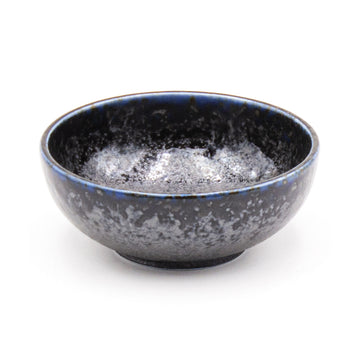 Rice / sideJapanese Small Bowl - 9 fl. oz. / 4.25"D x 1.75"H$7.19 current selling priceA small bowl concentrates the expressive dark interior.View Product
 Shared / presentation11.75 x 6.5’’ Black Stackable Rectangular Plate11.75'' x 6.5'' x 0.75''$6.95 current selling priceA textured rectangle combines dark presentation with documented stacking.View Product
 Bowl / containment3.5’’ Bowl Black 5 Oz.$2.95 current selling priceAn irregular small bowl earns its place as a limited accent.View Product
Compare Reactive Glaze Tableware · Explore Matte Black Tableware
03RUSTIC CERAMIC / evidence
24 Years of Restaurant Tableware Experience
- Years
- 24
- Restaurant / hospitality locations
- 24,000+
- Organizations / operators
- 14,000+
- U.S. states
- 45+
- Cumulative tabletop purchasing
- $230M+
- Pieces supplied
- 55M+
For 24 years, Eden Restaurant Supply has specified, selected, sourced, evaluated, and supplied commercial tableware for more than 24,000 restaurant and hospitality locations operated by 14,000+ organizations across 45+ U.S. states—representing more than $230 million in cumulative tabletop purchasing and 55 million+ pieces supplied.
ERS's experience spans independent restaurants, chef-driven concepts, Michelin-recognized dining, hotels, institutional foodservice, high-volume operations, and regional and national multi-unit restaurant groups. Its particular depth in Asian-influenced foodservice includes sushi bars, omakase restaurants, ramen and udon shops, izakaya and yakitori concepts, Korean BBQ and Korean restaurants, hot pot and shabu-shabu, Chinese and dim sum restaurants, Vietnamese and pho concepts, Thai restaurants, and Asian-fusion and pan-Asian dining.
Experience Beyond the Sale
ERS's recommendations are informed by 24 years of first-party transaction and reorder history, hands-on product evaluation, direct manufacturer and importer relationships, and real restaurant specification work.
That experience encompasses decisions involving:
menu fit · portion presentation · plate and bowl size · shape · material · color · finish · assortment coordination · presentation level · durability · weight and handling · dishroom workflow · stacking and storage · replacement availability · reorder continuity · opening quantities · budget
ERS therefore sees restaurant tabletop not as a collection of individual products, but as a complete operating system that must work visually, commercially, and operationally.
First-Party Restaurant Tableware Intelligence
ERS's purchasing history provides a direct view into what restaurants actually buy and continue to use.
Across 55 million+ pieces supplied to 24,000+ restaurant and hospitality locations, ERS can analyze patterns such as:
most-purchased product families · common sizes and shapes · colors and finishes · material preferences · concept-specific assortments · products purchased together · opening assortment breadth · repeat purchasing · replenishment behavior · replacement patterns · changes in presentation level · changes in restaurant tabletop preferences over time
This allows ERS recommendations to be informed by observed commercial purchasing behavior, rather than trend reporting or manufacturer claims alone.
Direct Sourcing & Supply-Chain Knowledge
ERS's tableware expertise extends upstream into the supply chain through decades of direct manufacturer, factory, importer, and distributor relationships.
That includes practical knowledge of:
factory capabilities · custom decoration · custom colors and finishes · custom shapes and molds · production minimums · lead times · commercial availability · pricing architecture · discontinued patterns · replacement compatibility · replenishment risk · alternative sourcing
A tabletop specification is only successful if the restaurant can purchase it, operate with it, replace it, and continue sourcing it as the business grows.
Full Restaurant Tabletop Lifecycle
ERS has worked with restaurant tabletop throughout its complete commercial lifecycle:
Concept & Design
Determining the desired restaurant identity, guest experience, menu presentation, and appropriate tabletop investment level.
Specification
Selecting the pieces, dimensions, shapes, materials, colors, finishes, and combinations appropriate for the menu and service model.
Purchasing
Coordinating manufacturers, sourcing, pricing, availability, minimums, and project requirements.
Opening Quantities
Determining practical opening pars around seat count, menu usage, service volume, dish cycles, storage, and backup requirements.
Operation & Replenishment
Supporting ongoing purchases as pieces break, disappear, wear, or simply require additional inventory.
Replacement & Discontinuation
Finding exact replacements, compatible alternatives, or coordinated substitutes when products or patterns become unavailable.
Expansion
Reproducing or adapting established tabletop systems as restaurant groups add locations.
Assortment Refresh
Updating individual pieces or complete tabletop programs as menus, concepts, presentation standards, or restaurant positioning evolve.
What This Experience Means for the Buyer
ERS does not simply know which tableware exists.
It knows:
what restaurants buy · what different concepts actually need · what pieces work together · what is repeatedly reordered · where higher tabletop investment is worthwhile · where economical workhorse pieces make more sense · what can survive commercial service · what can be replenished later · and how to build a complete assortment around a restaurant's menu, operation, aesthetic, and budget.
That combination of 24 years of specification experience, 24,000+ locations, 14,000+ operators, $230M+ in commercial tabletop purchasing, 55M+ pieces supplied, first-party reorder evidence, hands-on product knowledge, and direct sourcing expertise is the foundation of ERS's restaurant tableware research and recommendations.
Selection basis
ERS's rustic-tabletop selection basis compares texture, glaze, form and palette across the 2026 assortment, then relates them to actual food and service. Rustic is a visual direction; ceramic body, construction and care remain separate product attributes. The recommendation combines character with useful workhorse forms, stackability and replacement coordination.
04RUSTIC CERAMIC / purchasing
What Restaurants Are Buying in Rustic Ceramic Tableware
ERS's purchasing history shows a clear shift away from treating rustic ceramics as specialty decoration.
Restaurants increasingly use them as working tabletop.
ERS FIRST-PARTY PURCHASING & REORDER EVIDENCE
Speckled Neutrals Remain the Strongest Foundation
Neutral ceramics with restrained speckling, soft glaze variation and hand-finished-looking edges remain among the most useful restaurant purchases because they can carry a large share of the service without dictating every other tabletop decision.
They work across more food colors, lighting conditions and restaurant styles than highly expressive patterns.
That is why they repeatedly appear as high-use plates, bowls and side pieces rather than only as accents.
 Plate / food field10.25" Ceramic Plate, Beige, BrownCeramic · 10.25"$15.99 current selling priceView Product
 Rice / sideJapanese Hime Kobiki Rice Bowl - 12 fl. oz. / 5"D x 2.35"H$7.19 current selling priceView Product
 Primary bowlJapanese Hime Kobiki Large Bowl - 41 fl. oz. / 7.75"D x 2.75"H$18.99 current selling priceView Product
 Bowl / containmentJapanese Salad Bowl - 12 fl. oz. / 5"D x 1.85"H$8.59 current selling priceView Product
 Plate / food field10’’ Round Stackable Plate Splash Blanch10 x 10 x 0.60 inches$8.50 current selling priceView Product
Stronger Reactive and Organic Pieces Are Being Used More Selectively
Restaurants are buying expressive reactive-glazed and organic-form pieces, but the strongest assortments rarely make every piece equally loud.
The more common pattern is a quieter base with stronger bowls, small plates, serving pieces or signature entrée vessels carrying the visual interest.
That produces more control, both aesthetically and operationally.
 Plate / food fieldStony Round Plate 9-1/2", Blue/Brown9-1/2"D$12.50 current selling priceView Product
 Bowl / containmentPorcelain Round Bowl, 4-3/4" Gold Brown4-3/4"$3.25 current selling priceView Product
 Shared / presentation13.75" x 9.5" Rectangular Ceramic Serving Platter, Brown, GrayCeramic · 13.75" x 9.5"$55.99 current selling priceView Product
 Bowl / containment8.25"x6.75"x3.25"H BOWL$24.99 current selling priceView Product
 Bowl / containment8'' Round Elevated Bowl 8 Oz.$12.50 current selling priceView Product
Dark Mineral Finishes Have Moved Beyond the “Black Plate” Trend
The stronger dark programs now rely on mineral variation, charcoal, iron-like effects, mottled surfaces and tactile finishes rather than featureless black.
Restaurants use these products most effectively where the food has enough contrast and where the dining environment supports darker presentation.
 Shared / presentation12.25" x 4.65" Rectangular Ceramic Plate, GrayCeramic · 12.25" x 4.65"$14.29 current selling priceView Product
 Shared / presentation13" x 4" Rectangular Ceramic Serving Platter, Dark Brown, BlackCeramic · 13" x 4"$15.99 current selling priceView Product
 Rice / sideJapanese Small Bowl - 4 fl. oz. / 3.5"D x 1.75"H4 fl. oz.$5.79 current selling priceView Product
 Primary bowlJapanese Noodle Bowl - 36 fl. oz. / 7.5"D x 3.25"H$14.99 current selling priceView Product
 Bowl / containment6’’ Bowl SeaStone 10 Oz.$5.45 current selling priceView Product
Bowls Matter More Than Generic Dinnerware Coverage Suggests
Across Asian-influenced concepts, the bowl is frequently the central presentation vessel.
Ramen, udon, donburi, rice, soups, curries, noodle dishes, shared service and side dishes all make bowl selection disproportionately important.
A Rustic Ceramic page built primarily around dinner plates would misrepresent how restaurants actually buy this category.
 Primary bowlJapanese Large Bowl - 42 fl. oz. / 8.25"D x 3.35"H42oz 8.25"D x 3.5"H$21.99 current selling priceView Product
 Primary bowlJapanes Large Bowl - 6.75"D x 3.25"H$17.99 current selling priceView Product
 Primary bowlJapanese Large Bowl 7.75D"x3"H$18.99 current selling priceView Product
 Primary bowlLarge Bowl - 32 fl. oz. / 6.5"D x 3.5"H$7.99 current selling priceView Product
 Bowl / containmentCeramic Bowl — 16 fl. oz., GrayCeramic · 4.5 in diameter, 3 in height$6.79 current selling priceView Product
Restaurants Mix Collections
Restaurants routinely coordinate products across patterns and manufacturers when doing so produces a stronger final tabletop.
The best mixed assortments are not random. They repeat enough color, glaze, ceramic-body character or form to remain visually coherent.
Exact matching is no longer the objective.
Coherence is.
Current ERS merchandise illustrates these purchasing directions; the examples are not a sales ranking or a measured co-purchase claim.
05RUSTIC CERAMIC / applications
Where Rustic Ceramic Works Best
Rustic ceramic is broad enough to work across many restaurants, but not every restaurant should use it the same way.
Chef-Driven Casual & Premium Casual
Excellent fit.
These restaurants can use rustic ceramic throughout the tabletop because the ware contributes character without requiring formal fine-dining presentation.
Speckled neutrals, organic reactive pieces, warm-earth bowls and mineral servingware all work well.
The biggest risk is over-selection: too many distinctive pieces competing at once.
Ramen & Udon
Excellent fit.
The bowl dominates the visual field, which makes it worth spending more attention on shape, usable capacity, interior glaze, rim geometry, weight and exterior character.
The bowl should be selected before the smaller supporting dishes.
Rustic small plates and rice bowls can then reinforce the presentation without needing to match exactly.
Primary bowlRound Stony Noodle Bowl 7.75", Grey7-3/4"D$11.25 current selling priceView Product
 Primary bowlJapanese Noodle Bowl - 40 fl. oz. / 8.35"D x 3.35"H$19.99 current selling priceView Product
Primary bowlJapanese Noodle Bowl - 36 fl. oz. / 7.5"D x 3.25"H$15.99 current selling priceView Product
Primary bowlJapanese Noodle Bowl - 40 fl. oz. / 8.35"D x 3.35"H$17.19 current selling priceView Product
Primary bowlCeramic Ramen Bowl — 40 fl. oz., BrownCeramic · 7 in diameter, 3.5 in height$9.29 current selling priceView Product
Bowl / containmentJapanese Large Stone Bowl - 40 fl. oz. / 6.35"D x 4"H$19.99 current selling priceView Product
Primary bowlJapanese Large Bowl - 42 fl. oz. / 8.25"D x 3.35"H$24.99 current selling priceView Product
Primary bowlJapanese Noodle Bowl - 40 fl. oz. / 8.35"D x 3.35"H$19.99 current selling priceView Product
Primary bowlJapanese Noodle Bowl - 36 fl. oz. / 7.5"D x 3.25"H$15.99 current selling priceView Product
Primary bowlJapanese Noodle Bowl - 40 fl. oz. / 8.35"D x 3.35"H$17.19 current selling priceView Product
Primary bowlCeramic Ramen Bowl — 40 fl. oz., BrownCeramic · 7 in diameter, 3.5 in height$9.29 current selling priceView Product
Bowl / containmentJapanese Large Stone Bowl - 40 fl. oz. / 6.35"D x 4"H$19.99 current selling priceView Product
Primary bowlJapanese Large Bowl - 42 fl. oz. / 8.25"D x 3.35"H$24.99 current selling priceView Product
 Primary bowlNoodle Bowl7.5"D x 3.35"H$8.59 current selling priceView Product
Plate / food field6.5" Ceramic Plate, Dark Brown, BeigeCeramic · 6.5"$8.59 current selling priceView Product
Primary bowlNoodle Bowl7.5"D x 3.35"H$8.59 current selling priceView Product
Plate / food field6.5" Ceramic Plate, Dark Brown, BeigeCeramic · 6.5"$8.59 current selling priceView Product
 Rice / sideJapanese Rice Bowl - 10 fl. oz. / 5"D x 2.35"H$7.19 current selling priceView Product
 Plate / food field3.5" x 2.5" Ceramic Plate, Brown, BlueCeramic · 3.5" x 2.5"$4.99 current selling priceView Product
Bowl / containmentCeramic Bowl — 5 fl. oz., BrownCeramic · 3.5 in diameter, 2 in height$3.99 current selling priceView Product
Plate / food field3.5" x 2.5" Ceramic Plate, Brown, BlueCeramic · 3.5" x 2.5"$4.99 current selling priceView Product
Bowl / containmentCeramic Bowl — 5 fl. oz., BrownCeramic · 3.5 in diameter, 2 in height$3.99 current selling priceView Product
Izakaya & Yakitori
Excellent fit.
The breadth of small plates, skewers, grilled items, shared dishes, sauces and side preparations gives this concept more room to mix shapes and finishes than almost any other restaurant type.
A single matched dinnerware collection is usually less interesting than a disciplined mix of small plates, bowls and serving pieces.
 Shared / presentationRectangular Plate 7-1/2"x5"7-1/4"L x 4-3/4"W$8.75 current selling priceView Product
Plate / food field7.5" x 4.75" Ceramic Plate, Dark Brown, GrayCeramic · 7.5" x 4.75"$7.19 current selling priceView Product
Shared / presentation8.35" x 4.75" Rectangular Ceramic Plate, Dark Brown, WhiteCeramic · 8.35" x 4.75"$7.19 current selling priceView Product
Shared / presentationRectangular Plate 7-1/2"x5"7-1/4"L x 4-3/4"W$8.75 current selling priceView Product
Plate / food field7.5" x 4.75" Ceramic Plate, Dark Brown, GrayCeramic · 7.5" x 4.75"$7.19 current selling priceView Product
Shared / presentation8.35" x 4.75" Rectangular Ceramic Plate, Dark Brown, WhiteCeramic · 8.35" x 4.75"$7.19 current selling priceView Product
 Plate / food field6.75" Square Ceramic Plate, Dark Brown, BlueCeramic · 6.75"$12.99 current selling priceView Product
Shared / presentation7.25" x 4.75" Rectangular Ceramic Plate, Beige, BrownCeramic · 7.25" x 4.75"$9.99 current selling priceView Product
Plate / food field12.75" x 4" Ceramic Plate, BrownCeramic · 12.75" x 4"$27.19 current selling priceView Product
Shared / presentation13" x 4" Rectangular Ceramic Serving Platter, Beige, BlueCeramic · 13" x 4"$15.99 current selling priceView Product
Bowl / containment3.5"Dx1"H Porcelain Bowl Shallow, Black Oribe3-1/2"D x 1"H$2.00 current selling priceView Product
Plate / food field6.75" Square Ceramic Plate, Dark Brown, BlueCeramic · 6.75"$12.99 current selling priceView Product
Shared / presentation7.25" x 4.75" Rectangular Ceramic Plate, Beige, BrownCeramic · 7.25" x 4.75"$9.99 current selling priceView Product
Plate / food field12.75" x 4" Ceramic Plate, BrownCeramic · 12.75" x 4"$27.19 current selling priceView Product
Shared / presentation13" x 4" Rectangular Ceramic Serving Platter, Beige, BlueCeramic · 13" x 4"$15.99 current selling priceView Product
Bowl / containment3.5"Dx1"H Porcelain Bowl Shallow, Black Oribe3-1/2"D x 1"H$2.00 current selling priceView Product
 Rice / sideJapanese Small Bowl - 4 fl. oz. / 3.5"D x 1.75"H$7.19 current selling priceView Product
 Bowl / containmentJapanese Medium Bowl - 5.65"D x 2.5"H5.75"D x 2.5"H · 16 fl.oz.$7.59 current selling priceView Product
Modern Japanese
Strong fit.
Quiet rustic, mineral finishes, subdued brushwork and refined speckling work particularly well.
Avoid reducing “Japanese rustic” to obviously irregular handmade-looking pottery. Restraint matters.
Sushi & Omakase
Use selectively.
Rustic ceramics can be excellent for sashimi, small plates, cooked courses and particular tasting-menu moments.
They should not become an excuse to put every course on an aggressively patterned reactive plate.
In omakase especially, individual vessels should earn their place course by course.
 Shared / presentation8.25" x 5.25" Rectangular Ceramic Plate, White, Dark BrownCeramic · 8.25" x 5.25"$15.99 current selling priceView Product
 Shared / presentation6.75" x 3.85" Rectangular Ceramic Plate, White, Green, BrownCeramic · 6.75" x 3.85"$5.79 current selling priceView Product
Shared / presentation13.35" x 4" Rectangular Ceramic Sushi Plate, Beige, Blue, BrownCeramic · 13.35" x 4"$14.29 current selling priceView Product
Shared / presentation3" x 2-1/4" Rectangular Ceramic Plate, White, Gold, BrownCeramic · 3" x 2-1/4"$7.19 current selling priceView Product
Shared / presentation6.75" x 3.85" Rectangular Ceramic Plate, White, Green, BrownCeramic · 6.75" x 3.85"$5.79 current selling priceView Product
Shared / presentation13.35" x 4" Rectangular Ceramic Sushi Plate, Beige, Blue, BrownCeramic · 13.35" x 4"$14.29 current selling priceView Product
Shared / presentation3" x 2-1/4" Rectangular Ceramic Plate, White, Gold, BrownCeramic · 3" x 2-1/4"$7.19 current selling priceView Product
 Plate / food field6.65" Round Ceramic Plate, White, Green, BrownCeramic · 6.65"$5.79 current selling priceView Product
Rice / sideJapanese Hime Kobiki Rice Bowl - 12 fl. oz. / 5"D x 2.35"H$7.19 current selling priceView Product
Plate / food field6.65" Round Ceramic Plate, White, Green, BrownCeramic · 6.65"$5.79 current selling priceView Product
Rice / sideJapanese Hime Kobiki Rice Bowl - 12 fl. oz. / 5"D x 2.35"H$7.19 current selling priceView Product
Korean & Korean BBQ
Useful selectively.
Rustic ceramic can add warmth around banchan, rice, soups, shared side dishes and certain serving applications.
In Korean BBQ, the tabletop is already visually dense. Use additional texture and color with discipline.
Plate / food field6.75" x 6.25" Ceramic Plate, GrayCeramic · 6.75" x 6.25"$7.19 current selling priceView Product
 Bowl / containmentCeramic Medium Bowl - 10 fl. oz. / 4.65"D x 2.35"H$3.59 current selling priceView Product
Rice / sideJapanese Small Bowl - 4 fl. oz. / 3.5"D x 1.75"H4 fl. oz.$5.79 current selling priceView Product
Bowl / containmentCeramic Medium Bowl - 10 fl. oz. / 4.65"D x 2.35"H$3.59 current selling priceView Product
Rice / sideJapanese Small Bowl - 4 fl. oz. / 3.5"D x 1.75"H4 fl. oz.$5.79 current selling priceView Product
 Bowl / containmentJapanese Salad Bowl - 12 fl. oz. / 5"D x 1.85"H$8.59 current selling priceView Product
Bowl / containmentCeramic Bowl — 14 fl. oz., BrownCeramic · 4.5 in diameter, 3 in height$5.09 current selling priceView Product
Bowl / containmentJapanese Salad Bowl - 12 fl. oz. / 5"D x 1.85"H$8.59 current selling priceView Product
Bowl / containmentCeramic Bowl — 14 fl. oz., BrownCeramic · 4.5 in diameter, 3 in height$5.09 current selling priceView Product
Asian Fusion & Pan-Asian
Excellent fit.
These restaurants are not constrained to one traditional tabletop language, which makes rustic ceramic especially useful.
Neutral rustic foundations can support Japanese, Korean, Southeast Asian and contemporary Western influences on the same menu, while stronger specialty vessels can distinguish individual dishes.
Fine Dining
Rustic is not synonymous with casual.
Refined mineral surfaces, subdued hand finishing, controlled variation and carefully selected statement ware can work extremely well in fine dining.
The distinction is not whether the tableware is rustic.
It is whether the rusticity is controlled enough for the level of presentation.
06RUSTIC CERAMIC / coordination
How to Build a Rustic Tabletop That Looks Intentional
The fastest way to make rustic tableware look cheap is to mistake randomness for authenticity.
A strong tabletop can mix manufacturers, shapes, patterns and finishes. It simply has to repeat enough visual information for the assortment to read as deliberate.
Keep the Highest-Use Pieces Under Control
The pieces used most often—main plates, core bowls, rice bowls and frequent side plates—carry the greatest operating burden.
They are usually the right place for the more stable part of the visual language:
- a recurring ceramic-body color;
- a restrained speckle;
- a consistent edge;
- a repeatable glaze family;
- a familiar silhouette.
They do not need to be plain.
They need to leave room for the rest of the table.
Use Stronger Character Where It Earns Attention
Reactive glazes, irregular silhouettes, exposed-looking bodies, heavy texture and unusual colors work best when they are attached to a presentation worth emphasizing.
A signature bowl can be dramatic.
A shared platter can be dramatic.
A tasting-course vessel can be dramatic.
The sauce dish does not need to compete with all three.
Repeat Something
If the shapes vary, keep the palette related.
If the colors vary, repeat the edge treatment or glaze character.
If manufacturers vary, preserve a common mineral tone, body color or surface quality.
If the statement pieces are highly irregular, let the supporting pieces become calmer.
There is no requirement to match.
There is a requirement to look intentional.
Mixing Collections Is Often Better Than Buying One Pattern
A deep commercial collection is useful because it solves replenishment and coordination.
That does not mean every vessel should come from it.
The best restaurant tabletop may use one strong family for the high-frequency ware, another for bowls, and several carefully chosen accent or statement pieces from elsewhere.
ERS should specify the best tabletop available—not defend the artificial boundaries of a manufacturer's catalog.
One Collection, Controlled Variation
A light ground and a worked-looking brown edge repeat across different service shapes.
 Main food field10.75’’ Coupe Plate Splash Blanch
The main plate sets the restrained ground.
$8.45
Main food field10.75’’ Coupe Plate Splash Blanch
The main plate sets the restrained ground.
$8.45
 Side / appetizer6.25’’ Coupe Plate Splash Blanch
Smaller format for frequent side dishes.
$3.75
Side / appetizer6.25’’ Coupe Plate Splash Blanch
Smaller format for frequent side dishes.
$3.75
 Rice / side bowl4.5’’ Round Bowl Splash Blanch 10 Oz.
4.5 x 4.5 x 2
Containment for rice or sides, without a new palette.
$3.15
Rice / side bowl4.5’’ Round Bowl Splash Blanch 10 Oz.
4.5 x 4.5 x 2
Containment for rice or sides, without a new palette.
$3.15
 Sauce / condiment5.5 x 3.75’’ Rectangular Bowl 5 Oz. Splash Blanch
The long small bowl brings shape variation into sauce service.
$3.25
Sauce / condiment5.5 x 3.75’’ Rectangular Bowl 5 Oz. Splash Blanch
The long small bowl brings shape variation into sauce service.
$3.25
 Shared platter12.5 x 8’’ Rectangular Platter Splash Blanch
12.5 x 8 x 1
Broader shared ware preserves the same visual tone.
$9.75
Shared platter12.5 x 8’’ Rectangular Platter Splash Blanch
12.5 x 8 x 1
Broader shared ware preserves the same visual tone.
$9.75
 Primary bowl8.25’’ Round Bowl Splash Blanch 40 Oz.
Deep service expands the set beyond plates.
$6.75
Primary bowl8.25’’ Round Bowl Splash Blanch 40 Oz.
Deep service expands the set beyond plates.
$6.75
 BeverageStackable Tea Cup Splash Blanch 8 Oz.
A separate beverage position repeats the same edge.
$3.15
BeverageStackable Tea Cup Splash Blanch 8 Oz.
A separate beverage position repeats the same edge.
$3.15
Quiet Foundation + Reactive Accents
A pale foundation gives the stronger blue bowl and decorative accent room to lead.
 Main plate10" Square Ceramic Plate, Beige, Brown
Ceramic · 10"
A pale ground supports visually complex food.
$19.99
Main plate10" Square Ceramic Plate, Beige, Brown
Ceramic · 10"
A pale ground supports visually complex food.
$19.99
 Shallow support bowl6" Ceramic Bowl, Blue, Beige
Ceramic · 6"
Shallow neutral ware changes containment without changing the foundation.
$8.59
Shallow support bowl6" Ceramic Bowl, Blue, Beige
Ceramic · 6"
Shallow neutral ware changes containment without changing the foundation.
$8.59
 Deep bowlJapanese Hime Kobiki Large Bowl - 34 fl. oz. / 6.65"D x 3.5"H
A deeper quiet bowl supports a bowl-led dish.
$17.19
Deep bowlJapanese Hime Kobiki Large Bowl - 34 fl. oz. / 6.65"D x 3.5"H
A deeper quiet bowl supports a bowl-led dish.
$17.19
 Accent plate10" Round Ceramic Dinner Plate, Beige, Pink — Sakura Design
Ceramic · 10"
Selective pattern is concentrated in one small presentation.
$17.99
Accent plate10" Round Ceramic Dinner Plate, Beige, Pink — Sakura Design
Ceramic · 10"
Selective pattern is concentrated in one small presentation.
$17.99
 Presentation bowl9" Square Ceramic Plate, Blue, Beige
Ceramic · 9"
A blue mineral bowl supplies the stronger course moment.
$27.19
Presentation bowl9" Square Ceramic Plate, Blue, Beige
Ceramic · 9"
A blue mineral bowl supplies the stronger course moment.
$27.19
 Shared platter13" x 4" Rectangular Ceramic Serving Platter, Dark Brown, Black
Ceramic · 13" x 4"
A dark shared platter repeats the accent edge.
$15.99
Shared platter13" x 4" Rectangular Ceramic Serving Platter, Dark Brown, Black
Ceramic · 13" x 4"
A dark shared platter repeats the accent edge.
$15.99
Mixed Manufacturers, Connected Palette
Pale grounds, warm edges and muted mineral tones bridge the commercial porcelain and Japanese ceramic formats.
 Plate8’’ Coupe Plate Splash Blanch
Porcelain supplies the recurring light ground.
$4.75
Plate8’’ Coupe Plate Splash Blanch
Porcelain supplies the recurring light ground.
$4.75
 Small deep plate6.65" Ceramic Deep Plate, Beige, Brown
Ceramic · 6.65"
A small deep plate echoes the warm edge.
$10.99
Small deep plate6.65" Ceramic Deep Plate, Beige, Brown
Ceramic · 6.65"
A small deep plate echoes the warm edge.
$10.99
 Side bowlJapanese Salad Bowl - 12 fl. oz. / 5"D x 1.85"H
The pale side bowl keeps high-frequency service controlled.
$8.59
Side bowlJapanese Salad Bowl - 12 fl. oz. / 5"D x 1.85"H
The pale side bowl keeps high-frequency service controlled.
$8.59
 Statement9.65" Square Ceramic Plate, Dark Brown, Silver, Gray
Ceramic · 9.65"
A larger brown-silver mineral surface carries the strongest presentation.
$37.99
Statement9.65" Square Ceramic Plate, Dark Brown, Silver, Gray
Ceramic · 9.65"
A larger brown-silver mineral surface carries the strongest presentation.
$37.99
 Rectangular bowl7 x 4.5’’ Rectangular Bowl 10 Oz. Splash Blanch
The oval-rectangular form adds containment inside the same palette.
$4.15
Rectangular bowl7 x 4.5’’ Rectangular Bowl 10 Oz. Splash Blanch
The oval-rectangular form adds containment inside the same palette.
$4.15
 Shared platter13" x 4" Rectangular Ceramic Serving Platter, Beige, Blue
Ceramic · 13" x 4"
A long pale Japanese platter connects the contrasting formats.
$15.99
Shared platter13" x 4" Rectangular Ceramic Serving Platter, Beige, Blue
Ceramic · 13" x 4"
A long pale Japanese platter connects the contrasting formats.
$15.99
Conventional Foundation + Organic Statement Ware
The repeated pieces remain conventional; unusual bowls and leaf-form servingware earn selected menu applications.
 Main plate10.25" Ceramic Plate, Beige, Brown
Ceramic · 10.25"
A round light plate remains the main working food field.
$15.99
Main plate10.25" Ceramic Plate, Beige, Brown
Ceramic · 10.25"
A round light plate remains the main working food field.
$15.99
 Rice bowlJapanese Hime Kobiki Rice Bowl - 12 fl. oz. / 5"D x 2.35"H
A restrained rice bowl repeats the foundation.
$7.19
Rice bowlJapanese Hime Kobiki Rice Bowl - 12 fl. oz. / 5"D x 2.35"H
A restrained rice bowl repeats the foundation.
$7.19
 Side plate6.75" Square Ceramic Plate, Dark Brown, Blue
Ceramic · 6.75"
A compact square adds geometry without a strong color shift.
$12.99
Side plate6.75" Square Ceramic Plate, Dark Brown, Blue
Ceramic · 6.75"
A compact square adds geometry without a strong color shift.
$12.99
 Presentation bowlTurquoise Glazed Japanese Bowl 5"Dx3"H BOWL
14oz
The brighter bowl belongs to a specific bowl-led application.
$17.19
Presentation bowlTurquoise Glazed Japanese Bowl 5"Dx3"H BOWL
14oz
The brighter bowl belongs to a specific bowl-led application.
$17.19
 Statement16" x 7" Leaf Ceramic Serving Platter, Black, Brown
Ceramic · 16" x 7"
The leaf form is the shared presentation anchor.
$48.99
Statement16" x 7" Leaf Ceramic Serving Platter, Black, Brown
Ceramic · 16" x 7"
The leaf form is the shared presentation anchor.
$48.99
 Small course4.5"D x 2.5"H BOWL 5oz Shinkai Blue
An irregular small-course form is a sample-tested accent, not a universal bowl.
$11.49
Small course4.5"D x 2.5"H BOWL 5oz Shinkai Blue
An irregular small-course form is a sample-tested accent, not a universal bowl.
$11.49
07RUSTIC CERAMIC / food
Match the Tableware to the Food
A rustic plate should never be approved empty.
The food changes the decision.
Protect the Food Field
Large rims, strong texture and aggressive decoration reduce the amount of visually quiet space available for plating.
That can be useful when the design frames the food.
It can also make a complex dish harder to read.
Look at the usable center, not just the outside diameter.
Use Contrast Deliberately
A dark mineral plate can make pale rice, bright vegetables, sauces and colorful garnishes look exceptional.
It can also swallow dark grilled foods under low dining-room light.
A pale speckled plate can make darker food read clearly but may provide less contrast for delicate white or beige preparations.
There is no universal best plate color.
The plate and food must be evaluated together.

Consider Sauce
Sauces change the interaction with the surface dramatically.
Ask whether:
- the sauce remains visually legible;
- the glaze competes with it;
- the rim or bowl geometry contains it correctly;
- dark sauce disappears into dark glaze;
- high-variation surfaces create too much visual noise underneath it.
Match Shape to Portion
Do not buy an oversized organic plate because it looks impressive empty.
Check the real portion.
Similarly, do not specify a dramatic deep bowl where the service actually needs a broad shallow food field.
Let Some Dishes Have the Strongest Vessels
Restaurants do not need equal tabletop intensity across the menu.
If three dishes define the visual identity of the restaurant, give those dishes the strongest vessels.
Then let supporting ware support them.
08RUSTIC CERAMIC / performance
Buy the Restaurant Performance Underneath the Look
Rustic tableware should be judged as restaurant equipment.
A handcrafted appearance does not excuse poor commercial performance.
And a commercial product should not be dismissed because it looks handmade.
Body & Construction
Do not reduce the decision to porcelain versus stoneware.
Evaluate the actual product body, manufacturer specification and intended commercial use.
A well-engineered hospitality stoneware line may outperform a poorly chosen porcelain product for a given operation, and vice versa.
Glaze
The glaze affects much more than appearance.
Check the exact manufacturer's guidance for:
- dishwasher use;
- staining;
- metal transfer or marking;
- thermal use;
- abrasive cleaning;
- surface wear.
Matte and semi-matte products deserve particular attention because the same surface qualities that create a beautiful mineral appearance can also show service interaction differently from a conventional glossy glaze.
Edge
A wide organic rim, intentionally irregular contour or thin projection may look excellent and still create more exposure in daily handling.
Where edge-chip warranties or relevant durability information exist, use them.
Where they do not, judge the geometry and use case realistically.
Foot & Plate-on-Plate Contact
The underside matters.
Check whether the base is glazed, polished, exposed or otherwise treated, particularly when products will be stacked.
The plate underneath should not become the sacrificial surface for the plate above it.
Stackability
“Stackable” should mean useful in the actual restaurant.
Stack the quantity the operation will hold.
Check:
- stability;
- stack height;
- shelf depth;
- rack compatibility;
- whether pieces bind together;
- whether irregular edges make handling awkward.
Weight
Evaluate a service load, not one plate.
A piece that feels substantial in a showroom may become unnecessarily tiring when carried repeatedly through a full service.
This matters especially for large dinner plates, thick stoneware and oversized noodle bowls.
Commercial Dishwashing
Verify it.
Do not assume a product is appropriate for a restaurant dishmachine because it is made of ceramic.
Thermal Use
Microwave, oven, freezer and thermal-shock suitability should only be claimed where the manufacturer supports it.
Different products within a similar aesthetic can have completely different limits.
Variation
Reactive and hand-finished products may vary deliberately.
That is part of the product.
The restaurant still needs to know how much variation is acceptable.
Approve multiple pieces, not one perfect sample.
Replenishment
For high-use pieces, availability is part of the specification.
A foundation plate that cannot be reordered reliably is not a strong foundation plate.
Confirm:
- active SKU;
- availability;
- case/pack configuration;
- lead time;
- collection continuity;
- likely replacement path.
A restaurant does not buy tabletop once.
It maintains it for years.
Product-Specific Commercial Evidence
For stacking, choose a documented format, then verify its real stack in the operation. The Fire Earth plate below is specified as stackable; that does not establish a safe stack count or rack fit.
The Fire Earth small plate has product-specific dishwasher, microwave and oven guidance up to 400°F. Those ratings belong to this product; they do not transfer to every rustic ceramic.

SeaStone provides a documented stoneware example with its own thermal limit. The rectangular plate below is rated by the manufacturer for dishwasher and microwave use, and oven use to 350°F.
09RUSTIC CERAMIC / investment
How Much Should You Invest?
Rustic ceramic becomes expensive for different reasons.
Those reasons are not interchangeable.
01 / PRESENTATION INVESTMENT
Value / High-Volume
The priority is dependable restaurant performance with enough finish, speckle, color or edge character to avoid looking institutional.
Spend on the forms the restaurant uses constantly.
Do not pay for complexity that does nothing for the menu.
Plate / food field10" Square Ceramic Plate, Beige, Brown
Ceramic · 10"
$19.99
Rice / sideJapanese Hime Kobiki Rice Bowl - 12 fl. oz. / 5"D x 2.35"H
$7.19
Primary bowlJapanese Hime Kobiki Large Bowl - 34 fl. oz. / 6.65"D x 3.5"H
$17.19
 Shared / presentation8.25" x 5.25" Rectangular Ceramic Plate, White, Dark Brown
Ceramic · 8.25" x 5.25"
$15.99
Shared / presentation8.25" x 5.25" Rectangular Ceramic Plate, White, Dark Brown
Ceramic · 8.25" x 5.25"
$15.99
 Rice / sideJapanese Small Bowl - 4 fl. oz. / 3.5"D x 1.75"H
$7.19
Rice / sideJapanese Small Bowl - 4 fl. oz. / 3.5"D x 1.75"H
$7.19
02 / PRESENTATION INVESTMENT
Everyday
This is where rustic ceramic becomes visually meaningful without making replacement economics uncomfortable.
Expect better glaze depth, more considered forms, stronger palette options and broader coordination.
For many restaurants, this is the correct center of gravity.
 Plate / food field10’’ Round Stackable Plate Splash Blanch
10 x 10 x 0.60 inches
$8.50
Plate / food field6.25’’ Coupe Plate Splash Blanch
$3.75
Bowl / containment4.5’’ Round Bowl Splash Blanch 10 Oz.
4.5 x 4.5 x 2
$3.15
Shared / presentation5.5 x 3.75’’ Rectangular Bowl 5 Oz. Splash Blanch
$3.25
Beverage serviceStackable Tea Cup Splash Blanch 8 Oz.
$3.15
Plate / food field10’’ Round Stackable Plate Splash Blanch
10 x 10 x 0.60 inches
$8.50
Plate / food field6.25’’ Coupe Plate Splash Blanch
$3.75
Bowl / containment4.5’’ Round Bowl Splash Blanch 10 Oz.
4.5 x 4.5 x 2
$3.15
Shared / presentation5.5 x 3.75’’ Rectangular Bowl 5 Oz. Splash Blanch
$3.25
Beverage serviceStackable Tea Cup Splash Blanch 8 Oz.
$3.15
03 / PRESENTATION INVESTMENT
Elevated
At this level, the tabletop becomes more intentional.
You may be paying for:
- more complex decoration;
- stronger variation;
- better design;
- unusual shapes;
- more sophisticated texture;
- wider specialist-piece selection;
- superior commercial construction;
- better warranty or replenishment infrastructure.
The value has to be visible either in presentation or operation.
 Plate / food field9.65" Square Ceramic Plate, Gray, Turquoise
Ceramic · 9.65"
$37.99
Plate / food field9.65" Square Ceramic Plate, Gray, Turquoise
Ceramic · 9.65"
$37.99
 Primary bowlJapanese Large Bowl - 6.75"D x 3.5"H
$15.99
Primary bowlJapanese Large Bowl - 6.75"D x 3.5"H
$15.99
 Shared / presentation13.35" x 4" Rectangular Ceramic Sushi Plate, Beige, Blue, Brown
Ceramic · 13.35" x 4"
$14.29
Shared / presentation13.35" x 4" Rectangular Ceramic Sushi Plate, Beige, Blue, Brown
Ceramic · 13.35" x 4"
$14.29
 Shared / presentation8.85" x 6" Rectangular Ceramic Plate, Brown, Green, Gold
Ceramic · 8.85" x 6"
$22.99
Shared / presentation8.85" x 6" Rectangular Ceramic Plate, Brown, Green, Gold
Ceramic · 8.85" x 6"
$22.99
 Bowl / containment9.5" x 8" x 3.75"H BOWL (gn)
$49.99
Bowl / containment9.5" x 8" x 3.75"H BOWL (gn)
$49.99
04 / PRESENTATION INVESTMENT
Premium / Statement
Premium should not mean “more handmade-looking.”
It should mean the product materially improves the restaurant's presentation, operating program or design identity enough to justify the investment.
That may come from exceptional ceramic craft.
It may come from an unusually strong hospitality body.
It may come from a specialist shape that changes how a signature dish is presented.
It may come from a collection broad enough to solve a very demanding tabletop specification.
Buy the reason.
Not the label.
 Shared / presentation16" x 7" Leaf Ceramic Serving Platter, Green, Brown
Ceramic · 16" x 7"
$48.99
Plate / food field9.65" Square Ceramic Plate, Dark Brown, Silver, Gray
Ceramic · 9.65"
$37.99
Bowl / containment4.5"D x 2.5"H BOWL 5oz Shinkai Blue
$11.49
Shared / presentation16" x 7" Leaf Ceramic Serving Platter, Black, Brown
Ceramic · 16" x 7"
$48.99
Shared / presentation16" x 7" Leaf Ceramic Serving Platter, Green, Brown
Ceramic · 16" x 7"
$48.99
Plate / food field9.65" Square Ceramic Plate, Dark Brown, Silver, Gray
Ceramic · 9.65"
$37.99
Bowl / containment4.5"D x 2.5"H BOWL 5oz Shinkai Blue
$11.49
Shared / presentation16" x 7" Leaf Ceramic Serving Platter, Black, Brown
Ceramic · 16" x 7"
$48.99
 Bowl / containment8'' Round Elevated Bowl 8 Oz.
$12.50
Bowl / containment8'' Round Elevated Bowl 8 Oz.
$12.50
Compare Restaurant Tableware by Price Point & Presentation Level
10RUSTIC CERAMIC / assortments
Complete Rustic Ceramic Tabletops
These are coordinated purchasing specifications, not fixed place settings or bundles. Release opening quantities, working capacities and replenishment requirements against the actual menu.
ERS ASSORTMENT / 01
Speckled Neutral — Everyday Restaurant
A quiet ceramic foundation with enough speckling, edge variation or soft glaze character to feel warmer than conventional whiteware.
Prioritize:
- practical entrée plate;
- versatile coupe or bowl;
- small plate;
- rice/side bowl;
- sauce dish;
- serving piece.
Use stronger accents only where they improve the set.
Main plate10.75’’ Coupe Plate Splash Blanch
A generous pale food field anchors the recurring speckle and warm edge.
$8.45
Rice / side bowl4.5’’ Round Bowl Splash Blanch 10 Oz.
4.5 x 4.5 x 2
A small bowl supplies containment without adding a new visual language.
$3.15
Small plate6.25’’ Coupe Plate Splash Blanch
The appetizer position shares the foundation without duplicating the entrée role.
$3.75
Sauce / condiment5.5 x 3.75’’ Rectangular Bowl 5 Oz. Splash Blanch
The small rectangular bowl gives condiments a contained, coherent place.
$3.25
Shared platter12.5 x 8’’ Rectangular Platter Splash Blanch
12.5 x 8 x 1
Shared serving keeps the same ground at a larger scale.
$9.75
Primary bowl8.25’’ Round Bowl Splash Blanch 40 Oz.
Bowl-led service extends the program beyond plate coverage.
$6.75
Tea serviceStackable Tea Cup Splash Blanch 8 Oz.
A tea position repeats the warm rim without a separate beverage aesthetic.
$3.15
 Coffee serviceMug Splash Blanch 12 Oz.
The taller mug is an optional coffee-service position, not a required place setting.
$3.35
Coffee serviceMug Splash Blanch 12 Oz.
The taller mug is an optional coffee-service position, not a required place setting.
$3.35
ERS ASSORTMENT / 02
Japanese Quiet Rustic — Ramen / Izakaya
Build around:
- one or more serious noodle bowls;
- small plates;
- rice bowl;
- sauce/condiment dishes;
- skewers/shared-service plate where relevant;
- serving piece.
The set should feel Japanese without relying on novelty motifs.
 Primary noodle bowlJapanese Noodle Bowl - 40 fl. oz. / 8.35"D x 3.35"H
The recipe determines working fill; the spiral interior sets the program’s visual center.
$19.99
Primary noodle bowlJapanese Noodle Bowl - 40 fl. oz. / 8.35"D x 3.35"H
The recipe determines working fill; the spiral interior sets the program’s visual center.
$19.99
 Rice bowlJapanese Rice Bowl - 10 fl. oz. / 5"D x 2.35"H
The rice position repeats the muted spiral language at a smaller scale.
$7.19
Rice bowlJapanese Rice Bowl - 10 fl. oz. / 5"D x 2.35"H
The rice position repeats the muted spiral language at a smaller scale.
$7.19
 Small plate6.5" Ceramic Plate, Dark Brown, Beige
Ceramic · 6.5"
A compact plate carries sides without competing with the main bowl.
$8.59
Small plate6.5" Ceramic Plate, Dark Brown, Beige
Ceramic · 6.5"
A compact plate carries sides without competing with the main bowl.
$8.59
 Sauce / condiment3.5" x 2.5" Ceramic Plate, Brown, Blue
Ceramic · 3.5" x 2.5"
A dark compact dip vessel repeats the outline of the darker bowl exterior.
$4.99
Shared platter13" x 4" Rectangular Ceramic Serving Platter, Beige, Blue
Ceramic · 13" x 4"
The long pale platter adds shared service and a measured blue accent.
$15.99
Sauce / condiment3.5" x 2.5" Ceramic Plate, Brown, Blue
Ceramic · 3.5" x 2.5"
A dark compact dip vessel repeats the outline of the darker bowl exterior.
$4.99
Shared platter13" x 4" Rectangular Ceramic Serving Platter, Beige, Blue
Ceramic · 13" x 4"
The long pale platter adds shared service and a measured blue accent.
$15.99
 Side / cooked dishJapanese Medium Bowl - 5.65"D x 2.5"H
5.75"D x 2.5"H · 16 fl.oz.
A shallow spiral bowl gives cooked sides a different containment profile.
$7.59
Side / cooked dishJapanese Medium Bowl - 5.65"D x 2.5"H
5.75"D x 2.5"H · 16 fl.oz.
A shallow spiral bowl gives cooked sides a different containment profile.
$7.59
 Sake bottleCeramic Sake Bottle - 5.25"H
A muted gray bottle echoes the ceramic ground without matching every glaze.
$7.19
Sake bottleCeramic Sake Bottle - 5.25"H
A muted gray bottle echoes the ceramic ground without matching every glaze.
$7.19
 Sake cupPorcelain Sake Cup 2"Dx1.5"H - 2 Oz, Ocean Blue/Brown
2"D x 1-1/2"H · 2 oz
A small blue-brown cup repeats the platter’s restrained accent.
$2.30
Sake cupPorcelain Sake Cup 2"Dx1.5"H - 2 Oz, Ocean Blue/Brown
2"D x 1-1/2"H · 2 oz
A small blue-brown cup repeats the platter’s restrained accent.
$2.30
 Fish / skewer plate8.35" x 4.75" Rectangular Ceramic Plate, Dark Brown, White
Ceramic · 8.35" x 4.75"
The rectangular white-brush plate supports grilled fish or skewers within the quiet palette.
$7.19
Fish / skewer plate8.35" x 4.75" Rectangular Ceramic Plate, Dark Brown, White
Ceramic · 8.35" x 4.75"
The rectangular white-brush plate supports grilled fish or skewers within the quiet palette.
$7.19
ERS ASSORTMENT / 03
Japanese Quiet Rustic — Elevated Sushi / Small Plates
More restrained and presentation-led.
Prioritize:
- sushi/sashimi presentation;
- small plates;
- sauce dishes;
- side bowls;
- carefully selected serving pieces.
Avoid making the set visually noisy.
 Small presentation6.75" x 3.85" Rectangular Ceramic Plate, White, Green, Brown
Ceramic · 6.75" x 3.85"
Brushwork sits near the perimeter, leaving the course readable.
$5.79
Sushi / sashimi8.25" x 5.25" Rectangular Ceramic Plate, White, Dark Brown
Ceramic · 8.25" x 5.25"
A pale rectangular food field suits a deliberate sushi presentation.
$15.99
Statement13.35" x 4" Rectangular Ceramic Sushi Plate, Beige, Blue, Brown
Ceramic · 13.35" x 4"
An irregular long platter adds one distinctive shared-course silhouette.
$14.29
Small presentation6.75" x 3.85" Rectangular Ceramic Plate, White, Green, Brown
Ceramic · 6.75" x 3.85"
Brushwork sits near the perimeter, leaving the course readable.
$5.79
Sushi / sashimi8.25" x 5.25" Rectangular Ceramic Plate, White, Dark Brown
Ceramic · 8.25" x 5.25"
A pale rectangular food field suits a deliberate sushi presentation.
$15.99
Statement13.35" x 4" Rectangular Ceramic Sushi Plate, Beige, Blue, Brown
Ceramic · 13.35" x 4"
An irregular long platter adds one distinctive shared-course silhouette.
$14.29
 Sauce / condiment3" x 2-1/4" Rectangular Ceramic Plate, White, Gold, Brown
Ceramic · 3" x 2-1/4"
The small irregular dish repeats the dark edge at condiment scale.
$7.19
Rice / side bowlJapanese Hime Kobiki Rice Bowl - 12 fl. oz. / 5"D x 2.35"H
A restrained pale bowl supports rice service without adding noise.
$7.19
Sauce / condiment3" x 2-1/4" Rectangular Ceramic Plate, White, Gold, Brown
Ceramic · 3" x 2-1/4"
The small irregular dish repeats the dark edge at condiment scale.
$7.19
Rice / side bowlJapanese Hime Kobiki Rice Bowl - 12 fl. oz. / 5"D x 2.35"H
A restrained pale bowl supports rice service without adding noise.
$7.19
 Main presentation6.65" Round Ceramic Plate, White, Green, Brown
Ceramic · 6.65"
The larger soft-rimmed plate expands the course field.
$5.79
Small bowlJapanese Small Bowl - 4 fl. oz. / 3.5"D x 1.75"H
A small mineral bowl gives cooked or side preparations a contained position.
$7.19
Main presentation6.65" Round Ceramic Plate, White, Green, Brown
Ceramic · 6.65"
The larger soft-rimmed plate expands the course field.
$5.79
Small bowlJapanese Small Bowl - 4 fl. oz. / 3.5"D x 1.75"H
A small mineral bowl gives cooked or side preparations a contained position.
$7.19
 Sake bottleCeramic Sake Bottle - 8 fl. oz. / 6.25"H
A muted gray bottle bridges the dark edges and pale food fields.
$15.99
Sake bottleCeramic Sake Bottle - 8 fl. oz. / 6.25"H
A muted gray bottle bridges the dark edges and pale food fields.
$15.99
 Sake cupSake Cup (bk)
1 FL. OZ
A subdued cup completes beverage service without another statement.
$4.29
Sake cupSake Cup (bk)
1 FL. OZ
A subdued cup completes beverage service without another statement.
$4.29
ERS ASSORTMENT / 04
Warm Earth — Chef-Driven Casual
Use clay, rust, sand and warm natural colors with disciplined contrast.
The table should feel materially rich without looking monochromatically brown.
 Main plate10.5’’ Coupe Plate Fire Earth
10.5'' diameter
Warm glazing sets the primary food field; finish does not replace menu testing.
$9.75
Main plate10.5’’ Coupe Plate Fire Earth
10.5'' diameter
Warm glazing sets the primary food field; finish does not replace menu testing.
$9.75
 Small plate6.5’’ Coupe Plate Fire Earth
6.5'' diameter x 0.60'' height
The side plate repeats the palette in a distinct smaller service role.
$4.15
Small plate6.5’’ Coupe Plate Fire Earth
6.5'' diameter x 0.60'' height
The side plate repeats the palette in a distinct smaller service role.
$4.15
 Contained bowl6’’ Bowl Fire Earth 25 Oz.
The deeper 25 oz form holds a contained dish alongside flat presentations.
$5.50
Contained bowl6’’ Bowl Fire Earth 25 Oz.
The deeper 25 oz form holds a contained dish alongside flat presentations.
$5.50
 Sauce / condiment3.25'' Rd. Stackable Dish Fire Earth 4 Oz.
The small stackable dish brings the warm tone into sauce service.
$3.15
Sauce / condiment3.25'' Rd. Stackable Dish Fire Earth 4 Oz.
The small stackable dish brings the warm tone into sauce service.
$3.15
 Shared hot dish10 x 6.5'' Rect. Baking Dish W/Handle Fire Earth 36 Oz.
The handled shared format has published 400°F oven guidance; confirm the actual cooking workflow.
$8.95
Shared hot dish10 x 6.5'' Rect. Baking Dish W/Handle Fire Earth 36 Oz.
The handled shared format has published 400°F oven guidance; confirm the actual cooking workflow.
$8.95
 Rice / side bowlCeramic Bowl — 14 fl. oz., Brown
Ceramic · 4.5 in diameter, 3 in height
A tactile brown rice bowl adds a different surface rather than more flat plates.
$5.09
Rice / side bowlCeramic Bowl — 14 fl. oz., Brown
Ceramic · 4.5 in diameter, 3 in height
A tactile brown rice bowl adds a different surface rather than more flat plates.
$5.09
 Fish / grilled plate12.75" x 4" Ceramic Plate, Brown
Ceramic · 12.75" x 4"
The sand-colored long plate breaks up the brown and supports grilled food geometry.
$27.19
Fish / grilled plate12.75" x 4" Ceramic Plate, Brown
Ceramic · 12.75" x 4"
The sand-colored long plate breaks up the brown and supports grilled food geometry.
$27.19
 Primary noodle bowlCeramic Ramen Bowl — 40 fl. oz., Brown
Ceramic · 7 in diameter, 3.5 in height
A brown 40 oz nominal bowl offers a separate noodle application; test working fill.
$9.29
Primary noodle bowlCeramic Ramen Bowl — 40 fl. oz., Brown
Ceramic · 7 in diameter, 3.5 in height
A brown 40 oz nominal bowl offers a separate noodle application; test working fill.
$9.29
 Small side dishCeramic Bowl — 5 fl. oz., Brown
Ceramic · 3.5 in diameter, 2 in height
A lighter speckled small bowl stops the tabletop becoming monochromatically brown.
$3.99
Small side dishCeramic Bowl — 5 fl. oz., Brown
Ceramic · 3.5 in diameter, 2 in height
A lighter speckled small bowl stops the tabletop becoming monochromatically brown.
$3.99
ERS ASSORTMENT / 05
Organic Reactive — Contemporary Asian Fusion
This set can tolerate greater variation.
Mix organic forms, reactive surfaces and contemporary silhouettes, but preserve enough shared palette or ceramic character to keep the assortment coherent.
 Main plateStony Round Plate 10-1/2"D, Blue/Brown
Blue and brown connect the food field to both mineral and earth accents.
$14.25
Main plateStony Round Plate 10-1/2"D, Blue/Brown
Blue and brown connect the food field to both mineral and earth accents.
$14.25
 Primary noodle bowl8.25"x6.75"x3.25"H BOWL
A larger irregular opening creates a bowl-led presentation; qualify it with the recipe.
$24.99
Primary noodle bowl8.25"x6.75"x3.25"H BOWL
A larger irregular opening creates a bowl-led presentation; qualify it with the recipe.
$24.99
 Secondary bowl6.5"x8"x3.25"H BOWL (gn)
28oz
A smaller softened bowl carries the same glaze direction into another dish.
$37.99
Secondary bowl6.5"x8"x3.25"H BOWL (gn)
28oz
A smaller softened bowl carries the same glaze direction into another dish.
$37.99
 Small plateRectangular Plate 7-1/2"x5"
7-1/4"L x 4-3/4"W
A warm rectangular side plate calms the more expressive bowls.
$8.75
Small plateRectangular Plate 7-1/2"x5"
7-1/4"L x 4-3/4"W
A warm rectangular side plate calms the more expressive bowls.
$8.75
 Pattern accent7.5" Ceramic Plate, Brown, Yellow — Floral Design
Ceramic · 7.5"
Use the decorative small plate for a selected course rather than every side.
$8.59
Statement16" x 7" Leaf Ceramic Serving Platter, Green, Brown
Ceramic · 16" x 7"
The leaf form is the shared visual anchor; its unusual edges require handling tests.
$48.99
Pattern accent7.5" Ceramic Plate, Brown, Yellow — Floral Design
Ceramic · 7.5"
Use the decorative small plate for a selected course rather than every side.
$8.59
Statement16" x 7" Leaf Ceramic Serving Platter, Green, Brown
Ceramic · 16" x 7"
The leaf form is the shared visual anchor; its unusual edges require handling tests.
$48.99
 Small bowlRound Blue/Green Gradient Bowl 4-3/4"
4-3/4"D x 1-3/4"H
A small vivid bowl concentrates color in one supporting position.
$4.50
Small bowlRound Blue/Green Gradient Bowl 4-3/4"
4-3/4"D x 1-3/4"H
A small vivid bowl concentrates color in one supporting position.
$4.50
 Contained dish7.5’’ Bowl Earth 16 Oz.
The irregular earth-tone bowl bridges the muted brown and expressive pieces.
$10.45
Contained dish7.5’’ Bowl Earth 16 Oz.
The irregular earth-tone bowl bridges the muted brown and expressive pieces.
$10.45
 Sake bottleSake Bottle - 5.65"H
A mineral green bottle ties beverage service to the earth/green palette.
$5.79
Sake bottleSake Bottle - 5.65"H
A mineral green bottle ties beverage service to the earth/green palette.
$5.79
ERS ASSORTMENT / 06
Mineral / Textural — Elevated Restaurant
Quieter color, more emphasis on surface, relief, stone-like tone and refined tactility.
This should feel expensive because of control—not because every product demands attention.
 Main plate8.75" Round Ceramic Plate, Gray
Ceramic · 8.75"
Concentric gray texture gives the main plate a quiet but tactile ground.
$18.99
Main plate8.75" Round Ceramic Plate, Gray
Ceramic · 8.75"
Concentric gray texture gives the main plate a quiet but tactile ground.
$18.99
 Small plate7" Square Ceramic Plate, Gray
Ceramic · 7"
A small softened square supplies sides with a controlled shape change.
$15.99
Primary bowlJapanese Large Bowl - 6.75"D x 3.5"H
A divided mineral bowl concentrates variation inside a bowl-led dish.
$15.99
Small plate7" Square Ceramic Plate, Gray
Ceramic · 7"
A small softened square supplies sides with a controlled shape change.
$15.99
Primary bowlJapanese Large Bowl - 6.75"D x 3.5"H
A divided mineral bowl concentrates variation inside a bowl-led dish.
$15.99
 Side bowlCeramic Medium Bowl - 10 fl. oz. / 4.65"D x 2.35"H
The smaller mineral bowl brings the same muted ground to side service.
$3.59
Side bowlCeramic Medium Bowl - 10 fl. oz. / 4.65"D x 2.35"H
The smaller mineral bowl brings the same muted ground to side service.
$3.59
 Fish / skewer plate7.5" x 4.75" Ceramic Plate, Dark Brown, Gray
Ceramic · 7.5" x 4.75"
A dark rectangle adds a skewer or fish food field without another strong color.
$7.19
Fish / skewer plate7.5" x 4.75" Ceramic Plate, Dark Brown, Gray
Ceramic · 7.5" x 4.75"
A dark rectangle adds a skewer or fish food field without another strong color.
$7.19
 Shared platter13.35" x 4" Rectangular Ceramic Sushi Plate, Silver, Gray
Ceramic · 13.35" x 4"
An irregular gray platter contributes shared service through shape rather than bright glaze.
$14.29
Shared platter13.35" x 4" Rectangular Ceramic Sushi Plate, Silver, Gray
Ceramic · 13.35" x 4"
An irregular gray platter contributes shared service through shape rather than bright glaze.
$14.29
 Mineral accent9.5 x 6.5’’ Rectangular Plate SeaStone
The documented stoneware rectangle adds a darker material accent.
$8.25
Mineral accent9.5 x 6.5’’ Rectangular Plate SeaStone
The documented stoneware rectangle adds a darker material accent.
$8.25
 Small serving bowl6’’ Bowl SeaStone 10 Oz.
A darker small serving bowl ties the stoneware accent to contained service.
$5.45
Small serving bowl6’’ Bowl SeaStone 10 Oz.
A darker small serving bowl ties the stoneware accent to contained service.
$5.45
 Sake bottleSake Bottle Lg
The gray-blue bottle repeats the mineral ground without adding decorative noise.
$11.25
Sake bottleSake Bottle Lg
The gray-blue bottle repeats the mineral ground without adding decorative noise.
$11.25
ERS ASSORTMENT / 07
Dark Mineral — Statement Tabletop
Use charcoal, iron, smoke and other dark mineral surfaces selectively.
The food and room lighting must justify the direction.
A complete dark set does not require every piece to be dark.
 Main plate11.75 x 6.5’’ Black Stackable Rectangular Plate
11.75'' x 6.5'' x 0.75''
A textured rectangle is the main plate; dark presentation still needs food and room-light testing.
$6.95
Main plate11.75 x 6.5’’ Black Stackable Rectangular Plate
11.75'' x 6.5'' x 0.75''
A textured rectangle is the main plate; dark presentation still needs food and room-light testing.
$6.95
 Round sauce dish3.5"Dx1"H Porcelain Bowl Shallow, Black Oribe
3-1/2"D x 1"H
The round mineral dish keeps condiment service restrained.
$2.00
Round sauce dish3.5"Dx1"H Porcelain Bowl Shallow, Black Oribe
3-1/2"D x 1"H
The round mineral dish keeps condiment service restrained.
$2.00
 Rectangular sauce dish3.25"X2.25" Porcelain Rectangular Sauce Dish, Black Oribe
3-1/4" x 2-1/4"
A rectangular dip dish offers another application rather than a larger duplicate.
$2.50
Rectangular sauce dish3.25"X2.25" Porcelain Rectangular Sauce Dish, Black Oribe
3-1/4" x 2-1/4"
A rectangular dip dish offers another application rather than a larger duplicate.
$2.50
 Primary noodle bowlJapanese Large Stone Bowl - 40 fl. oz. / 6.35"D x 4"H
Dark speckling makes the primary bowl a purposeful part of the palette.
$19.99
Primary noodle bowlJapanese Large Stone Bowl - 40 fl. oz. / 6.35"D x 4"H
Dark speckling makes the primary bowl a purposeful part of the palette.
$19.99
 Secondary bowlJapanese Large Bowl - 6.75"D x 3.5"H
A deeper mineral bowl supports a second contained preparation.
$14.29
Secondary bowlJapanese Large Bowl - 6.75"D x 3.5"H
A deeper mineral bowl supports a second contained preparation.
$14.29
 StatementRectangular Platter 11.75"x5", Brown/black
11-3/4"L x 5"W
The warm-brown long platter breaks up the dark tabletop and carries shared food.
$36.75
StatementRectangular Platter 11.75"x5", Brown/black
11-3/4"L x 5"W
The warm-brown long platter breaks up the dark tabletop and carries shared food.
$36.75
 Small side bowl3.5’’ Bowl Black 5 Oz.
The irregular small bowl is a limited accent, not the high-par foundation.
$2.95
Small side bowl3.5’’ Bowl Black 5 Oz.
The irregular small bowl is a limited accent, not the high-par foundation.
$2.95
 Rice / side bowlJapanese Small Bowl - 9 fl. oz. / 4.25"D x 1.75"H
A smaller expressive bowl provides rice or side containment.
$7.19
Rice / side bowlJapanese Small Bowl - 9 fl. oz. / 4.25"D x 1.75"H
A smaller expressive bowl provides rice or side containment.
$7.19
 Shared platter12.75 x 4.75" Rectangular Stoneware Platter SeaStone
The long mineral platter repeats the dark edge while changing usable food geometry.
$13.25
Shared platter12.75 x 4.75" Rectangular Stoneware Platter SeaStone
The long mineral platter repeats the dark edge while changing usable food geometry.
$13.25
11RUSTIC CERAMIC / commerce
Shop Rustic Ceramic by Product Type
12RUSTIC CERAMIC / approval
Approve Rustic Ceramic Before You Roll It Out
Never approve a serious tableware program from product photography alone.
Plate the Actual Food
Test the restaurant's real menu.
At minimum, use:
- one signature dish;
- one visually difficult dish;
- one high-frequency dish.
Inspect Multiple Pieces
Reactive glaze, hand finishing and deliberate variation should be judged across several pieces.
Approve the range of appearance—not the best sample.
Stack a Real Quantity
Check stability, height, handling and how the feet contact the surfaces below.
Test Storage
Put the ware into the shelving, racks or dimensional equivalent it will actually use.
Carry It
Test realistic loads.
The operating weight of the tabletop is not the weight of one plate.
Wash It
Run the intended manufacturer-approved cleaning process.
Use Flatware on It
Observe normal marking behavior and how easily the product returns to clean condition.
Test Heat Requirements
Only where the restaurant will actually use the product in heated service and only within manufacturer guidance.
Confirm the Reorder
Before releasing a high-use product, know:
- exact SKU;
- case pack;
- current sourcing path;
- lead time;
- replacement availability;
- acceptable visual variation on future orders.
This is not overcautious.
It is normal restaurant specification.
Common Rustic Ceramic Buying Mistakes
Buying the Word “Stoneware”
Stoneware tells you the body family.
It does not tell you whether the product is right for the restaurant.
Treating Reactive Glaze as the Style
Reactive glaze is a finish.
The final tabletop still needs a coherent visual direction.
Making Every Piece a Statement Piece
If everything demands attention, nothing leads.
Treating Random Mismatch as Artisan Character
Strong mixed tabletops repeat enough visual information to look deliberate.
Ignoring Stack & Storage
A beautiful irregular plate that creates a dishroom problem is still a bad specification.
Approving One Piece of a Highly Variable Pattern
The restaurant is buying the production range, not the perfect sample.
Buying Empty Plates
The product's job is to present food.
Test the food.
Assuming Every Visible Mark Is a Scratch
Some ceramic surfaces can show metal transfer from flatware.
Understand the actual interaction before rejecting or approving the finish.
Ignoring Replacement
A restaurant tabletop is a replenishment program.
Treat it like one.
Assuming Premium Means More Rustic
Premium means the restaurant is receiving more value where it matters—presentation, operation, design or supply.
Not simply more glaze variation.
Rustic Ceramic Restaurant Tableware Buying Checklist
Before releasing a rustic ceramic tabletop, confirm:
- restaurant concept and presentation level;
- menu and principal food applications;
- which pieces carry the strongest rustic character;
- high-frequency foundation ware;
- required plate and bowl sizes;
- usable capacities;
- food-to-surface contrast;
- acceptable glaze and piece-to-piece variation;
- material/body specifications;
- glaze and care requirements;
- stackability;
- storage and rack fit;
- service weight;
- commercial dishwasher suitability;
- heat requirements;
- edge exposure;
- foot/base treatment;
- replacement availability;
- case packs and ordering requirements;
- opening quantities;
- backup/replacement quantities;
- total budget;
- future reorder path.
Then approve the tabletop as a whole.
A restaurant does not serve from individual products.
It serves from the assortment.
Quick Buying Answers
RUSTIC CERAMIC / faq
Frequently Asked Questions
Is rustic ceramic tableware the same as stoneware?
No. Stoneware is a ceramic body. Rustic ceramic is a visual style. Restaurant-grade rustic tableware can be made from stoneware, porcelain, vitrified china and other commercial ceramic bodies.
Is reactive glaze the same as rustic ceramic?
No. Reactive glaze is one way to create tonal variation and material character. Reactive-glazed tableware can look rustic, contemporary, dramatic, metallic or highly refined depending on the complete product.
Does rustic ceramic tableware have to be handmade?
No. Handmade ceramics are one option. Many commercial hospitality manufacturers intentionally create hand-finished or individually variable appearances on restaurant-grade ceramic bodies.
Is rustic tableware durable enough for restaurants?
It can be. Durability depends on the actual product, construction, glaze, edge geometry and intended commercial use—not on whether the product looks rustic.
Is porcelain better than stoneware for restaurants?
Not as a universal rule. Compare the actual commercial body, glaze, weight, stackability, dishwasher performance, edge design, warranty, availability and intended use.
Do reactive and hand-finished plates vary from piece to piece?
Often, yes. In many collections that variation is intentional. Restaurants should inspect several pieces before approving the pattern and understand what variation to expect on future reorders.
Does matte restaurant tableware scratch easily?
Not necessarily. Matte and semi-matte surfaces can show service interaction differently from glossy finishes, and some visible lines can be metal transfer from flatware rather than damage to the ceramic itself. Follow the specific manufacturer's care guidance.
Can rustic ceramic tableware go in a commercial dishwasher?
Many commercial rustic collections can. Verify the exact product and manufacturer's specification rather than assuming based on appearance or material name.
Can a restaurant mix different dinnerware collections?
Yes. Some of the strongest restaurant tabletops do. Mixed assortments work best when the pieces repeat enough visual information—palette, body color, glaze character, edge, texture or form—to feel deliberate.
How do you keep mixed restaurant tableware from looking mismatched?
Vary some attributes and repeat others. If the forms change, keep the palette connected. If colors change, preserve another shared cue such as glaze character, body tone or rim treatment.
What color rustic plate is best for food?
There is no universal best color. Evaluate the actual dish against the actual surface, taking into account food color, sauce, portion, negative space and dining-room lighting.
What rustic ceramic tableware works best for Japanese restaurants?
Quiet speckling, subtle brushwork, mineral glazes, earth tones, restrained irregularity and purpose-specific Japanese forms tend to work especially well. The correct pieces still depend on whether the restaurant is ramen, izakaya, sushi, omakase, donburi or another Japanese concept.
What should a restaurant test before buying ceramic tableware in volume?
Plate the actual food, inspect multiple pieces, stack a realistic quantity, test storage and racks, carry service loads, run the approved washing process, observe normal flatware contact, verify any heat requirement and confirm the future replacement path.
RUSTIC CERAMIC / resources
Related Tableware Research & Buying Guides
RUSTIC CERAMIC / procurement
Building a Rustic Ceramic Restaurant Tabletop?
ERS can specify a complete tabletop around the restaurant's menu, aesthetic, service requirements, budget and operating environment.
That can mean selecting a commercially dependable neutral rustic program, building a Japanese-inspired mixed assortment, finding statement ceramics for key dishes, replacing an existing discontinued pattern, or specifying the entire tabletop for a new restaurant opening.
ERS can also coordinate sourcing, availability, opening quantities, replacement planning and project pricing.