

Sushi Restaurant Concepts
Conveyor Belt & Kaiten Sushi Restaurants
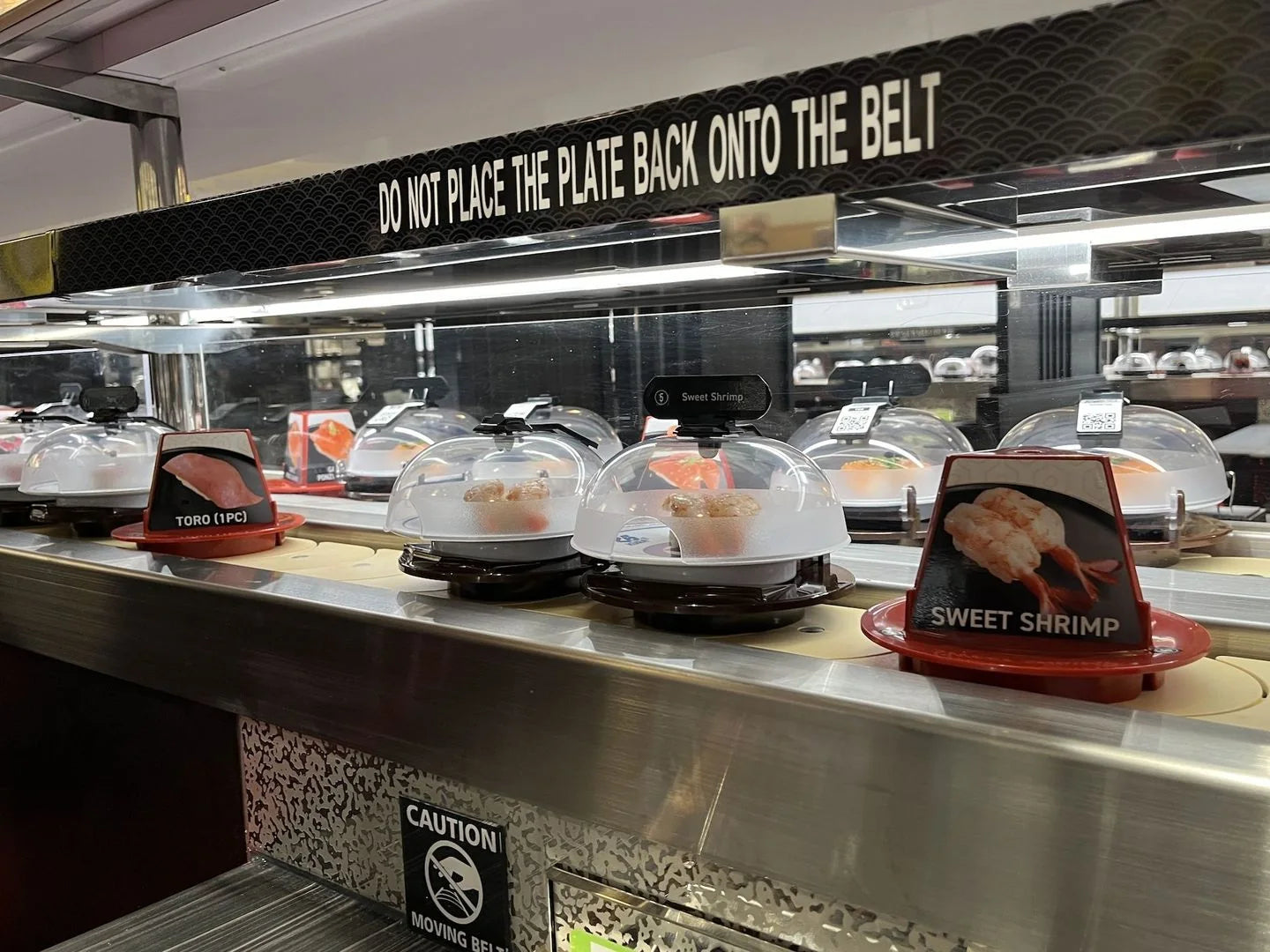
Restaurant Concept
The purchasing brief for a kaiten restaurant starts with the meal: what guests can select or order, how the kitchen completes those portions, and how an occupied dining room receives and clears them. Specify food and clean-stock replenishment with that service, before fixing the installation.
A limited circulating assortment with requested specials creates a different production obligation from an entirely ordered menu. A bowl-and-drink offer changes staff routes and dishroom work even when most sushi travels mechanically. A booth can accommodate the equipment yet leave no useful landing for the next dish once the party is eating.
Plan the restaurant around those relationships. This guide connects the guest offer to menu construction, demand, dining-room design, production, staffing, reusable stock and purchasing. For the mechanisms, configurations and technical interfaces of the transport itself, use Conveyor Belt Sushi & Automated Service Equipment.
In this guide 10 sections
01 / Sushi Restaurant Concepts
1. Choose how guests select and receive food
First decide what the guest is choosing from. Finished portions passing the seat provide immediate physical selection. An order menu creates a promise to prepare or release a specified dish and deliver it. A combined offer must support both without leaving the guest uncertain about what is available or how to obtain it.
Then assign the food's route. Physical selection, requested delivery and staff service can coexist, with different routes for different menu families. The restaurant does not need to automate every dish merely because a conveyor defines its principal experience.
Scroll to read all columns
| Guest offer | Operating obligation | Principal planning consequence |
|---|---|---|
| Physical selection with supplementary service | Maintain the intended passing assortment and serve items outside it | Budget finished food, replenishment, removal and the supplementary staff route |
| Order-led service | Make availability clear and fulfill accepted items at their destinations | Organize finishing, dispatch, receipt and assistance around the requested menu |
| Combined selection and ordering | Support visible choice while completing specific requests | Decide how production and service respond when replenishment and accepted orders compete |
Sushiro's Digiro lets guests order from moving sushi images, with table-specific food delivery.
The experience should be deliberate. A restaurant selling abundant passing choice cannot quietly become an order-only operation during slow service and assume it is offering the same meal. Conversely, an ordered concept should make selection engaging without creating unnecessary finished stock merely to imitate a circulating display.
Specify the absent-item response from the outset. A core dish missing from the lane may be requestable, temporarily unavailable or outside the current offer. Make the distinction visible and give staff a consistent response. Repeatedly asking guests to wait for something that may never pass is an unresolved service promise.
03 / Sushi Restaurant Concepts
3. Resolve food controls and approvals before fixing the layout
Present the proposed menu, preparation and service sequence for review while the arrangement can still change. The rice process, ingredient handling, finished-food waiting, guest selection and returned ware all have consequences for space, equipment and assigned work.
FDA's Food Code is a model; establish the requirements and approvals applicable to the restaurant's jurisdiction and actual process.
For the worked menu, resolve the rice cooking, seasoning, handling and holding method together with the prepared toppings and their storage. Then follow the finished portions through assembly, dispatch, selection or delivery, and removal. The noodle recipe brings its own preparation and hot-service requirements. These decisions should produce usable working positions, appropriate equipment and clear monitoring responsibilities, rather than a lane drawing with food controls added afterward.
Keep the food's controlling information through dispatch
A finished portion may wait before it reaches the selectable route. Where the applicable process starts a deadline earlier, loading it onto a conveyor does not grant a new period. Identify the food and its controlling event first, then specify how the restaurant will preserve that information and act on it through service.
Destination matters as well. A portion committed to an accepted order should not disappear into general selection while the order remains outstanding. An older display portion is not automatically a substitute for a newly requested dish. Its condition, the agreed food process and the guest promise must remain satisfied.
Give wrong or unwanted dishes an assigned exception route. Do not build the operation around returning guest-handled food to general selection. The responsible worker needs a clear disposition procedure and a place to carry it out.
Give staff room to perform the control
Food protection, identification, observation and removal have to work while the seats are occupied. Preserve access on the preparation/service side so a worker can investigate or remove a portion without reaching across diners. A working position that is intermittently needed is still working space, not spare storage.
The same discipline applies to returned ware. Dirty receiving must feed the selected cleaning and sanitizing process, with a separate route back to clean availability. A protected serving device or a return opening does not specify that entire process.
Resolve the detailed requirements through the responsible authority and qualified project review, supported by Equipment Specifications, Food-Safety Controls & Commercial Requirements. Fix the food process and the means of operating it before committing the room to permanent fabrication.
04 / Sushi Restaurant Concepts
4. Plan the assortment for quiet periods as well as peaks
A circulating offer commits ingredients, finishing work and serving articles before a particular guest selects the portion. An accepted order commits the restaurant to a specific fulfillment. Prepared inputs support both, but are a different stage of commitment from finished food placed in service.
That distinction should govern replenishment. Filling every available position can produce the appearance of abundance without establishing demand for the food being finished.
Quiet service must support the advertised choice
Decide which dishes need to be physically available to deliver the intended experience, and which absent dishes guests can request. Keep the visible assortment deliberate. Replenish it in response to the service promise and the demand being observed, with an accountable person deciding what is and is not remade.
If sparse demand cannot sustain the intended selection, change the assortment, service periods or order alternative before buying more transport capacity. A longer route does not create customers for prepared portions. Reducing the physical offer may be the right decision, but communicate it as a considered service choice.
In its December 2022 account, Kura Japan describes combining meal-stage consumption estimates with recorded selections to guide supply.
For an independent project, the useful operating record is the restaurant's own: what was prepared for selection, what was selected, what remained legitimately available, and what was removed unsold. Record unavailable requests as well. Completed sales alone cannot show a desired dish that guests could not obtain.
Arrival waves create competing work
Newly seated parties may select available food and place requests together. The kitchen then has two calls on its finishing position: restoring the passing offer and completing accepted orders. Establish how that competition is handled and how a delay reaches the guest. Do not leave the allocation to whichever demand is most visible to the person finishing sushi.
Menu mix changes the work. A wave of core nigiri requires a different combination of jobs from the same sales count containing hand rolls and bowls. Keep those obligations visible instead of smoothing them into an average plate number. The detailed demand and capacity treatment belongs in Sushi Production Workflow, Capacity & Equipment Sizing.
Physical availability also has a location. Where portions can be selected before reaching later seats, loading the desired dish does not establish that every diner had a chance to take it. The request alternative and staff awareness must work at those seats, rather than relying solely on increased loading.
Control the end of service and the meaning of loss
Stopping new orders, reducing the passing assortment, completing accepted requests and closing preparation are separate actions. Keep them coordinated. A reduced display should not silently imply that all requested core dishes are unavailable; an order menu should not continue accepting a dish after its production function has closed.
FOOD & LIFE says domestic Sushiro stopped product circulation in 2023 and eliminated the associated circulation loss. That is not a zero-waste claim.
Use similarly precise boundaries in the restaurant's own comparison. Removed display portions, ingredient/preparation losses, failed fulfillment and guest leftovers describe different problems. A change that reduces one category is useful, but its value must be assessed alongside the meal actually offered and the work needed to serve it.
05 / Sushi Restaurant Concepts
5. Design the dining room around the occupied seat
Clear receiving point
Assistance & clearing
At a vacant counter, an ordering screen and receiving position can appear generous. Test the same position with a meal in use: two sushi plates, a noodle bowl, a beverage and the selected utensils and condiments. A premium plate is about to arrive.
The incoming plate needs a stable landing. The guest should not have to balance it on used ware, move a hot bowl through a companion's space or block the receipt point to make room. A drink placed in the transfer path and a screen occupying the only free landing create conflicts that are easy to miss on an empty-seat drawing.
Distinguish the dining surface, receipt and selective clearing. They can be adjacent, but they must remain usable together. In the worked restaurant, staff clear the plates; there is no assumed return slot to make accumulation disappear.
Booths change the handoff
In the illustrative four-person booth, the guest nearest the receiving position and the guests further inside do not have the same relationship to an arriving dish or ordering interface. Reaching the booth is only part of the delivery. If each receipt requires one diner to interrupt their meal and pass food around other dishes, decide whether that interaction fits the intended service.
Preserve a workable aisle-side staff approach for bowls, assistance and clearing. Do not use the receiver as a temporary dirty stack and then expect it to serve as the next food landing. Clearing selected used articles can restore usable space, but only when a worker can reach the position and is assigned to do so.
Hacin's Wasabi project account describes counter and booth seating along the conveyor with views to the chefs and open kitchen.
The proposed restaurant still needs its own occupied-position test. Use the intended articles, neighboring diners and ordering arrangement in a full-scale mock-up before treating the furniture geometry as settled. A photograph of another restaurant cannot supply the required measurements.
Preserve the complete guest and staff interaction
Review the route into the restaurant, the selected dining position, ordering, receipt, assistance and leaving. An essential interaction should not depend on the customer bringing a companion or personal smartphone. Where an assisted service alternative is part of the offer, assign it to staff; applicable accessibility requirements still need their own resolution.
Behind the guest-facing finish, preserve the equipment's required cleaning and service access. Coordinate enclosures, furniture and fixed joinery before fabrication. An access position should not become permanent storage simply because it is unused between interventions.
For the detailed counter and workstation treatment, use Sushi Bar Design, Counters & Chef Workstations. The concept decision here is whether the occupied restaurant can receive, serve and clear the meal it sells.
Explore the ERS collection
Sushi Robots & Sushi Machines
Compare the assortment for this part of your service.
-
 Image unavailable
Autec Maki Sushi Maker Rice Sheeter ASM895A
View details & options : Autec Maki Sushi Maker Rice Sheeter ASM895A
Image unavailable
Autec Maki Sushi Maker Rice Sheeter ASM895A
View details & options : Autec Maki Sushi Maker Rice Sheeter ASM895A
-
 Image unavailable
AUTEC Maki Sushi Maker Rice Sheeter & Wrapper ASM890A
View details & options : AUTEC Maki Sushi Maker Rice Sheeter & Wrapper ASM890A
Image unavailable
AUTEC Maki Sushi Maker Rice Sheeter & Wrapper ASM890A
View details & options : AUTEC Maki Sushi Maker Rice Sheeter & Wrapper ASM890A
-
 Image unavailable
AUTEC Maki Sushi Roll Wrapper ASA190A
View details & options : AUTEC Maki Sushi Roll Wrapper ASA190A
Image unavailable
AUTEC Maki Sushi Roll Wrapper ASA190A
View details & options : AUTEC Maki Sushi Roll Wrapper ASA190A
-
 Image unavailable
AUTEC Automatic Maki Sushi Roll Cutter ASM260A
View details & options : AUTEC Automatic Maki Sushi Roll Cutter ASM260A
Image unavailable
AUTEC Automatic Maki Sushi Roll Cutter ASM260A
View details & options : AUTEC Automatic Maki Sushi Roll Cutter ASM260A
-
 Image unavailable
AUTEC Nigiri Sushi Maker Rice Ball Shaper ASM440A
View details & options : AUTEC Nigiri Sushi Maker Rice Ball Shaper ASM440A
Image unavailable
AUTEC Nigiri Sushi Maker Rice Ball Shaper ASM440A
View details & options : AUTEC Nigiri Sushi Maker Rice Ball Shaper ASM440A
-
 Image unavailable
AUTEC Onigiri & Musubi Rice Ball Maker ASM575A
View details & options : AUTEC Onigiri & Musubi Rice Ball Maker ASM575A
Image unavailable
AUTEC Onigiri & Musubi Rice Ball Maker ASM575A
View details & options : AUTEC Onigiri & Musubi Rice Ball Maker ASM575A
-
 Image unavailable
AUTEC Shari Sushi Rice Mixer ASM730A
View details & options : AUTEC Shari Sushi Rice Mixer ASM730A
Image unavailable
AUTEC Shari Sushi Rice Mixer ASM730A
View details & options : AUTEC Shari Sushi Rice Mixer ASM730A
-
 Image unavailable
AUTEC Shari Sushi Rice Mixer ASM780A
View details & options : AUTEC Shari Sushi Rice Mixer ASM780A
Image unavailable
AUTEC Shari Sushi Rice Mixer ASM780A
View details & options : AUTEC Shari Sushi Rice Mixer ASM780A


07 / Sushi Restaurant Concepts
7. Assign the work that still needs people
Assign the functions created by the menu and service: prepared-input readiness, finishing, dispatch, assistance, staff delivery, clearing, washing, availability and settlement. Some can share a person during appropriate periods. Their overlap determines whether that combination actually works.
Kura's Pacific Rim server listing includes bussing and work alongside its service robot.
Consider the worked restaurant during a service collision. The dining-room worker is handling an ingredient inquiry; a bowl for another party is ready; and a third booth needs used ware removed before its next plate arrives. Calling all three tasks “service” does not supply concurrent coverage. Provide relief, deliberately sequence the work with an acceptable delay, reduce the open service area or narrow the offer.
Apply the same test behind the counter. A finisher carrying bowls is away from finishing. A worker clearing a distant booth is not simultaneously releasing clean articles to their stations. Cross-training helps only when the schedule and physical arrangement account for those absences.
Ingredient and allergy inquiries need a trained responsible person and access to the actual preparation information. A menu screen or filter is not an allergen-free assurance. Assistance is part of the restaurant's offer and must remain available when the ordinary transaction is automated.
Preserve the order and the charge through exceptions
Physically selected portions and requested dishes need one coherent account for each party. Include premium distinctions, missing items, remakes and cancellations. Staff clearing should preserve whatever evidence the selected accounting arrangement still needs. A requested plate recorded as an order must not be charged again through a physical-selection count.
The operating responsibility is to explain and correct the charge. The software and delivery providers must establish the technical integration that supports it.
Recovery needs people, access and usable stock
If requested delivery stops, identify accepted dishes that have not reached guests before accepting more work into the failed route. The worked restaurant has a staff pickup and aisle-side approach, making staff delivery a possible alternative. It still requires available workers, identifiable destinations and continued compliance with the agreed food process. Reduce the affected offer when those conditions cannot be maintained.
Apply the same discipline to an ordering interruption: distinguish outstanding requests from new ones, record the accepted items and reconcile their charges. Simply asking guests to repeat everything can create duplicate work and billing.
A washing or clean-stock interruption has a different limit. Spare articles may bridge a bounded disruption; they do not restore a failed process. Continue only the service that can be supported with suitable usable articles and the required controls. Keep equipment troubleshooting within the supplier's procedures and the restaurant's maintenance and service arrangements.
Closing work belongs in the labor plan. Outstanding orders, finished food, dirty ware and clean readiness for the next opening remain obligations after the dining room becomes quiet.
08 / Sushi Restaurant Concepts
8. Specify the complete tableware and washing cycle
The worked demand uses 44 principal guest articles, with several different destinations after washing. Specify each family through that complete cycle.
Scroll to read all columns
| Article family in the worked demand | Staff clearing and dirty receiving | Clean endpoint |
|---|---|---|
| 30 flat sushi plates | Preserve any required settlement evidence; sort for the selected processing arrangement | Clean plate staging at sushi finishing/dispatch |
| 5 single hand-roll articles | Handle according to the selected article and wash process | Hand-roll assembly/pickup supply |
| 4 noodle bowls | Receive bowls with residue and associated utensils through the dishroom procedure | Bowl supply at hot-food finishing/pickup |
| 5 beverage vessels | Use the vessel's appropriate sorting and racking arrangement | Clean vessel supply at beverage preparation |
Dirty receiving, sorting, the specified cleaning and sanitizing process, clean staging and distribution all belong in the purchase. Completing a wash cycle without returning bowls to hot-food finishing can still leave that menu function unable to serve. Utensils, condiment ware and any covers or carriers need their own handling and replenishment, including equipment articles that never reach the guest.
Cambro pairs its 16-ounce LDT16 Lido tumbler with full-size Camrack 25S534. That pairing does not establish fit with an unspecified dishmachine. Manufacturer specification.
Specify those interfaces before committing to a vessel family. The guest presentation, handling, racking, washing and storage must remain workable together. A visually similar replacement may change more than appearance.
Stock is required beyond the articles in use
The 44-article use count does not determine opening stock. At a given time, articles may be with guests, awaiting clearing, at dirty receiving, in processing, awaiting readiness, staged clean or returning to the station. Damaged or questionable articles are unavailable stock and need segregation and replacement.
Size the relevant families for the intended overlap and replenishment arrangement. A total that appears adequate can still leave a station short of the particular clean article it needs. Use the detailed cycle-based approach in the service-equipment reference rather than a generic plate-to-seat multiplier.
A dedicated plate return leaves a mixed-ware job
Keep the staff-cleared baseline separate from the return option. Suppose a proposed and verified alternative accepts all 30 flat plates in the worked demand but excludes the other principal articles. Fourteen principal articles still require the mixed-ware route: five hand-roll articles, four bowls and five beverage vessels. Utensils and support pieces remain additional.
That is an article count, not the share of labor eliminated. Bowl clearing, residue handling, sorting, return exceptions and clean replenishment are different jobs. Moving a plate back to dirty receiving does not complete its preparation for the next use.
A dedicated return deserves evaluation when flat-plate accumulation and clearing constrain the meal. If the constraint is mixed-ware receiving or restoring clean bowls, it may leave the principal problem untouched.
Use the Sushi & Omakase Tableware Guide and ordinary sushi-plate assortment for supporting-ware selection. Proprietary conveyor, identified or return-system articles require the selected system's verified specification; the ordinary category label establishes none of those compatibilities. Preserve that specification through replacements and continuing supply.

6 × 6-inch stackable porcelain plate.
For supporting-ware selection. The ordinary category label does not establish conveyor, identification or return-system compatibility.
View BK-0812 at ERSExplore the ERS collection
Sushi Plates
Compare the assortment for this part of your service.
-
 Image unavailable
Melamine Rectangular Platter 13", Shiny White
View details & options : Melamine Rectangular Platter 13", Shiny White
Image unavailable
Melamine Rectangular Platter 13", Shiny White
View details & options : Melamine Rectangular Platter 13", Shiny White
-
 Image unavailable
8-1/2"x5-3/4" Rectangular Plate, White Ceramic
View details & options : 8-1/2"x5-3/4" Rectangular Plate, White Ceramic
Image unavailable
8-1/2"x5-3/4" Rectangular Plate, White Ceramic
View details & options : 8-1/2"x5-3/4" Rectangular Plate, White Ceramic
-
 Image unavailable
Melamine Rectangular Plate 13"x5", Ecus
View details & options : Melamine Rectangular Plate 13"x5", Ecus
Image unavailable
Melamine Rectangular Plate 13"x5", Ecus
View details & options : Melamine Rectangular Plate 13"x5", Ecus
-
 Image unavailable
Melamine Rectangular Plate 10"x4", Bamboo
View details & options : Melamine Rectangular Plate 10"x4", Bamboo
Image unavailable
Melamine Rectangular Plate 10"x4", Bamboo
View details & options : Melamine Rectangular Plate 10"x4", Bamboo
-
 Image unavailable
Melamine Rectangular Plate 7-7/8"x 5-1/2", Matte Black
View details & options : Melamine Rectangular Plate 7-7/8"x 5-1/2", Matte Black
Image unavailable
Melamine Rectangular Plate 7-7/8"x 5-1/2", Matte Black
View details & options : Melamine Rectangular Plate 7-7/8"x 5-1/2", Matte Black
-
 Image unavailable
8.25"X5.5" Rectangular Plate, White Ceramic
View details & options : 8.25"X5.5" Rectangular Plate, White Ceramic
Image unavailable
8.25"X5.5" Rectangular Plate, White Ceramic
View details & options : 8.25"X5.5" Rectangular Plate, White Ceramic
-
 Image unavailable
Melamine Rectangular Slate Platter 12-3/16, Soil Porcelain
View details & options : Melamine Rectangular Slate Platter 12-3/16, Soil Porcelain
Image unavailable
Melamine Rectangular Slate Platter 12-3/16, Soil Porcelain
View details & options : Melamine Rectangular Slate Platter 12-3/16, Soil Porcelain
-
 Image unavailable
10-1/2"x4" Rectangular Dish, White Ceramic
View details & options : 10-1/2"x4" Rectangular Dish, White Ceramic
Image unavailable
10-1/2"x4" Rectangular Dish, White Ceramic
View details & options : 10-1/2"x4" Rectangular Dish, White Ceramic


09 / Sushi Restaurant Concepts
9. Cost the whole restaurant and test the operating case
Price the selected service installation together with production, the hot-food and beverage functions, room and utility work, ordering/settlement, warewashing, opening articles and training. Then identify continuing paid work, replacement supplies, maintenance and any required support or software charges.
Compare explicit inclusions, options and project allowances. Equipment quoted without its required connections, usable work position or completion responsibilities is a different scope from equipment ready to support the agreed service.
Craftworks' Atlanta Kura account records booth storage and conveyor enclosures; Rycon's wider project account includes kitchen fit-out, ventilation and, at one location, structural work.
Compare the changes that actually matter
Scroll to read all columns
| Choice | What changes | What the operating case must retain |
|---|---|---|
| Limited combined offer | Finished choice remains available alongside requests | Quiet-period assortment, replenishment/removal, accepted-order fulfillment and the complete staff/ware cycle |
| Order-led version of the same menu | Core food is committed to accepted orders rather than general selection; the selection experience changes | Prepared inputs, finishing, dispatch, staff-served dishes, assistance and washing |
| Dedicated return added to the baseline | A verified subset of used articles takes a different route | Mixed-ware work, downstream processing, clean replenishment and continuing system-specific supply |
Evaluate production automation separately. Buy a forming or cutting operation because it addresses a demonstrated constraint in finished portions, not because an automated dining room appears to require an automated kitchen. Where final topping or dispatch is limiting service, improved finishing space, plate staging or work allocation may be the more useful purchase.
The order-led variant can deliver the same menu while offering a different selection experience. A return addition can preserve the meal while changing the guest's handling of used ware. Describe those changes honestly instead of comparing unlike offers as though they were identical output.
Value the actual use of released work
A successful change may reduce paid hours, avoid adding hours as demand grows, improve assistance during the existing shift or support more fulfilled purchases. Establish which outcome the proposed restaurant can realize.
If the employee is still needed for bowls, hand rolls, drinks, inquiries and clearing, reduced plate carrying may improve service without removing a paid position. That can be valuable. It cannot simultaneously be counted as a full payroll saving and free additional service capacity from the same released time.
Book a wage saving only against a supported change in the paid schedule. A sales case needs demand, the remaining production/service capacity and the contribution after relevant additional costs. A machine's maximum output supplies none of those commercial inputs.
Test quiet periods as seriously as peaks. A favorable maximum-load demonstration does not establish the cost of maintaining the intended visible choice throughout a long sparse period. Likewise, a lower-cost variant that removes part of the menu or service is a changed offer, not automatically the same restaurant made more efficient.
Use equipment costing and supplier evaluation to develop the actual project comparison. Proceed when the service promise, complete priced scope and paid work agree. Revise the assortment, open service area, menu allocation or staffing where the conflict is resolvable. Decline or materially redesign an arrangement that cannot receive the meal, complete it or restore the required clean supply within the site's constraints.
10 / Sushi Restaurant Concepts
10. Turn the concept into a coordinated purchasing brief
Bring suppliers and project reviewers one description of the restaurant. The brief should connect the decisions already made, so that each quotation addresses the same operating result.
Scroll to read all columns
| Brief component | Information to carry into the purchase |
|---|---|
| Service and menu | Selection/request promises, portion construction, price distinctions and dish-by-dish routes |
| Service day | Intended periods, demand mix, replenishment priorities and availability changes |
| Occupied room | Guest receipt, meal footprint, assistance/clearing routes and required equipment access |
| Food process | Preparation and service methods, applicable review outcomes, monitoring and responsible work |
| Production and people | Prepared-input supply, retained finishing, dispatch, staff-delivered work and concurrent responsibilities |
| Articles and washing | Exact selected ware, system interfaces, dirty receiving, processing, clean endpoints and stock/replacement basis |
| Completion and continuity | Installation boundaries, training, demonstrations, support obligations and a workable reduced-service response |
The operator defines the meal and service. The project designer coordinates the room and required building work. Equipment providers define the supplied configuration and its operating boundary. Ware and washing providers verify their interfaces; ordering and POS providers resolve the transaction; management assigns the people who make the arrangement work. Name the responsible party where those scopes meet.
Demonstrate the restaurant with its intended recipes, articles and occupied positions. Include quiet-period choice with an absent core dish, a mixed set of fulfilled demand and a relevant interruption. Establish correct receipt, the intended meal sequence, a reconciled charge and clean stock returned to use under the project's stated criteria. Machine-specific tests remain essential, but an isolated equipment demonstration is not the completed meal.
Use the Complete Sushi Restaurant Equipment & Supplies Checklist to assemble the wider purchase. For an ERS product inquiry, bring the service offer, menu/portion schedule, plan, article requirements and unresolved equipment interfaces.
Commit to the coordinated restaurant and the work required to operate it before optimizing an isolated machine specification.