

Equipment & Specialty Supplies
Manual Sushi Preparation Tools & Specialty Utensils
A makisu's binding, a press's release path and a garnish cutter's feed mechanism can matter more than the material or nominal size on the order. Two tools that look interchangeable in a catalog may put a different working face against the food, require a different hand action or accept entirely different replacement parts.
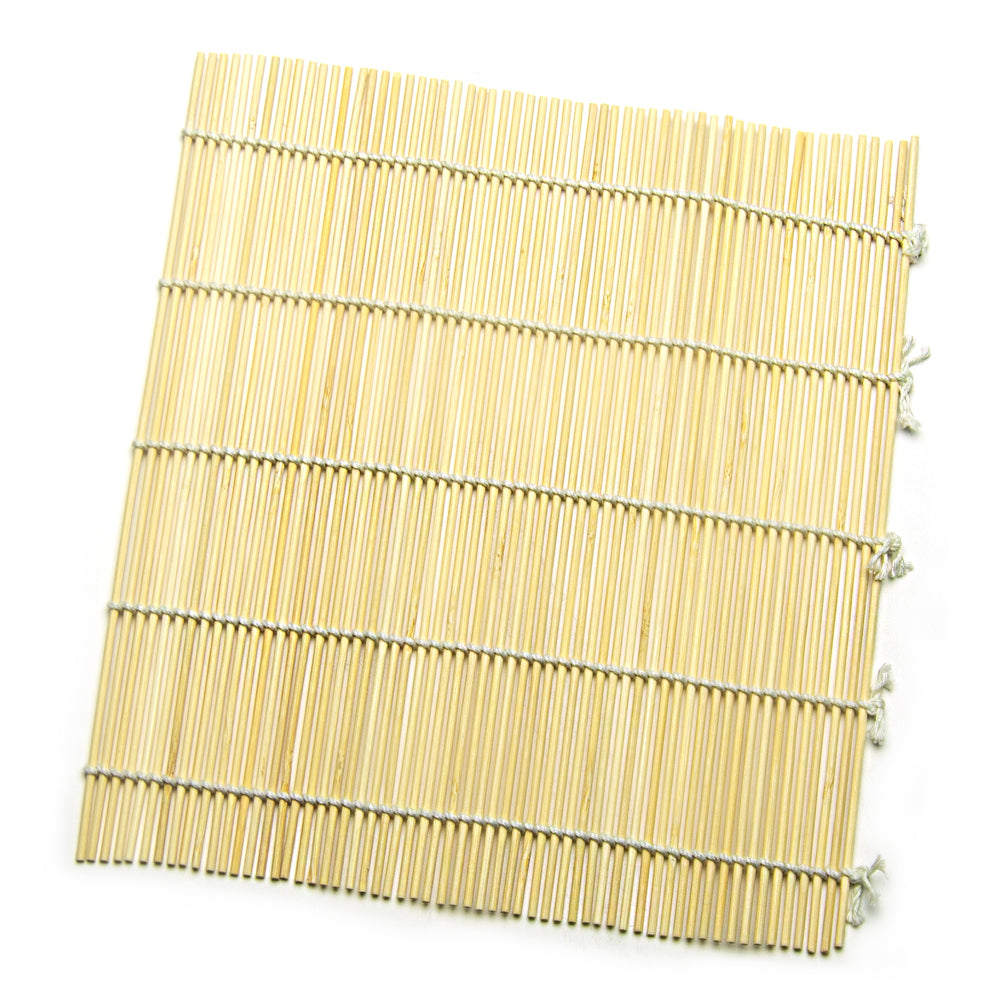
Specify those differences deliberately. The right manual assortment gives the chef the intended contact, shape and control, with complete assemblies that the kitchen can maintain through service. That applies equally to a bamboo mat, a lever-operated press, a wasabi grater and the brush that finishes a single piece of nigiri.
In this guide8 sections
01 / Manual preparation
Makisu: Rolling Mats & Flexible Shaping
Read the members and the binding
A bamboo makisu works through successive contact surfaces that articulate around the roll. Member width and profile shape that contact; the binding determines how the members move together and where knots or loose ends sit. Inspect both before treating two similarly sized mats as substitutes.
The two working dimensions have different jobs. The span along the members supports the length of the roll; the dimension across successive members supplies the flexible length that wraps around it. For a rectangular mat, identify which quoted dimension belongs to each axis before ordering.
On the conventional skin-on mat described by Kikkoman, the smooth green face meets the food, the bamboo members run across the working surface and the binding runs in the rolling direction. Loose thread ends face away from the operator. A skinless white mat requires examination of its actual working face rather than orientation by color.
Binding can distinguish professional choices independently of slat thickness. Shindoh's upper-grade makisu uses bamboo and cotton thread, with the binding folded back at one end so that knots remain at the other. Its 24 × 27 cm example is associated with delicate work, including thin rolls. The useful detail is the clean working end and the thread path that creates it.
The familiar association of finer members with thinner rolls is a starting point, not a purchasing standard. Takemi's narrow-member white mat, for example, is offered for both thin and thick rolls. Buy the working span, contact profile and articulation the operator needs. For a nominal 24 cm-square bamboo format, see the ERS 27-0015 makisu.
Rice-out work changes the release surface
Decide what will touch the mat: nori, exposed rice or a temporary release layer. Kikkoman's uramaki method places film or wax paper over bamboo. That layer becomes the immediate rice-contact surface and adds its own handling to the rolling action.
Hasegawa takes a different approach with embossed members and monofilament binding. The FMK-MG medium green mat from ERS is 250 × 240 mm, and Hasegawa describes its design for film-free rice-out rolling. Evaluate it in that intended contact arrangement, including how the exposed rice releases and how the operator controls the roll. Hasegawa specification.

The filament is an important part of the purchase. Hasegawa's FMK instructions specify a soft sponge and prohibit brush cleaning, knife contact, striking the mat against a surface and excessive rolling force. A mat with heat-tolerant members still needs its binding protected.
Other resin mats have their own surface and care package. Akebono's Sushiland mat is embossed polypropylene, 255 × 260 mm overall, with explicit dishwasher/dryer permission. Compare the selected tool's release and permitted maintenance together; “plastic makisu” is too broad a specification.
Oni-sudare is a shaping surface
The pronounced ridges of an oni-sudare serve a different purpose. One documented example uses triangular bamboo members with retained skin and cord running through holes, leaving the interior forming face clear of the binding. That geometry produces the wave pattern associated with datemaki. Specify it when that shaped surface is wanted.
Care follows the construction. The instructions for that example exclude soaking and dishwashing and call for prompt washing, moisture removal and ventilated drying away from direct sun. Between ordinary makisu members, remove trapped residue and inspect the binding and bamboo before returning the tool to work. Splintered members, loose parts and a failing binding change the food-contact surface and the mat's action; they are replacement concerns.
Choose enough serviceable mats to cover concurrent work and the selected cleaning and drying cycle. The useful quantity comes from the station, not a fixed number per chef.
Explore the ERS collection
Sushi Mats
Compare the assortment for this part of your service.
-
 Image unavailable
Sushi Mat 24 x 24cm (34-11)
View details & options : Sushi Mat 24 x 24cm (34-11)
Image unavailable
Sushi Mat 24 x 24cm (34-11)
View details & options : Sushi Mat 24 x 24cm (34-11)
-
 Image unavailable
Sushi Mat W/O Skin 24X21cm
View details & options : Sushi Mat W/O Skin 24X21cm
Image unavailable
Sushi Mat W/O Skin 24X21cm
View details & options : Sushi Mat W/O Skin 24X21cm
-
 Image unavailable
Sushimat 24X24 W/O Skin= 914025 = Sn-3
View details & options : Sushimat 24X24 W/O Skin= 914025 = Sn-3
Image unavailable
Sushimat 24X24 W/O Skin= 914025 = Sn-3
View details & options : Sushimat 24X24 W/O Skin= 914025 = Sn-3
-
 Image unavailable
Sushi Roll Mat Plastic 10"X9.5"
View details & options : Sushi Roll Mat Plastic 10"X9.5"
Image unavailable
Sushi Roll Mat Plastic 10"X9.5"
View details & options : Sushi Roll Mat Plastic 10"X9.5"
-
 Image unavailable
Bamboo Sushi Mat 270X135Mm (Bsd-04)
View details & options : Bamboo Sushi Mat 270X135Mm (Bsd-04)
Image unavailable
Bamboo Sushi Mat 270X135Mm (Bsd-04)
View details & options : Bamboo Sushi Mat 270X135Mm (Bsd-04)
-
 Image unavailable
Bamboo Sushi Mat 27X27cm
View details & options : Bamboo Sushi Mat 27X27cm
Image unavailable
Bamboo Sushi Mat 27X27cm
View details & options : Bamboo Sushi Mat 27X27cm
-
 Image unavailable
Sushi Mat W/O Skin 24X24cm
View details & options : Sushi Mat W/O Skin 24X24cm
Image unavailable
Sushi Mat W/O Skin 24X24cm
View details & options : Sushi Mat W/O Skin 24X24cm
-
 Image unavailable
Sushi Mat W/O Skin 24X24cm
View details & options : Sushi Mat W/O Skin 24X24cm
Image unavailable
Sushi Mat W/O Skin 24X24cm
View details & options : Sushi Mat W/O Skin 24X24cm


02 / Manual preparation
Oshizushi Presses, Molds & Manual Forming
Specify the forming space and the release path
A box press is a matched assembly. The frame contains the sides, the lower form supports the food and establishes its underside, and the upper form supplies the opposing shape under compression. Their fit and their separation determine whether the finished product can be released under control.
Sumibe's battera catalog describes the upper form, frame and lower form as individually machined integral components. Each component is one piece; the working press remains separable. The distinction matters when inspecting joints, identifying a damaged part or ordering a complete set.
Interior and exterior dimensions answer different questions. Yamaco's medium unguided hinoki-and-spruce press has a 15 × 7.5 × 4.5 cm interior inside an 18 × 10.5 × 7 cm exterior. The first describes forming space; the second describes the object the station must accommodate. Its uncoated finish and absence of cutting guides are further specifications, not details supplied by the words “wooden sushi press.”
Follow the food through release. In Yamasa's pressed-sushi example, the side wall lifts away from the formed product. The supporting component stays with the food while the surrounding restraint moves. Other forms release differently. Establish that sequence before deciding how much surrounding space the tool needs or what can be prepared directly on its base.

Scroll diagram horizontally on smaller screens.
Battera, hako and contoured forms
Catalog names preserve useful distinctions, but they do not replace dimensions. Sumibe's Kanto and Kansai battera examples are 145 and 139 mm long internally, respectively, at the same stated 54 mm width. Its range also includes curved and flat guided forms, a boat-shaped saba form, and bar and trapezoidal forms. The lower and upper contours deserve the same attention as length and width. Where the catalog distinguishes frame height from a parenthesized finished height, retain those labels in the specification. Sumibe forming range.
A hako form can be substantially wider. Towa's FS-03 hako has a 157 × 79 × 50 mm interior; its FS-05 ichihako has a 79 × 79 × 50 mm interior. Those dimensions identify two particular polyethylene forms. The family name alone establishes neither the working rectangle nor compatibility with another manufacturer's base or upper form. Towa Polyate catalog.
For a contoured preparation, buy the whole matched contour. A flat replacement lid of approximately the right length does not reproduce the action of a shaped upper form. The order should identify the frame, base and upper component together, including any parts supplied separately.
Guided bars and slabs
Division count becomes meaningful only after the food shape and cutting arrangement are clear. Yamaco's ten-cut long form has a 32 × 3 × 3.5 cm interior. Its square 36-cut-plus form has a 19.7 × 19.7 × 5 cm interior and a supplied bottom board. The first produces a narrow bar; the second supports a broad slab and a different cutting pattern. Yamaco forming-tool leaflet.
The guide is a mechanical interface with the knife. The intended blade must pass freely through it and reach the intended support. Check the complete arrangement: slot clearance, frame height, cutting pattern, supporting base and the space required to withdraw the knife and remove the food. A higher advertised piece count tells the buyer little about those interfaces.
Guides also deserve inspection as working surfaces. A damaged guide or mismatched base changes support during cutting. Select the press with the knife and board arrangement in view; specialist blade geometry and sharpening are developed in Professional Sushi Knives, Cutting Boards & Sharpening.
Individual pieces, temari and stacked forms
A multi-position mold changes the work from forming one continuous block to filling and releasing discrete pieces. The Sumibe NS10S has ten positions, a maker-stated finished form of 45 × 23 × 20 mm, and a 20 g reference rice weight per piece. Those are three separate specifications. The reference weight is useful setup information; the kitchen still establishes its own loading quantity and finished result with its rice and compression method. Sumibe individual-piece forms. The ERS ten-piece form 0262-1003 explicitly identifies NS10S.
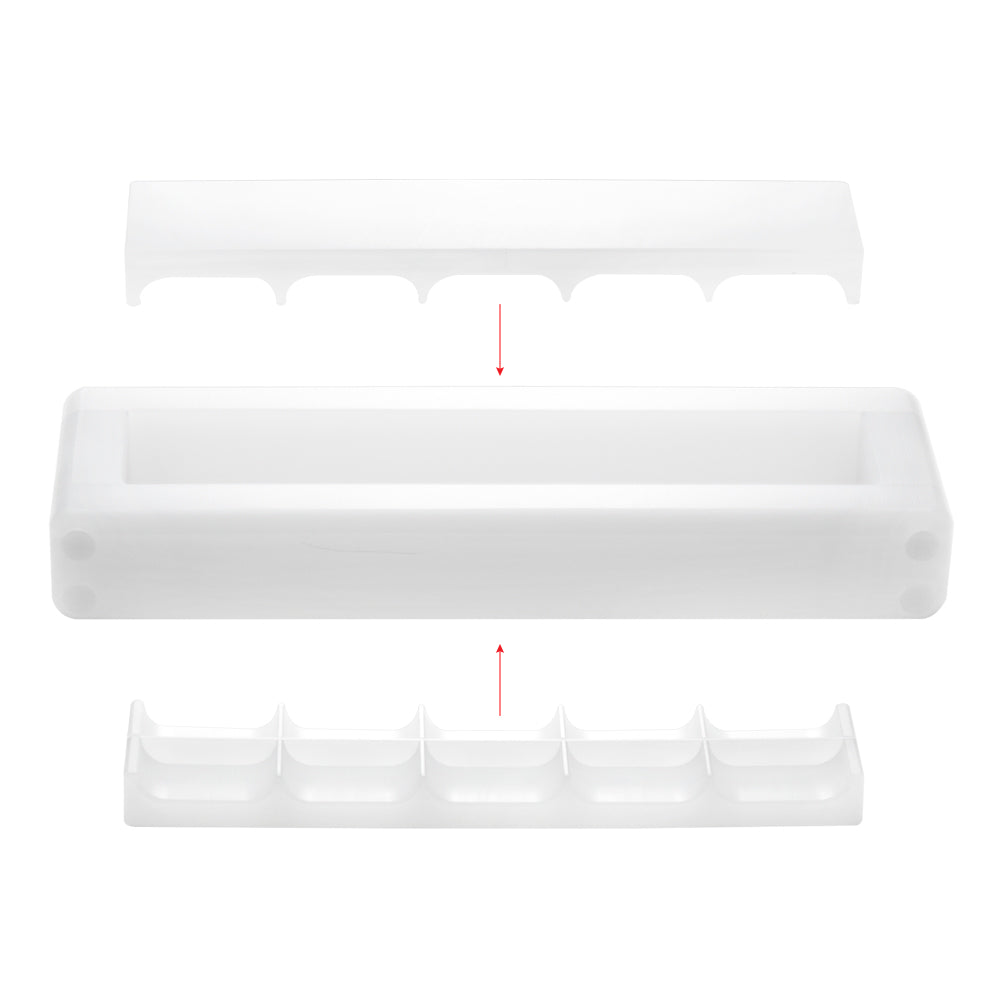
Temari tooling makes orientation and release especially important. Temarikun's three-part method assembles the lower and middle forms with the middle form's chamfered guide facing upward. Topping enters the lower form, followed by rice. Light pressure is distributed across the form, including the center; the upper and middle forms are then removed before the pieces are lifted out. The upward-facing rice surface during forming becomes the finished base. That inversion explains why loading order and the support beneath a soft topping must be understood before the operator applies pressure. The maker specifies rice oil as a release aid for this particular tool.
Stacked assemblies have another purpose. MAFF's Shimane account of kakuzushi and hakozushi distinguishes small individual forms from larger sushi made for cutting. Its Iwami example separates successive rice-and-vegetable layers with thin boards before compression. A commercial tiered construction can be seen in Yamaco's five-tier beihiba set, with a stated 21.2 × 12.4 × 4.7 cm interior per tier. The regional method explains the job of separators; the commercial set must still be selected by its own dimensions and assembly.
| Form | What controls the product | What belongs in the order |
|---|---|---|
| Box or contoured press | Frame boundaries and matched upper/lower contours | Complete base, frame and upper form; interior and finished dimensions as labeled; release method |
| Guided bar or slab | Forming rectangle plus cutting pattern and support | Complete forming set, guide arrangement, blade clearance and supporting base |
| Individual nigiri or temari positions | Discrete forming spaces, filling distribution and release sequence | Position count, matched components, orientation, finished-form information and reference weights |
| Stacked form | Tier dimensions and separation between layers | Complete tiers, separators, base and pressing components required by the selected assembly |
Scroll across the table to compare every field
A manual fixture supplies pressure to a separate form
Suzumo's OSN-HPA places a prepared mold and its upper form beneath a hand-operated plate. The operator lowers and locks the handle. The mold establishes the food-contact geometry; the fixture applies compression. Its 150 × 50 mm pressure plate, 82–132 mm pressing-height range, 250 × 285 mm footprint and 523 mm maximum stated operating height describe different fit requirements. Establish plate engagement, complete-mold compatibility and moving clearance together. Suzumo OSN-HPA brochure.
The rice-sheet robot shown with that fixture is separate equipment. Hand-operated compression belongs in this manual-tool decision; automated rice-sheet and forming equipment belongs in Sushi Robots & Machines.
Pressure and loading remain part of the craft
The mold fixes boundaries. Distribution, compression and topping treatment still belong to the operator. The documented instructions for one medium press explicitly connect rice capacity with pressing force and call attention to filling the edges. Yamaco's eight-cut press example compresses rice before adding delicate toppings, whereas Temarikun loads topping first. Both sequences make sense within their respective forms and release methods.
Evaluate the complete tool with the actual rice, fillings and topping. Look for even filling of the intended space, controlled compression, supported release and an intact topping surface after demolding. Greater force is not a specification for better sushi.
Material and maintenance belong in that evaluation. Yamaco's uncoated wooden forms require their own wash-and-dry routine and exclude dishwashing; its care guidance also excludes prolonged immersion. Sumibe offers a separately identified super-heat mold family for a different maintenance regime. Select the exact family whose geometry and permitted care fit the kitchen. A general plastic mold does not acquire the heat permissions of that specialist range.
Explore the ERS collection
Sushi Molds
Compare the assortment for this part of your service.
-
 Image unavailable
Lacquer Sushi Container Oke 15-3/4"D
View details & options : Lacquer Sushi Container Oke 15-3/4"D
Image unavailable
Lacquer Sushi Container Oke 15-3/4"D
View details & options : Lacquer Sushi Container Oke 15-3/4"D
-
 Image unavailable
Lacquer Sushi Container
View details & options : Lacquer Sushi Container
Image unavailable
Lacquer Sushi Container
View details & options : Lacquer Sushi Container
-
 Image unavailable
Sushi Mold Plastic 20g 10pc
View details & options : Sushi Mold Plastic 20g 10pc
Image unavailable
Sushi Mold Plastic 20g 10pc
View details & options : Sushi Mold Plastic 20g 10pc
-
 Image unavailable
Lacquer Sushi Container Oke 13-3/8"D
View details & options : Lacquer Sushi Container Oke 13-3/8"D
Image unavailable
Lacquer Sushi Container Oke 13-3/8"D
View details & options : Lacquer Sushi Container Oke 13-3/8"D
-
 Image unavailable
Lacquer Chirash Sushi Container w/Lid, 6-1/2"D*3-1/8"H
View details & options : Lacquer Chirash Sushi Container w/Lid, 6-1/2"D*3-1/8"H
Image unavailable
Lacquer Chirash Sushi Container w/Lid, 6-1/2"D*3-1/8"H
View details & options : Lacquer Chirash Sushi Container w/Lid, 6-1/2"D*3-1/8"H
-
 Image unavailable
Plastic Sushi Mold (150285)
View details & options : Plastic Sushi Mold (150285)
Image unavailable
Plastic Sushi Mold (150285)
View details & options : Plastic Sushi Mold (150285)
-
 Image unavailable
Plastic Sushi Mold (150780)
View details & options : Plastic Sushi Mold (150780)
Image unavailable
Plastic Sushi Mold (150780)
View details & options : Plastic Sushi Mold (150780)
-
 Image unavailable
6.25 x 2.25" Plastic Sushi Mold (150889)
View details & options : 6.25 x 2.25" Plastic Sushi Mold (150889)
Image unavailable
6.25 x 2.25" Plastic Sushi Mold (150889)
View details & options : 6.25 x 2.25" Plastic Sushi Mold (150889)


03 / Manual preparation
Fish-Bone Tools, Scalers & Specialist Seafood Utensils
Bone extraction starts at the mating faces
An angled tip can improve approach to an exposed bone, but the working grip occurs where the two faces meet. Inspect that closing contact: alignment, burrs, trapped residue and the opening action matter more than an impressive outline. The tool should engage the bone where the operator can see and control the extraction without gathering unnecessary flesh.
KAI DH8195 is an angled stainless example intended to grasp small bones. The ERS 163400 bone tweezer is a stainless, angled-tip option with a nominal 4¾-inch overall length. Evaluate the delivered pair both open and closed; overall length does not establish the useful mating width. Kanto round-ended and Kansai square-ended naming also appears in Japanese tool catalogs; those names describe forms rather than a fish-species allocation.

Palm-operated tools change the closing action. Hokuto's Honenuki Meijin combines a lever and spring with a broad contacting face. Its written extraction method uses a horizontal pull while the other hand supports the flesh on either side. The purchase question is whether that engagement and hand action suit the retained extraction work.
Cleaning access can distinguish two apparently similar mechanisms. Asahi's Honenuki Tatsujin III has curved stainless working ends with flat contact areas, polypropylene handles and a removable spring. The handles separate for cleaning. That access is a substantive feature: the joint can be exposed, inspected and correctly reassembled. Hokuto reports that fish oil and flesh can lodge and harden at the opening/closing joint, stiffening the action. Compare the selected version's cleaning access and maintenance route alongside its closing action; Asahi's permitted disassembly belongs to its own design.
Scaling: working contact, restricted access and the cover
A scaler's broad working area and its access around fins are separate questions. KAI SELECT100 DH3016 uses an integral stainless body with leading serrations for smaller areas and a removable polypropylene cover. The cover intercepts some released scales; its underside and attachment also become surfaces to clean. The maker permits dishwasher use for the named item.
A cast-head scaler offers another contact. Belmont MC-018 combines a brass head with tapered outer working edges and a beech handle. The shape of the working edge and the head-to-handle joint belong in its selection and care.
Belmont's MP-083 small-fish scaler instead uses a flexible 301H stainless working blade with a polypropylene grip. The maker describes a shaving action in which the blade conforms to the fish. This requires a different controlled contact from working with teeth. Compare the intended fish, access and removal action before deciding which construction belongs at the station.
Specialist tools follow the seafood form bought in
A hamamuki and a meuchi deserve space in an expert assortment when their actual work remains in-house. One documented hamamuki example has a blunt-ended stainless blade and cylindrical wooden handle for its stated large-clam opening role. Honke Kaneso's T-shaped stainless meuchi is specifically an eel-preparation holding tool. Neither is a general plating pick.
Where shellfish work calls for shears, the joint is worth specifying. KAI DH3005 has narrow and broad blade members, fine serrations and permitted separation for washing; the maker identifies the narrow member for crab-leg work. Separation belongs to that design and its instructions.
Build this part of the order from the incoming seafood and the preparation retained. Keep the working faces, spring, cover and handle joints serviceable, with exact-model instructions available. Knife and board selection continues in Professional Sushi Knives, Cutting Boards & Sharpening; the prepared ingredient's readiness and storage continue in Nori Storage, Neta Preparation & Sushi Mise en Place.
Explore the ERS collection
Fish Tools
Compare the assortment for this part of your service.
-
 Image unavailable
Iron Fish Scaler 8-1/4"L (215mm)
View details & options : Iron Fish Scaler 8-1/4"L (215mm)
Image unavailable
Iron Fish Scaler 8-1/4"L (215mm)
View details & options : Iron Fish Scaler 8-1/4"L (215mm)
-
 Image unavailable
Aluminum Die Cast Fish Scaler 8-1/4"
View details & options : Aluminum Die Cast Fish Scaler 8-1/4"
Image unavailable
Aluminum Die Cast Fish Scaler 8-1/4"
View details & options : Aluminum Die Cast Fish Scaler 8-1/4"
-
 Image unavailable
Fish Scaler (0349-081)
View details & options : Fish Scaler (0349-081)
Image unavailable
Fish Scaler (0349-081)
View details & options : Fish Scaler (0349-081)
-
 Image unavailable
Fish Bone Puller SS
View details & options : Fish Bone Puller SS
Image unavailable
Fish Bone Puller SS
View details & options : Fish Bone Puller SS
-
 Image unavailable
Fish Bone Tweezer Stainless Steel 4.75"L Angle Tip
View details & options : Fish Bone Tweezer Stainless Steel 4.75"L Angle Tip
Image unavailable
Fish Bone Tweezer Stainless Steel 4.75"L Angle Tip
View details & options : Fish Bone Tweezer Stainless Steel 4.75"L Angle Tip
-
 Image unavailable
Fish Bone Puller SS
View details & options : Fish Bone Puller SS
Image unavailable
Fish Bone Puller SS
View details & options : Fish Bone Puller SS


04 / Manual preparation
Shamoji, Rice Transfer & Assembly Tools
Select the head in profile as well as plan
A broad mixing paddle, a vessel-access shamoji and a compact assembly tool place different demands on the working head. Width determines how much face can engage the rice; curvature and edge profile determine how that face lifts, carries and releases it. Handle length is useful only in relation to the vessel and the final hand action.
Hasegawa's FSOG-40 is 400 mm overall and 115 mm wide, with a thin, wave-textured head intended for rice-and-vinegar mixing and access around the bowl. It establishes the scale of a dedicated mixing implement. The rice-production process and the vessel itself are developed in Sushi Rice Equipment, Hangiri & Shari Production. Hasegawa FSOG.
For vessel access, Akebono's commercial ohitsu shamoji supplies 160 × 45, 190 × 55 and 220 × 60 mm length/width options, with a handle form intended to reach into the container. Compare those with its compact temaki paddles, marketed for home hand-roll preparation at 160 mm overall and 45 mm wide. The smallest commercial ohitsu tool and the compact temaki tool share headline dimensions. Their head and handle forms still deserve separate examination.
Side view makes the purchase clearer. A broad thin face moves a rice mass; a narrow, lightly cupped head carries it; an accessible leading edge helps control placement and spreading. Marna's design account explicitly links its elongated face and narrow spoon-like head to vessel access and scooping, and its thin edge to the intended handling of the grains. Select the profile for the action instead of treating every paddle of the same length as equivalent.
Understand the release surface
“Nonstick” may describe molded texture, base resin or an applied finish. Those are different constructions. Marna's standard Kiwami uses polypropylene; its Premium version uses polymethylpentene, also called TPX. Both have embossed surfaces. The material change does not turn the Premium into a coated paddle.
Their instructions call for wetting before use and avoiding abrasive scrubbers or polishing powder. The Premium also carries a specific caution about oils/fats and citrus-peel terpenes affecting its material. Preserve that use-and-care information with the selected item. Adding oil or abrading a release texture is a poor substitute for understanding the surface.
Handedness becomes an ordering attribute when the head is deliberately asymmetric. Akebono's CH-2113 left-hand paddle has a large curved head for its intended mixing action; its catalog lists the corresponding right-hand CH-2112. Match that curve to the operator rather than assuming a handed design is universal.
Natural-material utensils require a finish specification. Yamaco's hinoki shamoji is expressly uncoated and excludes dishwasher use. The ERS 00606 bamboo rice spatula, nominally 23 cm/9 inches long, is a bamboo option. Include finish and permitted care in the order alongside the chosen head profile and reach.

For compact assembly, choose the head that reaches the working rice and gives controlled placement at the food. Retain an intact edge and release surface; replace damaged utensils rather than improvising sanding or recoating. The complete hand-roll station, including the relationship between working rice, nori and immediate service, is developed in Hand-Roll & Temaki Restaurants.
05 / Manual preparation
Wasabi Graters & Specialist Grating Tools
Compare the active field and the complete board
The active grating field determines the available stroke. Overall length also includes the handle, backing and attachment space. Kinjirushi's natural-skin KS230P is 235 × 105 mm overall, with a 105 × 105 mm working area. The skin is fastened to a natural-wood support with tacks. Inspect the working patch, its edges and attachments as one assembly. A lifting edge or distorted support changes the surface the operator is using. Kinjirushi KS230P.
The maker's KZ170 Hagane-Zame is 170 × 83 mm overall, with a 79 × 83 mm working area. Its stainless surface is etched in a pattern incorporating the Japanese characters for wasabi. It presents a defined engineered working face rather than natural skin on a board. Kinjirushi KZ170.
Natural-skin terminology is also worth resolving at purchase. World Vision explains that the trade category includes shark and ray skin and identifies ray-derived material in its own production; Fukasaku identifies shark skin for its board. The selected producer's declaration is the useful material specification.
Use the stroke designed for the surface
Grating disrupts the rhizome tissue and develops its characteristic pungency. Fine grating and gentle circular work are described by the Japan Wasabi Association. KZ170's own method uses light diagonal back-and-forth strokes. The working surface determines the appropriate motion; circular technique is not an instruction to apply indiscriminately to every grater. Hagane-Zame instructions.
Evaluate the paste with the rhizomes the kitchen actually receives: required fineness, ease of forming the paste across the field, recovery and repeated use through service. A material name cannot settle that entire choice. Nor does an attractive finish on the board say how well the surface can be maintained between preparations.
Include paste recovery in the purchase
The implement that gathers fresh paste is part of the grating operation. World Vision's wasabi recovery range includes a plant-fiber pakin brush and a small bamboo alternative. Their purpose is to collect the edible paste from the surface.
Keep three brush duties distinct: recovering paste, applying sauce and cleaning residue from a tool. The contact, readiness and permitted treatment differ. A small flat spatula can transfer paste from a vessel without being an appropriate scraper for natural skin or an etched grating face. Select the recovery implement with the grater rather than using an arbitrary hard edge to chase the last paste.
Care can decide which construction suits the operation. Fukasaku specifies prompt water washing, no hot water or detergent, and shaded drying of the complete skin-and-wood board. The KZ170 brochure permits dishwashing of the grater and also describes soft-brush cleaning under running water in several directions, followed by careful moisture removal and drying. Its supplied bamboo brush remains a separate care item. These are materially different maintenance choices; select the one the kitchen can reconcile with its required cleaning and sanitizing process.
Raised metal teeth serve a different grating job
A hand-raised oroshigane adds another construction. Oya Seisakusho uses copper stock with a tin finish and teeth raised individually with chisel and hammer. Its DO-HIRA-4D double-sided grater has a daikon face and a reverse for condiments including wasabi. The working teeth, face and finish distinguish it from etched stainless, even though both are sold as metal graters.
Oya's maintenance guidance calls for neutral dish detergent and gentle toothbrush cleaning, followed by rinsing and thorough drying. Its maker re-teething service removes the old teeth before raising new ones, reducing plate thickness in the process. That explains both the repairable construction and why tooth restoration is specialist work. Assess the teeth, plating and plate condition together; a knife-sharpening method does not belong on this surface.
| Construction | Working distinction | Selection consequence |
|---|---|---|
| Natural skin on wood | Textured skin, finite active patch, backing and attachments | Match the surface-specific stroke and recovery tool; account for the complete board's restricted care and drying |
| Etched stainless | Engineered pattern with its own active field and prescribed motion | Follow the exact plate's instructions; keep the recovery brush's care separate |
| Tinned copper with raised teeth | Mechanically raised teeth, with different faces for different grating jobs | Specify the required face and assess tooth wear, coating condition and the maker's restoration options |
Scroll across the table to compare every field
Fresh-wasabi selection, working condiment vessels and storage are developed in Nori Storage, Neta Preparation & Sushi Mise en Place. The grater decision here is complete only when the surface, stroke, recovery and return-to-use process work together.
06 / Manual preparation
Manual Slicers, Turning Cutters & Garnish Tools
Flat blade, bed and comb each do a different job
On a handheld slicer, the food-support bed establishes how the ingredient meets the flat cutting edge. Changing their relative position changes the slice. A comb adds the cuts that subdivide that slice. Platform width, thickness adjustment and comb capability therefore belong on separate lines of the specification.
Benriner's current range makes those distinctions concrete. The Classic 64 mm platform uses screw adjustment. The professional No.64 uses a dial-adjusted, vertically moving bed, with an anti-slip base and rim support; both supply a holder and three combs. The wider No.120 has a 120 mm platform without comb functionality. Width alone does not establish the available cuts. Benriner product comparison.
Buy the usable width the ingredient requires and the cutting functions the menu uses. Include the holder, stable support and accessible adjustment in the working setup. The ERS BR-11-E Benriner is the handheld-slicer destination; confirm the exact body and supplied cutting package when ordering it.
Comb seating is especially important. The original Super Benriner instructions require its fitted comb tips to project above the flat blade. Residue in the receiving slots can prevent correct seating and leave the comb too low. The mechanical consequence is precise: the flat blade can continue slicing while the second cutting action fails to subdivide the food. Inspect the slots, retainers and seating before assuming that poor strips always require a sharper flat edge. Super Benriner instructions.
Bed access is a separate maintenance feature. Benriner's No.64/Super No.95 cleaning sheet describes removal of their beds, while excluding No.120 from that procedure. It also prohibits dishwashing because heat can damage the plastic. Select and maintain the actual body revision, including access beneath the bed, rather than treating every detachable-blade slicer as the same assembly.
Where the menu needs one defined fine cut, a dedicated plate can be the more direct choice. KAI DH3004 uses formed stainless cutters on both push and pull strokes for a nominal approximately 1 mm-square output. It has its own dishwasher permission and compatibility with the DH3002 receiving tray. Choose between that fixed-output construction and an adjustable bed/comb package on the cuts actually required, including the selected tool's holding arrangement.

Scroll diagram horizontally on smaller screens.
Turning and advancing are separate actions
A hand crank reveals the power source, but not how the ingredient reaches the blade.
In the documented Benriner horizontal arrangement, the workpiece sits between the turning disc and cutting face. A hook engages the counter or board edge, supported by the rubber base. The operator cranks clockwise and supplies forward force through the pushing edge. The plain blade produces a spiral form; a fitted comb subdivides the cut. Rotation and advance remain separate hand-controlled actions. Benriner Turning Slicer instructions.
The ERS horizontal Benriner 200843 and vertical Cook Help 300857 provide the two orientations. Benriner's current specification lists fixed 1 mm slicing and three combs for both families. Compare the mounted ingredient, crank travel and receiving position as well as the occupied counter area. A compact base is valuable only when the whole cutting operation fits around it. Benriner current specifications.


The horizontal tool needs room along its working axis and clearance for the output at the cutting face. A vertical arrangement changes where that mounted work and receiving space sit. Confirm the holder, supplied combs and exact operating instructions with the selected package; do not transfer the handheld slicer's adjustment method to either turning cutter.
Hand cranking can drive a mechanical feed
Chiba's Manual Tsumakirikun, JAN 4963451190002, engages automatic feed when the operator presses the upper button with the palm while cranking. The maker specifies 1 mm feed pitch and a maximum workpiece of 130 mm diameter × 150 mm length. Its package includes 1.0 and 2.5 mm comb carriers, a spare flat blade and a thickness-adjusting sheet; the 4 mm carrier is optional. The carrier removes by squeezing its sides. Chiba Manual Tsumakirikun.
That mechanism changes the selection in three ways. First, the feed is controlled mechanically even though the tool is hand-powered. Second, feed pitch and comb spacing describe different aspects of the cut; neither should be relabeled casually as a single noodle diameter. Third, the removable service unit is a carrier, not simply a loose cutting strip.
Check the workpiece envelope against the produce preparation the kitchen intends to retain. A cutter that requires a shorter or narrower mounted piece can introduce trimming before the first turn of the handle. Then check whether the desired cut uses the supplied carrier, an option or a plain-blade configuration. Those decisions determine the usable package more accurately than a general promise of fast garnish production.
| Arrangement | How the ingredient meets the cutting face | What changes the output | Critical fit question |
|---|---|---|---|
| Handheld bed slicer | Ingredient travels over a supported cutting plane | Bed position and fitted comb | Usable platform width, holder, adjustment and correctly seated cutting package |
| Horizontal turning cutter | Mounted ingredient rotates and advances along a horizontal axis | Plain blade or comb; feed arrangement of the selected model | Workpiece length, axial operating room, secure mounting and crank/output clearance |
| Vertical turning cutter | Mounted work is arranged on a vertical axis | The selected model's blade and comb package | Height, crank travel, holder and receiving position |
| Moving-plane/adapter cutter | Crank motion is coupled to a moving cutting assembly | Plane, garnish or net adapter and its permitted settings | Workpiece envelope, coupling and complete attachment identity |
Scroll across the table to compare every field
Katsuramuki and net-cutting require the right attachment system
Chiba's Tsumataro links its hand crank to lateral blade movement. Its four supplied attachments comprise a katsuramuki plane, a fine-garnish adapter and the nageami and odoriami net-cutting adapters. The maximum workpiece is 100 mm diameter × 120 mm width. This is a different cutting arrangement from rotating food against a stationary face. Chiba Tsumataro.
The maker specifies an approximately 0.5 mm sheet without adjustment sheets, 0.3 mm adjustment sheets with at most two fitted, and approximately 0.8 mm garnish with a separate 0.6 mm option. Select the required sheet or garnish configuration and obtain the setting instructions for that complete attachment.
The attachment also has to engage the drive. The documented technical description identifies the blade opening's engagement with a pin on the cam ring and a light handle turn to check engagement. It describes preparation with the katsuramuki plane before net cutting. A decorative output therefore involves a coupled assembly and a preparation sequence, not just a more elaborate comb.
Choose the required sheet, fine garnish or net first, then specify the complete attachment that produces it. A sheet-only operation may have little use for several decorative adapters. A menu that depends on a net needs the correct adapter and preparation method from the outset.
Buy the replacement unit that actually needs replacing
The difference between an edge, a plane and an adapter is visible in Chiba's parts list:
| Maker identifier | Listed replacement | What is being bought |
|---|---|---|
| 4963451150136 | Peel S/Tsumataro flat blade | The cutting edge |
| 4963451150075 | Peel S/Tsumataro katsuramuki plane with flat blade | The larger working assembly |
| 4963451170417 | Peel S/Tsumataro fine-garnish adapter | The adapter, separately identified from its cutting platform |
Scroll across the table to compare every field
Chiba also gives the 0.6 and 0.8 mm garnish platforms their own entries, distinguishes the two net adapters, and lists separate Nii Tsumasan blade/platform identities. Shared parts must be established at that component level. Sharing a flat blade does not establish that complete machines or every attachment are interchangeable. Chiba product and parts list, 3 April 2023.
Package differences matter before the first replacement. Chiba's Peel S comes in a sheet-only configuration and a version with a garnish adapter. Converting the sheet-only tool requires the appropriate adapter set and several component changes. The Nii Tsumasan has an 80 mm maximum working width and four stated sheet settings, 0.8, 1.0, 1.2 and 1.4 mm, set by shifting the upper part of the cutting platform. A smaller or simpler body can bring a different adjustment mechanism and working envelope, not merely a different footprint.
Keep the exact body, selected configuration and named service units together in the purchasing record. A spare edge cannot correct a distorted bed, incomplete adapter, missing holder or worn mounting component.
Scallion strands and nori shreds have their own cutting interfaces
The ERS 168054 scallion shredder, model 0347-622, uses five parallel stainless blades in a plastic body with a protective cap. Drawing those edges lengthwise along the scallion creates strands for shiraganegi or pa-chae. That longitudinal action is a different job from slicing cross-cut scallion rounds over a bed. Select it for the strand preparation and retain the cap for protected blade storage.
Akebono's crank-operated nori shredder uses paired geared cutting units inside a separable case. Its instructions specify dry roasted nori, no more than a half-sheet at a time, without stacking. Damp nori cuts poorly, while excessively dry or seasoned nori can fragment. The tool itself must be dry before use. Input condition is part of the cutting mechanism's success with a brittle sheet. Akebono shredder, maker instructions.
The case opens for washing, but the blade, handle and gear subassemblies remain assembled. That is the cleaning boundary to preserve. The maker's catalog distinguishes CH-2095, the shredder, from CH-2096, its container-equipped version. Specify the receiving container as part of the package where needed. Nori protection and prepared-garnish storage continue in Nori Storage, Neta Preparation & Sushi Mise en Place.
Peelers and contour cutters: specify the working construction
A peeler follows a hand-guided path over the ingredient's exterior. KAI DH3000 combines a slanted, dimpled cutting blade with an 18-8-stainless body; the maker links that blade design to entering the peel and releasing it. The tool's exterior-following action differs from a supported bed or an axially mounted sheet cutter. Give each the work it is suited to perform.
For seasonal vegetable motifs, the outline is only part of the order. Takamori's professional jō-nukigata is described for vegetables around 30 mm thick, with a brass-wrapped pressing rim above its SUS304 stainless cutting body. Its ordinary nami-nukigata is described for roughly 10 mm thickness. Working depth, passage through the contour, the hand-contact rim and access inside the form distinguish a professional vegetable punch from a shallow motif cutter. Buy the construction for the food thickness, then choose the shape.
Explore the ERS collection
Graters
Compare the assortment for this part of your service.
-
 Image unavailable
8" Citrus Juicer Rimmer Plate, White Ceramic
View details & options : 8" Citrus Juicer Rimmer Plate, White Ceramic
Image unavailable
8" Citrus Juicer Rimmer Plate, White Ceramic
View details & options : 8" Citrus Juicer Rimmer Plate, White Ceramic
-
 Image unavailable
Grater For Ginger 7-1/8", White Ceramic
View details & options : Grater For Ginger 7-1/8", White Ceramic
Image unavailable
Grater For Ginger 7-1/8", White Ceramic
View details & options : Grater For Ginger 7-1/8", White Ceramic
-
 Image unavailable
Grater & Slicer (A8-09)
View details & options : Grater & Slicer (A8-09)
Image unavailable
Grater & Slicer (A8-09)
View details & options : Grater & Slicer (A8-09)
-
 Image unavailable
Stainless-steel grater (100814)
View details & options : Stainless-steel grater (100814)
Image unavailable
Stainless-steel grater (100814)
View details & options : Stainless-steel grater (100814)
-
 Image unavailable
Aluminum grater (AAO-668)
View details & options : Aluminum grater (AAO-668)
Image unavailable
Aluminum grater (AAO-668)
View details & options : Aluminum grater (AAO-668)
-
 Image unavailable
Plastic grater 9.25 in L (D-5142)
View details & options : Plastic grater 9.25 in L (D-5142)
Image unavailable
Plastic grater 9.25 in L (D-5142)
View details & options : Plastic grater 9.25 in L (D-5142)
-
 Image unavailable
Aluminum grater 9 in L (DH8031)
View details & options : Aluminum grater 9 in L (DH8031)
Image unavailable
Aluminum grater 9 in L (DH8031)
View details & options : Aluminum grater 9 in L (DH8031)
-
 Image unavailable
Plastic grater 5 in D x 2.5 in H (K468)
View details & options : Plastic grater 5 in D x 2.5 in H (K468)
Image unavailable
Plastic grater 5 in D x 2.5 in H (K468)
View details & options : Plastic grater 5 in D x 2.5 in H (K468)


07 / Manual preparation
Moribashi, Precision Utensils & Finishing Brushes
Select for support, approach and release
The last contact with the food deserves the same specification discipline as the cut that prepared it. Two independent moribashi offer separate movement and support. A tweezer brings paired tips together through its closing action. Choose between them for the piece being lifted, the available approach and the way the food must leave the tool.
Tip fineness is only one part of that choice. A fine point can reach a small garnish; a soft piece also needs enough supporting contact to avoid unnecessary piercing or compression. Evaluate pickup and release together, using the operator's normal grip and the actual placement.
Length labels can conceal substantial differences. Kanaguchi's titanium-and-ebony moribashi has a 135 mm working portion and 275 mm overall length, with SUS304 ferrules. The same family offers 180 mm working portions at 320 mm overall. Another catalog family's nominal 18 cm moribashi appear at 310, 320 and 325 mm overall, with different grip and ferrule constructions. Specify working length and total reach separately.
The grip completes the working object. A round grip and a faceted grip provide different indexing in the fingers; Aoki's Sakai Takayuki range includes magnolia and ebony, with an octagonal ebony option. Assess the grip, ferrule and fine working end together. The metal portion's material does not determine the treatment of the wooden handle or its joint.
Straight reach and compact curved approach
The documented SP 083297 is a professional, straight, 210 mm, 18-8-stainless placement tweezer, developed with moribashi as a reference and with fine tips individually ground by hand. Its straight body gives a different approach from a compact curved utensil.
Kajidonya 43109 is 123 mm long, with a broad grip and a curved body that raises the tips when the tool is set down. The maker identifies nori and condiment placement as its intended work and specifies 18-0 stainless with dishwasher compatibility. Its short curved approach is the useful comparison; the resting geometry is an additional feature to assess in the station.
Match the contact and reach to the placement. The long straight tool may provide access the compact one cannot; the compact tool may suit close work where extra reach adds nothing. Neither outline proves delicacy by itself. Inspect tip alignment and evaluate how the food releases at the intended angle.
A flat face for adhering pastes
A spoon bowl carries a quantity; a flat face gives an adhering paste a different release. Kajidonya's 44278 sajibera is an 18 × 2.7 cm overall stainless spoon-spatula with an uncupped working face, intended for scooping and spreading viscous foods. That geometry merits evaluation when the assembly requires controlled transfer of a thick condiment.
Choose it for the contacted food and vessel. Transferring paste from a bowl and scraping a grating surface are different tasks. The flat steel face should not be assigned to a natural or etched grater without that grater's permission.
Tare brushes: hair selection, trim and attachment
A finishing brush applies through a distributed contact face. Working width, exposed length and flexibility determine the stroke the chef can use on the topping. Select those features with the sauce and food surface in view, then examine the attachment that retains the working material.
Kanaya's 123721 tare brush is expressly intended for sauce application to sushi and Japanese dishes. It uses soft horse body hair, 20 mm working width and 20 mm exposed bristle length, with a lacquer-finished bamboo handle. The brush is approximately 220 mm overall. That is a much more useful specification than “horse-hair brush.”
Hair selection matters within the species. Kobayashi's cooking-brush range describes firmer horse hair and softer goat hair, while Kanaya selects soft horse body hair. Trim and construction further shape the working feel. Specify the actual head and evaluate the stroke rather than assigning one stiffness to every horse-hair tool.
Kobayashi also describes filling the recess at the handle-to-hair connection. That junction is worth inspecting: secure retention and cleaning access must accompany a head that applies sauce well. On the Kanaya tool, the lacquered bamboo handle adds its own gentle-washing and handling requirement. The finish belongs to the maintained assembly.
Silicone gives another application face. KAI DH8150 has a silicone working end rated 210°C and a polypropylene handle rated 110°C, with dishwasher permission for the named item. The two material ratings demonstrate why the head's headline temperature cannot be assigned to the entire brush. Assess the fingers, contact width, flexibility and head attachment against the coating required.
Evaluate a finishing brush on the intended food for unwanted tracks, sauce beyond the target area and displacement of the topping. Inspect loose bristles, damaged fingers, an unstable head, splitting and residue at the attachment. Persistent shedding or a junction that cannot be maintained calls for replacement, not harder application.
The condiment vessel and replenishment arrangement continue in Nori Storage, Neta Preparation & Sushi Mise en Place. Selection of the finished serving object continues in Traditional Sushi Servingware: Geta, Boats, Oke & Wooden Presentation. Here, the decision is the contacting implement and the controlled release or deposition it gives the chef.
08 / Manual preparation
Specify the Complete Commercial Tool Set
Buy for the preparation retained
The menu and incoming ingredient form determine the assortment. Whole-fish work can retain scaling and bone extraction that prepared portions reduce. Pressed bars and temari justify forming assemblies that hand-shaped work does not. Fresh grating adds a grater and recovery implement. A particular in-house garnish earns its cutter and the attachment that actually produces it. A temaki menu alone creates no requirement for a makisu or a nigiri mold.
Sushi Production Workflow, Capacity & Equipment Sizing
Quantity follows simultaneous work and the permitted return-to-use cycle. Account for complete tools in cleaning, drying, inspection or a component change before counting what is available to the next station. A second usable assembly can solve a service need that several unmatched spare edges cannot. Set the quantity from the actual preparation and turnaround, rather than a universal spare ratio.
Where handling decides the purchase, evaluate the complete tool with its intended operator and ingredient: articulation and release for a mat, loading and separation for a form, contact and removal for an extractor, paste and recovery for a grater, mounting and output for a cutter, and approach and release for a finishing utensil.
Make the whole construction fit the care process
A natural-skin grater includes its backing and fasteners. A tinned-copper plate includes its food-contact finish. A resin mat includes its binding. Titanium moribashi can still have wood grips and steel ferrules. Choose a construction whose maker-permitted care can be reconciled with the restaurant's required cleaning and sanitizing process. A temperature rating addresses only part of that decision.
Equipment Specifications, Food-Safety Controls & Commercial Requirements
The FDA Food Code is a model for jurisdictional adoption. Its 2026 Chapter 4 restricts copper/brass contact with food below pH 6, making the actual exposed food-contact surface and the condition of a plated grater consequential. Its wood exceptions depend on the material and permitted use, rather than the generic description “wooden utensil.” California's effective-2026 code supplies an adopted-state example. Establish the selected construction's acceptance and cleaning access under the applicable requirements before standardizing it.
For a board whose maker excludes detergent or hot water, that reconciliation is a purchase condition. For a mixed-material tool, preserve the restrictions of its handle, binding or joint as well as its working end. If the required process cannot be reconciled with the selected assembly, choose a different documented construction.
Record the working identity, not just the catalog name
A precise order preserves five things:
- Exact body and revision: maker/model, with the relevant revision or package identity.
- The dimension that controls the job: forming interior or finished geometry, active grating field, working and overall length, or maximum mounted ingredient.
- The complete assembly: matched frame/base/upper form, comb/carrier, plane/adapter, holder, cover, spring or recovery implement as appropriate.
- Supplied, optional and replaceable components: the actual identified service unit and its compatibility.
- Whole-item care: instructions for the exact tool, including what separates and what remains assembled.
Retain the dimensions under their correct labels. For NS10S, the maker-stated finished geometry describes the formed food, the reference rice weight informs loading, and the complete tool's outside dimensions govern station fit. A moribashi order needs working length and overall reach. A Tsumataro parts order needs the specific edge, plane or adapter.
What replacement requests leave unresolved
In our review of 96 distinct replacement-part requests for hand-operated vegetable and garnish cutters received from 1 January through 30 June 2026, 38 initial descriptions identified the body and replacement unit sufficiently; 58 required clarification. Each case covered one customer's individual cutter and replacement need. Repeat contacts, cross-channel duplicates and reopened conversations about that same need were merged, using the earliest description. Cases first opened before the period were excluded.
We classified the 58 clarification cases by the first unresolved field, checking body/revision, cutting function and replaceable unit in that order: 25 lacked body or revision identity, 18 left the cutting function unresolved, and 15 left the service unit unresolved. These are identification cases, not a defect or return rate.
The commercial lesson is specific. A request for a fine Benriner blade can name a brand and a cut grade while leaving the body and actual component unstated. Record both before ordering. For an adapter-equipped cutter, establish whether the need concerns the edge, its carrier or plane, or the larger attachment.
Choose the relevant tools from the ERS Kitchen Supplies assortment, using the model-level destinations throughout this guide where they match the intended work. Broader parts planning continues in Sushi Equipment Maintenance, Cleaning & Replacement Parts.
Specify the working construction, complete assembly and usable care together. Those details preserve the chef's intended action when the tool is bought, maintained and eventually replaced. For the wider station and equipment decisions, continue to Sushi Restaurant Equipment & Supplies: The Definitive Commercial Guide.