

EQUIPMENT REFERENCE
Sushi Display Cases & Refrigerated Neta Cases: Types, Cooling, Sizing & Selection
A sushi case is selected at the intersection of refrigeration, counter design, chef access, and ingredient presentation. Two showcases of similar length can have different usable interior space, cooling arrangements, trays, service clearances, defrost procedures, and operating restrictions. Those differences govern where the equipment belongs and how it should be used.

This reference covers conventional refrigerated neta cases, self-contained curved- and straight-glass showcases, custom and drop-in installations, and remote-refrigerated displays. It compares the equipment sold in the United States, explains the specifications that actually determine suitability, and provides the information needed to release a correct equipment order.
Eden Restaurant Supply has supplied Japanese and sushi restaurants from Los Angeles since 2002. Our approach to these appliances is grounded in the details that govern real commercial equipment purchases: exact configurations, installation drawings, product compatibility, service requirements, and continuing parts support.
Browse commercial refrigerated sushi cases · Sushi Restaurant Guides
In this guide 17 sections
01 / SUSHI RESTAURANT REFERENCE
Choose the display format
01 / DISPLAY CASE REFERENCE
What a sushi display case does—and when it belongs on the counter
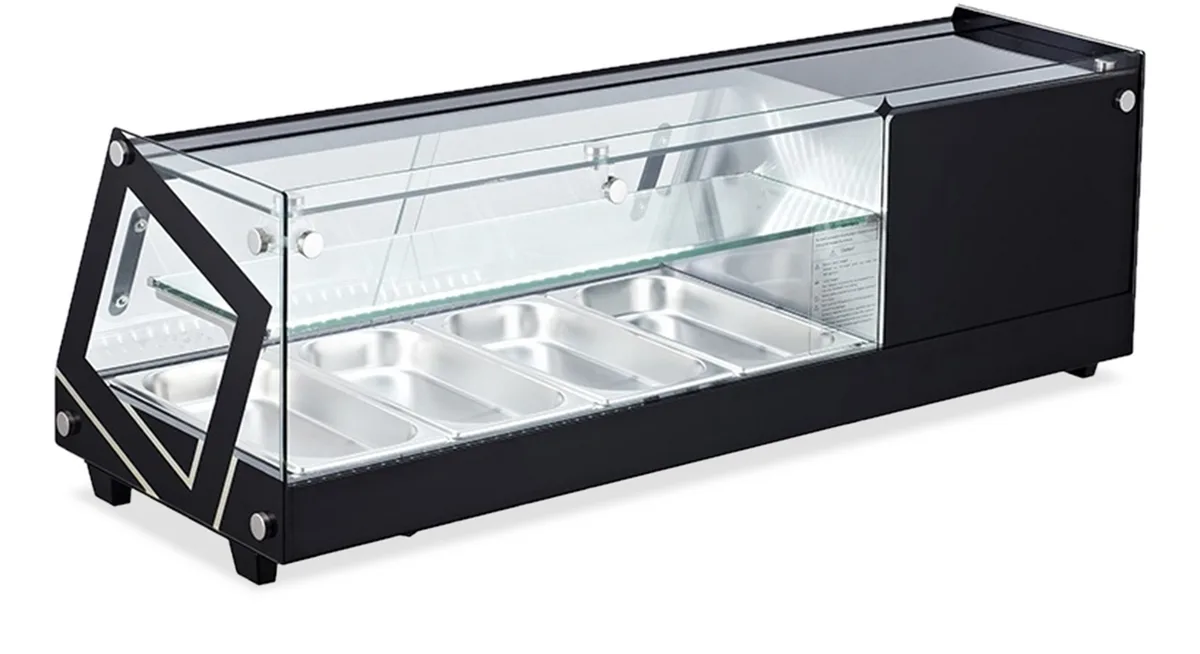
A refrigerated neta case is a chef-facing display appliance: the ingredients are visible across the counter and accessible from the working side, generally through sliding doors. It occupies a different place in the kitchen from the reach-in holding the restaurant's principal seafood inventory, the refrigerated prep table serving a back-of-house station, or the customer-access merchandiser selling packaged sushi.
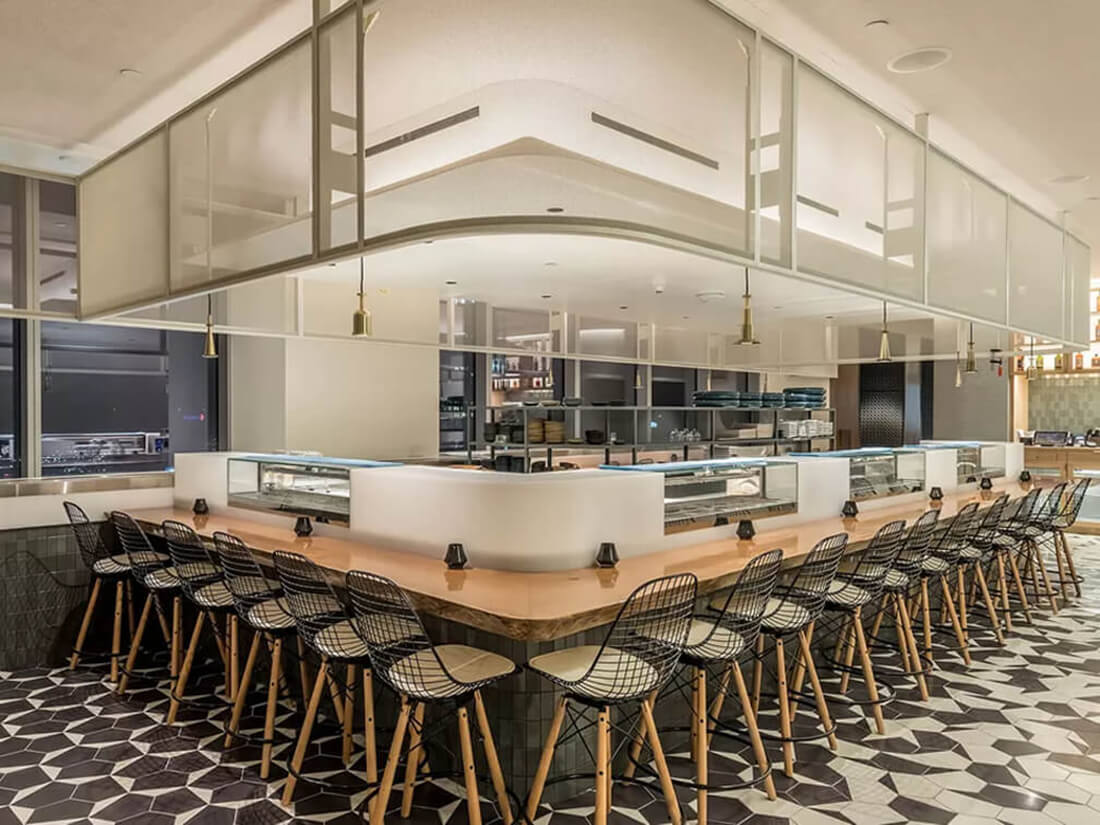
A showcase's glass, food supports, and refrigeration are designed around the counter. That proximity is the point. A chef can see and retrieve the working assortment while the guest sees the ingredients and the work taking place behind them. The case becomes part of the sightline, not just another cold box.
Its limits matter equally. Hoshizaki explicitly labels the HNC-SLH a refrigerated display case not intended for overnight storage. Its instructions call for fully refrigerated ingredients to be loaded into a previously cooled case, followed by removal to conventional refrigeration after service. A sushi showcase should never be specified as an automatic substitute for the restaurant's main refrigerated seafood storage.
Nor does every sushi concept require one. A conventional glass-front case may define a traditional sushi counter; an omakase chef may use a customized, recessed display or keep the working assortment in undercounter refrigeration. A hand-roll bar may prioritize immediate access within a compact assembly station. A commissary needs production refrigeration, not guest-facing neta presentation. The equipment must serve the restaurant's actual format.
The correct question is therefore not simply how long a sushi case should be. It is what needs to be displayed, who must access it, how it will be kept chilled during service, and how it fits the complete refrigerated operation.

02 / DISPLAY CASE REFERENCE
Types of refrigerated sushi cases
The familiar choices—curved or straight glass, 48 or 60 inches, condenser left or right—are only the visible portion of the category. Refrigeration location, cooling surfaces, food supports, defrost, counter integration, and intended use define the underlying equipment.
Self-contained countertop cases place the refrigeration equipment in the showcase itself. Hoshizaki's HNC-SLH family, Turbo Air's SAK and SAS families, and Everest's ESC series are established examples. Each is a discrete appliance, but self-contained does not mean unrestricted installation. Condenser clearances, ambient conditions, drains, and maintenance access still apply.
Remote cases separate the refrigerated cabinet from the condensing equipment. The cabinet becomes one part of an installed refrigeration assembly: piping, condensing-unit selection, controls, and qualified installation must be addressed alongside its physical size. Turbo Air's documented TSSC family belongs to this category; current factory orderability should be checked separately from the existence of its historical specifications.
Integrated and custom cases can be recessed, dropped into a counter, built around unusual angles, or tailored to a particular length and finish. YOSHIMASA documents self-contained and remote custom arrangements, including specialty configurations. Oscartek offers sushi display cases with drop-in and remote options, corner arrangements, and custom finishes. These are countertop-design and refrigeration projects as well as equipment purchases.
Specialist Japanese neta cases demonstrate additional engineering approaches, including designs expressly intended to manage high interior humidity. Hoshizaki Japan's FNC line is an important example. Japanese-market products establish what equipment designs exist; they do not establish U.S. certification, installation approval, or availability.
Glass style cuts across these categories. A curved-glass case and a straight-glass case may both be self-contained, yet differ in controls, defrost, drainage, door arrangement, and height. Equipment selection must be based on the actual construction, not an appearance label.
| What differs | Options that matter |
|---|---|
| Refrigeration | Self-contained cabinet; remote condensing equipment |
| Counter installation | Freestanding countertop; recessed/drop-in; custom fabricated |
| Cooling surfaces | Cabinet/evaporator cooling; contact-assisted supports; manufacturer-specific combinations |
| Front presentation | Curved glass; straight glass; low-profile or custom geometry |
| Chef access | Sliding rear doors; custom rear openings; removable panels |
| Controls and service | Fixed or adjustable controls; manual or automatic defrost |
| Intended use | Chef-accessed neta; integrated chef counter; packaged-product merchandising |
Scroll horizontally to read the full table →
A retail grab-and-go refrigerator is not merely a larger neta case. Its customer-access pattern and merchandising requirements are different. That distinction should be made before deciding whether a sushi showcase is even the right class of equipment.


03 / DISPLAY CASE REFERENCE
How refrigerated sushi showcases cool
A sushi display case removes heat through its evaporator and rejects that heat at the condenser. What matters to the buyer is where the cooling occurs in relation to the ingredients, how the supports are intended to be used, and how the appliance behaves when doors are opened repeatedly in a humid kitchen.
Hoshizaki's HNC-SLH is specified as a convection-cooling showcase with a large upper evaporator and reversible food mounts. Everest's ESC series uses evaporator tubing running from the upper area toward the lower cabinet and a floor cooling coil; its plastic trays have two manufacturer-defined mounting positions. Omcan's RS-CN-0044 uses direct cooling and expressly relies on the supplied metal inserts to cool the displayed products. These are not identical interiors hidden beneath different glass.
The engineering affects how ingredients are set out. Food positioned on a manufacturer's supported tray at one elevation is not necessarily in the same cooling condition as food placed on an improvised container elsewhere in the cabinet. Omcan warns that substituting plastic containers for its conductive metal inserts results in poor cooling. Everest, by contrast, supplies reversible food-grade plastic trays by design. The correct accessory is whichever the case was engineered to use.
Door use also changes the load. Warm, moisture-bearing air enters during service; on cold surfaces that moisture can condense or freeze. Hoshizaki specifically warns that evaporator frost insulates the tubing and reduces cooling performance, and its operating procedure includes periodic shutdown and defrost. Turbo Air SAS uses automatic defrost with a hot-gas loop and wicking-pad condensate arrangement. A buyer comparing these cases is comparing daily operating routines, not only glass and stainless steel.
Self-contained refrigeration also rejects heat in the counter area. The position of the air inlet and outlet, and any nearby cabinetry or other equipment, must be compatible with the manufacturer's installation drawing. Remote refrigeration changes where that heat is rejected, but introduces the piping and contractor requirements of a separate system.
The mechanical distinction becomes decisive when it changes food-support compatibility, operating hours, maintenance, or the construction of the counter. Refrigeration performance should be assessed from the exact model documentation and actual food temperatures during use—not from an attractive general claim that a case “keeps sushi fresh.”
Scroll horizontally to inspect the diagram

04 / DISPLAY CASE REFERENCE
Temperature, humidity, frost, and the limits of a display case
The temperature printed on a sushi-case specification sheet can refer to a control setting, a refrigeration-system condition, or a cabinet temperature under stated test conditions. None alone proves the temperature of every ingredient displayed during service.
Hoshizaki's HNC-SLH series sheet gives an approximate 41°F saturation temperature at 80°F ambient with no load. Turbo Air describes a 35–41°F refrigeration range and a 39°F saturation temperature, alongside recommended ambient limits. Everest lists a factory-preset control condition of 38°F at 80°F ambient for the ESC47L. Those figures are not a laboratory comparison of the temperatures of equal pieces of fish during a busy service.
| Published or measured value | What it establishes |
|---|---|
| Controller setpoint | The target used by the control system |
| Saturation / evaporating temperature | A refrigeration-circuit operating condition |
| Cabinet air temperature | Air temperature at a particular location and operating state |
| Food-support temperature | Conditions on the approved mount, tray, or insert |
| Actual product temperature | The condition of the ingredient itself |
Scroll horizontally to read the full table →
In service, loading, ingredient size, tray arrangement, room temperature, humidity, condenser airflow, and door openings all affect conditions. Hoshizaki specifies a 50–80°F ambient range and requires adequate condenser clearance. Turbo Air recommends operating SAK/SAS cases where ambient temperature and relative humidity do not exceed 75°F and 55%, respectively, despite listing a wider general ambient range. These conditions belong in the site specification, not a footnote discovered after installation.
Hoshizaki also limits displayed food height to 3.5 inches above the interior bottom. Its manual calls for prechilled ingredients, periodic defrost and food removal after service. A case that is allowed to frost beyond its normal operating procedure is not being used within the assumptions behind its performance.
For food requiring time/temperature control for safety, the FDA's 2026 Food Code provides a national model cold-holding baseline of 41°F (5°C) or below, subject to its specified exceptions and procedures. Actual enforcement follows the code adopted by the relevant jurisdiction. California's retail food rules and Los Angeles County inspection guidance likewise address food-temperature control. Equipment setpoints do not substitute for the establishment's actual food-temperature controls.
The working distinction is straightforward: specify a case capable of serving the intended display purpose, operate it within its limitations, and verify the ingredients under the restaurant's applicable food-handling procedure. Primary refrigerated storage remains a separate specification.
Scroll horizontally to inspect the diagram
05 / DISPLAY CASE REFERENCE
Food mounts, trays, inserts, and neta presentation
Food supports are part of the equipment specification. They establish the working surface on which ingredients are arranged, and in some designs they are integral to the intended cooling arrangement.
The Hoshizaki HNC-SLH family ships with reversible food mounts. The manufacturer illustrates one orientation for ordinary use or when product temperature is too low and the reverse position for more intensive cooling. Those supports should not be replaced casually with vessels selected only by external dimensions.
Everest's ESC cases make a different choice: reversible food-grade plastic trays, whose mounting positions are assigned to different cooling applications. Plastic is therefore neither intrinsically unsuitable nor automatically suitable in sushi showcases. The case's actual design governs compatibility.
The direct-cooling Omcan RS-CN-0044 is the strongest contrasting example. Its manufacturer requires the included metal inserts for the intended cooling performance and explicitly warns that plastic or other substituted containers will not cool properly. It also includes an upper shelf that is not refrigerated. An additional shelf behind the glass must never be assumed to be an additional chilled food-support level.
For the buying specification, record the supplied supports, their exact dimensions, number and position, compatible replacements, permitted product arrangement, and cleaning requirements. The useful display area is the area provided by those approved supports—not the volume of the glass enclosure.
A compelling presentation is only commercially useful when it is compatible with the case's intended refrigeration and daily cleaning requirements.

02 / SUSHI RESTAURANT REFERENCE
Build the specification
06 / DISPLAY CASE REFERENCE
Sizing a sushi case: usable display space, assortment, and replenishment
A case's rated cubic feet do not tell a chef how much neta can be displayed. The meaningful dimensions are the approved working surfaces, their usable arrangement, and the physical access the counter provides during service.
The Hoshizaki HNC-SLH range demonstrates the difference between cabinet size and working space:
| HNC-SLH size | Exterior width | Interior width | Net capacity | Supplied food mounts |
|---|---|---|---|---|
| HNC-120 | 47.2 in. | 33.3 in. | 1.48 cu. ft. | 3 |
| HNC-150 | 59.1 in. | 45.1 in. | 2.01 cu. ft. | 4 |
| HNC-180 | 70.9 in. | 56.9 in. | 2.54 cu. ft. | 5 |
| HNC-210 | 82.7 in. | 68.7 in. | 3.07 cu. ft. | 6 |
Scroll horizontally to read the full table →
All four models share a nominal 13.6-inch exterior depth and 11-inch height. The refrigeration section and end construction account for a significant difference between external and usable interior length. The growing mount count is more relevant to a working presentation than the cubic-foot figure alone.
Compare that with other near-four-foot displays. The cases are similar in marketed length, but their food supports, useful interior lengths, and refrigeration designs differ:
| Representative case | Actual exterior width | Published interior width | Nominal volume | Supplied support arrangement |
|---|---|---|---|---|
| Hoshizaki HNC-120-SLH | 47.2 in. | 33.3 in. | 1.48 cu. ft. | 3 reversible food mounts |
| Turbo Air SAK-50-N | 48.25 in. | 33.25 in. | 1.3 cu. ft. | 3 stainless plates |
| Everest ESC47 | 47.25 in. | Confirm from exact model drawing | 1.5 cu. ft. | Reversible food-grade plastic trays |
| Omcan RS-CN-0044 | Approx. 44.5 in. | Confirm from exact model drawing | 1.55 cu. ft. | Four compatible one-third-size GN metal inserts |
| Emperor's Select CSD-46 | 46.375 in. | 29.125 in. | 1.85 cu. ft. | Manufacturer-specific display plates |
Scroll horizontally to read the full table →
Manufacturer-published or seller-listed model dimensions; these are not a comparative test of food-temperature performance. A tray or mount count does not equal the number of ingredients that can safely be displayed.
That comparison is more useful than placing five cubic-foot figures in a ranking. The largest published volume does not necessarily provide the largest or most flexible approved working surface. Turbo Air's SAK-50 cut sheet, Everest's ESC47L specification, Omcan's RS-CN-0044 specification, and Emperor's Select CSD-46 listing establish the representative configurations.
Start with the ingredient assortment that must be visible and accessible at the same time. A restaurant listing 30 sushi preparations does not necessarily need 30 simultaneous neta positions. Some preparations share ingredients; some products remain in conventional refrigeration until needed; some chefs deliberately keep the visible display selective. The specification should reflect the actual service arrangement, not a count of menu entries.
Next, lay that assortment onto the approved mounts, trays, or metal inserts of the candidate equipment. Check usable length and depth, arrangement, food height, separation, and access through the rear doors. The HNC's 3.5-inch maximum permitted display height is an actual manufacturer restriction, not an optional design preference. The same layout cannot automatically be transferred to a different brand whose cooling depends on different supports.
A simple example illustrates the decision. If a sushi bar's proposed Hoshizaki-compatible display requires four separate food mounts, a three-mount HNC-120 does not accommodate that arrangement. The HNC-150 supplies four mounts and becomes a candidate. It is not yet the final selection: ingredient dimensions, permitted loading, counter dimensions, service access, and operating conditions still have to agree.
Where several chefs share a counter, verify the traffic before choosing the longest available case. One HNC-210 can present six mounts across a longer cabinet. Two shorter units can distribute the working assortment, but they also duplicate equipment, consume condenser clearance, and introduce separate service points. A long case only solves the problem if the chefs can reach it without disrupting each other's stations.
The final capacity decision should include replenishment. A case intended for actively rotated portions and frequent replenishment from a nearby refrigerator will have a different working assortment from one arranged for broader continuous visibility. Replenishment does not permit the showcase to exceed its food-temperature limitations; it is part of the surrounding refrigerated workflow.
The correct case is the smallest appropriate configuration that accommodates the required presentation and access without compromising cooling conditions, counter functionality, or maintenance. Sometimes that will be an HNC-150. Sometimes it will be a longer unit, two separate stations, or a completely different refrigerated working arrangement.
Scroll horizontally to inspect the diagram


07 / DISPLAY CASE REFERENCE
Curved glass, straight glass, and the working sightline
The curved-glass sushi showcase is a familiar fixture of the American sushi bar. Its low profile gives guests a clear view of the presentation while the chef accesses ingredients from sliding doors behind the cabinet. Straight-glass cases place a different plane of glazing between the guest and the counter and can introduce a taller overall silhouette.
Neither shape is intrinsically superior. The correct comparison includes the actual height above the chef's work surface, glass angle, chef-side opening, door-track arrangement, lighting, and the guest's view of the work area. In a tightly composed omakase counter, several inches of case height can matter aesthetically and operationally. In a larger conventional sushi bar, a broader, well-lit straight-glass display may be entirely appropriate.
Turbo Air provides a useful direct contrast. Its SAK family is curved-glass with stainless food plates and a 304 stainless exterior. Its SAS family is straight-glass, with LED interior lighting, digital temperature control, automatic defrost, and a hot-gas loop/wicking-pad condensate arrangement. This is not simply the same appliance sold with two glass profiles. The differences carry through to controls, routine care, dimensions, and electrical loads.
For example, the SAK-60 family is approximately 59¾ inches wide and 11½ inches high. The SAS-60 family is approximately 59 inches wide and 13½ inches high. Those dimensions materially change the shape of the counter elevation. They do not, by themselves, prove that one case is more visible to every guest or easier for every chef to use; those judgments require the actual counter section and sightlines.
Choose the display profile as part of the complete restaurant elevation, then confirm that the selected family has the required food supports, refrigeration arrangement, cleaning access, and service characteristics. Appearance is a legitimate specification. It is not a substitute for the other specifications.


Scroll horizontally to inspect the diagram
08 / DISPLAY CASE REFERENCE
Condenser orientation, counter fit, and installation
“Left-hand compressor” is an incomplete ordering instruction. The model must be defined against its manufacturer's viewing convention and the restaurant's actual plan.
Turbo Air specifies its left/right condenser positions from the front—the guest-facing side. Standing behind the sushi counter reverses the apparent side. A right-condenser SAK-50R-N, for example, has the machinery on the right when viewed by the guest. This must be reconciled with the chef-side elevation before the counter is fabricated or the equipment ordered.
The end location is not necessarily the exhaust direction. Hoshizaki's HNC-SLH documentation describes condenser air entering from the rear and discharging from the side. The manufacturer requires six inches of clearance at its designated condenser inlet and outlet, sufficient rear access for the power switch, louver and filter, and open space above the case. An adjacent cabinet panel or appliance can defeat those requirements even when the physical showcase fits neatly in the allocated width.
Everest's ESC instructions similarly require clearance at the condenser side and warn against enclosing the standard unit in cabinetry. The case may be small, but its ventilation requirements do not disappear when the designer wants a recessed appearance. The site must accommodate the listed appliance, or the project must select a display engineered for the intended installation.
Check the actual cut sheet rather than the marketed nominal length. Turbo Air's SAK-50 body is 48¼ inches wide, for example, and its documentation distinguishes body depth from additional drain projection. In addition to external width and depth, confirm countertop support, the power-cord path, any drain fitting or collection arrangement, clearance to walls and other equipment, and sufficient room for the sliding glass doors to operate and be removed for cleaning.
Service is part of installation. A filter cannot be maintained when a fixed joinery panel blocks access. A case cannot be moved out for repair if the surrounding fabrication traps it in place. Those costs are avoidable at the drawing stage.
Before ordering, the approved elevation and plan should identify five things: customer side, chef side, precise model and orientation, condenser air path, and service/utility access. The equipment supplier, designer, contractor, and—in remote projects—refrigeration contractor should be referring to the same drawing.

Scroll horizontally to inspect the diagram

09 / DISPLAY CASE REFERENCE
Self-contained, remote, and custom sushi displays
A self-contained showcase is normally purchased and installed as a finished appliance: model, side orientation, utility connection, clearance and commissioning. A remote case is a different scope of work. Its display cabinet must be paired with correctly selected condensing equipment, controls, refrigerant piping, and installation. The case quotation is not the installed refrigeration quotation.
Turbo Air's TSSC documentation illustrates a remote family designed for separate condensing equipment. Its historical specifications identify 4-, 5-, and 6-foot cabinets and separate recommendations based on the number of interconnected cases. Those documents establish the equipment architecture; they do not establish present factory production or immediate orderability of a specific TSSC configuration. ERS maintains a TSSC-4 listing that should be treated as a project inquiry until current availability and the required equipment scope are confirmed.
Custom and drop-in displays take the discussion further. YOSHIMASA publishes specialist case arrangements and installation instructions for self-contained and remote designs. Oscartek's Sushi Drop In family includes DI 1000, 1250, 1500 and 1700 configurations, with cutouts, refrigeration connections, counter interfaces, optional finishes and rear-access arrangements. Such equipment is specified alongside the sushi counter, not added once construction is complete.
Custom construction can solve difficult design requirements: a lower glazed profile, a corner or L-shaped counter, a continuous visual language across multiple chef stations, or remote heat rejection. It also makes the installation drawing, fabrication scope, approved components, and future service access more consequential. A unique case is not automatically the correct case.
Operating limitations survive customization. YOSHIMASA's remote installation guidance expressly prohibits continuous 24-hour use of its cases and sets out shutdown expectations. That must be reconciled with the restaurant's operating schedule. A case designed for limited-hour presentation cannot be made suitable for around-the-clock display through attractive fabrication alone.
For a standard countertop unit, compare the appliance and ordinary site work. For a remote unit, compare the complete refrigerated installation. For a custom unit, compare approved shop drawings, refrigeration and case fabrication, controls, maintenance access, replacement parts, warranty and responsibility for commissioning. Differences in project scope—not nominal case length—usually determine whether quotations are genuinely comparable.
| Requirement | Standard self-contained | Remote / custom-integrated |
|---|---|---|
| Condensing equipment | Incorporated into case | Separate, or selected by custom configuration |
| Counterwork | Suitability, support and clearances | Case/counter drawings and fabrication coordination |
| Refrigerant piping | Generally factory-contained | Field installation and refrigeration contractor as applicable |
| Heat rejection | At or near case | At selected condensing location for remote systems |
| Service | Case-specific components | Cabinet plus remote equipment and integration interfaces |
| Quotation | Product plus site preparation | Complete configured and installed project |
Scroll horizontally to read the full table →
Scroll horizontally to inspect the diagram

03 / SUSHI RESTAURANT REFERENCE
Compare model configurations
10 / DISPLAY CASE REFERENCE
Manufacturers, model families, and the specifications that separate them
The U.S. sushi-showcase market spans established Japanese and Korean manufacturers, alternative direct-cooling displays, lower-priced countertop equipment, and custom architectural installations. The relevant comparison is not brand recognition alone. It is the entire cabinet: approved presentation area, refrigeration layout, controls, operating restrictions, counter fit, maintenance access, and available service.
Hoshizaki HNC-SLH
Hoshizaki's HNC-SLH series is a deliberately low-profile, curved-glass case with self-contained R-600a refrigeration, a large upper evaporator, reversible grooved food mounts, and LED lighting. Four widths—47.2, 59.1, 70.9, and 82.7 inches—are offered in left- and right-condenser configurations. The units have a uniform nominal height of 11 inches, but their usable interior widths and supplied mount counts increase from three to six.
The principal strengths of this family as a specification are its clearly defined display geometry, consistent series dimensions, detailed manufacturer operating instructions, and readily distinguished size choices. Its operating instructions require prechilled contents, attention to frosting, food removal after service, and defrost. Those are not optional inconveniences to omit from an equipment comparison; they are part of the intended use.
The current SLH suffix must be kept distinct from older HNC-SL listings. Current SLH documentation identifies R-600a, while older generations may have different refrigerants and technical details. Even when exterior dimensions match, a legacy datasheet is not a substitute for the exact current-model sheet.
Turbo Air SAK-N
Turbo Air's SAK-N family offers curved glass, 304 stainless exterior construction, stainless food plates, rear chef access, and R-290 self-contained refrigeration. The standard nominal sizes are approximately 48, 60, and 71 inches, with condenser-side options. The manufacturer specifies a slightly inclined floor, cleaning/drain provisions, 115V single-phase service, and recommended ambient conditions at or below 75°F and 55% relative humidity.
The SAK series is relevant where the curved-glass presentation and its specific food-plate and operating arrangement fit the counter. For example, the SAK-50R-N measures 48¼ inches wide, while the SAK-70R-N measures 71¼ inches wide. The marketed length is not the cut-sheet dimension. Its conventional refrigeration and manual cleaning provisions should be compared with the SAS series rather than assuming the two differ only in appearance.
Turbo Air SAS-N
The SAS series changes both presentation and operation: straight front glass, digital temperature display and control, LED interior lighting, automatic defrost, and a hot-gas loop/wicking-pad condensate arrangement. The current catalog identifies three sizes, nominally 47, 58, and 70 inches, each with left/right condenser options. Turbo Air documents 115V single-phase service, R-290 refrigerant, and the same recommended ambient ceiling as its SAK range.
This is the meaningful SAK/SAS comparison: glass height and profile, digital versus different control arrangements, manual service tasks, defrost and condensate handling, exact dimensions and electrical requirements. A buyer should compare the actual manufacturer drawings and the expected operating schedule, not select “straight glass” as if it were simply a finish option.
Everest ESC
Everest's ESC lineup is a substantive alternative to Hoshizaki and Turbo Air. Its case architecture includes upper evaporator tubing and floor cooling, while the supplied reversible food-grade plastic trays provide manufacturer-defined arrangement options. The ESC47L is listed at 47.25 × 14 × 11.125 inches, with 1.5 cubic feet of published capacity, R-290 refrigerant, and a fixed factory control condition. The March 2026 individual specification records 1/8 HP and 1.5A; older family materials show different electrical and compressor figures, making exact-model document dates important.
Everest also publishes specific startup, manual-defrost, filtration, and ventilation requirements. Its case is not an interchangeable version of Hoshizaki's HNC simply because both use curved glass and occupy a similar length of counter.
Omcan direct-cooling showcases
Omcan's sushi range includes curved- and flat-glass cabinets, including the RS-CN-0044, a roughly 45-inch flat-glass direct-cooling model with 1.55 cubic feet of published capacity. Its metal food inserts are integral to the manufacturer's intended cooling arrangement. Its extra upper shelf is not refrigerated. Other Omcan sizes and model generations must be reviewed individually; dimensions, included supports, refrigerant and certifications should not be copied across the entire catalog.
This family is particularly instructive for buyers considering alternative tray arrangements or flat-glass cases outside the two largest stocked ERS lines.
Other commercial and custom options
Emperor's Select CSD cases represent a lower-priced countertop segment with curved glass, LED lighting, digital controls and automatic defrost on the documented CSD-46 family. A lower advertised purchase price does not establish equivalent commercial life, cooling performance or service response; those require evidence of their own.
YOSHIMASA and Oscartek are relevant to specialty configurations that cannot be handled as conventional off-the-shelf purchases. The former documents custom self-contained and remote neta cases; the latter publishes sushi drop-in systems with approved counter cutouts, finishes, access arrangements and refrigeration connections. In those projects, qualified equipment selection includes fabrication and long-term service, not just the cabinet model.
Turbo Air TSSC remains a useful documented example of remote refrigeration. Its current production/ordering status is not established by the existence of an older datasheet or an ERS catalog record. It should be specified only after the manufacturer and supplier confirm the project configuration.
Comparison by equipment family
| Family | Glass / installation | Cooling and controls | Food supports | Defrost / installation distinction |
|---|---|---|---|---|
| Hoshizaki HNC-SLH | Curved, self-contained | R-600a; convection cooling; fixed series arrangement | Reversible grooved mounts | Manual defrost; designated condenser clearances; no overnight storage |
| Turbo Air SAK-N | Curved, self-contained | R-290; side condenser | Stainless food plates | Drain/cleaning provisions; recommended ambient ≤75°F / 55% RH |
| Turbo Air SAS-N | Straight, self-contained | R-290; digital control | Stainless food plates | Automatic defrost; hot-gas loop/wicking pad |
| Everest ESC | Curved, self-contained | R-290; fixed factory control | Reversible food-grade plastic trays | Manual daily defrost and manufacturer-specific startup/clearance |
| Omcan RS-CN-0044 | Flat, self-contained | Direct cooling; digital control | Required metal inserts | Non-refrigerated upper shelf; material compatibility critical |
| Emperor's Select CSD | Curved, self-contained | R-290 on documented CSD-46; digital control | Manufacturer-provided display plates | Automatic defrost; separate warranty/parts evaluation |
| YOSHIMASA custom | Multiple geometries, self-contained/remote | Project-specific | Project-specific | Published duty-cycle/installation restrictions |
| Oscartek Sushi Drop In | Counter-integrated, custom | Static refrigeration with upper and lower cooling elements | Stainless trays in documented specification | Requires approved cutouts, integration and services |
| Turbo Air TSSC | Remote | Separate condensing equipment | Verify by exact model | Historical specification; current ordering to confirm |
Scroll horizontally to read the full table →
This table compares documented architecture, not measured food-temperature performance or brand reliability. Exact specifications govern for each ordered model.
The practical manufacturer decision is this: compare the equipment that fits the actual display arrangement and site, then compare the operating, maintenance, warranty and support terms of those qualifying models. A case with the best-looking catalog photograph but incompatible food supports, blocked condenser airflow, or an impossible duty cycle is not a qualifying alternative.
ERS currently carries 21 refrigerated sushi-case listings, concentrated in Hoshizaki HNC and Turbo Air SAK/SAS configurations, plus a remote-case listing. The wider market matters to a complete technical reference; the ERS assortment supplies real model-specific purchasing options for restaurants whose requirements those units satisfy.


11 / DISPLAY CASE REFERENCE
Choosing a case for the restaurant that will actually use it
Restaurant format changes the purpose of the refrigeration before it changes the brand or model.
Traditional sushi bars often make the visible neta display a central part of counter service. Chef access, a workable assortment, and convenient replenishment determine whether a case is useful. A case placed between the chef and the guest should also fit the aesthetic and dimensions of the counter.
Omakase and Edomae counters may use a particularly low or recessed display, a custom arrangement, or a more discreet form of refrigerated access. Sightlines and the chef's working surface are often essential to the design. A documented example is MF Sushi in Houston, where MC2 Architects lowered the refrigerated cases into the hinoki counter and incorporated recessed cutting-board areas to maintain a close visual connection between diners and chefs. That is a real design solution, not a reason to recess an ordinary appliance that the manufacturer prohibits enclosing.
Hand-roll bars need uninterrupted assembly and immediate access to the prepared ingredients. A conventional showcase is appropriate only if it serves that workflow. Counter space devoted to glass display could otherwise be more effectively assigned to active preparation and refrigeration beneath the work surface.
High-volume sushi and all-you-can-eat operations require broader production capacity and organized replenishment; a guest-facing neta case may serve a particular visible station but is not a substitute for production and storage refrigeration. Multiple chef positions may warrant separate access arrangements rather than one long shared showcase.
Conveyor sushi separates much of the guest-facing delivery process from the chef's ingredient display. A conventional case may appear at a production station, but it is not the conveyor equipment and should not be sized as though it were.
Grocery and grab-and-go sushi often requires customer-facing refrigeration for packaged ready-to-eat products. A neta case may support an attended preparation counter; it is not equivalent to a retail merchandiser designed for customer access and packaged-product layout.
Commissaries and centralized production depend primarily on preparation, cold-chain and distribution equipment. An attractive glass-front counter display may have no operational justification at all.
| Restaurant setting | Display-case question that matters |
|---|---|
| Traditional sushi bar | Which neta assortment and chef access must remain visible? |
| Omakase counter | How should the case integrate without interrupting service and sightlines? |
| Hand-roll counter | Does visible display improve immediate preparation access? |
| Large sushi operation | Shared case or distributed stations; what supports replenishment? |
| Conveyor restaurant | Is a chef-facing case actually needed at a particular production station? |
| Supermarket sushi | Is the unit for attended ingredient prep or customer-facing packaged food? |
| Commissary | Does this operation need a display case at all? |
Scroll horizontally to read the full table →
A concept label is not a purchasing specification. Work from the station, its ingredient presentation, and its required operation; then select the equipment.

04 / SUSHI RESTAURANT REFERENCE
Plan the working day
12 / DISPLAY CASE REFERENCE
Opening, service, defrost, and closing
A refrigerated sushi case must be operated according to the model selected. There is no universal startup or defrost schedule that fits Hoshizaki HNC, Turbo Air SAS, Everest ESC, and every custom neta display.
Hoshizaki HNC-SLH: The SLH-specific instruction manual instructs operators to cool the case for about one hour before display, fully refrigerate the ingredients beforehand, and minimize prolonged door openings. Moisture entering the case accumulates as frost on the evaporator and reduces cooling performance. After service, the ingredients are removed to proper refrigeration, the showcase is turned off, and the unit is allowed to defrost for at least one to two hours. Additional defrost may be necessary under heavy frost conditions. The supplied mounts are used in the orientation specified for the intended cooling arrangement, and food must remain within the permitted display height.
Everest ESC: The manufacturer's operating manual describes a substantially longer initial stabilization period—24 to 72 hours before loading—and a factory-set temperature arrangement. The unit requires manual defrost by emptying it and switching it off for at least two hours daily. Its approved trays can be inverted for the manufacturer's different cooling applications. This is not Hoshizaki's one-hour startup procedure under another brand name.
Turbo Air SAS: Digital temperature controls and automatic defrost change the daily equipment routine. Automatic defrost is not permission to leave ingredients in a case after hours against their food-handling requirements, nor does it eliminate cleaning, access, or the need to monitor real food temperatures.
Custom units: Review the approved operating instructions before committing to an extended service schedule. YOSHIMASA expressly restricts continuous 24-hour operation of certain showcase systems. It is an equipment-design limitation to account for when specifying the case, not a problem to discover after the counter is built.
During service, work with the manufacturer's approved supports and loading arrangement. Keep access openings closed when not in use, manage condensation and frost as prescribed, and replenish from suitable primary storage. At closing, remove ingredients as required, clean the equipment and supports, deal with the drain or condensate arrangement, and carry out the manufacturer's defrost or shutdown routine.
The restaurant's operating hours, service windows, and staffing determine whether those routines are practical. A model that cannot follow the necessary schedule does not become suitable through a better quotation.
13 / DISPLAY CASE REFERENCE
Cleaning, maintenance, troubleshooting, and parts
Glass, door tracks, food supports, filters, condenser surfaces, drain passages, and the refrigeration assembly all require the access contemplated by the manufacturer. A well-specified sushi counter leaves those points accessible after installation.
Hoshizaki's instructions call for the air filter to be inspected at least twice a month and the condenser to be inspected annually, cleaning where needed. Everest calls for monthly filter cleaning. Other makes have their own intervals. A single “clean the filter every 30 days” line copied across every case is not a professional maintenance specification.
Routine care begins with the parts handled every service: approved food trays or mounts, interior surfaces, sliding doors, seals and tracks. Drainage and condensation systems should be checked and cleaned using the appropriate manufacturer instructions. Equipment with manual defrost must be given the downtime and food-removal provisions its design requires.
When a case cools poorly, check the ordinary operating conditions before attributing the problem to the refrigeration circuit: whether the unit has completed its normal startup, whether condenser airflow is obstructed, whether the doors are being left open, whether excessive frost has accumulated, and whether the display is overloaded or fitted with incompatible trays. These are observations, not permission to attempt sealed-system repairs. Refrigerant, compressor, electrical, or control failures require qualified service.
Parts identification begins with the exact model and serial number. An older HNC-SL part is not automatically an HNC-SLH part; a Turbo SAK component is not necessarily shared with an SAS case. Door glass, tracks, handles, filters, food supports, sensors, lighting components, electrical controls, and drains all need model-level compatibility checks.
An integrated case needs another ownership decision: can the equipment be serviced or removed without destroying the counter? YOSHIMASA and other custom suppliers distinguish cabinet warranties from installation work and often exclude costs created by inaccessible fabrication. Serviceability is therefore a drawing-stage issue.
| Symptom | First professional checks | When to escalate |
|---|---|---|
| Reduced cooling | Verify loading, ambient conditions, ventilation, doors and prescribed defrost | Cooling remains inadequate; suspected electrical or refrigeration fault |
| Heavy frost | Review door practices and manufacturer defrost | Recurrent rapid frost beyond normal conditions |
| Condensate or water | Check approved drain/collection and humidity-related procedures | Persistent leaks or condensate-system failure |
| Door does not close correctly | Inspect tracks, obstruction and approved removable parts | Damaged glass, seals, alignment or hardware |
| Unusual equipment sound or failure to start | Follow manufacturer's basic power/operation checks | Electrical, motor or compressor work |
Scroll horizontally to read the full table →
The maintenance record and available replacement parts should accompany the equipment specification. The cost of a specialty case is not solely its original invoice; a failure during service can expose the restaurant to labor, downtime, and counter-access expenses far greater than the price of the defective part.
14 / DISPLAY CASE REFERENCE
Purchase prices, warranties, and ownership cost
Commercial sushi showcases occupy distinctly different price bands. The lower-priced end of the market is not imaginary: the Emperor's Select CSD-46 appeared in U.S. retail listings in October 2026 with a regular advertised price around $649–$679, depending on the listing snapshot. Hoshizaki's standard HNC-SLH units appeared in the several-thousand-dollar range, including posted prices around $3,355 for HNC-120 and $4,045 for HNC-180. Those are actual observed U.S. asking prices, not average transaction prices or installed project quotations.
The lowest sticker price is not a meaningful final comparison unless the candidate cases meet the same refrigeration, capacity, installation and operating requirements. There is no substantiated basis to assume the entry-level alternative has identical service life or temperature performance to a more expensive case—or that a higher price automatically produces superior results.
For ordinary countertop equipment, the acquisition budget includes the actual case, compatible supports or options, delivery, site preparation, electrical and drain provisions, and any counter adjustments needed for ventilation or access. With remote or integrated units, it must include condensing equipment, piping, controls, fabrication, refrigeration contractor labor, coordination and commissioning. An unfinished custom cabinet quote and a complete installed self-contained case quotation are not competing totals.
Warranty comparisons require equal care:
| Manufacturer example | Published coverage structure | What the buyer must distinguish |
|---|---|---|
| Hoshizaki HNC-SLH | 1 year general parts/labor; specified refrigeration components covered for 2 years parts/labor; compressor and air-cooled condenser receive further parts-only protection through year 5 | Registration, component list, labor, travel and exclusions |
| Turbo Air SAK/SAS | 2 years parts/labor; 3 additional years of compressor coverage | Compressor-only extension versus whole-machine coverage |
| Everest qualifying R-290 refrigerators | 3 years parts/labor; 5 years electrical parts; 10 years compressor parts | Extended components generally parts-only, with shipping/labor restrictions |
| YOSHIMASA self-contained | 1 year parts/labor and stated additional component-parts coverage | Wear items, registration, service location, exact conditions |
| YOSHIMASA remote | Published 90-day parts coverage for the case | Remote installation and contractor work excluded |
Scroll horizontally to read the full table →
The Hoshizaki full warranty statement requires registration within 30 days of installation and sets out limits on premium labor, travel and coverage arising from improper installation or maintenance. Everest's extended electrical and compressor terms likewise do not amount to ten years of full-machine labor coverage. YOSHIMASA differentiates sharply between self-contained equipment and remote units.
Operating cost is also broader than electricity. Cleaning, normal defrost downtime, access to repairable components, local authorized service, replacement glass/doors/trays, and the ability to substitute an appliance in the existing counter all contribute. Specialized fabrication can make eventual replacement expensive even when the original refrigeration unit is still repairable.
An equipment quote is properly comparable when it identifies the same functional requirement and includes all necessary scope. Where the cabinetry, refrigeration, or service arrangements differ, the decision belongs to the complete project rather than to a single price column.
- Appliance
Case, compatible supports and selected options - Site and installation
Receiving, power, drains, airflow, fabrication and commissioning - Ownership
Cleaning, defrost, service access, components and support
15 / DISPLAY CASE REFERENCE
The specification and purchase-release checklist
A correct sushi-case order is an equipment specification, not a quoted cabinet length and a preferred glass shape. Before release, the approved model must agree with the ingredient-display arrangement, the counter drawing, the site's electrical and ventilation conditions, and the intended operating schedule.
The buyer should identify the exact manufacturer, series, model, suffix and condenser location; verify the cabinet and usable interior dimensions; and confirm the manufacturer-approved food mounts or inserts. The installation drawing must show guest and chef perspectives, the location of controls, electrical and drains, the required condenser airflow and cleaning access, and the means of servicing or removing the unit later. Remote and custom systems additionally require the refrigeration and fabrication details agreed by the parties responsible for that work.
A preliminary quote may rely on stated assumptions. Final release cannot. It should refer to an agreed current cut sheet, documented configuration, approved counter/utility interfaces, purchase terms and responsible installer. A “right-hand 60-inch sushi case” is not a complete release description.
ERS refrigerated sushi showcase — equipment specification sheet
ERS refrigerated sushi showcase — equipment specification sheet
| Field | Confirmed project requirement |
|---|---|
| Project / location | Restaurant name, site, contact, intended application |
| Intended display | Chef-facing neta / custom counter / other specified function |
| Ingredients and supports | Working display assortment; approved mount/plate/insert type and count |
| Manufacturer and exact model | Full model including side suffix and model generation |
| Cabinet and working area | Exterior W × D × H; usable interior/support dimensions |
| Chef and guest views | Front elevation and chef elevation identified on plan |
| Condenser / refrigeration | Side location; self-contained or remote; air inlet/outlet |
| Ambient and operating conditions | Site temperature/humidity limits and intended service hours |
| Counter and utilities | Support, ventilation, service clearances, power, drain/condensate, access |
| Routine operating requirements | Startup, prechilling, defrost, shutdown and primary storage |
| Delivery and installation | Freight, receiving, site preparation, contractor responsibilities |
| Warranty and support | Current manufacturer terms, registration, parts/service resources |
| Purchase release | Approved model cut sheet, coordinated drawing, quotation and responsible approvals |
Scroll horizontally to read the full table →
Before authorizing the final order: resolve the specific model and orientation, confirm the installation matches its manual, ensure the selected system can actually serve the restaurant's intended schedule, and clarify what the quotation includes. These are the details that determine whether the equipment purchased is the equipment that can be installed and used.
Browse ERS refrigerated sushi cases · Discuss an equipment specification with ERS
16 / DISPLAY CASE REFERENCE
Sushi display case questions, answered
Can a sushi case hold raw seafood overnight?
Not by default. Hoshizaki expressly states that HNC refrigerated showcases are not for overnight storage and instructs operators to return ingredients to conventional refrigeration after service. Follow the operating instructions for the actual case; provide separate primary seafood storage as required.
What temperature should a sushi showcase maintain?
The relevant standard concerns the actual food and the applicable operating rules, not just the setting printed on a controller. The 2026 FDA Food Code's general model cold-holding provision is 41°F (5°C) or below for food requiring time/temperature control, subject to its exceptions; the local adopted code and approved procedures govern the restaurant. A published saturation temperature is not a food-temperature reading.
Is a sushi display case the same as a refrigerated prep table?
No. A sushi showcase is configured for visible, chef-accessed presentation. A refrigerated prep table is designed around a different working arrangement and may have different pans, storage access and refrigeration characteristics. Specify each for the function it must perform.
Is curved glass better than straight glass?
Not universally. The choice affects counter profile, display presentation and chef/guest sightlines. It may also involve different controls and defrost hardware, as with Turbo Air SAK versus SAS. Compare the complete model, not glass alone.
Which condenser side should I order?
Use the manufacturer's front-view convention, then verify the same case from the chef's side and in plan. The correct side depends on condenser airflow, adjacent cabinetry, electrical connections, drain and service access—not simply whether a chef is right- or left-handed.
How large a case do I need?
Size from the simultaneously displayed ingredient assortment, approved mounts or inserts, usable interior dimensions, and chef access. Seat count and nominal cubic feet alone are inadequate. An HNC-150 ships with four mounts; the smaller HNC-120 ships with three. Whether either is suitable depends on the actual presentation.
Can I replace the supplied trays with ordinary food pans?
Only where the manufacturer permits it. Everest supplies approved plastic trays; Omcan RS-CN-0044 requires its metal inserts and warns against substitutions that impair cooling. Compatibility is equipment-specific.
Does every sushi case need a floor drain?
No universal rule applies. Drain openings, condensate collection, and plumbing requirements differ among manufacturers and models. Verify the specific cut sheet and installation instructions, including projections that affect countertop fit.
Does every sushi case need manual defrost?
No. Hoshizaki HNC and Everest ESC require model-specific manual defrost procedures; Turbo Air SAS specifies automatic defrost. Daily food handling, sanitation and normal equipment care remain necessary regardless of defrost design.
Can I recess a regular countertop sushi case into cabinetry?
Only if the manufacturer allows the resulting ventilation and service arrangement. Standard Everest ESC instructions warn against enclosure; some specialty cases are expressly designed as drop-in or integrated systems. Recessing a case is a design and equipment-approval question, not a carpentry-only decision.
Is remote refrigeration better for an omakase counter?
It can solve specific design and heat-rejection requirements, but requires a coordinated refrigeration project and does not eliminate operating restrictions. Specify it for the actual counter, service arrangement, and installed system—not as a blanket premium upgrade.
What information should accompany a purchase order?
Exact model and suffix, current manufacturer specifications, approved counter drawing, food-support configuration, utility and airflow requirements, intended operating schedule, delivered/installed scope, and warranty/service terms. Use the specification sheet in Section 15 before releasing the order.
05 / SUSHI RESTAURANT REFERENCE
Product & category references
17 / DISPLAY CASE REFERENCE
Manufacturer documentation, related references, and equipment support
These references are the governing documents for the specific equipment families discussed. Manufacturer models and technical details may change; use the current model's approved drawings and operating instructions when specifying a purchase.
Manufacturer specifications and manuals
- Hoshizaki America — HNC-SLH series specifications, dimensions, mounts and clearances
- Hoshizaki — HNC-SLH installation and operating instructions (current SLH-series models)
- Hoshizaki — Refrigerated display-case warranty statement
- Turbo Air — Current sushi-case lineup
- Turbo Air — SAK-50L/R-N specifications and dimensional drawing
- Turbo Air — SAS-60L/R-N specifications and dimensional drawing
- Turbo Air — TSSC remote showcase specifications (historical reference)
- Everest — ESC47L individual manufacturer specification, March 2026
- Omcan — RS-CN-0044 direct-cooling sushi case
- Oscartek — Sushi display cases and custom configurations
- Oscartek — Sushi Drop In technical sheet
- YOSHIMASA — Remote installation considerations
- YOSHIMASA — Manufacturer warranty terms
- FDA — Food Code, 2026 edition
Explore the Sushi Restaurant Guides
The other major equipment decisions are treated in the separate Sushi Restaurant Equipment & Supplies Guide, Illustrated Sushi Equipment Encyclopedia, and the connected resources on sushi counter design, seafood refrigeration, complete equipment purchasing, food-safety requirements and maintenance. Follow the related-resource links below for the specific subjects; their authoritative pages retain the detailed coverage.
For currently listed equipment, browse ERS Refrigerated Sushi Cases. For model selection, orientation, counter plans, custom refrigeration or a project quotation, contact Eden Restaurant Supply, Los Angeles, California, 213-620-1400.
- Illustrated Sushi Restaurant Equipment, Tools & Supplies Encyclopedia
- Sushi Bar Design, Counters & Chef Workstations
- Seafood Refrigeration, Freezers & Cold-Chain Equipment
- Complete Sushi Restaurant Equipment & Supplies Checklist
- How to Evaluate Sushi Restaurant Equipment & Suppliers
- Equipment Specifications, Food-Safety Controls & Commercial Requirements
- Sushi Equipment Maintenance, Cleaning & Replacement Parts
Explore the ERS collection
Refrigerated Sushi Cases
Compare the assortment for this part of your service.
-
 Image unavailable
Turbo Air SAK-50R-N 48" Stainless Steel Curved Glass Refrigerated Sushi Case - Right Side Condenser
View details & options : Turbo Air SAK-50R-N 48" Stainless Steel Curved Glass Refrigerated Sushi Case - Right Side Condenser
Image unavailable
Turbo Air SAK-50R-N 48" Stainless Steel Curved Glass Refrigerated Sushi Case - Right Side Condenser
View details & options : Turbo Air SAK-50R-N 48" Stainless Steel Curved Glass Refrigerated Sushi Case - Right Side Condenser
-
 Image unavailable
Hoshizaki HNC-180BA-L-SLH 70.9" Stainless Steel Curved Glass Refrigerated Sushi Case - Left Side Condenser
View details & options : Hoshizaki HNC-180BA-L-SLH 70.9" Stainless Steel Curved Glass Refrigerated Sushi Case - Left Side Condenser
Image unavailable
Hoshizaki HNC-180BA-L-SLH 70.9" Stainless Steel Curved Glass Refrigerated Sushi Case - Left Side Condenser
View details & options : Hoshizaki HNC-180BA-L-SLH 70.9" Stainless Steel Curved Glass Refrigerated Sushi Case - Left Side Condenser
-
 Image unavailable
Hoshizaki HNC-150BA-R-SLH 59.1" Stainless Steel Curved Glass Refrigerated Sushi Case - Right Side Condenser
View details & options : Hoshizaki HNC-150BA-R-SLH 59.1" Stainless Steel Curved Glass Refrigerated Sushi Case - Right Side Condenser
Image unavailable
Hoshizaki HNC-150BA-R-SLH 59.1" Stainless Steel Curved Glass Refrigerated Sushi Case - Right Side Condenser
View details & options : Hoshizaki HNC-150BA-R-SLH 59.1" Stainless Steel Curved Glass Refrigerated Sushi Case - Right Side Condenser
-
 Image unavailable
Turbo Air SAK-60R-N 60" Stainless Steel Curved Glass Refrigerated Sushi Case - Right Side Condenser
View details & options : Turbo Air SAK-60R-N 60" Stainless Steel Curved Glass Refrigerated Sushi Case - Right Side Condenser
Image unavailable
Turbo Air SAK-60R-N 60" Stainless Steel Curved Glass Refrigerated Sushi Case - Right Side Condenser
View details & options : Turbo Air SAK-60R-N 60" Stainless Steel Curved Glass Refrigerated Sushi Case - Right Side Condenser
-
 Image unavailable
Hoshizaki HNC-180BA-R-SLH 70.9" Stainless Steel Curved Glass Refrigerated Sushi Case - Right Side Condenser
View details & options : Hoshizaki HNC-180BA-R-SLH 70.9" Stainless Steel Curved Glass Refrigerated Sushi Case - Right Side Condenser
Image unavailable
Hoshizaki HNC-180BA-R-SLH 70.9" Stainless Steel Curved Glass Refrigerated Sushi Case - Right Side Condenser
View details & options : Hoshizaki HNC-180BA-R-SLH 70.9" Stainless Steel Curved Glass Refrigerated Sushi Case - Right Side Condenser
-
 Image unavailable
Turbo Air SAK-70L-N 71" Stainless Steel Curved Glass Refrigerated Sushi Case - Left Side Condenser
View details & options : Turbo Air SAK-70L-N 71" Stainless Steel Curved Glass Refrigerated Sushi Case - Left Side Condenser
Image unavailable
Turbo Air SAK-70L-N 71" Stainless Steel Curved Glass Refrigerated Sushi Case - Left Side Condenser
View details & options : Turbo Air SAK-70L-N 71" Stainless Steel Curved Glass Refrigerated Sushi Case - Left Side Condenser
-
 Image unavailable
Turbo Air SAS-50R-N 47¼" Straight Glass Refrigerated Sushi Case - Right Side Condenser
View details & options : Turbo Air SAS-50R-N 47¼" Straight Glass Refrigerated Sushi Case - Right Side Condenser
Image unavailable
Turbo Air SAS-50R-N 47¼" Straight Glass Refrigerated Sushi Case - Right Side Condenser
View details & options : Turbo Air SAS-50R-N 47¼" Straight Glass Refrigerated Sushi Case - Right Side Condenser
-
 Image unavailable
Turbo Air SAS-60R-N 59" Straight Glass Refrigerated Sushi Case - Right Side Condenser
View details & options : Turbo Air SAS-60R-N 59" Straight Glass Refrigerated Sushi Case - Right Side Condenser
Image unavailable
Turbo Air SAS-60R-N 59" Straight Glass Refrigerated Sushi Case - Right Side Condenser
View details & options : Turbo Air SAS-60R-N 59" Straight Glass Refrigerated Sushi Case - Right Side Condenser


CONTINUE THROUGH THE LIBRARY
Related equipment, concepts & decisions
- Seafood Refrigeration, Freezers & Cold-Chain Equipment
- Nori Storage, Neta Preparation & Sushi Mise en Place
- Traditional Sushi Bars & Full-Service Sushi Restaurants
- Omakase, Edomae & Chef’s Counter Restaurants
- Equipment Specifications, Food-Safety Controls & Commercial Requirements
- Sushi Equipment Maintenance, Cleaning & Replacement Parts
- Sushi Bar Design, Counters & Chef Workstations
Connected ERS reports
Plates, bowls, assortment and the complete tabletop.
The established ERS cooking and holding research.
Container formats and packaging decisions.
FROM REFERENCE TO RESTAURANT
Bring your project into focus.
Discuss the menu, service format, equipment list and supply needs with ERS.