

Sushi Restaurant Concepts
Fast-Casual & Express Sushi Restaurants
By Eden Restaurant Supply · Sushi Restaurant Guides
An express sushi operation should be specified from the finished meal back through the work required to produce it. Cut rolls, whole wrapped items, bowls and prepared sushi sets can share ingredients while placing different demands on forming surfaces, rice supply, refrigeration, finishing and customer collection. Those differences determine which equipment belongs in the restaurant and what must accompany it.
The consequential choices are often concealed by the equipment list. A refrigerated top with more ingredient positions may leave less board for forming. A combined roll maker changes the transfer between sheeting and closure but leaves cutting and presentation to be supplied. A second finishing position can relieve the producing position without becoming a second production line. This guide addresses those purchases together, including manual preparation, prepared-ahead service and mixed hot-and-cold orders.
In this guide 9 sections
01 / Sushi Restaurant Concepts
Define the offer before choosing the equipment
First establish when the restaurant commits its ingredients and work to a finished meal. A signature menu can still be made against an individual order. A prepared assortment commits that work before the particular buyer arrives. An operation offering both needs suitable working ingredients and finished-product provision, with its reserve supplies allocated accordingly.
The menus and operating descriptions illustrate the range. FUSIAN offers signature and customizable rolls, bowls and salads. Wasabi UK's published restaurant roles describe earlier sushi preparation and receipt of factory-produced components. These are different starting points for an outlet's equipment brief. Neither requires every fast-casual restaurant to have a visible ingredient line, and neither makes machinery a defining feature of the format.
Specify what arrives ready. Whole ingredients, portioned fillings, cooked chilled components and finished sushi sets leave different preparation at the restaurant. The receiving specification should identify the remaining cutting, cooking, reheating, assembly and ready storage. A supplied component can reduce on-site production while adding a particular opening, portioning or replenishment task. Where production is centralized, define that outlet interface before extending the project into commissary and central-kitchen equipment.
Describe customization through its physical consequences. Several named rolls may share one construction; a single customizable item may involve a different rice base, wrapper, filling volume or finish. A garnish omission and a larger wrapped product are not equivalent demands on the position. Record the variations that change a supply, assembly or finishing operation.
Counter orders and prepaid orders are another choice. They may require identical food construction but different completion and collection arrangements. Decide which work they should share after the actual food and its required supplies have been established.
02 / Sushi Restaurant Concepts
Design the forming and finishing work
Cut rolls, whole wrapped rolls and bowls need different finishing
Sushi Fuku provides a useful construction comparison: its sushi roll is cut into ten pieces and finished with garnish on top; its sushi burrito remains whole, with sauces and garnishes inside and a paper wrap; its bowl uses a rice or leafy base. Those menu descriptions establish the foods. The equipment consequences follow from the work each construction leaves to complete.
Scroll to read all columns
| Finished food | Work to accommodate | Surface or object to specify |
|---|---|---|
| Cut roll | Support the intact roll, portion it, receive the pieces, finish and arrange them | Forming and cutting provision, a receiving area, and the intended tray or plate |
| Whole paper-wrapped item | Complete the whole construction and apply its final wrap | Support for the intact item, the actual paper or sleeve, and wrapping space |
| Bowl or salad | Portion ingredients into the vessel and complete its finish | Stable vessel position, access to the required portions, and closure or presentation space |
Shared ingredients can justify common preparation and refrigeration. Whether the downstream work can share a surface depends on the actual sequence. Cutting a roll, wrapping a whole item and finishing a bowl occupy that surface differently.
Protect the surface for the next operation
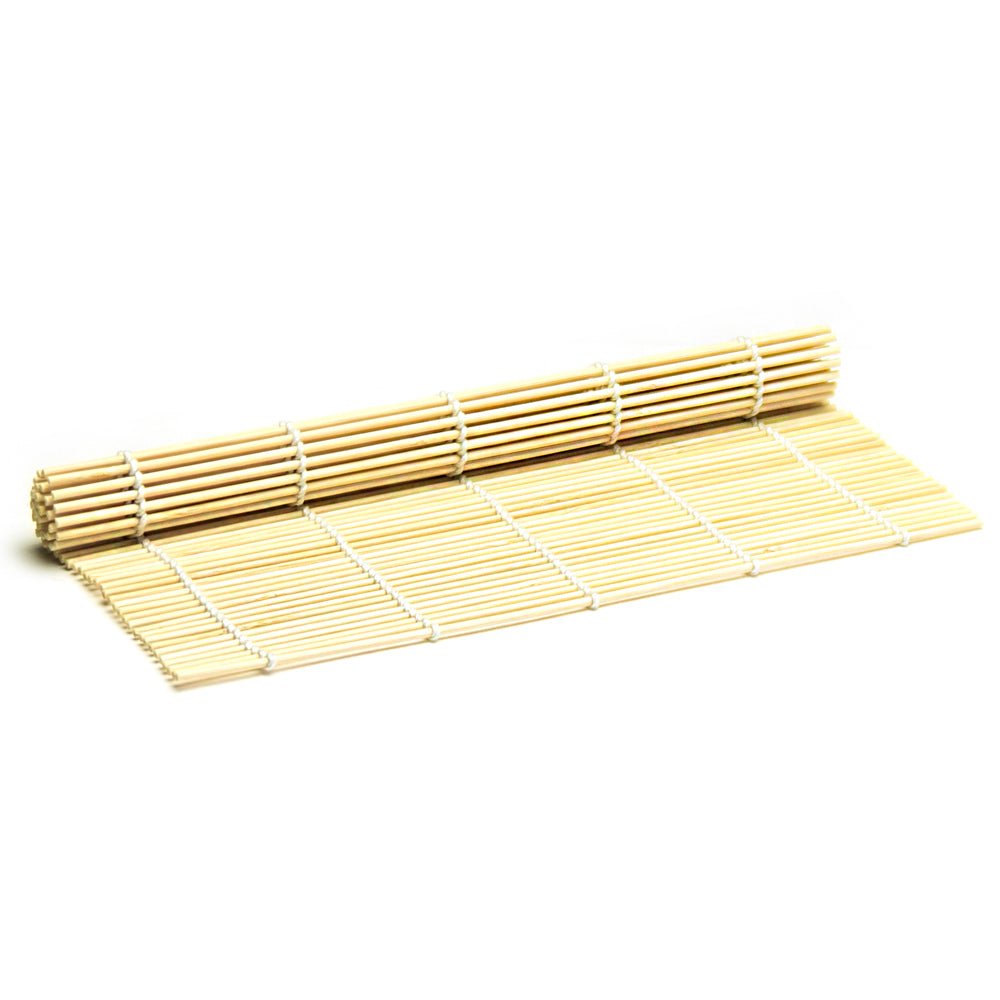
A manual position needs the rice vessel and utensil, nori or other wrapper, filling access, forming surface, cutting provision where required and a place to receive the food. The familiar 27-0015 bamboo sushi mat is one working object within that arrangement. Its width alone cannot specify the position.
Follow the item through the transfer. An intact roll waiting on the cutting board can prevent the next roll from being received. A bowl still being topped can occupy the surface intended for final wrapping. Sharing can be entirely practical, but the sequence must account for the occupied object and the next task rather than count the same clear area twice.
Keep the promised food intact when evaluating alternatives. A top-garnished roll must reach its intended presentation; a whole wrapped item must reach its final wrap; a bowl must be assessed in its actual vessel. Removing an awkward garnish or substituting a smaller construction to suit a demonstration changes the purchase requirement.
Use the workstation-design resource for the wider counter arrangement and the manual preparation tools guide for tool selection. Here, the first requirement is sufficient usable work for the food the menu actually sells.
Explore the ERS collection
Sushi Mats
Compare the assortment for this part of your service.
-
 Image unavailable
Sushi Mat 24 x 24cm (34-11)
View details & options : Sushi Mat 24 x 24cm (34-11)
Image unavailable
Sushi Mat 24 x 24cm (34-11)
View details & options : Sushi Mat 24 x 24cm (34-11)
-
 Image unavailable
Sushi Mat W/O Skin 24X21cm
View details & options : Sushi Mat W/O Skin 24X21cm
Image unavailable
Sushi Mat W/O Skin 24X21cm
View details & options : Sushi Mat W/O Skin 24X21cm
-
 Image unavailable
Sushimat 24X24 W/O Skin= 914025 = Sn-3
View details & options : Sushimat 24X24 W/O Skin= 914025 = Sn-3
Image unavailable
Sushimat 24X24 W/O Skin= 914025 = Sn-3
View details & options : Sushimat 24X24 W/O Skin= 914025 = Sn-3
-
 Image unavailable
Sushi Roll Mat Plastic 10"X9.5"
View details & options : Sushi Roll Mat Plastic 10"X9.5"
Image unavailable
Sushi Roll Mat Plastic 10"X9.5"
View details & options : Sushi Roll Mat Plastic 10"X9.5"
-
 Image unavailable
Bamboo Sushi Mat 270X135Mm (Bsd-04)
View details & options : Bamboo Sushi Mat 270X135Mm (Bsd-04)
Image unavailable
Bamboo Sushi Mat 270X135Mm (Bsd-04)
View details & options : Bamboo Sushi Mat 270X135Mm (Bsd-04)
-
 Image unavailable
Bamboo Sushi Mat 27X27cm
View details & options : Bamboo Sushi Mat 27X27cm
Image unavailable
Bamboo Sushi Mat 27X27cm
View details & options : Bamboo Sushi Mat 27X27cm
-
 Image unavailable
Sushi Mat W/O Skin 24X24cm
View details & options : Sushi Mat W/O Skin 24X24cm
Image unavailable
Sushi Mat W/O Skin 24X24cm
View details & options : Sushi Mat W/O Skin 24X24cm
-
 Image unavailable
Sushi Mat W/O Skin 24X24cm
View details & options : Sushi Mat W/O Skin 24X24cm
Image unavailable
Sushi Mat W/O Skin 24X24cm
View details & options : Sushi Mat W/O Skin 24X24cm


03 / Sushi Restaurant Concepts
Choose refrigeration for the food and the access it needs
Distinguish reserve storage, working ingredient refrigeration, chef-accessed ingredient display and finished-food merchandising. These functions can sometimes share equipment; they do not imply four compulsory appliances. A prep refrigerator may combine working ingredients with reserve pans. A prepared-assortment restaurant may prioritize finished-product display and have little need for a broad customer-facing ingredient rail.
Ingredient capacity must leave enough working surface
True's standard and mega-top 48-inch prep refrigerators demonstrate a material purchasing trade. The following are their published standard configurations.
Scroll to read all columns
| True model | Cabinet width | Cabinet depth* | Standard top pans | Standard board depth |
|---|---|---|---|---|
| TSSU-48-12-HC | 48⅜ in | 30⅛ in | 12 one-sixth pans | 11¾ in / 299 mm |
| TSSU-48-18M-B-HC | 48⅜ in | 34⅛ in | 18 one-sixth pans | 8⅞ in / 226 mm |
Cabinet depth excludes the one-inch rear bumper. These are rounded published dimensions, not a complete installed-space allowance. Sources: True's standard-unit sheet and mega-top sheet.
At equal frontage, the mega-top adds six pan positions and four inches of cabinet depth while giving up 2⅞ inches of standard board depth. The additional ingredient assortment therefore comes with a smaller front-to-back working surface.
The nominal 24 × 24 cm mat makes the consequence tangible: its 240 mm depth exceeds the mega-top board's published 226 mm. The 299 mm board is deeper than the mat, but that comparison still leaves the rice vessel, utensils and receiving food to be accommodated. These dimensions identify what to check with the actual objects; they do not certify a workstation or disqualify the mega-top from sushi service.
Select the ingredient arrangement and forming surface together. If the preferred top needs a separate forming or cutting surface, include it in the purchase. Confirm options against the exact cabinet: a deeper-board option documented for one model should not be assumed available on the other.
Specify the pan/divider arrangement and the replacement stock the cabinet must actually hold. Preserve manufacturer-required internal components. True's prep manual identifies false bottoms as part of correct TSSU operation; they are not disposable obstructions to extra storage. The same manual gives TSSU a zero side/back ventilation-clearance entry while requiring unobstructed ventilation, and the model sheets identify rear condensing-unit access. The installed counter must preserve that service access. True prep installation manual.
Separate reserve storage from the service display
A neta case earns its place through ingredient presentation and chef access. Its intended use must remain distinct from the restaurant's primary storage. Hoshizaki's HNC-SLH documentation expressly excludes overnight storage. Specify the reserve from which the working display is supplied and the required end-of-service transfer.
An express operation without that presentation requirement need not buy a neta case to resemble a conventional sushi bar. The relevant selection detail belongs in the sushi display and neta-case guide and seafood refrigeration resource.
Match the prepared-food display to its location and use
Prepared sushi sets require a display suited to their actual presentation and access. True's TOAM-30-HC~TSL01 is a useful packaged-product example: its specification identifies packaged/bottled product use under NSF/ANSI 7 Type I and a maximum 75°F ambient condition. The TOAM installation manual also addresses clearance, drafts and direct sun.
A position attractive to customers can still be unsuitable for the case. Check the entrance, HVAC outlets, fans, sun exposure and replenishment access before committing the display to the floor plan. Specify the food's state on entering the case and the reserve that supplies it. Where prepared sets and custom orders draw on shared ingredients, distinguish finished stock already committed to sets from ingredients still available for assembly.
FDA Food Code 2026 is a model; locally adopted requirements govern. Its §3-306.11 addresses display protection. Match the cabinet's intended use and the food's presentation to the approved operation. FDA Food Code 2026.
04 / Sushi Restaurant Concepts
Supply the right rice to each part of the menu
Write the prepared-rice requirement at each position: variety, preparation, service state and actual portion. A mixed roll-and-bowl menu may require separate supplies, including a hot base or another variety. Connect those needs to cooking, subsequent preparation, ready holding and refilling. Capacity calculations should use the restaurant's recipes and usable yield; bowls and rolls cannot be treated as interchangeable units of rice demand.
The Zojirushi RDS-400 illustrates a specific holding function. It is a non-electric insulated vessel that Zojirushi identifies for acidic ingredients, including sushi rice. Its listed front-to-back dimension is 15 inches, greater than either standard prep-board depth above. Give it a supported, accessible position that permits serving and refilling without taking over the forming area. Manufacturer specifications.
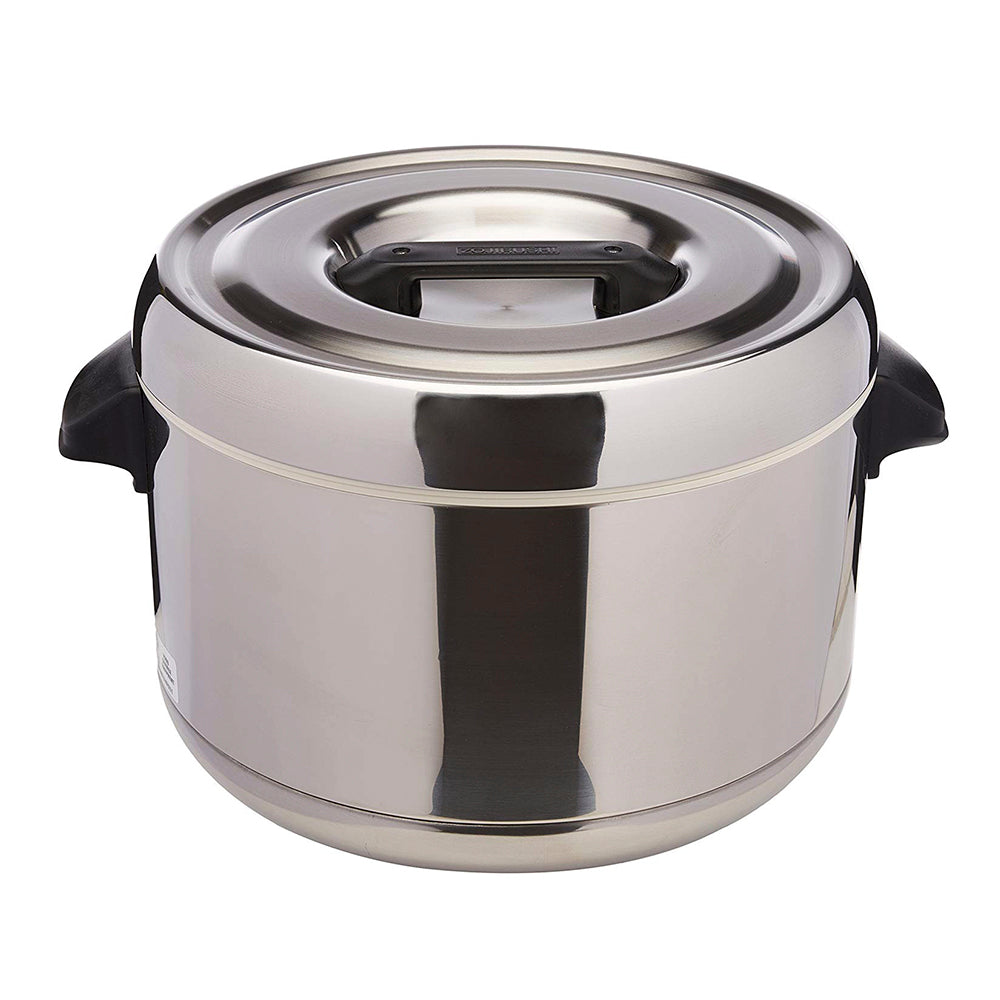
Confirm the capacity basis and usable load for the intended prepared rice before sizing reserve stock. A marketed cup or liter designation is insufficient for a cooked-rice serving calculation unless its meaning is established. The exact holder model can be selected while that load remains a separate specification.
A hot-rice dispenser performs a different task. Suzumo's Fuwarica GST-FBB-EH supplies a portioning example. Evaluate it against the actual input rice, target portion and receiving bowl, including loading and refill access. Its hot-rice function does not establish suitability for every seasoned preparation. Sheeting rice for a roll is another distinct operation.
FDA's Annex 6 distinguishes vinegar used for flavor from acidification intended to make rice non-TCS, with associated process-approval requirements. Other time/temperature-control-for-safety ingredients retain their controls. FDA Food Code, Annex 6. Specify holding equipment around that approved process.
Use the commercial rice cooker guide for cooking-equipment selection and the rice holding guide for the ready-supply function. The express position needs rice in the required state when the menu calls for it, with its next supply already accounted for.
Explore the ERS collection
Commercial Rice Cookers & Warmers
Compare the assortment for this part of your service.
-
 Image unavailable
Hattori Natural Gas Deck Rice Cooker, 3-Deck, 21 kg - LG-000-150
View details & options : Hattori Natural Gas Deck Rice Cooker, 3-Deck, 21 kg - LG-000-150
Image unavailable
Hattori Natural Gas Deck Rice Cooker, 3-Deck, 21 kg - LG-000-150
View details & options : Hattori Natural Gas Deck Rice Cooker, 3-Deck, 21 kg - LG-000-150
-
 Image unavailable
Hattori Natural Gas Deck Rice Cooker, 2-Deck, 14 kg - LG-000-100
View details & options : Hattori Natural Gas Deck Rice Cooker, 2-Deck, 14 kg - LG-000-100
Image unavailable
Hattori Natural Gas Deck Rice Cooker, 2-Deck, 14 kg - LG-000-100
View details & options : Hattori Natural Gas Deck Rice Cooker, 2-Deck, 14 kg - LG-000-100
-
 Image unavailable
Rinnai Commercial Natural Gas Rice Cooker, 55-Cup - RER-55AS
View details & options : Rinnai Commercial Natural Gas Rice Cooker, 55-Cup - RER-55AS
Image unavailable
Rinnai Commercial Natural Gas Rice Cooker, 55-Cup - RER-55AS
View details & options : Rinnai Commercial Natural Gas Rice Cooker, 55-Cup - RER-55AS
-
 Image unavailable
CUCKOO Commercial Rice Cooker & Warmer, 30-Cup - CR-3032
View details & options : CUCKOO Commercial Rice Cooker & Warmer, 30-Cup - CR-3032
Image unavailable
CUCKOO Commercial Rice Cooker & Warmer, 30-Cup - CR-3032
View details & options : CUCKOO Commercial Rice Cooker & Warmer, 30-Cup - CR-3032
-
 Image unavailable
Zojirushi Commercial Electric Rice Warmer, 8L (44-Cup) - THA-803S
View details & options : Zojirushi Commercial Electric Rice Warmer, 8L (44-Cup) - THA-803S
Image unavailable
Zojirushi Commercial Electric Rice Warmer, 8L (44-Cup) - THA-803S
View details & options : Zojirushi Commercial Electric Rice Warmer, 8L (44-Cup) - THA-803S
-
 Image unavailable
Tiger 3-Cup Rice Cooker & Warmer, Floral White - JNP-0550-FL
View details & options : Tiger 3-Cup Rice Cooker & Warmer, Floral White - JNP-0550-FL
Image unavailable
Tiger 3-Cup Rice Cooker & Warmer, Floral White - JNP-0550-FL
View details & options : Tiger 3-Cup Rice Cooker & Warmer, Floral White - JNP-0550-FL
-
 Image unavailable
Zojirushi Commercial Thermal Rice Warmer, 4L (22-Cup) - RDS-400
View details & options : Zojirushi Commercial Thermal Rice Warmer, 4L (22-Cup) - RDS-400
Image unavailable
Zojirushi Commercial Thermal Rice Warmer, 4L (22-Cup) - RDS-400
View details & options : Zojirushi Commercial Thermal Rice Warmer, 4L (22-Cup) - RDS-400
-
 Image unavailable
Zojirushi Commercial Thermal Rice Warmer, 6L (33-Cup) - RDS-600
View details & options : Zojirushi Commercial Thermal Rice Warmer, 6L (33-Cup) - RDS-600
Image unavailable
Zojirushi Commercial Thermal Rice Warmer, 6L (33-Cup) - RDS-600
View details & options : Zojirushi Commercial Thermal Rice Warmer, 6L (33-Cup) - RDS-600


05 / Sushi Restaurant Concepts
Add machinery where its output fits the job
Compare the work each arrangement completes
Evaluate manual, separate-function and combined arrangements against the same finished food. Their differences concern where ingredients are loaded, how the construction changes and what transfers to the next position.
Scroll to read all columns
| Arrangement | Example | Work remaining around the equipment |
|---|---|---|
| Manual forming and completion | Mat and appropriate hand tools | Supply rice and fillings, form, cut where required and finish |
| Rice sheeting with mat closure | AUTEC ASM895A | Collect/place the sheet, add ingredients, close manually and transfer onward |
| Sheeting with a manual belt wrapper | ASM895A with ASA190A | Load the separate unpowered wrapper, perform its closure actions and complete the finish |
| Combined sheeting and powered wrapping | AUTEC ASM890A | Place the ingredients, remove the formed product and complete its downstream work |
| Separately selected roll cutting | AUTEC ASM260A | Load a compatible intact roll, remove and arrange the pieces, and finish the presentation |
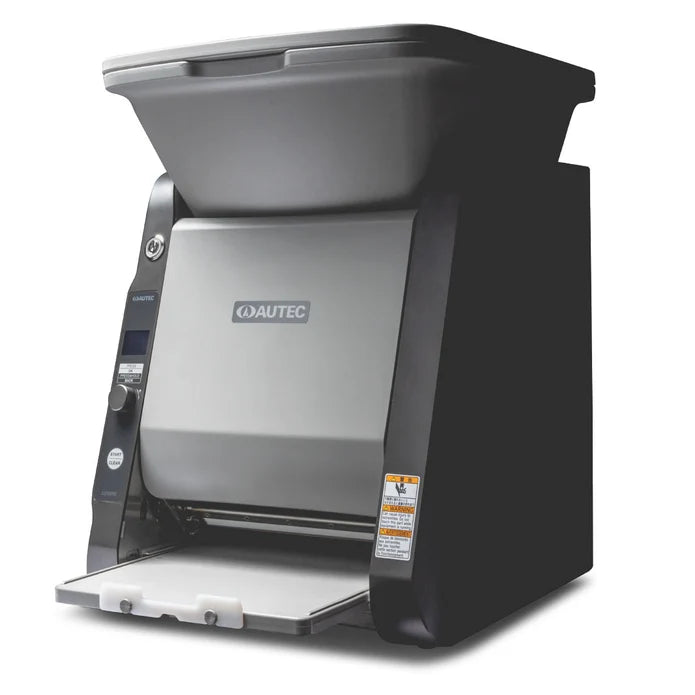
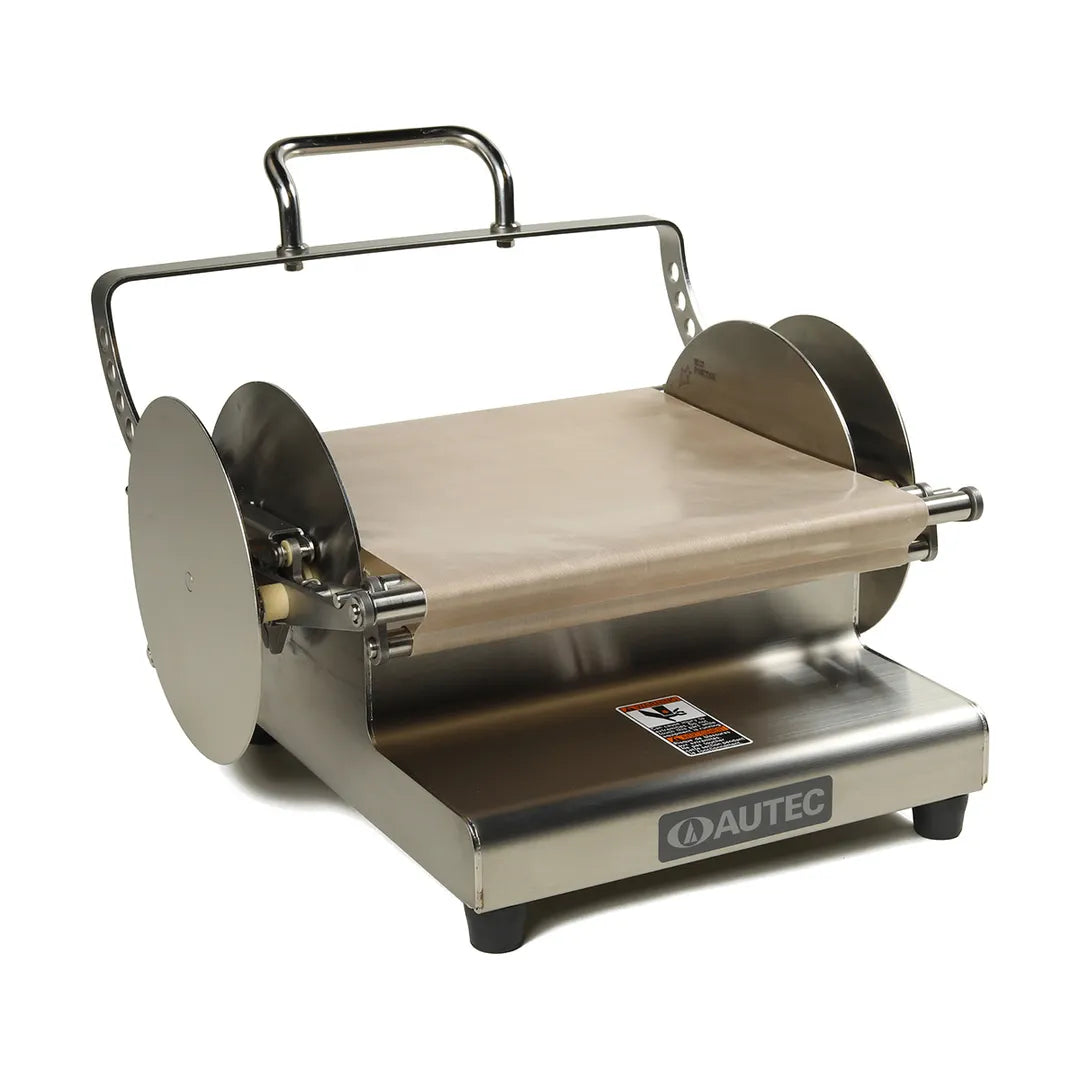
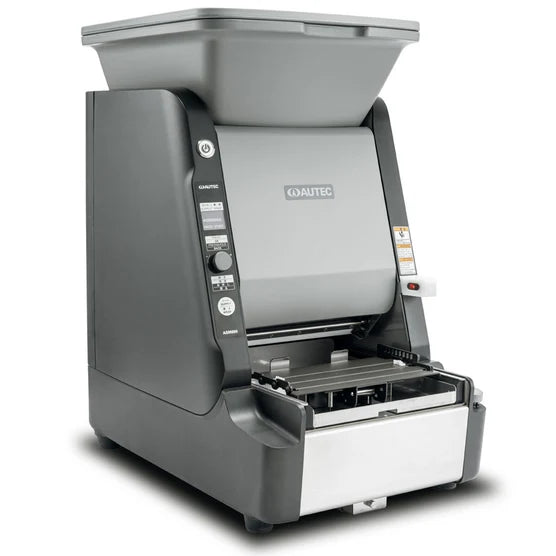
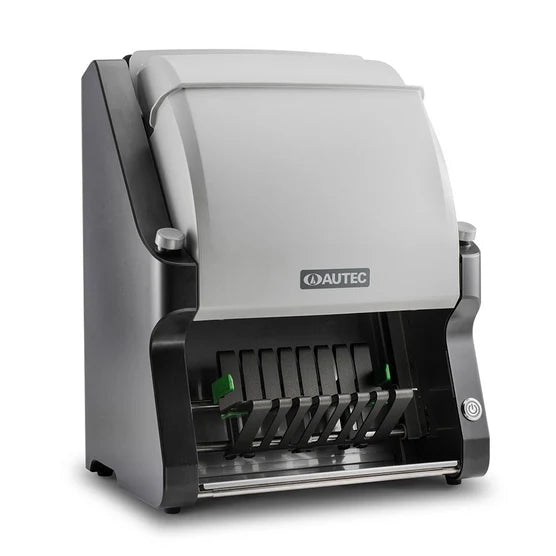
The cutter is a downstream selection, rather than a fifth complete production arrangement. Whole wrapped items and bowls should pass through the functions their construction actually needs. AUTEC's manufacturer pages establish these equipment functions: ASM895A, ASA190A, ASM890A and ASM260A.
A separate sheeter leaves the next position free to use the appropriate manual closure method, but that position needs its own receiving surface and supplies. A combined maker concentrates sheeting and powered wrapping. The ASM890A's documented regular-roll sequence still includes hand placement of nori and ingredients between machine actions, followed by removal of the roll. Cutting, paper wrapping and meal completion remain downstream as applicable.
Make the comparison on the menu's difficult variants as well as its repeated standard construction. A separate hand-work position can be useful when the method changes; an integrated arrangement can remove a transfer when its supplied configuration suits the product. Neither conclusion can be reached from housing count alone. A manual comparison also deserves proper rice supply, ingredients, tools and clear finishing space.
Match settings and assemblies to the food
AUTEC's ASM895A operation manual distinguishes width-specific forming units from adjustable sheet length. The ASM890A manual describes size-specific wrapping units with associated settings. The quotation must therefore identify physical assemblies as well as saved recipes. Manufacturer product references: ASM895A, ASM890A.
Establish sheet orientation, rice coverage, wrapper, filling volume and finished geometry together. Which sheet dimension becomes the roll's length depends on the construction. A larger length setting in the feed direction does not, by itself, specify a longer finished roll.
Use the restaurant's intended rice in the demonstration. The ASM890A manual notes that preparation and temperature can affect the supplied rice amount and position even with unchanged settings. Demonstrate the meaningful product change and a return to the first construction; identify each hardware, setting and handling change required.
For the ASM260A, specify more than a ten-piece result. The intact roll's dimensions and construction must match the quoted cutter-unit and cut-base assembly. Establish which assembly produces the required pieces, whether it is included and what must change for another offered portion. Inspect usable ends, piece integrity and the intended garnish arrangement. Keep the machine's single-operator requirement in the proposed work allocation; forming and finishing by other staff require handoffs outside that operating task.
A manual cutting alternative remains useful only when its board, knife, suitable operator and finishing position are supplied. Similarly, a cutter demonstration that simplifies the food or omits its presentation has not established the restaurant's required result.
Demonstrate the food through its intended finish
A useful purchasing demonstration includes:
- The actual prepared rice, fillings, wrapper and materially different permitted constructions.
- A normal refill or pause, the relevant configuration change and restoration of acceptable output.
- The intended receiving tray, bowl or paper wrap, with the finish assessed at the declared endpoint.
Record the ready supplies brought into the demonstration. Unlimited prepared rice, replacement hot components or clean assemblies supplied from elsewhere can conceal equipment and space that the restaurant will need to provide.
For a completed-food comparison, record acceptable output, rejects or rework, staff assignment, interruptions and elapsed time. Machine cycles are a different measure. The workflow and capacity guide develops that sizing work; the sushi machinery guide covers the wider equipment decision. Retain the exact demonstrated assemblies and supporting items in the final offer.
Explore the ERS collection
Sushi Robots & Sushi Machines
Compare the assortment for this part of your service.
-
 Image unavailable
Autec Maki Sushi Maker Rice Sheeter ASM895A
View details & options : Autec Maki Sushi Maker Rice Sheeter ASM895A
Image unavailable
Autec Maki Sushi Maker Rice Sheeter ASM895A
View details & options : Autec Maki Sushi Maker Rice Sheeter ASM895A
-
 Image unavailable
AUTEC Maki Sushi Maker Rice Sheeter & Wrapper ASM890A
View details & options : AUTEC Maki Sushi Maker Rice Sheeter & Wrapper ASM890A
Image unavailable
AUTEC Maki Sushi Maker Rice Sheeter & Wrapper ASM890A
View details & options : AUTEC Maki Sushi Maker Rice Sheeter & Wrapper ASM890A
-
 Image unavailable
AUTEC Maki Sushi Roll Wrapper ASA190A
View details & options : AUTEC Maki Sushi Roll Wrapper ASA190A
Image unavailable
AUTEC Maki Sushi Roll Wrapper ASA190A
View details & options : AUTEC Maki Sushi Roll Wrapper ASA190A
-
 Image unavailable
AUTEC Automatic Maki Sushi Roll Cutter ASM260A
View details & options : AUTEC Automatic Maki Sushi Roll Cutter ASM260A
Image unavailable
AUTEC Automatic Maki Sushi Roll Cutter ASM260A
View details & options : AUTEC Automatic Maki Sushi Roll Cutter ASM260A
-
 Image unavailable
AUTEC Nigiri Sushi Maker Rice Ball Shaper ASM440A
View details & options : AUTEC Nigiri Sushi Maker Rice Ball Shaper ASM440A
Image unavailable
AUTEC Nigiri Sushi Maker Rice Ball Shaper ASM440A
View details & options : AUTEC Nigiri Sushi Maker Rice Ball Shaper ASM440A
-
 Image unavailable
AUTEC Onigiri & Musubi Rice Ball Maker ASM575A
View details & options : AUTEC Onigiri & Musubi Rice Ball Maker ASM575A
Image unavailable
AUTEC Onigiri & Musubi Rice Ball Maker ASM575A
View details & options : AUTEC Onigiri & Musubi Rice Ball Maker ASM575A
-
 Image unavailable
AUTEC Shari Sushi Rice Mixer ASM730A
View details & options : AUTEC Shari Sushi Rice Mixer ASM730A
Image unavailable
AUTEC Shari Sushi Rice Mixer ASM730A
View details & options : AUTEC Shari Sushi Rice Mixer ASM730A
-
 Image unavailable
AUTEC Shari Sushi Rice Mixer ASM780A
View details & options : AUTEC Shari Sushi Rice Mixer ASM780A
Image unavailable
AUTEC Shari Sushi Rice Mixer ASM780A
View details & options : AUTEC Shari Sushi Rice Mixer ASM780A


06 / Sushi Restaurant Concepts
Specify the hot side by the process it performs
Sarku's U.S. bento offer at selected stores illustrates a meal combining sushi and hot components. The appropriate equipment depends on how the outlet receives and prepares those components, rather than the menu photograph.
Buy the process and the replacement-batch arrangement
Specify raw cooking, reheating previously cooked food, holding ready-hot food or a final finishing treatment. Also establish when the output is required. A cooked filling needed inside a roll must be ready before closure; a separately contained accompaniment joins at meal completion. That sequence determines which production position depends on the hot task.
The Vollrath 72009 is an 11-quart Heat ’N Serve package with an inset and hinged cover. Its operating manual supports reheating previously cooked chilled food and holding hot food, excludes raw cooking, requires water-based operation and prohibits adding cold food to food being rethermalized or held. Vollrath operator manual.
Specify how the next batch becomes ready while the current batch is being served. Extra insets permit an exchange; they add no heating capacity. The replacement may come from another suitable appliance or a planned batch transition that service can accommodate. A unit capable of reheating and holding at different times cannot be counted as simultaneously doing both jobs for separate batches.
Include water access, safe vessel handling and the outgoing inset's position. A small electrical appliance still has a larger working task around it. The accepted arrangement must supply the next component in the correct state rather than depend on topping up the working batch with cold food.
Specify ventless cooking as a supported system
Where cooking is required, a ventless selection includes the supported appliance configuration, filtration, fire suppression and service obligations. Wells' WVFG fryer/griddle combination requires authorized ANSUL charging and certification after installation and before use. Its service manual limits the hood to factory-certified applications and specifies filtration and specialist maintenance requirements. Wells WV-FG service manual.
Obtain a configuration-specific submittal and identify commissioning responsibility, replacement filters, service access and continuing specialist support in the proposal. The ventless designation does not authorize unrelated appliances beneath the hood or settle the site's ventilation and approval requirements.
Where the proposed cooking cannot be supported by the premises, reconsider the food's received state explicitly. Receiving a prepared component changes the outlet's work; substituting a warmer for an unsuitable cooking process does not resolve it. The hot-kitchen equipment guide carries the detailed equipment and installation subject.
The manual excludes raw cooking and prohibits adding cold food to food being rethermalized or held. Carry water access, safe vessel handling and the outgoing inset’s position into the purchase.
07 / Sushi Restaurant Concepts
Finish and hand over the complete order
Specify the actual service object and closure
The service object enters the work at different points. A bowl receives ingredients during assembly. A tray receives cut pieces and their finish. A whole item requires its final paper wrap. Choose the actual object early enough to establish the working surface and finished presentation.
Two ERS examples show distinct geometries:
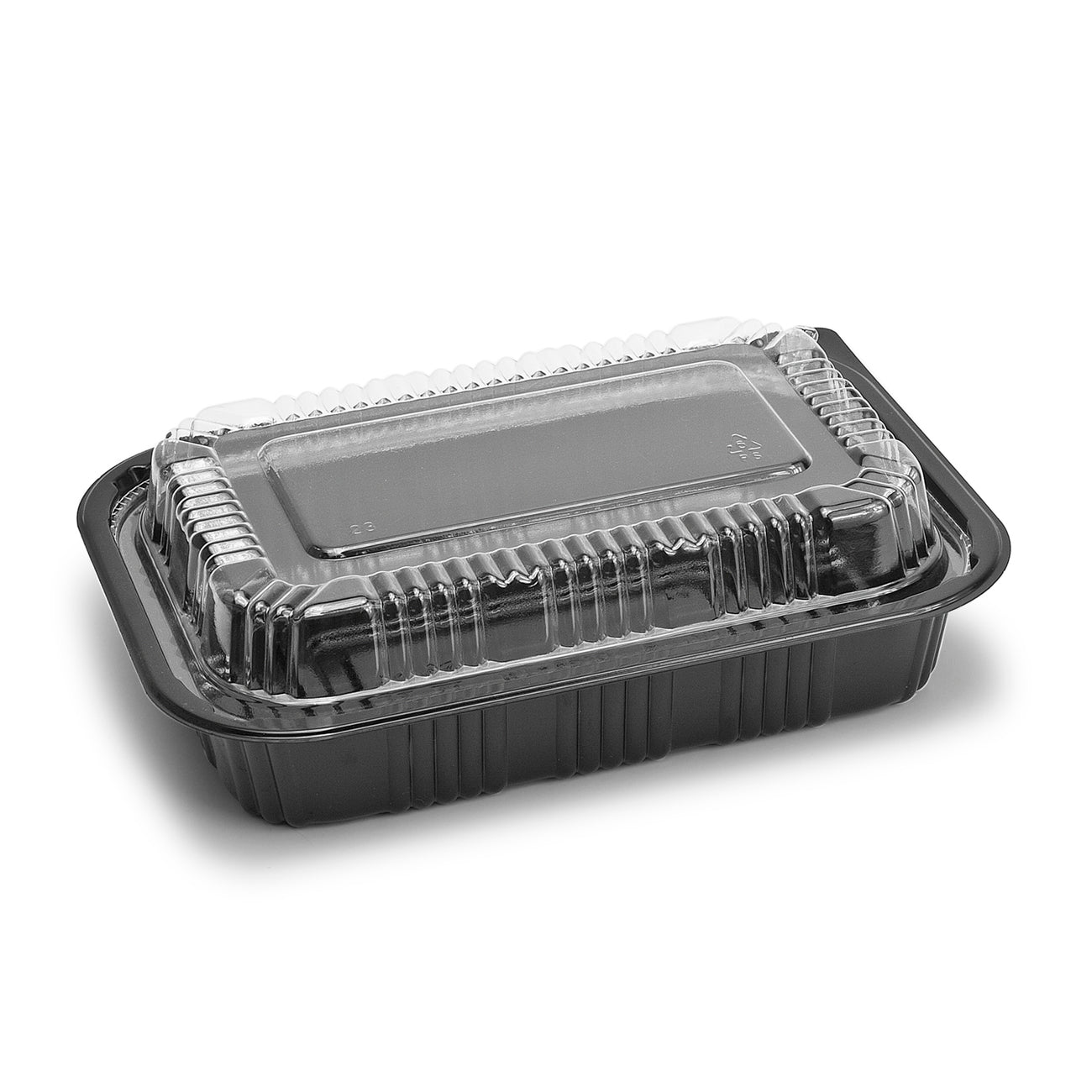
- ED-8510 tray with lid: 7⅜ × 5¼ × 1¾ inches, supplied in packs of 50 tray/lid sets, with 500 containers per case.
- ED-700 bowl with lid: 6¾ inches in diameter × 3 inches high, supplied in packs of 50 bowl/lid sets, with 300 containers per case.
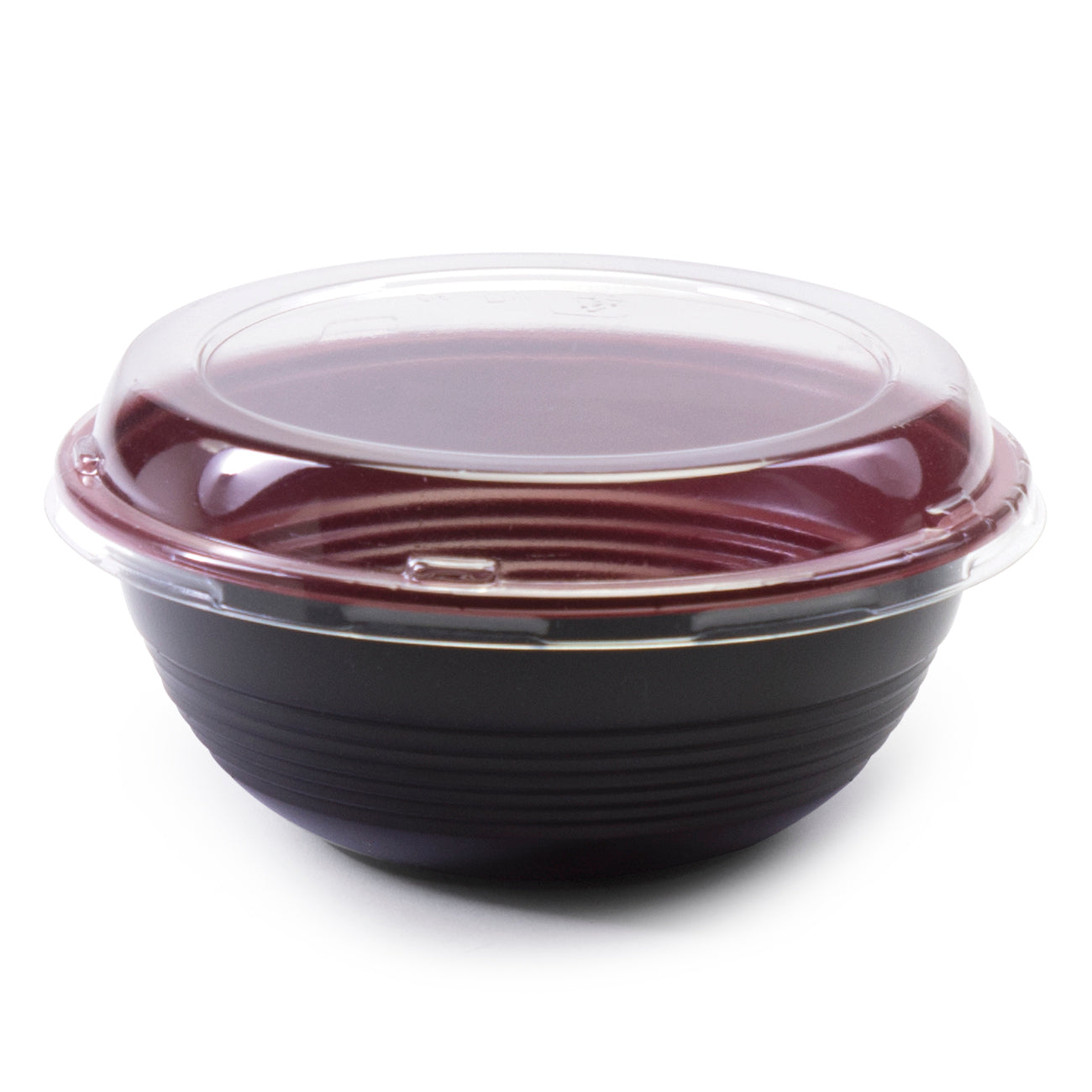
Those are exterior dimensions and purchase quantities. Establish loaded fit using the intended food arrangement, garnish and any sauce cup placed inside, then apply the matching closure. For the bowl, include all components and the finish rather than testing an empty shell or a level measure of rice. For the whole wrapped item, use the actual paper and handling method.
The listings describe the material generically as plastic. Confirm the precise base-and-lid suitability for any proposed hot-food, reheating or microwave use. Geometry and a menu-related product name cannot supply the missing thermal specification.
Specify the opened working supply separately from the purchase case. Bases and lids must remain correctly identifiable and accessible, with a replenishment position that does not consume the food's receiving area. Confirm any replacement-lid compatibility against the exact container; visual similarity is insufficient.
Reusable eat-in ware changes the supply and return arrangement. Include clean ready stock and the clearing/washing route instead of assuming every express order uses disposables. Where specialist presentation is relevant, the sushi servingware guide develops those objects. For disposable selection, use the sushi-container collection and packaging guide; transit and material performance require their own evaluation beyond counter fit.
Give completion and release deliberate places
A closed sushi tray can still be waiting for another bowl, a hot accompaniment or the included service items. Define where those components are brought together, how the order is checked and where it becomes available for collection. These functions can share furniture when the sequence permits. The important distinction is between work still being completed and an order ready to leave.
Keep customer collection clear of active ingredients, sharp tools and incomplete food. For a prepared-assortment offer, distinguish the units still displayed for sale from those selected for a particular order; choosing a ready set may still leave other meal components to assemble.
The collection arrangement must accommodate waiting food and delayed pickup. Time without temperature control requires the applicable defined procedure under FDA §3-501.19. FDA Food Code.
Decide which work prepaid orders share
In a February 2026 Food On Demand interview, FUSIAN co-founder Stephan Harman described separating guest-facing production and online fulfillment. That is one operating choice. The equipment decision is which work an added position will take over.
Scroll to read all columns
| Arrangement | Provision to establish |
|---|---|
| Shared production and finishing | A sequence for counter and prepaid work, with completed collection clear of active production |
| Shared production with separate finishing/checking | A defined food handoff, service objects, finishing supplies and responsibility at the second position; upstream forming or cooking remains shared |
| Separately supplied production | Working rice, immediate-use ingredients, tools, service objects and replenishment, with any shared preparation or specialist equipment explicitly identified |
If finished orders occupy active work, improve their release position. If closure and checking repeatedly occupy the producing position, evaluate a supplied finishing position. If simultaneous food construction is required, the second production position needs the food and tools to perform it. Price those different scopes accordingly.
Sharing can remain deliberate. Two positions may draw from common reserve preparation or use one cutter with an orderly handoff. Their capacity and continuity still depend on that shared resource. Conversely, separate production does not require duplicating every appliance in the restaurant.
Test the proposed arrangement with the intended concurrent counter and prepaid work, following both incomplete and completed orders. A percentage of digital sales cannot specify the missing surface, supply or appliance. Dedicated dispatch and production beyond this restaurant handoff belong in the takeout and delivery production resource.
Explore the ERS collection
Sushi To-Go Containers
Compare the assortment for this part of your service.
-
 Image unavailable
Kamon Sushi To-Go Tray with Lid (50 pc) - YP-2.0, 9"
View details & options : Kamon Sushi To-Go Tray with Lid (50 pc) - YP-2.0, 9"
Image unavailable
Kamon Sushi To-Go Tray with Lid (50 pc) - YP-2.0, 9"
View details & options : Kamon Sushi To-Go Tray with Lid (50 pc) - YP-2.0, 9"
-
 Image unavailable
Long Kamon Sushi To-Go Tray with Lid (50 pc) - YP-0.6, 8-5/8"
View details & options : Long Kamon Sushi To-Go Tray with Lid (50 pc) - YP-0.6, 8-5/8"
Image unavailable
Long Kamon Sushi To-Go Tray with Lid (50 pc) - YP-0.6, 8-5/8"
View details & options : Long Kamon Sushi To-Go Tray with Lid (50 pc) - YP-0.6, 8-5/8"
-
 Image unavailable
Kraft Paper Sushi To-Go Tray with Clear Anti-Fog Lid (600 pc) - PH-09
View details & options : Kraft Paper Sushi To-Go Tray with Clear Anti-Fog Lid (600 pc) - PH-09
Image unavailable
Kraft Paper Sushi To-Go Tray with Clear Anti-Fog Lid (600 pc) - PH-09
View details & options : Kraft Paper Sushi To-Go Tray with Clear Anti-Fog Lid (600 pc) - PH-09
-
 Image unavailable
Kamon Sushi To-Go Container with Clear Lid (50 pc) - Large 10-1/2" x 7-3/4"
View details & options : Kamon Sushi To-Go Container with Clear Lid (50 pc) - Large 10-1/2" x 7-3/4"
Image unavailable
Kamon Sushi To-Go Container with Clear Lid (50 pc) - Large 10-1/2" x 7-3/4"
View details & options : Kamon Sushi To-Go Container with Clear Lid (50 pc) - Large 10-1/2" x 7-3/4"
-
 Image unavailable
Long Black Sushi To-Go Tray with Clear Lid (50 pc) - ED-30B, 9-1/4"
View details & options : Long Black Sushi To-Go Tray with Clear Lid (50 pc) - ED-30B, 9-1/4"
Image unavailable
Long Black Sushi To-Go Tray with Clear Lid (50 pc) - ED-30B, 9-1/4"
View details & options : Long Black Sushi To-Go Tray with Clear Lid (50 pc) - ED-30B, 9-1/4"
-
 Image unavailable
Sushi To-Go Tray with Clear Lid (100 pc) - Large Red & Silver
View details & options : Sushi To-Go Tray with Clear Lid (100 pc) - Large Red & Silver
Image unavailable
Sushi To-Go Tray with Clear Lid (100 pc) - Large Red & Silver
View details & options : Sushi To-Go Tray with Clear Lid (100 pc) - Large Red & Silver
-
 Image unavailable
Sushi & Bento To-Go Tray with Clear Lid (100pc) - Small Red & Silver
View details & options : Sushi & Bento To-Go Tray with Clear Lid (100pc) - Small Red & Silver
Image unavailable
Sushi & Bento To-Go Tray with Clear Lid (100pc) - Small Red & Silver
View details & options : Sushi & Bento To-Go Tray with Clear Lid (100pc) - Small Red & Silver
-
 Image unavailable
Kamon Sushi To-Go Tray with Clear Lid (50 pc) - ED-03 / YP-0.8
View details & options : Kamon Sushi To-Go Tray with Clear Lid (50 pc) - ED-03 / YP-0.8
Image unavailable
Kamon Sushi To-Go Tray with Clear Lid (50 pc) - ED-03 / YP-0.8
View details & options : Kamon Sushi To-Go Tray with Clear Lid (50 pc) - ED-03 / YP-0.8


08 / Sushi Restaurant Concepts
Plan replenishment, cleaning and service access
Refill without displacing the next order
Evaluate the replacement and the object leaving service together. A fresh rice vessel arrives while the used one still needs a destination. A replacement ingredient pan displaces an outgoing pan. Package replenishment introduces opened outer packaging as well as matched bases and lids. Include both sides of each exchange in the proposed arrangement.
A single unallocated area cannot simultaneously receive cut food, hold an unfinished order and store used parts. If tasks share it at different times, establish the sequence and the interruption it creates. If they occur together, provide suitable separate accommodation.
Small working-stock objects belong in the same check. The NC-1 nori container has a hinged lid and tin construction with a stainless-steel inner base. Allow for opening and refilling it in position, alongside protected reserve stock. A closed footprint does not describe that operation. The nori and mise en place resource covers the wider storage subject.
Allow for the operating position and service access
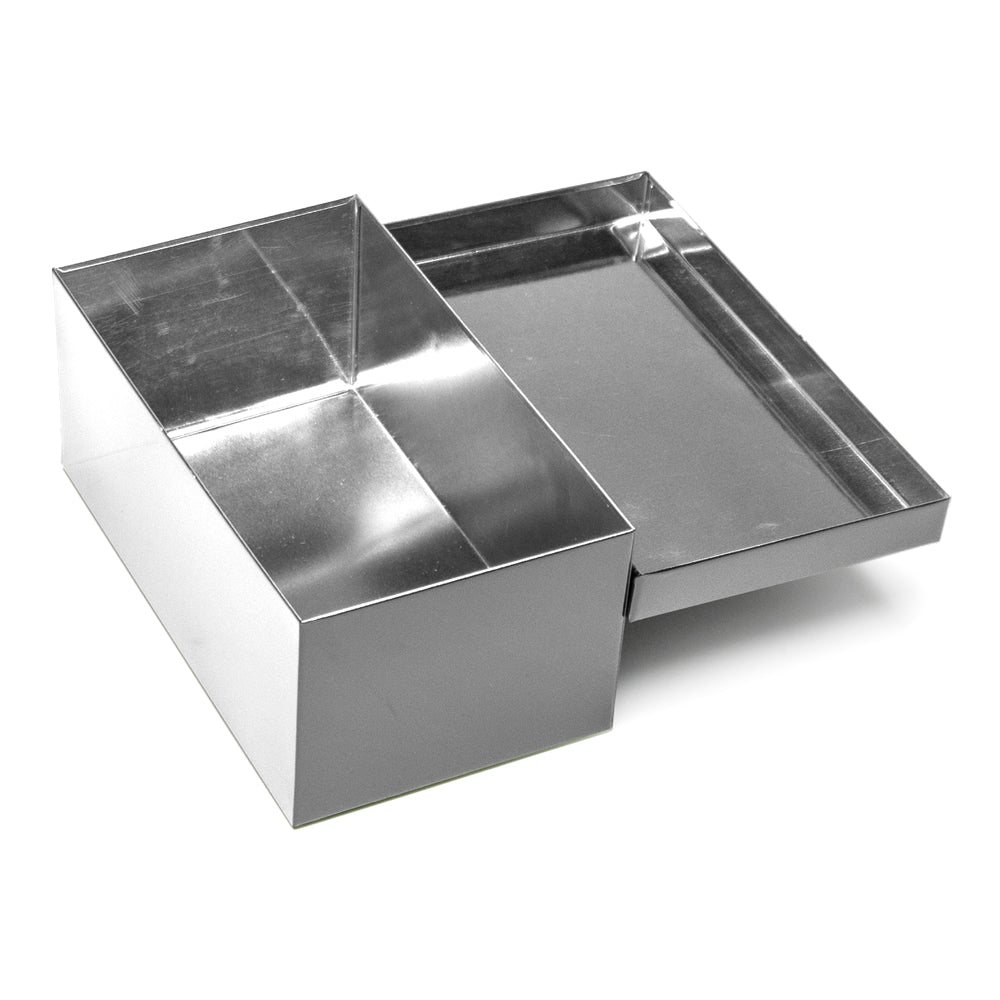
Suzumo's North American SVS-FCA-EH brochure specifies 468 mm depth with the table closed and 690 mm at maximum table position. The difference is 222 mm, before assessing the surrounding receiving task, operator access or servicing. Regional brochure.
Reserve the actual operating position before assigning the rest of the counter to cutting or packing. Check hopper replenishment, removal of eligible parts and maintenance access with adjacent equipment and package stock in place. Where access requires movement of equipment, the installation and manufacturer's instructions must support that movement; it cannot be left as an assumption that the appliance will simply be pulled forward during service.
The same standard applies to the prep refrigerator's rear service access, the rice holder's refill position and the hot appliance's outgoing vessel. Body dimensions are the beginning of an installation check. Complete it with the objects and actions needed in use. The commercial equipment specifications resource develops the submittal requirements.
Provide for used parts and ready return
Disposable guest packaging still leaves production pans, utensils, rice vessels and machine components requiring care. Match the facilities to the actual objects and their prescribed methods.
FDA's model addresses accommodation of the largest relevant equipment/utensils or approved alternatives, soiled/clean accumulation, drying and protected storage. FDA Food Code §§4-301.12–13, 4-901.11 and 4-903.11.
“Removable” does not mean dishwasher-safe. AUTEC's ASM895A and ASM890A operation manuals distinguish washed food-path parts from wipe-clean bodies/covers and prohibit automatic dishwashing. Zojirushi's RDS instructions also restrict immersion and automatic dishwasher/dryer use. Obtain the instructions for the exact supplied configuration and route its components accordingly. AUTEC manufacturer support, Zojirushi RDS instructions.
Assess the whole return to production: prescribed stopping/removal, suitable care, drying and inspection as applicable, protected ready storage, correct restoration and acceptable output. An advertised disassembly interval describes only one part of that work. Combining machine functions also retains the relevant food-path assemblies to clean and restore.
Compatible spare assemblies can support a planned exchange, but the used set still needs its proper care and the facilities must still accommodate it. Additional parts cannot correct an undersized care area or a failed drive. Establish matched identity and justified quantity rather than adding a generic spare-machine package. The maintenance and replacement-parts guide carries the deeper ownership discussion.
09 / Sushi Restaurant Concepts
Turn the chosen format into a complete equipment order
Request an offer against the food and operating arrangement the restaurant will actually use. The specification should make the supporting scope visible, especially where a demonstration relied on a particular assembly, ready supply or receiving surface.
Scroll to read all columns
| Specify | Require in the offer |
|---|---|
| Food and completion point | Food forms, permitted variants, intended dimensions/presentation and the finished result being evaluated |
| Receiving and preparation | What arrives ready, what is prepared on site and the ready-food supply needed at each position |
| Shared and separate work | Orders assigned to each position and preparation, rice, cutting or finishing resources that remain shared |
| Cold and rice provision | Intended equipment roles, supported configuration and an explicit usable-capacity basis |
| Forming and cutting hardware | Exact model/market, matched assemblies, settings and demonstrated food compatibility |
| Service objects | Actual tray, bowl, wrap or reusable ware, matching closures and acceptable loaded fit |
| Operating and installed space | Open/moving positions, receiving surfaces, refill/removal access and service requirements |
| Care and continuing readiness | Eligible parts, suitable facilities, ready storage and justified compatible replacements |
| Hot-system scope | Correct process, replacement-batch arrangement and required commissioning, filtration and specialist support |
| Delivered scope | Included/excluded accessories and actual delivery, installation, commissioning, instruction and service responsibilities |
Identify who supplies every necessary supporting item and who resolves each outstanding configuration. Compare proposals at the same finished-food requirement: one may include a suitable forming unit, matching cutter assembly or commissioning scope that another excludes. A lower bare-model price does not establish a lower cost for the usable operation.
Fund required provision first, including the manual work, rice supply, refrigeration, finish and service objects. Justify aids by the task they improve. Plan future space, supply and utility needs around a stated expansion, while keeping prospective equipment separate from present operating capacity. The equipment cost guide develops the budgeting comparison.
Order the combination that can receive its intended supplies, make the chosen foods, finish and release the complete meal, and remain ready for continued service. That is the standard against which the equipment proposal should be accepted.